Trump's 38th Call 'Deal is Imminent', Global Markets Experience TACO-style Surge

Odaily星球日报Published on 2026-06-12Last updated on 2026-06-12

Abstract

Former U.S. President Trump claimed for the 38th time that a "final agreement" is imminent, triggering a "TACO-style" surge in global stock markets. Major U.S. indices, as well as Japanese and South Korean markets, posted significant gains, with oil prices falling and gold rising. The market rally is attributed to renewed hopes for a ceasefire in the U.S.-Iran-Israel conflict, the latest U.S. CPI data showing inflation at a multi-year high but easing core pressures, and a significantly reduced expectation of a Federal Reserve rate hike this year. However, analysts warn of potential risks. The situation in the Middle East remains unresolved, with Iran denying any agreement. Several institutions have turned cautious, flagging overvaluation, speculative excess, and warning of a potential 6-7% correction in the S&P 500. Additionally, the massive SpaceX IPO, which has seen overwhelming retail demand, is testing market liquidity as investors may sell existing holdings to participate. Experts advise caution against market volatility driven by Trump's unpredictable statements.

Original|Odaily Planet Daily(@OdailyChina)

Author|Wenser(@wenser2010 )
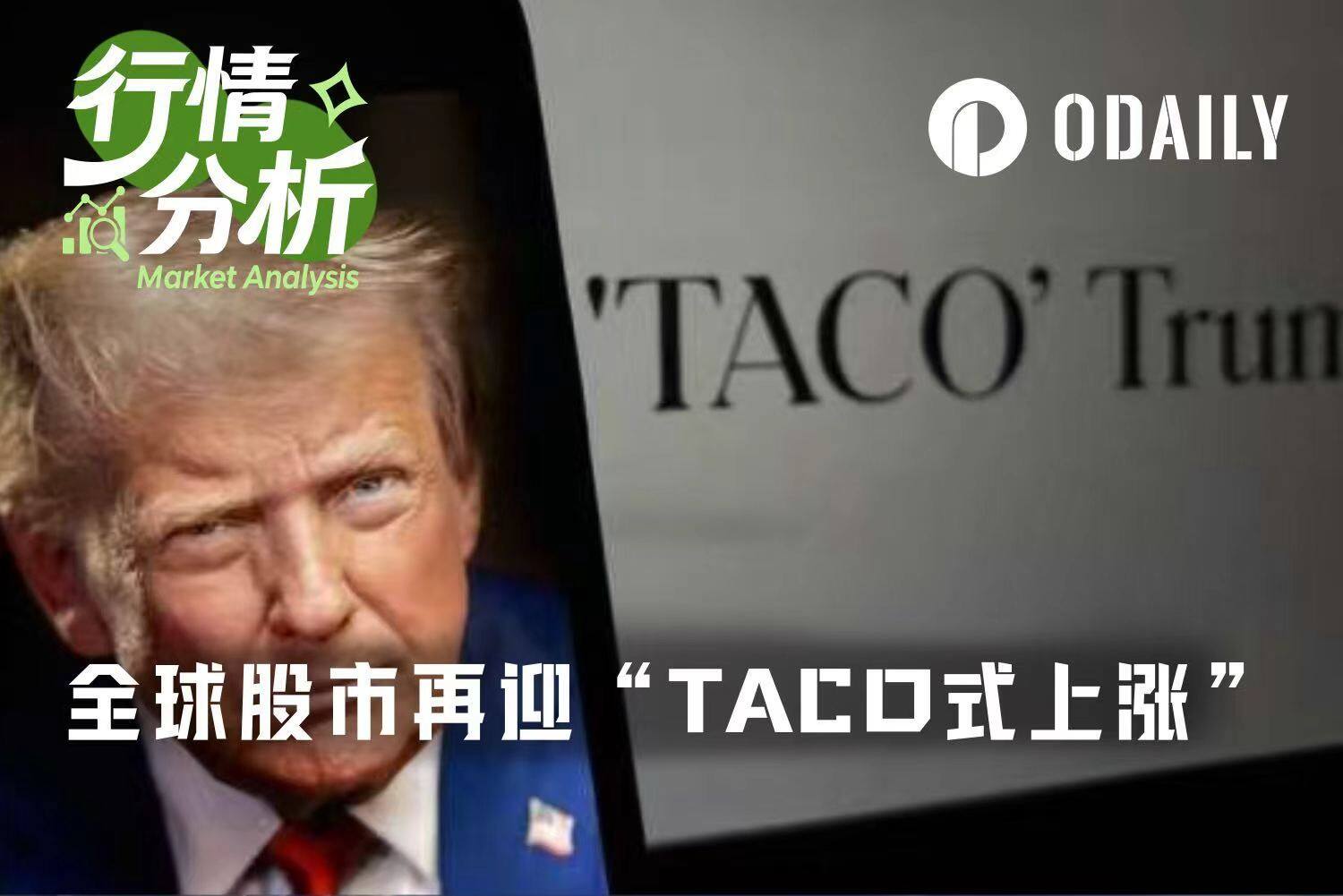
Following the US military's sudden strikes on Iran, and Trump's threat to "take tough action" against Iran which was subsequently canceled, Trump for the 38th time proclaimed that a "final deal is imminent". Financial markets worldwide, including the US stock market, jolted awake and once again experienced a "TACO-style surge".

This morning, all three major US stock indices closed higher, with the Dow Jones up 1.90%, the Nasdaq up 3.42%, and the S&P 500 up 1.73%. Crypto-related stocks rose across the board, with COIN up 4.99% intraday and HOOD up 7.40% intraday. Japanese and South Korean stock markets opened higher. The South Korean KOSPI index opened up 519.25 points, a 6.69% gain, at 8283.2 points, triggering a trading halt at one point, with gains later widening to 8%. The Nikkei 225 index opened up 880.53 points, a 1.37% gain, at 65097.80 points. Possibly influenced by this news, oil prices fell sharply by 4.3%, while gold prices rebounded by 3.1%.

As the US-Israel-Iran conflict enters its fourth month, global financial markets, particularly the US stock market, are pricing in positive developments such as the end of the war in advance, leading to a series of recent "news-driven rallies".

Macro Background: Trump's "Negotiation for Change", US CPI Hits 3-Year High, Fed Rate Hike Expectations Dim

Overall, the macro backdrop for today's stock market rally primarily includes the potential for peace talks in the war situation, the release of US CPI data, and the diminished expectations for a Fed rate hike.

Trump's Comments Again Show "TACO Power"

According to the latest news overnight and this morning, Trump first canceled the planned strikes and bombing operations against Iran scheduled for that evening. He subsequently posted, stating that related consultations had been submitted to and approved by Iran's highest leadership; the final terms (both in overall concept and specific details) had been approved by all relevant parties, including the US, Israel, Saudi Arabia, the UAE, Qatar, Turkey, Pakistan, Bahrain, Kuwait, Jordan, Egypt, and others. Although Iran and Israel later denied this, the market chose to embrace it.

Furthermore, Trump stated regarding the Iran issue that an "excellent agreement" had been reached, noting the relevant documents were in the final drafting stage and could be finalized in the coming days, ready for signing. He added that the agreement might be signed in Europe, possibly this weekend, with US Vice President Vance in attendance. He also said, "Once Iran signs the agreement, the Strait of Hormuz will be opened." Despite the Iran negotiations "taking too long", financial markets are currently choosing to "believe first".

US Core CPI Annual Rate Hits 3-Year High

This Wednesday, the US May CPI data was released, showing:

  • Seasonally Adjusted CPI MoM: 0.5%, expected 0.50%, previous 0.60%.
  • US May Seasonally Adjusted Core CPI MoM: 0.2%, expected 0.30%, previous 0.40%.
  • US May Unadjusted CPI YoY: 4.2%, expected 4.20%, previous 3.80%, the highest since April 2023.
  • US May Unadjusted Core CPI YoY: 2.9%, expected 2.90%, previous 2.80%, the highest since September 2025.

Some analysts believe that US inflation returning to the "4% range" suggests the peak of war-related inflation may be over. CPI rising sharply for the third consecutive month highlights the increasing pressure on household spending, as signs indicate more consumers are tapping into savings to cover expenses. After the data release, the probability of the Fed holding rates steady in June rose to 96.3%, greatly easing earlier Fed rate hike expectations. Trump responded to this data by boasting, "I love inflation."

Expectations for Fed Rate Hike This Year Significantly Eased

Following the CPI data release, the latest information shows the market no longer fully prices in a Fed rate hike this year.

Seema Shah, Chief Global Strategist at Principal Asset Management, stated, "US inflation remains uncomfortably high at 4%, but the weaker-than-expected core reading does relieve some pressure. With energy price increases being the main driver and housing costs easing, we haven't seen clear signs of broader second-round effects yet, which should allow the Fed to remain patient."

Afonso Borges, an analyst at Julius Baer, also pointed out that the modest rally led by short-term Treasuries after Wednesday's CPI report "makes sense," as the better-than-expected inflation data should reduce the risk of a Fed rate hike later this year.

Japanese and South Korean Markets: Retail Investors Borrow to Buy the Dip, Yen Continues to Depreciate

Shifting focus to Japanese and South Korean stock markets, they are currently in a phase of significant rebound after recent declines.

On June 10th, according to Yonhap News Agency, influenced by negative news from the US stock market and the sharp drop in semiconductor stocks, the Korea Composite Stock Price Index (KOSPI) experienced two days of severe adjustments. During this period, the overdraft account balances at major commercial banks increased by over 600 billion won (approximately 2.67 billion RMB). Analysis suggests this indicates retail investors, expecting a market rebound after the plunge, began using overdraft accounts for "borrowing to invest."

According to Nikkei News, the Bank of Japan (BoJ) is expected to raise its short-term policy rate from 0.75% to 1.0% at its monetary policy meeting on June 15th-16th, which would be the highest policy rate level since 1995. Possibly influenced by this news, USD/JPY rose 0.2% intraday, with the current exchange rate at 160.168.

Overall, funds in Japanese and South Korean stock markets continue to grow steadily, but a BoJ rate hike could gradually tighten liquidity in the Japanese capital market. Bank of America analyst Shusuke Yamada stated that if the BoJ takes a hawkish stance and raises rates at next week's meeting, it is expected to support the Yen. He noted that the market has already priced in the rate hike expectation.

Future Outlook: War Situation Uncertain, Institutions Warn of Deep Correction, Markets Face Liquidity Test

Although global stock markets surged today stimulated by Trump's unpredictable "positive news", examining various dynamic factors reveals market sentiment remains cautiously optimistic, with precautions for a deep correction.

No Turnaround in US-Iran Situation

Ali Akbar Dareini from the Tehran Strategic Studies Center stated that despite Trump announcing the cancellation of strikes against Iran, the situation hasn't changed. From Iran's perspective, before any negotiations begin or Iran is ready to discuss nuclear issues, the US first needs to take confidence-building measures, which hasn't happened. Reality shows the US hasn't taken any steps to ease tensions. Iran's position is not to compromise under coercion.

Institutional Bulls Turn Cautious, Warn of Deep Correction

Alex Altmann, Barclays' Head of Global Equity Strategy, who has often advocated "holding stocks" during market volatility and accurately timed rebounds, recently issued a rare cautious warning. In his latest market analysis, he stated that due to the combined pull of technical overbought conditions, overheated sentiment, and macro-environmental pressures, he has turned bearish on the short-term outlook for US stocks. He believes the US stock market is currently in the "middle of a structural correction," with the biggest hidden danger being the severe disconnect between retail sentiment and macroeconomic reality. He even bluntly stated, "The S&P 500 could face a total correction of 6%-7%."

Recent data from the American Association of Individual Investors (AAII) sentiment survey shows the bearish proportion among investors surged to 47.7% last week, nearing the year's high of 52% (March 18th) and well above the historical average of 31%.

Furthermore, several institutions have recently expressed bearish views: Previously, BofA Securities stated investors should be cautious about US stocks, as an increasing number of bearish signals suggest the market is nearing a top.

A team of strategists led by Savita Subramanian wrote in a report dated June 5th that about 70% of bear market signals have now been triggered, consistent with average levels during historical market peaks. The S&P 500 appears statistically overvalued on 17 out of 20 valuation metrics, with 8 indicators above levels seen during the tech bubble. Additionally, high P/E stocks significantly outperforming low valuation stocks is seen by the strategists as a sign of excessive speculation. Within the tech sector, the gap between the best and worst performing quintiles has widened to its highest level since February 2000.

Of course, this view has been openly opposed by the "new stock god" Serenity, who believes Bank of America's bearish rhetoric should be viewed cautiously, as a flood of negative news often appears when institutions need liquidity.

Regarding the South Korean stock market, on June 10th, the open interest in put options for the Kospi 200 index has recently surged sharply relative to call options, nearing levels that have historically preceded market declines. By the previous trading day's close, the ratio of protective put options used to hedge declines to speculative call options approached 2.5 times, hitting a five-year high. This indicator has only breached this threshold a few times before. Notably, South Korean retail investors sold over 1 trillion won worth of overseas stocks in the first week of June, potentially signaling a return of domestic investors to the local market.

SpaceX IPO Looms, US Market Faces Liquidity Test

The latest news indicates that retail subscription for the SpaceX US IPO has exceeded $100 billion. Combined with earlier information that "SpaceX plans to raise $75 billion, with 30% of shares offered to individual investors," the retail subscription is now over 4 times oversubscribed.

US investment manager Jim Chanos stated that investors are pricing in grand narratives rather than realistic profit prospects, with SpaceX's valuation multiples far exceeding those of Tesla (TSLA.O). Furthermore, institutions like Franklin Templeton, and sovereign wealth funds from Saudi Arabia and Kuwait have joined the IPO subscription frenzy. According to foreign media reports, several institutional investors have each placed orders for about $10 billion or more of shares. Two days ago, the SpaceX IPO had already attracted over $250 billion in investment demand, exceeding its planned fundraising of $75 billion, with oversubscription nearing 4 times. Based on market trend projections, by the official listing this Friday, the oversubscription ratio is expected to climb to 10 times.

"Wall Street's Oracle" and Bitmine Board Chairman Tom Lee commented on this, stating that at this stage, US stock investors are actively selling their existing holdings to raise cash to participate in this blockbuster IPO. This ongoing capital diversion effect might be the culprit behind the recent weakness in US stocks. Christophe Boucher, Chief Investment Officer at ABN Amro Investment Solutions (part of Dutch bank ABN Amro), also said, participating in the SpaceX IPO is similar to buying cryptocurrency about 15 years ago—either you could lose your entire principal or potentially achieve exponential returns.

Although the SpaceX IPO has raised concerns about market liquidity shortages, according to market news, S&P Dow Jones Indices believes SpaceX is eligible for rapid inclusion in certain indices. At that point, SpaceX could become a "phenomenal giant" in the US stock market.

In summary, global stock markets will continue to face influences such as capital liquidity, domestic market policies, and changes in the global situation like the US-Israel-Iran conflict. In the short term, be wary of Trump potentially staging another round of market manipulation with "intimidation-induced bearishness" and "TACO-style bullishness".

Related Questions

QWhat were the main factors contributing to the global stock market surge mentioned in the article?

AThe main factors contributing to the global stock market surge were Donald Trump's announcement of an 'imminent final agreement' regarding the US-Iran conflict, which led to a 'TACO-style rally.' Additionally, the release of US CPI data showing a 4.2% year-over-year inflation rate and a 2.9% core inflation rate, both at multi-year highs, along with a significant reduction in market expectations for a Federal Reserve interest rate hike this year, provided a supportive macroeconomic backdrop.

QWhat specific actions did investors in South Korea take following the recent market downturn, as described in the article?

AFollowing the recent market downturn, South Korean retail investors borrowed money through overdraft accounts to engage in 'borrowing investment,' with the total balance in major commercial bank overdraft accounts increasing by over 600 billion won (approximately 2.67 billion RMB). This indicates they were anticipating a market rebound and looking to buy at lower prices.

QAccording to the article, why did several investment institutions express a cautious or bearish outlook on US stocks despite the recent rally?

ASeveral investment institutions expressed a cautious or bearish outlook on US stocks due to concerns about technical overbought conditions, overheated sentiment, and macroeconomic pressures. For example, Barclays warned of a potential 6-7% correction in the S&P 500. Bank of America Securities noted that about 70% of bear market signals had been triggered and that the S&P 500 appeared statistically overvalued on many metrics. Additionally, the high level of put option activity relative to call options in the South Korean Kospi 200 index was seen as a potential warning sign for a market decline.

QWhat potential impact does the SpaceX IPO have on the liquidity of the US stock market, as discussed in the article?

AThe SpaceX IPO poses a potential liquidity challenge for the US stock market. With retail subscription demand exceeding $100 billion and total investment demand surpassing $250 billion for a planned $75 billion offering, it is suggested that investors may be selling existing stock holdings to raise cash to participate in the IPO. Analysts like Tom Lee point to this 'cash consolidation effect' as a possible reason for recent weakness in US stocks.

QHow did the article describe the official Iranian response to Trump's claims about a potential agreement?

AThe article described the official Iranian response as one of denial and continued firmness. Following Trump's claims, Iranian and Israeli sources reportedly denied the developments. An Iranian analyst from the Tehran Strategic Research Center stated that no trust-building measures had been taken by the US to ease tensions and reiterated Iran's position that it 'will not compromise under coercion,' indicating no fundamental change in the situation from Iran's perspective.

Related Reads

Xpeng and NIO Compete on Computing Power, Li Auto Shifts Architecture

On June 15, 2026, Li Auto unveiled details of its self-developed chip, Mahe M100, for its new L9 Livis model. CTO Xie Yan stated the goal was not just a faster chip, but a fundamentally different one, targeting the chip architecture itself. While competitors like NIO, Xpeng, and Huawei highlight TOPS (computing power) figures for their self-developed chips, Li Auto’s Mahe M100 focuses on redesigning the underlying architecture. It employs a "dynamic data flow architecture" to address memory bandwidth bottlenecks in large model inference, claiming up to 3x the effective computing power of Nvidia's Thor U for its specific workloads and a 40% reduction in latency. The chip's design was peer-reviewed and accepted at ISCA 2026. However, this performance is highly optimized for Li Auto's own VLA2.1 algorithm, meaning it may not generalize as well to other tasks. Li Auto aims to achieve full-stack in-house development with Mahe M100, covering chip, compiler, OS, AI algorithms, and domain controller—a level of vertical integration few competitors match. Beyond the chip, CEO Li Xiang introduced a new strategic narrative: the "embodied intelligent vehicle," defined as an integration of an EV, a professional driver, an AI computer, and a life assistant. This shifts competition from features like large screens to systemic AI capabilities. A key commitment was that Li Auto's Mahe VLA autonomous driving model will match Tesla's FSD V14 by Q4 2026, with specific OTA milestones set for July, September, and December. Financially, Li Auto faces pressure with declining revenue and vehicle gross margins since Q4 2025, while maintaining high R&D investment (approx. ¥12B in 2026, 50% AI-related). Its 2026 sales target is 550,000 vehicles, up from 406,000 in 2025. The new L9 Livis garnered over 10,000 pre-orders in two weeks. The effectiveness of these strategic moves—new products, OTAs, and the novel chip architecture—will begin to show in Q3 2026 financial results, with the year-end FSD V14 benchmark being the ultimate test.

marsbit37m ago

Xpeng and NIO Compete on Computing Power, Li Auto Shifts Architecture

marsbit37m ago

The Year of AI Applications: Saying 'Yes' While Ignoring Risks? A Comprehensive Open Source Log of Software Development's Journey

The Year of AI Applications: Blindly Saying "Yes" While Ignoring Risks? A Software Development Log Goes Fully Open Source. AI-generated code harbors risks hidden within seemingly correct programs, potentially leading to data leaks or asset loss. The open-source project "Narwhal AI Code Risks," from Peking University's Narwhal-Lab, compiles real-world cases, early warning signs, and typical risk pathways. Its goal is to help developers identify potential hazards early and avoid repeating past mistakes. In 2026, code is generated faster than ever but deployed with less scrutiny. The danger often lies not in glaring errors, but in code that appears normal—syntactically correct, passing all checks—yet introduces subtle but critical flaws like non-existent dependencies, excessive permissions, or exposed databases. A stark example is the Moonwell cbETH oracle incident. A configuration file error, where a cryptocurrency price was set to ~$1.12 instead of ~$2,200, slipped through 28 checks and a pull request signed by both AI (Claude, Copilot) and human developers. This "semantic deviation" resulted in a loss of $1.78 million. The risk is that AI can produce functionally valid code that is semantically wrong for the business context. As AI moves beyond simple code completion to modifying configurations, installing dependencies, and operating via autonomous agents, it traverses longer, less traceable paths within software engineering, blurring traditional boundaries and oversight points. The Narwhal AI Code Risks project structures information into three layers: `/cases` for documented real-world incidents, `/inferred` for early warning signals, and `/scenarios` for clear, generalized risk patterns not yet tied to specific events. This aims to create a lasting, public record to prevent collective amnesia about past AI-coding pitfalls. Risks are categorized into seven areas: Software Supply Chain (e.g., recommending fake packages), Code-Level Vulnerabilities (e.g., reintroducing path traversal bugs), Cloud & Infrastructure Misconfiguration (e.g., overly permissive settings), Agent Risks (from autonomous tool execution), Vertical Domain Risks (e.g., in finance, healthcare), Intellectual Property & Compliance issues, and Human Factors (like over-reliance on AI output). The project's core value is transforming isolated incidents into reusable knowledge—a foundational resource for developers to spot similar issues, for security researchers to build upon, for toolmakers to create detection rules, and for the community to contribute new findings. As AI integration accelerates, this open-source "logbook" serves as a crucial navigational aid, charting past errors to help future projects steer clear of the same traps.

marsbit37m ago

The Year of AI Applications: Saying 'Yes' While Ignoring Risks? A Comprehensive Open Source Log of Software Development's Journey

marsbit37m ago

The Foundation of SpaceX's Trillion-Dollar Valuation: Who is Dividing Up Musk's Annual Tens of Billions in Capital Expenditure?

SpaceX's trillion-dollar valuation is built on its three core businesses: Starlink (profitable, 60% of revenue), rockets (driving down launch costs), and AI (a major investment area). This creates a financial cycle: Starlink funds rocket development, which enables low-cost launches for AI hardware, generating future revenue. This cycle fuels annual capital expenditures of tens of billions, flowing to a vast supply chain. Suppliers are categorized by their replaceability. The first group includes irreplaceable players like NVIDIA (GPU/CUDA ecosystem), Eutelsat (critical radio spectrum), Filtronic (specialized amplifiers), Materion (strategic beryllium), and STMicroelectronics (antenna chips). The second group consists of hard-to-replace suppliers due to high switching costs, such as Honeywell (flight control), Carpenter Technology (specialty alloys), Hexcel (carbon fiber), Broadcom (data exchange), and Linde (industrial gases). The third group comprises high-volume, cost-critical suppliers for mass-produced items like Starlink terminals. Key names include Wistron NeWeb (primary manufacturer) and several A-share companies like Shenzhen Sunway (connectors), Pies New Materials (forgings), Western Superconducting (alloys), and Yingliu (castings). Other niche players include Trimble (timing), Astronics (power distribution), and CTS (thermal management). The article argues that investing in these suppliers, rather than SpaceX stock directly, offers an alternative opportunity. The rationale is threefold: procurement is just beginning to scale, SpaceX's IPO brings new transparency to its supply chain, and the situation mirrors early stages of past "super terminal" ecosystems like Apple or Tesla. While risks exist (commodity cycles, geopolitical factors, technology shifts), the core thesis is that SpaceX's massive, ongoing procurement will translate into reliable revenue for its key suppliers, regardless of its own stock price volatility.

marsbit1h ago

The Foundation of SpaceX's Trillion-Dollar Valuation: Who is Dividing Up Musk's Annual Tens of Billions in Capital Expenditure?

marsbit1h ago

SpaceX's Trillion-Dollar Valuation Base: Who's Sharing in Musk's Annual Tens of Billions in Capital Expenditure?

**Title: The Foundation of SpaceX's Trillion-Dollar Valuation: Who Benefits from Musk's Annual $100 Billion Capital Expenditure?** This article argues that investors seeking to benefit from SpaceX's growth might find greater opportunities in its supply chain rather than directly investing in the company itself, drawing parallels to historical successes with Apple, Tesla, and NVIDIA suppliers. **SpaceX's Business Model & Cash Flow:** SpaceX generates revenue from three main areas: 1. **Starlink:** Its profitable core, earning $11.3B in 2023 (60% of revenue), funding other ventures. 2. **Rockets (Falcon/Starship):** Requires $3B+ in annual R&D but achieves the world's lowest launch costs. 3. **AI:** Currently unprofitable (-$6B+ in 2023), investing heavily in ground-based supercomputers (220,000 GPUs) and future orbital data centers. The cycle is: Starlink profits → fund cheaper rockets → low-cost launches deploy AI hardware → AI compute rentals generate future revenue. This cycle drives annual procurement spending of tens of billions of dollars. **The Supply Chain Beneficiaries:** Suppliers are categorized by their replaceability: **1. Nearly Irreplaceable (High Barriers to Entry):** * **NVIDIA:** Powers the Colossus supercomputer; its CUDA ecosystem creates immense switching costs. * **Eutelsat (SATS):** Controls critical radio spectrum for satellite communications; holds a ~3% stake in SpaceX. * **Filtronic (FTC):** Supplies millimeter-wave signal amplifiers for Starlink satellites; SpaceX constitutes 83% of its revenue. * **Materion (MTRN):** Global leader in beryllium production, a strategic material used in Starship structures. * **STMicroelectronics (STM):** Supplies phased-array antenna chips for Starlink satellites. **2. Replaceable, but Switching Cost is Prohibitively High:** * **Honeywell (HON):** Provides flight control and inertial navigation systems with decades of certification. * **Carpenter Technology (CRS):** Manufactures ultra-pure specialty steel alloys for Raptor engines. * **Hexcel (HXL):** Supplies custom carbon fiber composites developed over a decade with SpaceX. * **Broadcom (AVGO):** Manages high-speed data switching. * **Linde Group:** Supplies industrial gases (liquid oxygen/nitrogen) from facilities built near SpaceX launch sites. **3. High-Volume, Cost-Critical Manufacturing:** Focuses on mass-producing components like Starlink user terminals (target: 30 million units). * **Key Players:** Wistron NeWeb (6285, primary terminal manufacturer), several Chinese A-share companies (e.g., Sunway Communication, PAX New Materials, Western Metal Materials, Yingliu Co.), and smaller US firms like Trimble (TRMB, timing systems). **Why Now?** Three factors make the supply chain opportunity timely: 1. **Volume Ramp-Up:** SpaceX plans 100 launches in 2026, aims for 30 million Starlink terminals, and will deploy AI data centers, meaning procurement will accelerate. 2. **Increased Transparency:** The IPO provides public financial data, allowing investors to track supplier order growth. 3. **Historical Precedent:** The current phase is likened to Tesla's early mass-production stage (circa 2018), suggesting a long growth runway for suppliers. **Conclusion:** The article posits that while investing in SpaceX stock is betting on Elon Musk's ambitious vision at a high valuation, investing in its established suppliers is a bet on the tangible, recurring revenue from its massive procurement budget, which is largely decoupled from day-to-day stock price volatility.

链捕手1h ago

SpaceX's Trillion-Dollar Valuation Base: Who's Sharing in Musk's Annual Tens of Billions in Capital Expenditure?

链捕手1h ago

Trading

Spot
Futures
活动图片