Trump's 38th Call 'Deal is Imminent', Global Markets Experience TACO-style Surge

Odaily星球日报Published on 2026-06-12Last updated on 2026-06-12

Abstract

Former U.S. President Trump claimed for the 38th time that a "final agreement" is imminent, triggering a "TACO-style" surge in global stock markets. Major U.S. indices, as well as Japanese and South Korean markets, posted significant gains, with oil prices falling and gold rising. The market rally is attributed to renewed hopes for a ceasefire in the U.S.-Iran-Israel conflict, the latest U.S. CPI data showing inflation at a multi-year high but easing core pressures, and a significantly reduced expectation of a Federal Reserve rate hike this year. However, analysts warn of potential risks. The situation in the Middle East remains unresolved, with Iran denying any agreement. Several institutions have turned cautious, flagging overvaluation, speculative excess, and warning of a potential 6-7% correction in the S&P 500. Additionally, the massive SpaceX IPO, which has seen overwhelming retail demand, is testing market liquidity as investors may sell existing holdings to participate. Experts advise caution against market volatility driven by Trump's unpredictable statements.

Original|Odaily Planet Daily(@OdailyChina)

Author|Wenser(@wenser2010 )
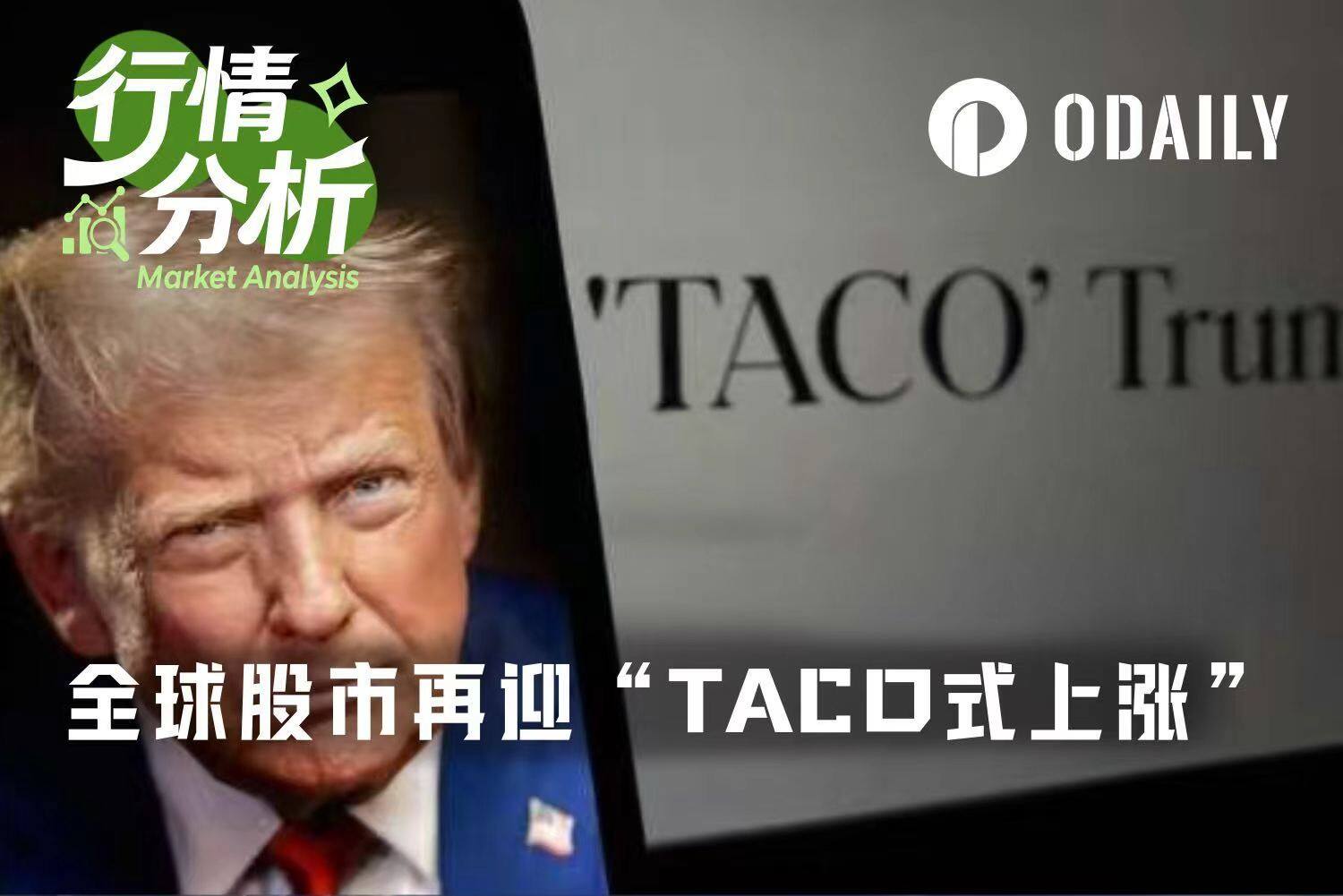
Following the US military's sudden strikes on Iran, and Trump's threat to "take tough action" against Iran which was subsequently canceled, Trump for the 38th time proclaimed that a "final deal is imminent". Financial markets worldwide, including the US stock market, jolted awake and once again experienced a "TACO-style surge".

This morning, all three major US stock indices closed higher, with the Dow Jones up 1.90%, the Nasdaq up 3.42%, and the S&P 500 up 1.73%. Crypto-related stocks rose across the board, with COIN up 4.99% intraday and HOOD up 7.40% intraday. Japanese and South Korean stock markets opened higher. The South Korean KOSPI index opened up 519.25 points, a 6.69% gain, at 8283.2 points, triggering a trading halt at one point, with gains later widening to 8%. The Nikkei 225 index opened up 880.53 points, a 1.37% gain, at 65097.80 points. Possibly influenced by this news, oil prices fell sharply by 4.3%, while gold prices rebounded by 3.1%.

As the US-Israel-Iran conflict enters its fourth month, global financial markets, particularly the US stock market, are pricing in positive developments such as the end of the war in advance, leading to a series of recent "news-driven rallies".

Macro Background: Trump's "Negotiation for Change", US CPI Hits 3-Year High, Fed Rate Hike Expectations Dim

Overall, the macro backdrop for today's stock market rally primarily includes the potential for peace talks in the war situation, the release of US CPI data, and the diminished expectations for a Fed rate hike.

Trump's Comments Again Show "TACO Power"

According to the latest news overnight and this morning, Trump first canceled the planned strikes and bombing operations against Iran scheduled for that evening. He subsequently posted, stating that related consultations had been submitted to and approved by Iran's highest leadership; the final terms (both in overall concept and specific details) had been approved by all relevant parties, including the US, Israel, Saudi Arabia, the UAE, Qatar, Turkey, Pakistan, Bahrain, Kuwait, Jordan, Egypt, and others. Although Iran and Israel later denied this, the market chose to embrace it.

Furthermore, Trump stated regarding the Iran issue that an "excellent agreement" had been reached, noting the relevant documents were in the final drafting stage and could be finalized in the coming days, ready for signing. He added that the agreement might be signed in Europe, possibly this weekend, with US Vice President Vance in attendance. He also said, "Once Iran signs the agreement, the Strait of Hormuz will be opened." Despite the Iran negotiations "taking too long", financial markets are currently choosing to "believe first".

US Core CPI Annual Rate Hits 3-Year High

This Wednesday, the US May CPI data was released, showing:

  • Seasonally Adjusted CPI MoM: 0.5%, expected 0.50%, previous 0.60%.
  • US May Seasonally Adjusted Core CPI MoM: 0.2%, expected 0.30%, previous 0.40%.
  • US May Unadjusted CPI YoY: 4.2%, expected 4.20%, previous 3.80%, the highest since April 2023.
  • US May Unadjusted Core CPI YoY: 2.9%, expected 2.90%, previous 2.80%, the highest since September 2025.

Some analysts believe that US inflation returning to the "4% range" suggests the peak of war-related inflation may be over. CPI rising sharply for the third consecutive month highlights the increasing pressure on household spending, as signs indicate more consumers are tapping into savings to cover expenses. After the data release, the probability of the Fed holding rates steady in June rose to 96.3%, greatly easing earlier Fed rate hike expectations. Trump responded to this data by boasting, "I love inflation."

Expectations for Fed Rate Hike This Year Significantly Eased

Following the CPI data release, the latest information shows the market no longer fully prices in a Fed rate hike this year.

Seema Shah, Chief Global Strategist at Principal Asset Management, stated, "US inflation remains uncomfortably high at 4%, but the weaker-than-expected core reading does relieve some pressure. With energy price increases being the main driver and housing costs easing, we haven't seen clear signs of broader second-round effects yet, which should allow the Fed to remain patient."

Afonso Borges, an analyst at Julius Baer, also pointed out that the modest rally led by short-term Treasuries after Wednesday's CPI report "makes sense," as the better-than-expected inflation data should reduce the risk of a Fed rate hike later this year.

Japanese and South Korean Markets: Retail Investors Borrow to Buy the Dip, Yen Continues to Depreciate

Shifting focus to Japanese and South Korean stock markets, they are currently in a phase of significant rebound after recent declines.

On June 10th, according to Yonhap News Agency, influenced by negative news from the US stock market and the sharp drop in semiconductor stocks, the Korea Composite Stock Price Index (KOSPI) experienced two days of severe adjustments. During this period, the overdraft account balances at major commercial banks increased by over 600 billion won (approximately 2.67 billion RMB). Analysis suggests this indicates retail investors, expecting a market rebound after the plunge, began using overdraft accounts for "borrowing to invest."

According to Nikkei News, the Bank of Japan (BoJ) is expected to raise its short-term policy rate from 0.75% to 1.0% at its monetary policy meeting on June 15th-16th, which would be the highest policy rate level since 1995. Possibly influenced by this news, USD/JPY rose 0.2% intraday, with the current exchange rate at 160.168.

Overall, funds in Japanese and South Korean stock markets continue to grow steadily, but a BoJ rate hike could gradually tighten liquidity in the Japanese capital market. Bank of America analyst Shusuke Yamada stated that if the BoJ takes a hawkish stance and raises rates at next week's meeting, it is expected to support the Yen. He noted that the market has already priced in the rate hike expectation.

Future Outlook: War Situation Uncertain, Institutions Warn of Deep Correction, Markets Face Liquidity Test

Although global stock markets surged today stimulated by Trump's unpredictable "positive news", examining various dynamic factors reveals market sentiment remains cautiously optimistic, with precautions for a deep correction.

No Turnaround in US-Iran Situation

Ali Akbar Dareini from the Tehran Strategic Studies Center stated that despite Trump announcing the cancellation of strikes against Iran, the situation hasn't changed. From Iran's perspective, before any negotiations begin or Iran is ready to discuss nuclear issues, the US first needs to take confidence-building measures, which hasn't happened. Reality shows the US hasn't taken any steps to ease tensions. Iran's position is not to compromise under coercion.

Institutional Bulls Turn Cautious, Warn of Deep Correction

Alex Altmann, Barclays' Head of Global Equity Strategy, who has often advocated "holding stocks" during market volatility and accurately timed rebounds, recently issued a rare cautious warning. In his latest market analysis, he stated that due to the combined pull of technical overbought conditions, overheated sentiment, and macro-environmental pressures, he has turned bearish on the short-term outlook for US stocks. He believes the US stock market is currently in the "middle of a structural correction," with the biggest hidden danger being the severe disconnect between retail sentiment and macroeconomic reality. He even bluntly stated, "The S&P 500 could face a total correction of 6%-7%."

Recent data from the American Association of Individual Investors (AAII) sentiment survey shows the bearish proportion among investors surged to 47.7% last week, nearing the year's high of 52% (March 18th) and well above the historical average of 31%.

Furthermore, several institutions have recently expressed bearish views: Previously, BofA Securities stated investors should be cautious about US stocks, as an increasing number of bearish signals suggest the market is nearing a top.

A team of strategists led by Savita Subramanian wrote in a report dated June 5th that about 70% of bear market signals have now been triggered, consistent with average levels during historical market peaks. The S&P 500 appears statistically overvalued on 17 out of 20 valuation metrics, with 8 indicators above levels seen during the tech bubble. Additionally, high P/E stocks significantly outperforming low valuation stocks is seen by the strategists as a sign of excessive speculation. Within the tech sector, the gap between the best and worst performing quintiles has widened to its highest level since February 2000.

Of course, this view has been openly opposed by the "new stock god" Serenity, who believes Bank of America's bearish rhetoric should be viewed cautiously, as a flood of negative news often appears when institutions need liquidity.

Regarding the South Korean stock market, on June 10th, the open interest in put options for the Kospi 200 index has recently surged sharply relative to call options, nearing levels that have historically preceded market declines. By the previous trading day's close, the ratio of protective put options used to hedge declines to speculative call options approached 2.5 times, hitting a five-year high. This indicator has only breached this threshold a few times before. Notably, South Korean retail investors sold over 1 trillion won worth of overseas stocks in the first week of June, potentially signaling a return of domestic investors to the local market.

SpaceX IPO Looms, US Market Faces Liquidity Test

The latest news indicates that retail subscription for the SpaceX US IPO has exceeded $100 billion. Combined with earlier information that "SpaceX plans to raise $75 billion, with 30% of shares offered to individual investors," the retail subscription is now over 4 times oversubscribed.

US investment manager Jim Chanos stated that investors are pricing in grand narratives rather than realistic profit prospects, with SpaceX's valuation multiples far exceeding those of Tesla (TSLA.O). Furthermore, institutions like Franklin Templeton, and sovereign wealth funds from Saudi Arabia and Kuwait have joined the IPO subscription frenzy. According to foreign media reports, several institutional investors have each placed orders for about $10 billion or more of shares. Two days ago, the SpaceX IPO had already attracted over $250 billion in investment demand, exceeding its planned fundraising of $75 billion, with oversubscription nearing 4 times. Based on market trend projections, by the official listing this Friday, the oversubscription ratio is expected to climb to 10 times.

"Wall Street's Oracle" and Bitmine Board Chairman Tom Lee commented on this, stating that at this stage, US stock investors are actively selling their existing holdings to raise cash to participate in this blockbuster IPO. This ongoing capital diversion effect might be the culprit behind the recent weakness in US stocks. Christophe Boucher, Chief Investment Officer at ABN Amro Investment Solutions (part of Dutch bank ABN Amro), also said, participating in the SpaceX IPO is similar to buying cryptocurrency about 15 years ago—either you could lose your entire principal or potentially achieve exponential returns.

Although the SpaceX IPO has raised concerns about market liquidity shortages, according to market news, S&P Dow Jones Indices believes SpaceX is eligible for rapid inclusion in certain indices. At that point, SpaceX could become a "phenomenal giant" in the US stock market.

In summary, global stock markets will continue to face influences such as capital liquidity, domestic market policies, and changes in the global situation like the US-Israel-Iran conflict. In the short term, be wary of Trump potentially staging another round of market manipulation with "intimidation-induced bearishness" and "TACO-style bullishness".


Related Questions

QWhat were the main factors contributing to the global stock market surge mentioned in the article?

AThe main factors contributing to the global stock market surge were Donald Trump's announcement of an 'imminent final agreement' regarding the US-Iran conflict, which led to a 'TACO-style rally.' Additionally, the release of US CPI data showing a 4.2% year-over-year inflation rate and a 2.9% core inflation rate, both at multi-year highs, along with a significant reduction in market expectations for a Federal Reserve interest rate hike this year, provided a supportive macroeconomic backdrop.

QWhat specific actions did investors in South Korea take following the recent market downturn, as described in the article?

AFollowing the recent market downturn, South Korean retail investors borrowed money through overdraft accounts to engage in 'borrowing investment,' with the total balance in major commercial bank overdraft accounts increasing by over 600 billion won (approximately 2.67 billion RMB). This indicates they were anticipating a market rebound and looking to buy at lower prices.

QAccording to the article, why did several investment institutions express a cautious or bearish outlook on US stocks despite the recent rally?

ASeveral investment institutions expressed a cautious or bearish outlook on US stocks due to concerns about technical overbought conditions, overheated sentiment, and macroeconomic pressures. For example, Barclays warned of a potential 6-7% correction in the S&P 500. Bank of America Securities noted that about 70% of bear market signals had been triggered and that the S&P 500 appeared statistically overvalued on many metrics. Additionally, the high level of put option activity relative to call options in the South Korean Kospi 200 index was seen as a potential warning sign for a market decline.

QWhat potential impact does the SpaceX IPO have on the liquidity of the US stock market, as discussed in the article?

AThe SpaceX IPO poses a potential liquidity challenge for the US stock market. With retail subscription demand exceeding $100 billion and total investment demand surpassing $250 billion for a planned $75 billion offering, it is suggested that investors may be selling existing stock holdings to raise cash to participate in the IPO. Analysts like Tom Lee point to this 'cash consolidation effect' as a possible reason for recent weakness in US stocks.

QHow did the article describe the official Iranian response to Trump's claims about a potential agreement?

AThe article described the official Iranian response as one of denial and continued firmness. Following Trump's claims, Iranian and Israeli sources reportedly denied the developments. An Iranian analyst from the Tehran Strategic Research Center stated that no trust-building measures had been taken by the US to ease tensions and reiterated Iran's position that it 'will not compromise under coercion,' indicating no fundamental change in the situation from Iran's perspective.

Related Reads

After Three Consecutive Quarters of Decline, Can the Crypto Market Find a Window for Stabilization in Q3?

The cryptocurrency market has just concluded its worst-performing quarter since 2022, with total capitalization dropping 12.6% to $2.1 trillion. All core metrics indicate capital is leaving the sector, not just rotating within it. Bitcoin fell 14.2% and Ethereum dropped 25.4% in Q2, breaking their previous correlation with US tech stocks. A key driver is the reversal in US spot Bitcoin ETF flows, which saw a net outflow of approximately $4.67 billion in Q2, including a record monthly outflow near $4.5 billion in June. While recent data suggests long-term holders are accumulating again, sustained ETF outflows mean continued selling pressure. Market focus is now singularly on the Federal Reserve. The upcoming July FOMC meeting is seen as the most critical event for Q3. A dovish signal could support Bitcoin reclaiming a $68,000-$84,000 range, while a hawkish stance might establish a new trading band around $50,000-$56,000. Additionally, regulatory uncertainty persists, with the progress of the crucial *CLARITY Act* stalling in the Senate, reducing its perceived 2026 passage probability to 40-45%. Despite the broad downturn, a few sectors showed growth. Prediction markets saw nominal volume surge 48.7% year-over-year to $113.8 billion, and tokenized collectibles transaction volume rose 143% quarterly to $1.4 billion. The Real-World Asset (RWA) tokenization sector also continued steady growth, now representing ~$28.1 billion in on-chain value. The market's foundation for an extreme crash appears limited, with Bitcoin price hovering near its 200-week moving average. However, the trading paradigm has shifted from narrative-driven speculation to decisions based on price action, policy developments, and interest rate expectations, making a broad sentiment-driven rally unlikely in the near term.

marsbit1h ago

After Three Consecutive Quarters of Decline, Can the Crypto Market Find a Window for Stabilization in Q3?

marsbit1h ago

BIT Trading Moment: BTC Still Suppressed by Weekly 200 EMA, Rejection May Restart Decline; Storage and Semiconductors that Surged Last Night Begin Falling in Evening Trading

**Crypto & Stock Market Wrap: Bitcoin Tests Resistance, Stocks Retreat After AI Surge** Bitcoin consolidates around $66,000, facing key resistance near $68,000—an area seen as a major psychological and technical hurdle where previous rallies have failed. Analysts note the cryptocurrency is caught between its 200-week moving average (~$63,333) and 200-week EMA (~$68,328). A clear break above $68k is needed to signal a stronger bullish trend, while a rejection could lead to a retest of $63k support. Market sentiment remains cautious, with low futures open interest pointing to a low-liquidity rebound rather than a full bull market. Bitcoin spot ETFs saw another $203 million inflow. US stock futures pointed lower after a strong Tuesday session led by a massive rebound in semiconductors and memory stocks. The rally was fueled by renewed optimism about AI-driven hardware demand, with Micron, SanDisk, and SK Hynix surging. However, those gains reversed in pre-market trading. Super Micro Computer (SMCI) soared over 20% after hours on strong guidance and a record backlog. Other standouts included Rocket Lab and nuclear energy plays Oklo and X-Energy. Rising oil prices (Brent above $91) and climbing Treasury yields (10-year near 4.64%), however, are reigniting inflation concerns and acting as a headwind for equities. In Asia, markets were mixed. South Korea's KOSPI pared early gains to close slightly higher as semiconductor stocks like SK Hynix gave back initial surges. Japan's Nikkei edged lower as the yen hit a fresh 38-year low against the dollar, raising fears of potential market intervention. Key events to watch include the Samsung Galaxy launch, AMD's AI event, and a slew of major tech earnings from Alphabet, Tesla, and IBM after the close on Wednesday, followed by the ECB meeting and Intel's earnings on Thursday.

marsbit1h ago

BIT Trading Moment: BTC Still Suppressed by Weekly 200 EMA, Rejection May Restart Decline; Storage and Semiconductors that Surged Last Night Begin Falling in Evening Trading

marsbit1h ago

Former CFTC Chairman, Circle President Tarbert: Preaching Long-Termism While Cashing Out $30 Million Himself

Former CFTC Chairman and Circle President Heath Tarbert has consistently advocated for a long-term vision in public, urging patience from investors as Circle’s stock price has fallen significantly from its peak. However, it has been revealed that since Circle’s IPO, Tarbert has continuously sold his CRCL shares through pre-arranged trading plans, cashing out approximately $30 million, without making any public market purchases. This contrast between his public messaging and personal actions has drawn criticism. Tarbert joined Circle in July 2023 as Chief Legal Officer, leveraging his regulatory experience to help guide the company through its IPO and expansion. Despite promoting stablecoins as long-term infrastructure, he established a 10b5-1 trading plan just before Circle went public, leading to substantial stock sales over the following year. In March 2026, he initiated another plan to sell more shares. His career trajectory highlights a pattern of moving between high-level regulatory roles and influential positions in the financial sector. After resigning as CFTC Chairman in early 2021, he joined Citadel Securities as Chief Legal Officer just 27 days later, during a period of intense regulatory scrutiny for the firm. He later joined Circle, aiding its efforts to navigate regulatory challenges for its public listing. While Tarbert's expertise in policy and compliance is valuable to companies like Circle, his actions—advocating long-term confidence while personally divesting—raise questions about the alignment between his public statements and his private financial decisions, leaving investors who followed his advice to bear the market risks.

marsbit2h ago

Former CFTC Chairman, Circle President Tarbert: Preaching Long-Termism While Cashing Out $30 Million Himself

marsbit2h ago

Gate Research Institute: The 'Wall Street-ization' Wave of Crypto Financial Products – Competition or Integration?

The article titled "Gate Research Institute: Are Crypto Financial Products Sparking a 'Wall Street' Wave—Competition or Convergence?" explores the evolving relationship between the crypto ecosystem and traditional finance (TradFi). The piece begins by reflecting on Bitcoin's original 2009 vision of decentralization, disintermediation, and moving away from banks. It then contrasts this with the 2024 landscape, where key crypto assets like Bitcoin are increasingly held through Wall Street products like ETFs issued by giants like BlackRock. The article questions whether this signifies that TradFi is systematically taking over the rights to issue, price, custody, and distribute crypto financial assets. The core argument is that this is not a zero-sum takeover but rather a bidirectional convergence where each side addresses the other's weaknesses. Crypto offers 24/7 global markets, programmable settlement, and open access but lacks compliant channels, institutional-grade custody, deep fiat liquidity, and mainstream distribution. TradFi possesses these but is constrained by legacy systems, limited operating hours, and slow settlement. Two primary convergence paths are highlighted: * **Path A (CEX to TradFi):** Exemplified by Gate, which has progressed from offering tokenized stocks and CFDs to providing direct, real stock trading (US, Hong Kong, South Korea) within its platform, using USDT. * **Path B (TradFi to Crypto):** Exemplified by Robinhood, which has integrated crypto trading, acquired exchanges like Bitstamp, and is moving traditional assets like stocks onto the blockchain via tokenization and its own Layer 2. Both paths are ultimately competing to become the next-generation, unified financial account—a "super account" where users can seamlessly trade cryptocurrencies, stocks, ETFs, RWA (Real World Assets), and tokenized treasury products in one interface. The growth of RWA and tokenized treasuries (e.g., BlackRock's BUIDL) is presented as the asset-layer fusion, providing stable, yield-bearing assets on-chain and acting as a bridge between the two worlds. In conclusion, the "Wall Street-ization" of crypto is framed as a mutual transformation. Decentralized ideals persist in the protocol layer, while at the application layer, a more efficient, global, and accessible unified capital market is emerging from this convergence. The future competition lies not between crypto exchanges and stockbrokers, but between platforms vying to offer the most comprehensive asset coverage, liquidity, and user experience within a single account.

marsbit2h ago

Gate Research Institute: The 'Wall Street-ization' Wave of Crypto Financial Products – Competition or Integration?

marsbit2h ago

Trading

Spot
活动图片




