Trump lauds Chris Waller as ‘great’ after Fed chair interview, will pick within weeks

cointelegraphPublished on 2025-12-19Last updated on 2025-12-19

Abstract

President Donald Trump praised Federal Reserve chair nominee Chris Waller as "great" and "fantastic," confirming he will announce his selection for the role within weeks. Waller, who has expressed crypto-friendly views, is among three or four candidates on the shortlist. According to prediction platform Polymarket, Waller currently has a 14% chance of selection, trailing crypto-supportive White House adviser Kevin Hassett (53%) and former Fed governor Kevin Warsh (28%). The crypto industry is closely monitoring the appointment due to the Fed's influence on interest rates, which significantly impact digital asset markets. Lower rates often drive investors toward higher-risk investments like cryptocurrencies.

United States President Donald Trump offered positive remarks about pro-crypto Fed chair nominee Chris Waller at a recent press conference, as speculation continues over his final choice.

“I think he’s great. I mean, he’s been a man who’s been there a long time. Somebody that I was very involved with and sense of his career, and he’s a fantastic man,” Trump said during a press conference on Thursday.

Waller has recently been perceived as relatively supportive of crypto, saying in an August speech at the Wyoming Blockchain Symposium 2025 that there is “nothing to be afraid of” about crypto payments operating outside the traditional banking system.

Trump says everyone on the shortlist “would be a good choice”

Waller currently has a 14% chance of being selected, according to crypto prediction platform Polymarket, making him the third most likely pick. Crypto-friendly White House economic adviser Kevin Hassett leads at 53%, followed by former Fed governor Kevin Warsh with 28% odds.
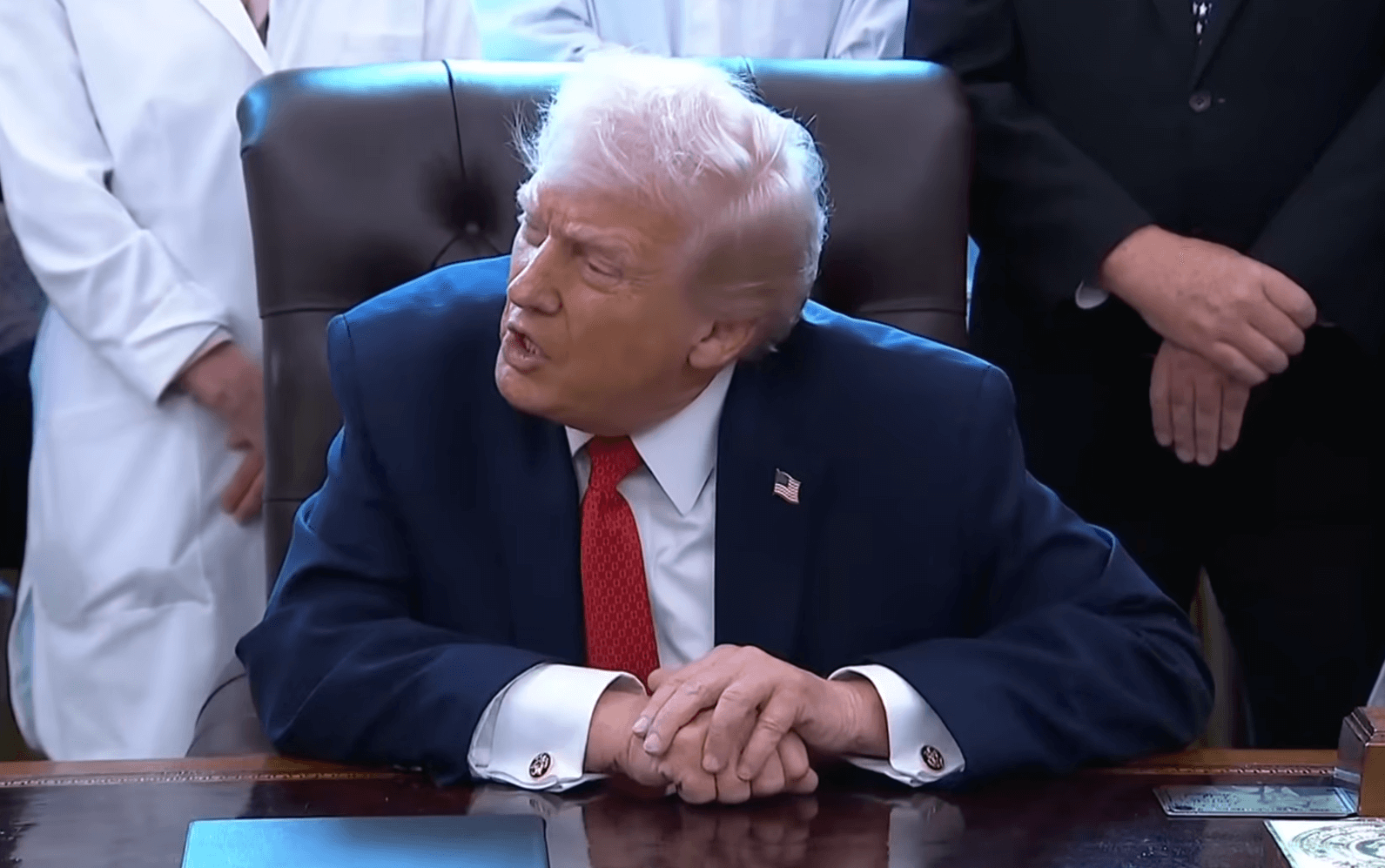
US President Donald Trump expects to make the Fed chair announcement in the next few weeks. Source: YouTube

Trump said that the list has been narrowed to three or four candidates. “I think every one of them would be a good choice, honestly,” he said.

When asked whether Fed governor Michelle Bowman was also on the shortlist, Trump did not directly answer the question, but described her as a “fantastic person.” Polymarket currently puts Bowman’s odds at 2%.

Trump said that he expects to make the announcement over the “next couple of weeks.” “I don’t know before the end of the year, but pretty soon,” Trump said.

Crypto industry has been keeping a close eye on Fed chair developments

The crypto industry has been paying close attention to developments surrounding Trump’s Fed chair nominee, with the discussion ramping up in recent months as the Fed’s role in monetary policy is often seen as affecting broader crypto market conditions.

Related: Global debt markets show dollar dominance moves in cycles, US Fed says

Interest rates, which are set by the Federal Reserve, are widely viewed as having a significant impact on the crypto market.

When rates are lowered, investors tend to seek higher-risk assets such as cryptocurrencies, as traditional investments like bonds and term deposits become less attractive.

Magazine: Big questions: Would Bitcoin survive a 10-year power outage?

Related Questions

QWhat did President Trump say about Chris Waller at the press conference?

APresident Trump said, 'I think he’s great. I mean, he’s been a man who’s been there a long time. Somebody that I was very involved with and sense of his career, and he’s a fantastic man.'

QAccording to the crypto prediction platform Polymarket, what are the odds for the top three Fed chair candidates?

AAccording to Polymarket, crypto-friendly White House economic adviser Kevin Hassett leads at 53%, followed by former Fed governor Kevin Warsh with 28% odds, and Chris Waller is third with a 14% chance.

QWhat is Chris Waller's stance on cryptocurrency, as mentioned in the article?

AChris Waller is perceived as relatively supportive of crypto. In a speech, he stated there is 'nothing to be afraid of' about crypto payments operating outside the traditional banking system.

QWhen does President Trump expect to announce his choice for Fed chair?

APresident Trump said he expects to make the announcement in the 'next couple of weeks' and that it would be 'pretty soon,' though he was unsure if it would be before the end of the year.

QWhy is the crypto industry paying close attention to the Fed chair nomination?

AThe crypto industry is paying attention because the Fed’s role in monetary policy, particularly in setting interest rates, is widely viewed as having a significant impact on broader crypto market conditions.

Related Reads

Wall Street Morning News: V-shaped Rebound at Month-end, but Nasdaq Suffers Worst July in 12 Years; Funds Accelerate Concentration Towards Cloud Giants

Despite a V-shaped rebound at the end of July, the Nasdaq posted its worst July since 2004, while the S&P 500 had its worst July since 2014. Markets were jolted by geopolitical shifts, as President Trump canceled a planned strike on Iran, leading WTI crude to plunge over 8%. This, alongside OPEC+ announcing a supply increase, reversed crude's sharp July gains. Treasury yields surged, with the 10-year yield rising over 30 basis points in July—its largest July increase since 2005. In a rare move, the US and Japan jointly intervened to weaken the USD/JPY, aiming to prevent potential Japanese sales of US Treasuries. While the tech sector faced deleveraging pressure throughout July, cloud giants staged a massive rally on strong earnings. Microsoft, Amazon, and Google collectively added nearly $1.5 trillion in market value last week. Amazon soared over 15% on accelerating AWS growth, Microsoft extended historic gains, Google fully recovered post-earnings losses, and Meta ended an 11-day losing streak. In contrast, Apple tumbled over 7% on supply chain and guidance concerns, ceding its "world's most valuable company" title to Nvidia. The memory and storage sector corrected sharply. Gold edged up 0.91% in July, with analysts viewing the ~30% pullback from January highs as a potential basing period, supported by long-term central bank demand. Key events to watch this week include earnings from Palantir, AMD, SpaceX (its first post-IPO report), and memory giants like Western Digital. The US July non-farm payrolls report on Friday will be critical for gauging the Fed's policy path. SpaceX also faces a significant lock-up expiration, testing market liquidity.

marsbit9m ago

Wall Street Morning News: V-shaped Rebound at Month-end, but Nasdaq Suffers Worst July in 12 Years; Funds Accelerate Concentration Towards Cloud Giants

marsbit9m ago

Rubin Ultra Makes Major Cuts, Even Nvidia Can't Handle Memory Price Hikes?

NVIDIA's Rubin Ultra, the top-tier variant of the newly announced Rubin AI accelerators, has reportedly seen significant specification downgrades, according to an industry report from SemiAnalysis. Initially designed with four compute dies (4-die), the Rubin Ultra is now said to be reduced to a 2-die design. Key changes highlighted in the report include: * **No increase in peak theoretical compute performance**, remaining at 35 PFLOPs like the standard Rubin. * **Severe reduction in memory capacity** to 192GB using 8-Hi HBM stacks, which is less than the standard Rubin's 288GB using 12-Hi stacks. * **Negligible memory bandwidth improvement** of only 1 TB/s. * **Slightly higher chip-level power consumption**. * The **primary upgrade is a massive increase in scale-up interconnect capacity**, supporting connections for up to 576 GPUs via NVLink, compared to 72 for the standard Rubin. The report suggests the redesign is primarily a cost-optimization move driven by the sharp rise in HBM (High-Bandwidth Memory) prices. By reducing the expensive HBM content and shifting investment towards enhanced system-scale networking, NVIDIA aims to maintain the platform's value for large-scale AI training clusters while managing soaring material costs. The news reportedly triggered a sell-off in South Korean memory stocks, with SK Hynix and Samsung shares falling around 8%, as markets grew concerned that NVIDIA—a major HBM buyer—might be reducing its reliance on high-capacity memory, potentially capping future pricing power for memory makers.

Odaily星球日报29m ago

Rubin Ultra Makes Major Cuts, Even Nvidia Can't Handle Memory Price Hikes?

Odaily星球日报29m ago

Can Generative Models Finally Be Trained End-to-End? The Core Is a For Loop

This article introduces a novel training paradigm for generative models called Explorative Modeling (XM), which enables true end-to-end training. Traditionally, powerful generative models like autoregressive and diffusion models are not trained end-to-end. They are trained to predict a single small step but require iterative multi-step sampling for inference. This "exposure bias" leads to error accumulation and limits performance. The core challenge XM addresses is "mode blurring." In generative tasks, a single input (e.g., "generate a dog") corresponds to many valid outputs (multiple modes). Standard training objectives like reconstruction loss force the model to average these modes, producing unrealistic, blurry outputs. To avoid this, existing models break generation into many small, almost deterministic steps, sacrificing end-to-end training. XM tackles this by restructuring the training loop itself. Its key insight is to amplify "generative expressivity." For each training input, instead of generating one sample, the model generates K candidate outputs. Only the candidate closest to the real data is used for computing the loss and updating the model via backpropagation. This simple "best-of-K" mechanism is implemented as a short for-loop. By exploring multiple possibilities, the model learns to distribute its guesses across different modes rather than collapsing to their uninformative average. The paper demonstrates that "exploration" acts as a new, powerful scaling axis. Gains from XM increase with model size, data scale, and compute. Experiments show improvements in FID scores for image generation and significant efficiency gains, sometimes outperforming larger models without exploration. When pushed to the limit, XM enables fully single-step, end-to-end generative models. In robotics tasks, an "Explorative Policy" matched the performance of a 100-step Diffusion Policy with a single forward pass, drastically improving inference speed. While the best-of-K concept is not entirely new, the authors' contribution lies in formally understanding it as a direct method to boost generative expressivity without fragmenting the generation process. This work suggests that as models scale, enhancing exploration during training may become crucial for overcoming fundamental performance bottlenecks.

marsbit1h ago

Can Generative Models Finally Be Trained End-to-End? The Core Is a For Loop

marsbit1h ago

Trading

Spot
活动图片