Trump in Web3 Games: Temporary Hype or Trend?

bitcoinistPublished on 2025-12-12Last updated on 2025-12-12

Abstract

The article "Trump in Web3 Games: Temporary Hype or Trend?" discusses the growing integration of political brands, particularly Donald Trump’s, into the crypto industry—especially within Web3 gaming. It highlights the recent launch of the 3D game *Trump Billionaires Club*, which features an in-game economy tied to the $TRUMP memecoin and user engagement mechanics. The piece argues that while political and media-driven narratives can generate initial user interest, they often fail to retain players without clear, sustainable incentives. Many gaming tokenomics rely on short-term emotional appeal rather than long-term engagement. In response, projects like PEPENODE are emerging with simplified, routine-based reward systems—such as virtual "mining" nodes—that require no technical knowledge or hardware. PEPENODE, promoted as the "first memecoin mine-to-earn" platform, allows users to buy and upgrade virtual mining nodes to earn rewards, including memecoins like PEPE and Fartcoin. Early data shows significant pre-sale interest, with $2.3 million raised and a token price of $0.001192. The project aims to combine meme-driven engagement with predictable, recurring action—a trend gaining traction as Web3 games seek broader, more consistent user bases beyond one-time hype. The article concludes that while politically themed games attract attention, their long-term success depends on transitioning from viral momentum to habitual use through clear mechanics and recurring value.

Trusted Editorial content, reviewed by leading industry experts and seasoned editors. Ad Disclosure

Political brands are increasingly penetrating the crypto industry—and today this is most noticeable in games. This week, the Spanish business publication Cinco Días described the launch of the 3D game Trump Billionaires Club, where the in-game economy is tied to the $TRUMP memecoin and user engagement mechanics.

For the market, this is a signal not so much about a specific politician, but about a direction: Web3 gaming is once again seeking a mass audience through recognizable themes and simple progression steps. When a product is understood without training, it's easier for the user to take the first step—buy a token, enter the game, complete tasks, and return tomorrow.

But this approach has a weak spot: the majority of gaming tokenomics live only on emotions and quickly burn out if the user has no clear reason to stay in the system. That is why 2025 looks like a race for mechanics that retain attention not with promises, but with regular action and predictable rewards.

Against this backdrop, memecoins are getting another chance to break out of the "buy and forget" mode into a format where the token becomes a participation tool. And here, the new project PEPENODE is trying to fill the niche: to combine meme energy with a clear gaming routine of mining, without requiring iron, electricity, or technical skills.

BUY PEPENODE

Why Gaming Memecoins Are Returning Attention to Simple Mechanics

Web3 games in 2025 need one thing: to convert the noise around a brand into a daily habit. Political and media themes provide traffic, but do not guarantee retention—users quickly leave if progress seems random or too complex.

Parallelly, the infrastructure side has become less painful for retail. According to Cointelegraph, average commissions on the Ethereum network after the Dencun update have noticeably decreased: in March 2025, the average swap was valued at approximately $0.39 versus around $86 a year earlier.

Hence the trend: projects are competing not only with memes, but also with "grounded" reward cycles—from simplified game quests to mining simulations. Against this backdrop, many investors are becoming interested in other market directions, including the list of the best altcoins for 2025.

PEPENODE currently looks like one of the variants in this logic, because it bets on regular activity and a clear interface, not on complex economics.

How PEPENODE Turns "Mining" into a Game Without Iron

The key idea of PEPENODE is positioning as the "world's first memecoin mine-to-earn": instead of classical mining with equipment, the project offers a virtual "mining" system. The entry is built around nodes and reward levels. This addresses three market pains at once: boring mining models, weak early incentives, and technical complexity for newcomers.
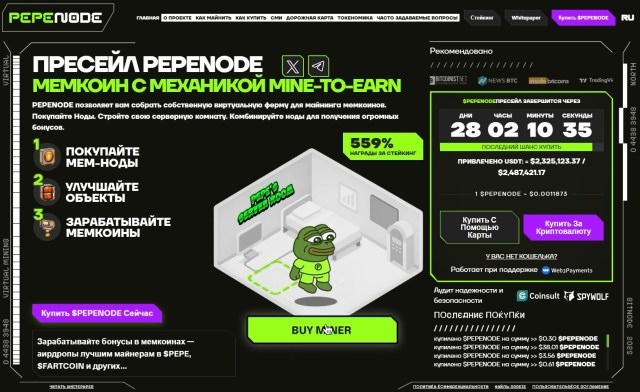
In product terms, this looks like a gamified panel. You buy and configure "node-miners," improve nodes to increase efficiency, and receive rewards, including memecoins like PEPE and Fartcoin. Importantly, the scenario of "enter — improve — collect reward" is simpler than dealing with iron and expenses.

Interest is also heating up the early demand dynamics. According to the presale team's data, PEPENODE has already attracted $2.3 million, and the token price is $0.001192. This is the level at which the base of early participants usually forms, if the product really promises activity after launch.

Large wallet tracking data indicates 2 purchases for a total of $215K; the largest deal—$51K—took place on February 8, 2025.

This bet has a clear logic: if the game finds an audience after launch, then "mining as a habit" may turn out to be stronger than the one-time hype around a loud name.

Editorial Process for bitcoinist is centered on delivering thoroughly researched, accurate, and unbiased content. We uphold strict sourcing standards, and each page undergoes diligent review by our team of top technology experts and seasoned editors. This process ensures the integrity, relevance, and value of our content for our readers.

Daria Vlasova

Follow

Crypto journalist, specializes in the digital asset market, DeFi platforms, and Web3 projects. Graduate of the Economics Faculty of Moscow State University. Since 2019, she has been writing about the crypto industry, tokenomics, and the development of new digital economy models.

Full Profile

Related Posts

Even 0.1 $BTC is financial independence for decades. But that's not enough

MEXC KYC Reward December 2025: First Trade Loss Coverage (100% Loss Coverage Up to 50 USDT)

Best crypto presale: MAXI stands out among meme-presale projects

Best crypto to buy now: MAXI attracts global attention after a surge in trading volume

Best crypto to buy now: Bitcoin Hyper (HYPER) shows the strongest growth signals

New crypto that could explode today: Pepenode (PEPENODE) predicted to surge strongly in the next few hours

Related Questions

QWhat is the main focus of the article regarding Web3 gaming trends in 2025?

AThe article focuses on the trend of Web3 gaming shifting towards simple, engaging mechanics and meme-driven economies to attract and retain a mass audience, moving away from complex models that rely solely on hype.

QWhat specific project is highlighted as an example of combining meme energy with a playable mining routine?

AThe project highlighted is PEPENODE, which positions itself as the 'first meme coin mine-to-earn' project, offering a virtual mining system with nodes and reward levels instead of traditional hardware-based mining.

QAccording to the article, what is the key weakness of many gaming tokenomics models that rely on emotions and hype?

ATheir key weakness is that they quickly lose value and user interest if there is no clear reason for the user to stay in the system, as they lack predictable, regular rewards and sustainable engagement mechanics.

QWhat infrastructure development is mentioned as making the market less painful for retail participants?

AThe article mentions that average commissions on the Ethereum network have noticeably decreased after the Dencun update, with the average swap fee estimated at around $0.39 in March 2025 compared to about $86 a year earlier.

QWhat early traction data is provided for the PEPENODE project in its pre-sale phase?

AThe pre-sale for PEPENODE had attracted $2.3 million, with a token price of $0.001192. Data also indicated two large purchases totaling $215K, with the largest single transaction being $51K on February 8, 2025.

Related Reads

Crypto Miners' Big AI Gamble: Valuations Enter Differentiation Stage, Comeback Fight Proves Tough

Crypto Mining Firms' AI Bet: Valuation Divergence and a Challenging Transformation Facing declining profitability in crypto mining, mining companies are pivoting to AI infrastructure, capitalizing on their existing power resources, land, and data center expertise to offer GPU compute power. This transition narrative has boosted their stock prices significantly, with firms like Hut 8 and Bitfarms seeing gains over 100% year-to-date, far outpacing Bitcoin. This has led to a market valuation split, with pioneers like CoreWeave reaching a $62.8B market cap, while others remain below $5B. The market currently prioritizes growth potential over short-term profits, which remain under pressure due to heavy capital expenditures for AI build-outs and crypto asset volatility. However, the transformation is a high-stakes gamble. Bitcoin mining profitability is shrinking, with the average production cost around $63,707 and miner margins contracting. While AI offers a more lucrative long-term path, it requires massive investment—estimated at a $500B near-term funding gap. Success now hinges on execution: delivering on contracted power capacity, securing quality tenants like major cloud providers, and managing the immense financial burden. The valuation focus is shifting from mere power capacity to project delivery, future cash flows, and tenant quality, making this a difficult but critical turnaround attempt.

链捕手5m ago

Crypto Miners' Big AI Gamble: Valuations Enter Differentiation Stage, Comeback Fight Proves Tough

链捕手5m ago

Analysis of the Latest Portfolio Adjustment by the "Top Player" in the U.S. Stock Market: $9 Billion Short on NVIDIA, Shifting Focus to Power and Memory Sectors

AI investor Leopold Aschenbrenner has made a significant portfolio shift, taking a $9 billion nominal short position against top AI infrastructure stocks like NVIDIA, ASML, and Oracle. Simultaneously, he is redirecting capital towards what he sees as the next critical bottlenecks in the AI boom: power, memory, and data center networking, alongside private investments in AI model companies like Anthropic. This move is interpreted not as a call that the AI bubble has burst, but as a rotation within the infrastructure stack. The analysis highlights NVIDIA's recent $25 billion bond issuance as a potential signal, questioning why a cash-rich company would seek external debt despite high profits and increased dividends/buybacks. The core investment thesis is that the initial, crowded "picks and shovels" trade in semiconductors is maturing. The next wave of capital is expected to flow into the physical and logistical constraints of AI expansion: electricity supply, memory chip capacity, data center construction, and enabling technologies like optical networking (fiber) for high-bandwidth communication, where copper remains crucial for short distances. Aschenbrenner's substantial (approx. 20% of fund) private stake in Anthropic is noted as a key part of his strategy—investing directly in the "mine" (AI models) rather than just the "shovels." The discussion concludes that while certain segments may be overvalued, the overarching AI infrastructure demand driven by real product usage remains robust. The most promising long-term investments are seen in essential, non-sexy infrastructure—particularly energy and power companies—whose demand is viewed as a global constant irrespective of AI's cyclicality.

marsbit26m ago

Analysis of the Latest Portfolio Adjustment by the "Top Player" in the U.S. Stock Market: $9 Billion Short on NVIDIA, Shifting Focus to Power and Memory Sectors

marsbit26m ago

BIT Research: Liquidity is Disappearing, Will Bitcoin Replay the Bottoming Pattern of 2022?

The crypto market is currently in an adjustment phase driven by policy expectations and liquidity shifts. Despite a brief rebound fueled by geopolitical easing and SpaceX's strong IPO performance, unexpectedly hawkish signals from new Fed Chair Kevin Warsh have removed anticipated easing support. Concurrently, stablecoin liquidity is shrinking, with insufficient new capital inflows, pushing the market into a typically quiet summer period. Pricing lacks catalysts for a sustained rally. Daily trading volume has significantly contracted, stablecoin growth has slowed markedly, and the supportive effect of Strategy's (formerly MicroStrategy) STRC preferred stock-financed Bitcoin purchases is fading. Amid policy uncertainty, seasonal weakness, and liquidity contraction, Bitcoin faces near-term downward pressure. Warsh's hawkish pivot and refusal to provide a clear policy outlook have increased risk premiums, historically unfavorable for Bitcoin. Technically, the trend remains bearish below $73,700, with $62,446 as critical support. A break below could accelerate declines, though a prolonged consolidation phase, similar to 2022's bottoming process, is possible. Liquidity is a core constraint. Current daily volume is around $500 billion, roughly 25% of the peak during the July-Oct 2025 rally. The 12-month growth rates for USDT and USDC have fallen to ~20%, with 6-month growth near zero, indicating weak new inflows. Bitcoin ETF and Strategy-driven inflows have also weakened, with a 30-day rolling net outflow. With inflation at 4.2% above the Fed's target, combined hawkish policy, seasonal factors, and liquidity shortages challenge Bitcoin's ability to hold above $60,000. However, this adjustment phase may be forming a cyclical low this summer, potentially setting the stage for the next bull cycle.

marsbit54m ago

BIT Research: Liquidity is Disappearing, Will Bitcoin Replay the Bottoming Pattern of 2022?

marsbit54m ago

Who Makes the Best Use of Claude Code? The Answer Might Not Be Programmers

Claude Code Usage Report Summary (Based on ~400k sessions) Core Finding: In agentic programming with Claude Code, a clear division of labor has emerged: humans primarily decide *what* to build (planning decisions), while Claude decides *how* to build it (execution decisions). Key Insights: 1. **Effectiveness is not limited to programmers.** In code-generation tasks, success rates for users in non-technical fields (law, finance, management, research) are nearing those of software engineers. What matters most is the user's domain expertise and understanding of the problem to be solved. 2. **Domain expertise drives success and efficiency.** Sessions where users exhibited "expert" proficiency in the task's domain saw verified success rates double compared to "novice" sessions. Experts also delegated more work per instruction, with Claude executing more actions and producing more output. 3. **AI is amplifying, not replacing, domain knowledge.** Claude Code lowers the *implementation* barrier, not the *judgment* barrier. The value of knowing the "what" and "why" is increasing relative to just knowing the "how" to code. 4. **Usage is evolving.** Over a 7-month period (Oct '25 - Apr '26), the share of sessions for debugging halved, while use for software operations, data analysis, and non-code writing roughly doubled. The estimated economic value of typical tasks increased by ~25%. Conclusion: The data suggests coding agents are making programming background less critical for completing technical tasks. However, they reward and amplify deep domain understanding. The ability to successfully direct an AI agent stems more from mastery of a specific field than from coding skill itself. The primary gains come from being competent in a domain; deep specialization adds only marginal additional advantage. This may signal a shift where software creation becomes integrated into various professions.

marsbit1h ago

Who Makes the Best Use of Claude Code? The Answer Might Not Be Programmers

marsbit1h ago

Trading

Spot
Futures
活动图片