Trial 1314 Days Late: Mastermind Behind $40 Billion Stablecoin Collapse Sentenced to 15 Years

marsbitPublished on 2025-12-12Last updated on 2025-12-12

Abstract

The trial of Do Kwon, the mastermind behind the $40 billion Terra (LUNA) and UST stablecoin collapse, concluded on December 11, 2025, with a 15-year prison sentence. After 1,314 days since the catastrophic crash, Kwon was convicted of orchestrating an "epic, generational-scale fraud" that wiped out life savings for over a million victims and triggered a crypto market crisis, including the fall of FTX. Despite his defense pleading for a five-year term, citing arrogance rather than greed as motive, the judge dismissed it as absurd and deemed the prosecution’s recommended 12 years too lenient. Kwon, who had initially pleaded not guilty, eventually admitted to two counts of conspiracy and wire fraud in August, agreeing to forfeit over $19 million in assets. Victim impact statements revealed devastating losses—homes, retirement funds, and education savings vanished. Many described being misled by Kwon’s false assurances and cult-like influence. In a rare apology, Kwon expressed remorse, acknowledging his "arrogance" and the pain he caused. He may serve half his sentence in the U.S. before potential transfer to South Korea, where he faces additional charges.

Author: Nancy, PANews

On December 11, 2025, 1314 days after the Terra collapse, Do Kwon finally faced justice and was sentenced to 15 years in prison.

Although this epic fraud case has come to a close, the evaporation of over $40 billion, affecting more than a million victims, stands as an expensive and painful lesson in the history of cryptocurrency development.

Luna Dream Shattered, Sentenced to 15 Years in Prison

On December 11, Do Kwon, wearing the yellow prison uniform of the Essex County Jail in New Jersey, sat at the defense table accompanied by four lawyers. The once-flamboyant crypto tycoon faced his final judgment.

During the hearing, Kwon's defense team attempted an emotional appeal, requesting the judge to limit the sentence to five years. They argued that Kwon's crimes stemmed more from arrogance and desperation than extreme personal greed, noting that he had already served time in Montenegro and might face prosecution in South Korea.

However, this argument was strongly refuted by U.S. prosecutors. They pointed out that the stablecoin concept promoted by Terraform Labs, along with its claimed real-world applications like Chai, was built on lies from the very beginning. At its peak, Kwon's token value soared, and he even named his daughter "Luna" to commemorate what he called his "greatest invention."

Prosecutors emphasized that the $40 billion collapse of the Terra ecosystem not only triggered a chain reaction of crises across the entire crypto market but also indirectly led to the bankruptcy of SBF's FTX exchange and sparked a crypto winter. (Related reading: LUNA and UST in the 'Big Short') Faced with such devastating consequences, Kwon and his supporters attempted to construct a "counter-narrative," portraying the collapse as a black swan event or market manipulation, showing no remorse. Furthermore, Kwon's misappropriation of funds, use of fake passports to flee to Singapore and Montenegro, and even his attempt to travel to the UAE demonstrated his extremely high risk of recidivism. Based on this, prosecutors recommended a 12-year sentence.

However, U.S. District Judge Engelmayer rejected the defense's utterly absurd request for a five-year sentence, while also stating that the prosecution's suggested 12 years was too lenient and failed to reflect the devastating impact on the victims.

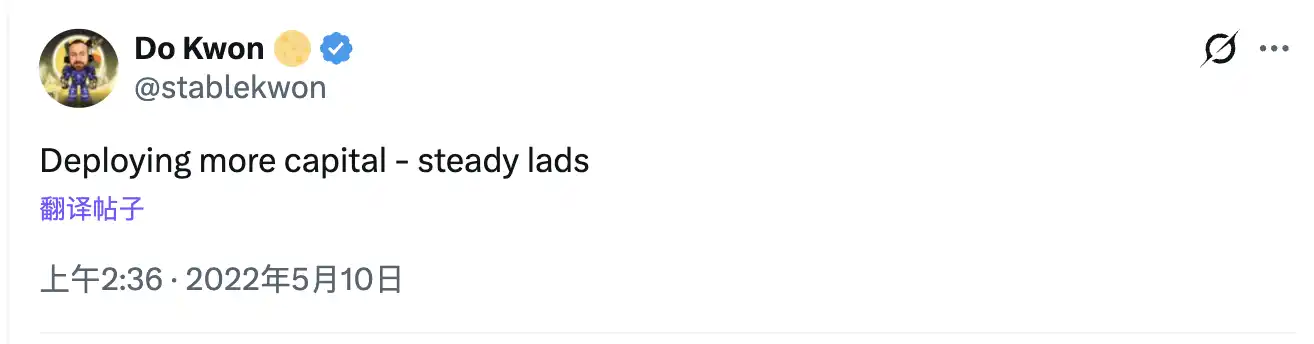
"This was an epic, cross-generational scale fraud. In the history of federal prosecutions, few frauds have caused damage comparable to this," Judge Engelmayer sternly rebuked, noting that Kwon could have chosen to tell the truth but instead chose to deceive investors who entrusted their life savings to him, taking a wrong path. He specifically mentioned the infamous tweet: "Deploying more capital – steady lads."
Ultimately, the judge sentenced Kwon to 15 years in prison.

In addition to the U.S., Kwon still faces fraud charges in South Korea. During the hearing, Kwon stated that he had not seen his family for three years and expressed a desire to serve his sentence in South Korea. U.S. prosecutors indicated that if Kwon complies with the agreement, they would support his application to be transferred to South Korea to serve the remainder of his sentence after completing half of it. In August of this year, Kwon pleaded guilty to two counts of conspiracy to commit fraud and wire fraud, and as part of the plea agreement, he also agreed to forfeit over $19 million in assets and some real estate.

Over a Million Victims, Mysterious Community Influence

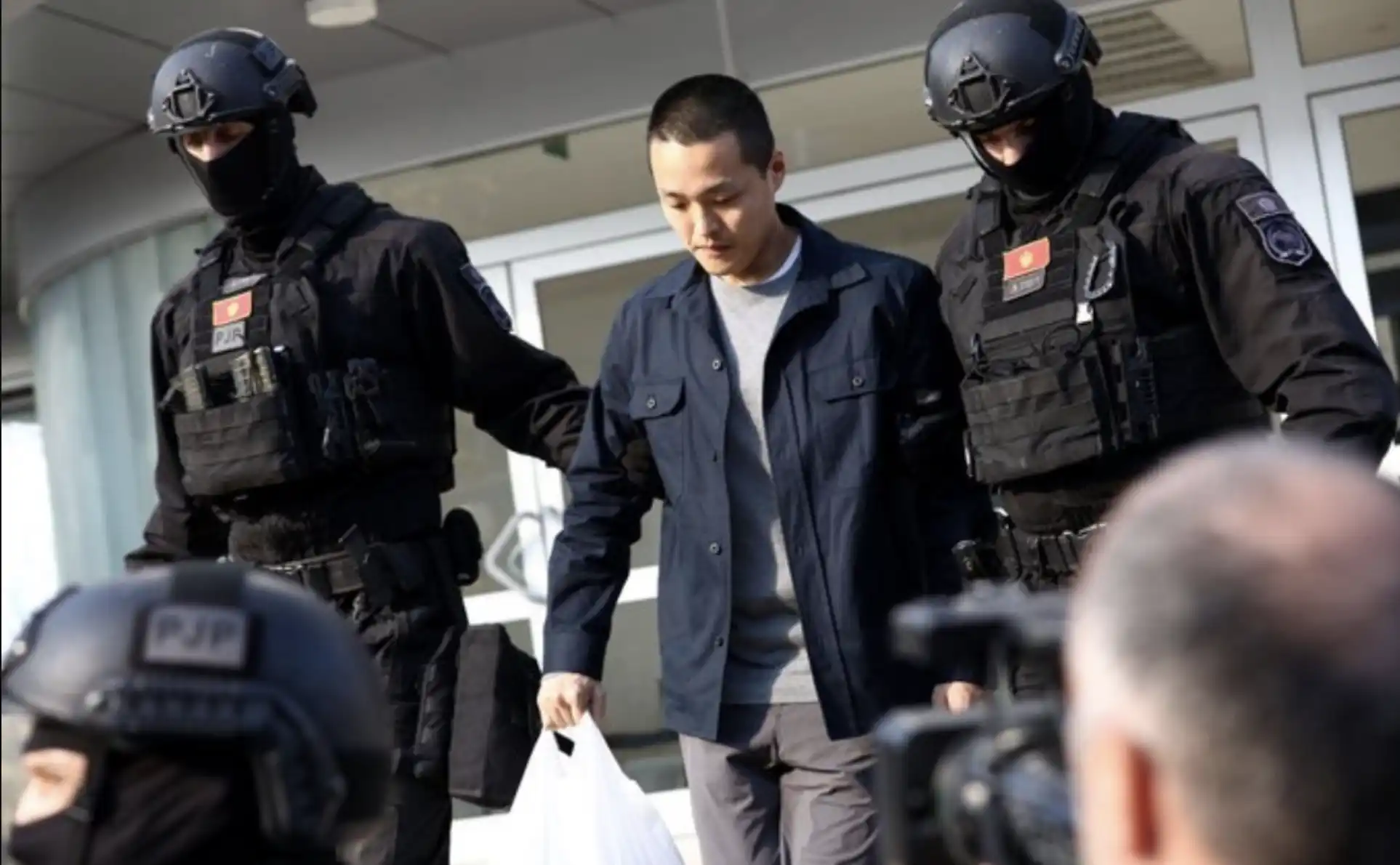
From his arrest at Podgorica Airport in Montenegro in March 2023 to his incarceration in the U.S. in December 2024, this 20-month legal battle finally reached its conclusion in a federal courtroom in New York.

Kwon's arrest once sparked an extradition battle between the U.S. and South Korea. During this period, he reached a settlement with the U.S. SEC for a staggering $4.5 billion, including $3.6 billion in disgorgement of ill-gotten gains. After more than a year of detention and diplomatic maneuvering, Montenegrin authorities finally handed him over to U.S. law enforcement late last year. Facing nine U.S. charges, including securities fraud and wire fraud, Kwon initially pleaded not guilty.

It wasn't until August this year that Kwon admitted to two counts of financial fraud, stating, "I concealed the truth about trading companies intervening to restore the peg, made false statements, and my actions were wrong." Given his guilty plea, although the statutory maximum sentence was 25 years, U.S. prosecutors recommended a sentence of no more than 12 years.
This trial was not only about Kwon's personal fate but also touched the nerves of millions of Terra victims worldwide.

However, a hiccup occurred just before the hearing. Judge Engelmayer expressed dissatisfaction with the inefficiency of the U.S. prosecutors, who did notifiy Terra victims until December 1st. The bankruptcy administrator delayed sending emails until December 8th, leaving victims almost no time to submit statements to the court. Judge Engelmayer believed that while the Terra bankruptcy case involved approximately 16,500 creditors, the number of actual victims could be as high as a million, stating, "You need to do better."

Judge Engelmayer stayed up late reading the 315 hastily submitted victim letters and stated bluntly that Kwon held an almost mystical control over Terra investors; many were like cult followers who had drunk the Kool-Aid and would never wake up.

During the hearing, the victims' accusations provided a more直观的 (intuitive - note: this Chinese word was left in the original text, meaning 'intuitive' or 'direct') sense of the devastating impact of the Terra collapse. Some lost their homes, others lost their retirement savings and their children's education funds, and some even became homeless.

One victim wrote, "All of Do Kwon's communication said everything was under control. Then the depeg happened, and I didn't dare close my eyes for four consecutive days... We were told to trust him, and then he disappeared." Another victim angrily accused, "My trust was weaponized. Do Kwon packaged himself as a visionary, and my hard-earned capital just evaporated." Another person lost $200,000 saved over 17 years overnight and pleaded in a letter, "Your Honor, please hold him accountable."

Kwon, who listened to parts of some letters via telephone, expressed a belated apology to the victims in court. "Their stories are heartbreaking and make me realize once again the enormous loss I caused. I want to tell these victims that I am sorry. For the past few years, almost every waking moment I have spent thinking about what I could have done differently then and what I can do now to make amends." In a letter submitted to the court last month, Kwon also wrote, "Looking back, I cannot understand my own arrogance... I bear the pain of everyone alone. I hope accepting any sentence can bring even a little comfort to those I have failed."

This忏悔 (repentance - note: this Chinese word was left in the original text, meaning 'repentance') contrasted sharply with his former arrogant image. Just hours before the Terra collapse in May 2022, Kwon was still mocking critics on Twitter, even leaving behind the arrogant remark, "I don't debate the poor."
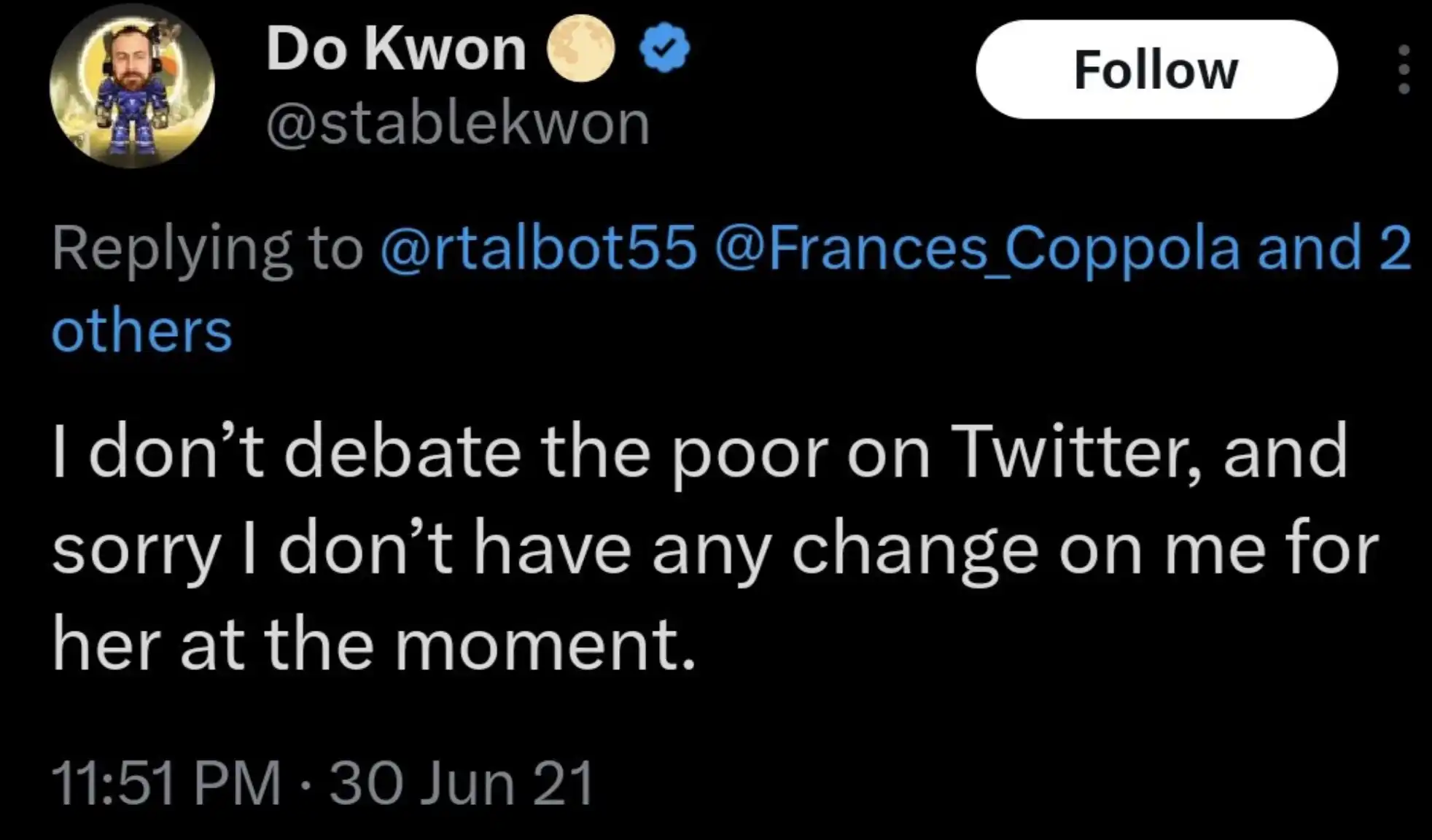
Note: Do Kwon's arrogant response to Frances Coppola's质疑 (doubts - note: this Chinese word was left in the original text, meaning 'doubts' or 'questions') about the algorithmic stablecoin design

An ironic scene also unfolded at the trial. As Kwon, wearing a yellow prison uniform and handcuffs, was escorted into the elevator, there were still many supporters applauding him, with some even shouting, "Hang in there, Do! Hold your head high!"

Related Questions

QWhat was the sentence given to Do Kwon for his role in the Terra collapse?

ADo Kwon was sentenced to 15 years in prison.

QHow much financial damage was caused by the collapse of the Terra ecosystem according to the article?

AThe collapse of the Terra ecosystem caused $40 billion in financial damage.

QWhat was the name of the company founded by Do Kwon that was central to this case?

AThe company was called Terraform Labs.

QWhat specific charges did Do Kwon plead guilty to in August?

AIn August, Do Kwon pleaded guilty to two counts of conspiracy to commit fraud and wire fraud.

QWhat did the judge say about Do Kwon's influence over the Terra investors?

AThe judge stated that Do Kwon had an almost mystical hold over Terra investors, with many described as being in a trance-like state, akin to cult followers who would never wake up.

Related Reads

From Airdrop Myth to King of Derivatives: A Look Back at Hyperliquid's 2025 Conquest

Reviewing crypto's growth in 2025, Hyperliquid stands out. It began the year with an epic airdrop and strong price performance, capturing attention. By year's end, it transformed into a top-four revenue-generating platform in crypto, earning over $650M and at one point capturing 70% of all perp trading volume. Its success was no accident. In Q1, it solidified its reputation by being first to list new assets like the TRUMP perp and launched HyperEVM, a smart contract layer. Q2 saw explosive growth: HYPE token surged 4x from April lows, and HyperEVM's TVL grew from $350M to $1.8B. The platform gained mainstream media coverage. In Q3, major wallets like Phantom and MetaMask integrated via Hyperliquid's builder codes, routing $158B in volume and earning partners nearly $50M. A high-profile stablecoin bid war was won by Native Markets, aligning with Hyperliquid's bootstrapped ethos. However, new competitors like Aster and Lighter emerged with aggressive airdrops. Q4 brought permissionless listings via HIP-3, enabling new markets like stock perps and yield-bearing collateral. Yet, HYPE fell nearly 50% from its September peak due to market conditions, a rare ADL event during a crash, and the start of team token unlocks. As perps go mainstream in 2026, Hyperliquid's true test begins. Its success came from building a superior product and ecosystem without shortcuts. Maintaining leadership will require doing it all over again in a crowded field.

marsbit6m ago

From Airdrop Myth to King of Derivatives: A Look Back at Hyperliquid's 2025 Conquest

marsbit6m ago

ETC Olympia Development Part 1: Implementing ECIP-1111 and ECIP-1112

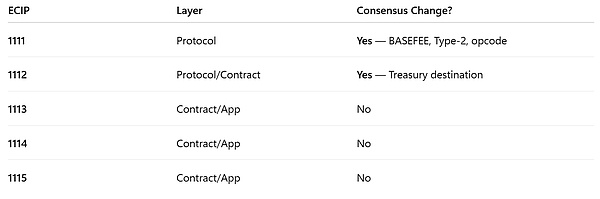
ETC Olympia Development Series Part 1: Implementing ECIP-1111 and ECIP-1112 This article introduces the first part of the Ethereum Classic Olympia development series, focusing on the implementation of ECIP-1111 and ECIP-1112. These two proposals are the only components within the broader Olympia framework that modify consensus behavior. ECIP-1111 modernizes the fee market by introducing an EIP-1559-style mechanism with a base fee and optional priority tip (miner tip). A key difference from Ethereum is that the base fee is not burned but is instead redirected to a treasury address defined by ECIP-1112. It also adds support for Type-2 transactions and the BASEFEE opcode (0x48), ensuring compatibility with modern EVM tooling and wallets. Crucially, it does not change miner rewards, monetary policy, or existing transaction types. ECIP-1112 defines an immutable, deterministic treasury smart contract that will receive the redirected base fees. This vault is designed to be receive-only upon activation, meaning it can accumulate value but cannot distribute funds until a separate, subsequent governance layer (defined in other ECIPs) is deployed and activated on the contract layer. The article emphasizes the modular architecture of Olympia. While the suite includes five ECIPs (1111-1115), only these two affect consensus. This separation ensures that the core protocol remains minimal and auditable, while future governance and funding mechanisms can evolve independently at the contract level without requiring further hard forks. The implementation is currently in the draft stage per the ECIP-1000 process. Any decision to move forward with mainnet activation will require extensive testing on the Mordor testnet and full community review.

金色财经11m ago

ETC Olympia Development Part 1: Implementing ECIP-1111 and ECIP-1112

金色财经11m ago

Market Divergence: SOL Becomes Institutional Darling, Terra Ecosystem Completely Collapses, ZEC Shorts Forced to 'Hold the Bag' by Whales?

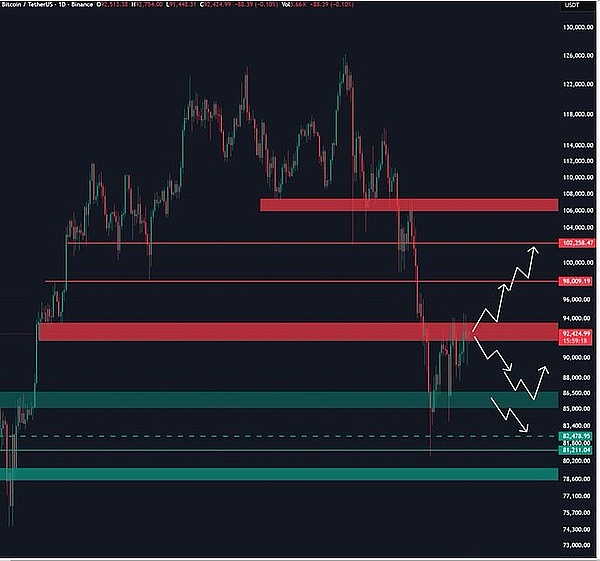
The cryptocurrency market is currently experiencing significant divergence, with some assets surging while others face severe downturns. Bitcoin (BTC) is testing a critical resistance zone between $92,000 and $94,000. A successful breakout could propel it toward $100,000, while failure may lead to a pullback below $90,000. Similarly, Ethereum (ETH) is approaching its key level at $3,400. Holding above this could push it to $3,700-$3,800, otherwise a retest of $3,000 support is likely. Solana (SOL) has emerged as a major institutional favorite. Despite market volatility, SOL ETFs continue seeing consistent inflows. Support from major platforms like Coinbase, which integrated Solana DEX functionality, and growing adoption by traditional finance giants like JPMorgan and Nasdaq, highlight strong fundamental strength. Accumulating SOL gradually is recommended. In contrast, the Terra ecosystem (LUNA, LUNC, USTC) has effectively collapsed. Founder Do Kwon received a 15-year prison sentence, and the project's $40 billion collapse triggered a broader market crisis. These assets are considered uninvestable. Zcash (ZEC) presents a cautionary tale for short sellers. Many are trapped in losing positions as large holders (whales) maintain price range, collecting funding rates systematically. This strategy allows whales to profit from perpetual funding while gradually squeezing shorts. The lesson: take profits quickly when shorting ZEC and avoid greed. Overall strategy: Wait for BTC/ETH to break key levels before acting, accumulate SOL steadily, avoid Terra assets entirely, and short ZEC with extreme caution.

金色财经11m ago

Market Divergence: SOL Becomes Institutional Darling, Terra Ecosystem Completely Collapses, ZEC Shorts Forced to 'Hold the Bag' by Whales?

金色财经11m ago

Trading

Spot
Futures
活动图片