Trading Volume of Crypto Company Preferred Shares Soars to $13 Billion, with Strategy and Alphabet Leading the Breakout of a 'New Financing Tool'

marsbitPublished on 2026-07-15Last updated on 2026-07-15

Abstract

In June 2026, trading activity in crypto company preferred shares surged dramatically, with monthly volume reaching approximately $13 billion when standardized to par value. This acceleration, primarily driven by STRK and a growing number of new preferred share listings, has transformed a niche, custom financing tool once dominated by financial institutions into a broader, more liquid, and increasingly evergreen asset class. Key indicators point to the market's maturation, with improved efficiency in pricing, secondary market depth, and persistent investor demand. Notably, this evolution is extending beyond crypto. In the same month, Alphabet launched its first convertible preferred share offering as part of a funding round exceeding $80 billion for AI infrastructure. Similarly, Super Micro Computer announced a $3.75 billion convertible preferred share issuance within a $7 billion capital raise for AI expansion, highlighting the growing role of preferred shares as a scalable financing tool across industries.

Author: Jeff Park

Compiled by: Shenchao TechFlow

Shenchao Introduction: Preferred shares were once exclusive financing tools for banks and insurance companies. Today, crypto companies like Strategy have transformed them into a highly liquid and sustainably tradable asset class. More critically, this path has evolved from crypto to traditional tech—Alphabet and Super Micro Computer are using it to finance AI infrastructure, with individual deal sizes reaching $80 billion. This is no longer a niche game.

In 2026, trading activity for crypto company preferred shares accelerated sharply, with monthly trading volume standardized at par value reaching approximately $13 billion in June. This surge was primarily driven by STRC and the increasing number of new preferred share listings, transforming a once-customized financing niche dominated by financial institutions (banks and insurance companies) into a broader, more liquid, and increasingly evergreen asset class.

Beyond higher trading volume, a key signal is the maturity of the preferred share market itself. As liquidity deepens, these instruments have become more efficient not only in terms of coupon rates and issuer quality but also in secondary market depth, relative value, and the persistence of investor demand. This evolution is beginning to extend beyond crypto: in June, Alphabet launched its inaugural convertible preferred share issuance as part of an equity financing exceeding $80 billion to fund AI infrastructure; meanwhile, Super Micro Computer announced the issuance of $3.75 billion in convertible preferred shares within a $7 billion capital raise for AI expansion, highlighting the increasingly vital role of preferred shares as a scalable financing tool across industries.
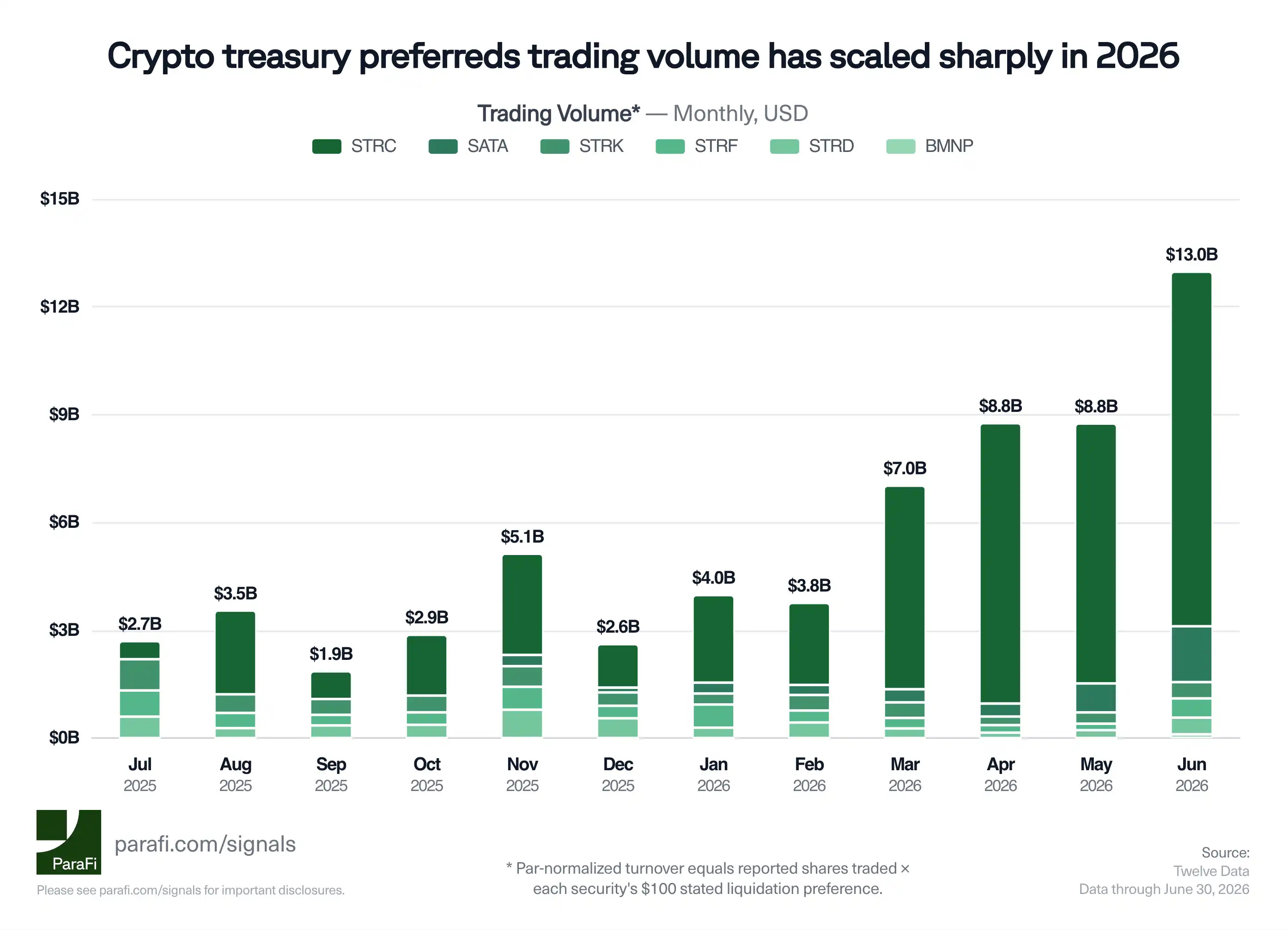
Note: The selected scope includes trading volume for STRK, STRF, STRD, STRC, SATA, and BMNP standardized on a par value basis. Par-value standardized turnover is calculated as reported traded share count multiplied by the $100 per share stated liquidation preference for each security. It does not represent actual dollar trading volume and, viewed alone, cannot establish market liquidity. Source: Twelve Data. Data as of June 30, 2026.

Important Disclosure: ParaFi Signals are for informational purposes only and should not be considered or construed as financial, legal, tax, or investment advice. The information above should not be regarded as a recommendation to buy or sell any particular security.


Related Questions

QAccording to the article, what was the approximate monthly trading volume of crypto enterprise preferred shares (normalized by par value) in June 2026?

AAccording to the article, the monthly trading volume of crypto enterprise preferred shares normalized by par value reached approximately $13 billion in June 2026.

QWhich two companies are highlighted in the article as using preferred shares for AI infrastructure funding?

AThe article highlights Alphabet and Super Micro Computer (SMCI) as using preferred shares for AI infrastructure funding.

QWhat is the primary historical user group of preferred shares as mentioned in the article?

AThe article states that preferred shares were historically a customized financing niche dominated by financial institutions, specifically banks and insurance companies.

QBesides higher trading volume, what key signal indicates the maturity of the preferred share market as described in the article?

AThe key signal of the market's maturity is that these instruments are becoming more efficient not only in terms of coupon rates and issuer quality, but also in secondary market depth, relative value, and the durability of investor demand.

QWhat should the 'Par Value Normalized Turnover' metric mentioned in the note NOT be interpreted as on its own?

AThe 'Par Value Normalized Turnover' metric alone should not be interpreted as establishing market liquidity, as it represents reported traded share numbers multiplied by a $100 liquidation preference per security and does not represent actual dollar trading volume.

Related Reads

Bitcoin Withdrawals Continue: 8 Years of Storage in a Coldcard Cold Wallet Ended in Zero

Coldcard Hardware Wallet Hacked: Losses Mount Due to Vulnerable Seed Generation A critical vulnerability in Coldcard hardware wallets has led to a continued wave of fund thefts. According to Galaxy Research, the total stolen has reached 1,367.05 BTC (approx. $88.6 million) from 4,585 addresses, a significant increase from the initial 594.5 BTC reported on July 30, 2026. Most of the stolen funds remain on the attackers' addresses. The issue is not with the current firmware, which Coinkite has updated, but with seed phrases generated on vulnerable devices between March 2021 and the release of fixed firmware versions. Due to a programmer error, devices switched from using a hardware random number generator to the software-based Yasmarang generator, which was initialized with publicly accessible data like the chip's serial number. This made the seed phrases predictable through offline brute-force attacks, meaning wallets remain at risk until funds are moved to a new wallet generated with the patched firmware. Affected devices include Mk2/Mk3 with firmware 4.0.1–4.1.9 (and up to 5.0.3), Mk4/Mk5 up to version 5.6.0, and Q models up to 1.5.0Q. The only exceptions are seeds created with a high-entropy method like at least 50 independent dice rolls or a strong unique BIP-39 passphrase. All other owners must generate a new seed on the fixed firmware and transfer their assets. A case highlighting the human impact involves a 39-year-old long-term investor who lost 2 BTC (approx. $130,000) in minutes. He had accumulated the Bitcoin over eight years through physical labor, viewing it as a financial lifeline and a retirement plan in a country suffering from hyperinflation. His story underscores that even conservative "buy and hold in cold storage" strategies can be compromised by such underlying technical flaws. From a technical perspective, this incident echoes historical failures where weak random number generators undermined cryptographic security, challenging the assumption that offline storage is automatically foolproof.

cryptonews.ru2h ago

Bitcoin Withdrawals Continue: 8 Years of Storage in a Coldcard Cold Wallet Ended in Zero

cryptonews.ru2h ago

Trading

Spot
活动图片




