
Trading Moment: Gold, Silver, and A-Shares Dance Together, BTC Attacks 98,000 with 94,500 as Base

marsbitPublished on 2026-01-14Last updated on 2026-01-14

Abstract

Financial markets are experiencing significant movements. Despite US core inflation cooling to a four-year low of 2.6%, expectations for a June Fed rate cut remain unchanged. This uncertainty has strengthened the role of precious metals as hedges, with gold hitting a record high above $4,639 and silver surpassing $91 for the first time, its market cap exceeding $5 trillion. Bitcoin broke through key resistance levels, reaching around $96,500 after the CPI data. Analysts are bullish, with targets up to $112,000, though some caution remains near the $98,000 level. Ethereum is attempting to hold above $3,300, with a breakout potentially leading to $4,000. Altcoins like Solana, meme coins (PEPE, WIF, BONK), and privacy coins (XMR, DASH) saw strong gains. However, newly listed tokens on Binance Alpha showed mixed performance. ETF flows were positive, with Bitcoin ETFs seeing $754 million and Ethereum ETFs $130 million in net inflows. Key events to watch include the Fed's "Beige Book" release and various crypto network upgrades.

Daily key market data review and trend analysis, produced by PANews.

1. Market Observation

Although the latest US core inflation data showed signs of cooling, falling to a four-year low of 2.6%, this did not change the market's general expectation for the Federal Reserve to start cutting interest rates in June this year. Fed officials seem to need more evidence of a weakening job market or sustained easing of price pressures before considering adjusting interest rate policy, causing the initial optimism from the inflation data to quickly fade, putting pressure on US stocks and strengthening the US dollar.

Against this backdrop of uncertainty, the role of precious metals as a "hedge against systemic risks" has become increasingly prominent. Spot gold once hit a new historical high intraday, reaching $4639, while silver was even stronger, touching the $91 mark for the first time, with its total market capitalization breaking through $5 trillion, surpassing Nvidia to become the world's second-largest asset. Market analysis believes this round of gains is more of a repricing of the ambiguous monetary policy outlook, deepening fiscal dominance, and geopolitical risks. Many institutions reacted positively, with ANZ predicting gold prices will break through $5000 in the second half of 2026, and Citigroup even raised its three-month target price to $5000 for gold and $100 for silver. Analysts at VanEck even modeled that, under the assumption of a global return to the gold standard, the "true" price of gold would far exceed current levels.

The A-share market experienced its first decline after 17 consecutive days of gains since January 13th, and January 14th was a dramatic day. The morning session continued the upward trend, with the three major indices collectively opening higher, the ChiNext Index once rising over 2%, and the STAR 50 Index surging over 4%. The market showed a broad rally, with over 4700 stocks rising and over a hundred stocks hitting the daily limit up, particularly in sectors like AI applications, semiconductors, and commercial aerospace. However, the situation changed abruptly in the afternoon. A notice from the Shanghai, Shenzhen, and Beijing Stock Exchanges about raising the minimum margin requirement for margin trading from 80% to 100% caused a brief market plunge. The three major indices once collectively turned negative, and the number of rising stocks plummeted. This move aims to reduce market leverage through counter-cyclical adjustments, protecting investors and promoting long-term stability.

Bitcoin broke through multiple key resistance levels such as $92,000 and $94,000 after the CPI data was released, once touching near $96,500. Michaël van de Poppe and Ali Charts both believe the bull market has started; the former pointed out that BTC has effectively stabilized above the 21-day moving average and is expected to attack $100,000 next week, while the latter stated that breaking through the $94,555 resistance level would point directly to a prediction of $105,921. Additionally, Ardi, Sykodelic, and Astronomer unanimously view $94,500 as the lifeline for the bulls. Ardi emphasized that as long as this support holds, it will sweep through the chip distribution area of $96,500-$97,200 and target $100,000. Astronomer further pointed out that the spot discount in the $80,000-$85,000 range has turned into a premium, which is a strong bullish signal, with subsequent targets as high as $112,000 and a new historical high.

Cautious voices are also not to be ignored. Murphy, through on-chain data analysis, pointed out that the market is in a weak balance of "sentiment repair + low selling pressure" but "insufficient demand." $98,000, as the cost line for short-term holders, is the real "bull-bear dividing line," and a strong intervention of US funds is necessary to break through it. Tradermayne believes there is a 70% probability of forming a secondary high; unless it stabilizes above $105,000, there is still a risk of a bear market. CrypNuevo and CJ worry that this is merely a liquidity grab targeting the 1W 50EMA or the inefficient zone around $97,000, and caution is needed against a bull trap and subsequent decline.

Ethereum, after receiving a response in a key support area, is attempting to break through and stabilize above $3300, but multiple attempts over the past two months have been unsuccessful. Analyst Man of Bitcoin pointed out that a successful break above $3300 would confirm the validity of its bullish roadmap. Investors like Jelle and Max noted that with the Russell 2000 index hitting a new high, the market environment is favorable for ETH to play catch-up. If it can stabilize above key support, $4000 will be the next core target. Looking at derivatives data, Ethereum's open interest is recovering while leverage is decreasing. This divergence usually means a healthier market持仓 structure, and spot buying is leading the recovery. Although plagued in the short term by L2分流 (L2分流 likely means分流to L2s or competition from L2s) and decreased DApp activity, Ethereum is expected to see a catch-up rally after Bitcoin stabilizes.

As the broader market warms up, Solana has attracted much attention due to the "cup and handle pattern" formed on its daily chart. Analysts believe its price structure suggests a potential breakthrough towards the target range of $180 to $190. Additionally, the spot SOL ETF continued to record net inflows in 2026, enhancing market bullish confidence. Inscription tokens like ORDI and SATS also gained over 20%. The Meme coin sector made a comeback, with tokens like PEPE, WIF, and BONK seeing significant gains. In the privacy coin sector, Monero (XMR) hit a new historical high breaking $700, leading other similar tokens like DASH to follow with gains of over 30%. Furthermore, the performance of Meme coins listed on Binance Alpha diverged. The "Dark Horse" (literal translation for 黑马) saw its market cap surge to $15 million before falling back to $11.6 million, with gains narrowing to 500%, while "Laozi" (老子) fell instead, with its market cap shrinking to $8 million, down 35% in 24 hours. In contrast, "Binance Life" (币安人生) became the biggest winner, its market cap once rising to $289 million, breaking its historical high. The top on-chain holder has floating profits exceeding $2.63 million, with a return rate of over 15,434.1%. Some analysts believe "Binance Life" could become a sentiment indicator for altcoins on the Binance platform. (*Note: The content is for reference only, not investment advice. Please do your own research.)

2. Key Data (As of January 14, 13:00 HKT)

(Data Source: CoinAnk, Upbit, SoSoValue, CoinMarketCap)

  • Bitcoin: $94,942 (Year-to-date +8.8%), daily spot trading volume $68.7 billion

  • Ethereum: $3,334 (Year-to-date +12.1%), daily spot trading volume $361.1 billion

  • Fear & Greed Index: 48 (Neutral)

  • Average GAS: BTC: 1.75 sat/vB, ETH: 0.02 Gwei

  • Market Dominance: BTC 58.7%, ETH 12.1%

  • Upbit 24-hour trading volume ranking: XRP, BTC, IP, ETH, SOL

  • 24-hour BTC Long/Short Ratio: 51.20% / 48.80%

  • Sector Gains/Losses: Crypto market broadly higher, NFT and GameFi sectors lead gains over 8%

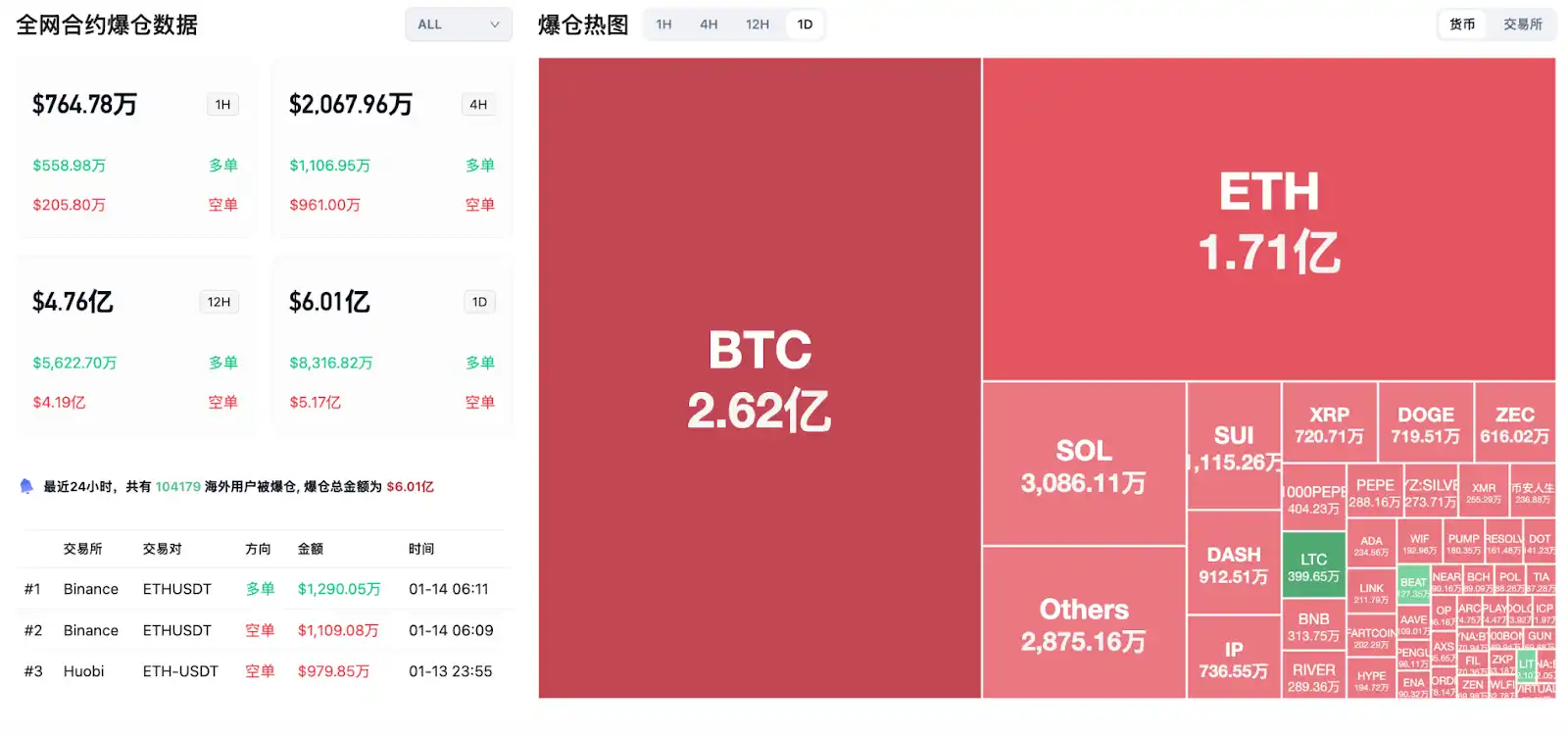
24-hour liquidation data: 104,179 people globally were liquidated, total liquidation amount was $601 million,其中BTC liquidations $262 million, ETH liquidations $171 million, SOL liquidations $30.86 million
3. ETF Flows (As of January 13)

  • Bitcoin ETF: +$754 million, none of the twelve ETFs had net outflows

  • Ethereum ETF: +$130 million, none of the nine ETFs had net outflows

  • XRP ETF: +$12.98 million

  • SOL ETF: +$5.91 million

4. Today's Outlook

  • Tom Lee urges BitMine shareholders to approve the proposal to increase authorized shares from 500 million to 50 billion by January 14th

  • BSC mainnet Fermi hard fork upgrade scheduled for January 14, 2026

  • Binance will list FOGO spot trading on January 15th and mark it with a seed tag

  • MANTRA: All ERC20 versions of OM will be deprecated on January 15th, please migrate as soon as possible

  • Aster: Phase 3 airdrop is open for claiming, will end on January 15, 2026

  • US Supreme Court postpones ruling on Trump tariff case, next ruling on January 14th

  • Federal Reserve releases the Beige Book" on economic conditions (January 15, 03:00)

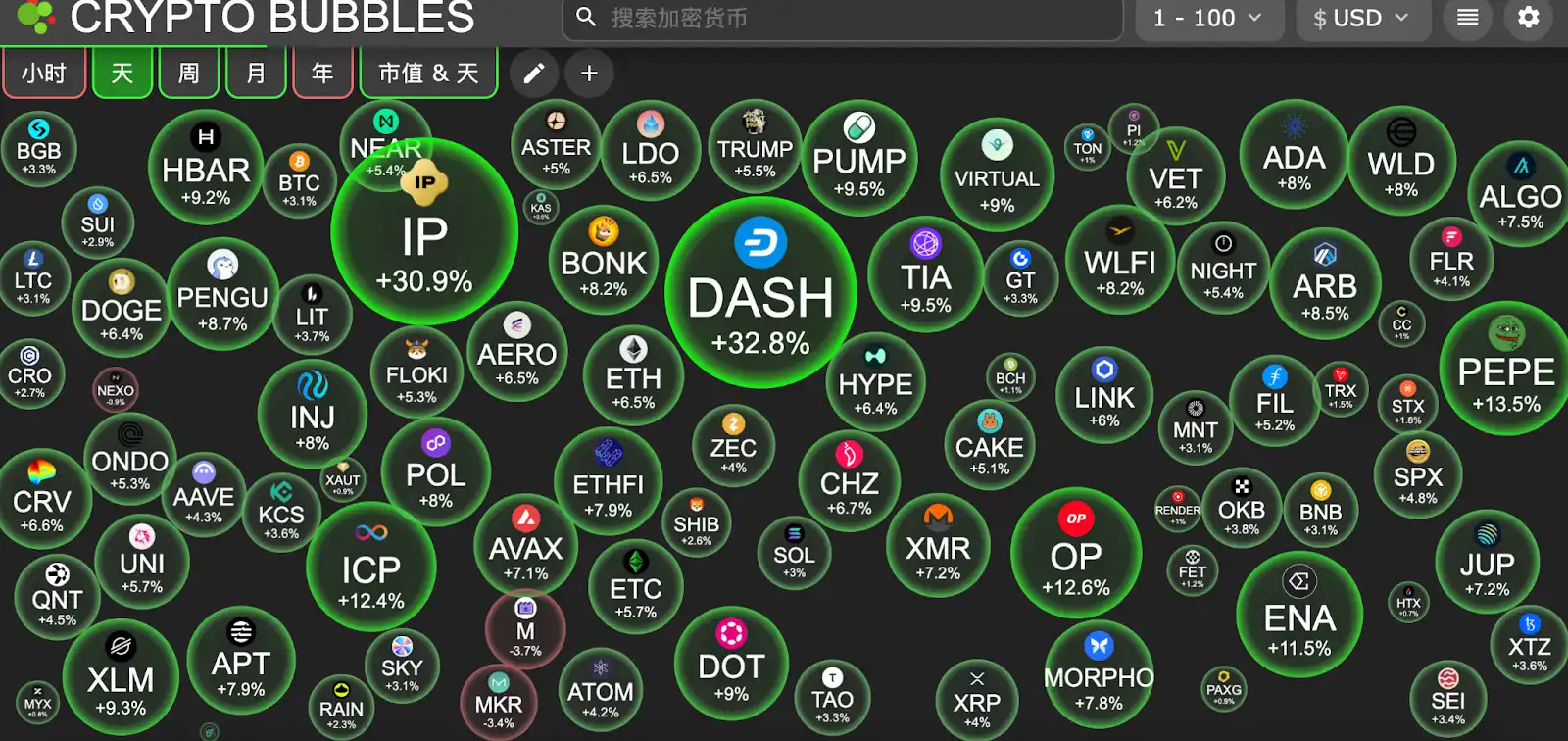
Today's top 100 coins by market cap, maximum gains: Dash up 32.7%, Story up 30.7%, Pepe up 13.5%, Optimism up 12.7%, Internet Computer up 12.3%.
5. Hot News

  • Corporate crypto holdings net increased by approximately 260,000 BTC in the past 6 months, three times the Bitcoin mining output during the same period

  • OpenSea Foundation is preparing for TGE, will consider historical trading volume and Treasures data

  • The top address for "Binance Life" has floating profits exceeding $2.63 million, with a return rate over 154,341.1%

  • DN token fell over 80% in 24 hours, DeepNode responded saying "working with market makers to resolve liquidity issues"

  • Spot silver approaches the $90 mark, hitting a new high again

  • Bitmine stakes another 94,400 ETH, worth $314 million

  • Zama will initiate token sales through CoinList and its own auction APP, FDV floor price is $55 million

  • SharpLink's staking收益 (staking收益 means staking rewards/yield) last week reached 500 ETH, cumulative收益 (收益 means rewards/yield)突破 (突破 means broke through) 11,000 ETH

  • Spot gold stands above $4620/oz, spot silver up over 3.00% intraday

  • US December unadjusted CPI year-on-year 2.7%, core CPI year-on-year 2.6%

  • "On-chain part-time stock investor" turns short on-chain gold, holdings reach $13 million

Related Questions

QWhat is the key support level for Bitcoin's upward movement according to multiple analysts mentioned in the article?

AThe key support level for Bitcoin's upward movement is $94,500, which is considered the lifeline for the bulls.

QWhat was the main reason for the temporary plunge in the A-share market on the afternoon of January 14th?

AThe temporary plunge was triggered by a notice from the Shanghai, Shenzhen, and Beijing Stock Exchanges announcing an increase in the minimum margin financing ratio from 80% to 100%.

QWhich precious metal reached a historic high with its total market capitalization surpassing $5 trillion, according to the article?

ASilver reached a historic high, surpassing the $90 mark, with its total market capitalization exceeding $5 trillion.

QWhat is the next core target price for Ethereum if it successfully breaks through and stabilizes above $3,300?

AThe next core target price for Ethereum is $4,000 if it successfully breaks through and stabilizes above $3,300.

QWhat was the overall net flow for Bitcoin ETFs as of January 13th?

AThe overall flow for Bitcoin ETFs was a net inflow of $754 million as of January 13th, with none of the twelve ETFs experiencing a net outflow.

Related Reads

Google TPU Shipments Revised Up by 50%

Recent industry research indicates a significant upward revision in the shipments of Google's TPU (Tensor Processing Unit) chips. Previous expectations for 2027 were set at around 10 million units, but new estimates now point to 15 million units, a 50% increase. This substantial boost directly translates to higher demand across the entire supporting supply chain. Google's TPU clusters utilize a standardized all-optical interconnect architecture. Consequently, key hardware components are deeply integrated and scaled in fixed ratios with the chips. The 15 million TPU target will drive corresponding demand increases for NPO optical engines (roughly a 1:1 match), 1.6T optical modules, OCS optical switches, high-end server power supplies, fiber optics & MPO connectors, and liquid cooling solutions. Among these, liquid cooling is highlighted as the sector experiencing the most significant transformation and offering the most stable potential for excess returns. As next-generation TPU chips reach power levels where traditional air cooling is insufficient, liquid cooling becomes essential. 2026 is forecasted as the first year of substantial adoption for Google's liquid cooling solutions. This shift, coupled with delivery and capacity bottlenecks faced by incumbent overseas manufacturers, is creating a prime window for domestic Chinese suppliers to enter and secure Google's core supply chain. The market size for Google-specific liquid cooling is projected to potentially triple from a baseline of hundreds of billions to around 300 billion units by 2028. The logic for the fiber optic sector is also being rewritten. Once considered a cyclical commodity tied to telecom operator procurement, fiber is now a strategic and scarce resource for AI Data Centers (AIDC). A severe supply-demand imbalance, driven by the long lead time for preform production (18-24 months) and surging demand from cloud giants, is supporting strong performance. Chinese fiber manufacturers are well-positioned to capture a significant share of global AIDC demand, with exports potentially reaching 200-300 million core kilometers in 2026. Overall, the investment focus within the AI computing industry is shifting from pure "chip performance speculation" towards the more certain incremental growth in computing infrastructure and its supporting ecosystem. The upward revision in Google TPU shipments, along with the potential for further doubling by 2028, is seen as solidifying performance visibility for the entire supporting supply chain over the next two years.

marsbit31m ago

Google TPU Shipments Revised Up by 50%

marsbit31m ago

What Wall Street Really Wants After the Crypto Story Recedes

The tide of speculative crypto narratives has receded, revealing Wall Street's true objective: building a controlled, yield-generating, and compliant financial pipeline on distributed ledgers. They are migrating core functions onto blockchains, not for decentralization, but for efficiency and new revenue streams. Key developments include BlackRock's BUIDL fund, a tokenized treasury fund acting as a foundational reserve asset, and the rise of Securitize, which is going public and partnering with the NYSE to build a 24/7 digital securities trading and settlement system. This signals a major shift of securities clearing to blockchain technology. To make volatile assets like Bitcoin palatable for institutional investors, firms like BlackRock and Goldman Sachs are creating "covered call" ETFs (e.g., BITA). These products systematically sell options on Bitcoin holdings, transforming price volatility into stable monthly income, effectively repackaging crypto as a yield-bearing asset. Stablecoins are being positioned not as speculative tools but as efficient payment rails. Companies like Stripe and Mastercard are integrating them for instant, low-cost merchant settlements and cross-border card payments, respectively. Critically, new legislation like the GENIUS Act shapes them as non-interest-bearing, heavily regulated extensions of the US dollar system. In summary, Wall Street is quietly constructing a parallel, blockchain-based financial infrastructure featuring tokenized traditional assets, structured crypto yields, and programmable dollar pipelines—all under its control and fully integrated with existing regulatory and credit frameworks.

marsbit48m ago

What Wall Street Really Wants After the Crypto Story Recedes

marsbit48m ago

Tying Itself to SpaceX: Cursor's $60 Billion Rise

This article recounts the rapid rise of AI-powered coding startup Cursor and its 25-year-old MIT graduate CEO, Michael Truell. Launched in 2023, Cursor achieved explosive growth, reaching over 10 billion USD in revenue by late 2025. However, its journey highlights a central dilemma for AI application companies: dependence on foundational model providers. Cursor initially relied heavily on Anthropic's models but faced an existential threat when Anthropic launched its own competing coding tool, Claude Code. In response, Cursor declared an internal emergency in early 2026 and accelerated development of its own model, Composer. To secure the immense computing power needed, Truell struck a pivotal deal with Elon Musk's SpaceX in April 2026. The collaboration grants Cursor access to SpaceX's supercomputing resources for Composer, while SpaceX's Grok model benefits from Cursor's programming data. The agreement includes a potential 600 billion USD acquisition of Cursor by SpaceX later in the year, though a substantial termination fee is in place if the deal falls through. The story explores Cursor's intense, sometimes controversial hiring practices involving lengthy unpaid "work trials," its complex partnership-turned-rivalry with Anthropic, and its high-stakes gamble to ensure independence through the SpaceX alliance. The core question remains: will Cursor evolve into a defining, independent "generational" software company, or become a key piece in a tech giant's AI arsenal?

marsbit52m ago

Tying Itself to SpaceX: Cursor's $60 Billion Rise

marsbit52m ago

Warsh's Debut: Will the FED Chair Who Knows Crypto Best Bring Surprises or Shocks to the Market?

Kevin Warsh, the new Federal Reserve Chairman, prepares for his inaugural press conference amidst a challenging macroeconomic landscape: resurgent inflation, a bond market sell-off, and political pressure from President Trump for rate cuts. Uniquely, Warsh holds indirect investments in over 20 crypto and Web3 entities (e.g., Solana, dYdX), making him the first Fed Chair with disclosed crypto exposure. His stance may combine a hawkish, inflation-focused monetary policy with a crypto-friendly regulatory philosophy that shifts from Powell’s “same risk, same rule” approach toward a framework acknowledging blockchain’s productivity value. Warsh’s leadership could impact crypto markets across three dimensions: a paradigm shift in regulation (potentially accelerating pro-innovation legislation and stable币 rules), a re-pricing of risk premiums based on clearer communication and his view of AI as a structural disinflationary force, and a long-term reallocation of global institutional capital driven by increased legitimacy. Two potential scenarios for the press conference are outlined. A “positive surprise” would involve a dovish-leaning tone on rates coupled with signals of regulatory openness, potentially boosting crypto asset valuations. Conversely, a “negative shock” would see a more hawkish-than-expected stance on inflation and rates, triggering a broad risk-asset selloff that crypto markets would not escape. While ethics rules required Warsh to divest his crypto holdings upon confirmation, his deep understanding of the technology may fundamentally lower policy uncertainty and build a more receptive long-term foundation for digital assets’ integration into the mainstream financial system.

marsbit11h ago

Warsh's Debut: Will the FED Chair Who Knows Crypto Best Bring Surprises or Shocks to the Market?

marsbit11h ago

Trading

Spot
Futures

Hot Articles

What is $BITCOIN

DIGITAL GOLD ($BITCOIN): A Comprehensive Analysis Introduction to DIGITAL GOLD ($BITCOIN) DIGITAL GOLD ($BITCOIN) is a blockchain-based project operating on the Solana network, which aims to combine the characteristics of traditional precious metals with the innovation of decentralized technologies. While it shares a name with Bitcoin, often referred to as “digital gold” due to its perception as a store of value, DIGITAL GOLD is a separate token designed to create a unique ecosystem within the Web3 landscape. Its goal is to position itself as a viable alternative digital asset, although specifics regarding its applications and functionalities are still developing. What is DIGITAL GOLD ($BITCOIN)? DIGITAL GOLD ($BITCOIN) is a cryptocurrency token explicitly designed for use on the Solana blockchain. In contrast to Bitcoin, which provides a widely recognized value storage role, this token appears to focus on broader applications and characteristics. Notable aspects include: Blockchain Infrastructure: The token is built on the Solana blockchain, known for its capacity to handle high-speed and low-cost transactions. Supply Dynamics: DIGITAL GOLD has a maximum supply capped at 100 quadrillion tokens (100P $BITCOIN), although details regarding its circulating supply are currently undisclosed. Utility: While precise functionalities are not explicitly outlined, there are indications that the token could be utilized for various applications, potentially involving decentralized applications (dApps) or asset tokenization strategies. Who is the Creator of DIGITAL GOLD ($BITCOIN)? At present, the identity of the creators and development team behind DIGITAL GOLD ($BITCOIN) remains unknown. This situation is typical among many innovative projects within the blockchain space, particularly those aligning with decentralized finance and meme coin phenomena. While such anonymity may foster a community-driven culture, it intensifies concerns about governance and accountability. Who are the Investors of DIGITAL GOLD ($BITCOIN)? The available information indicates that DIGITAL GOLD ($BITCOIN) does not have any known institutional backers or prominent venture capital investments. The project seems to operate on a peer-to-peer model focused on community support and adoption rather than traditional funding routes. Its activity and liquidity are primarily situated on decentralized exchanges (DEXs), such as PumpSwap, rather than established centralized trading platforms, further highlighting its grassroots approach. How DIGITAL GOLD ($BITCOIN) Works The operational mechanics of DIGITAL GOLD ($BITCOIN) can be elaborated on based on its blockchain design and network attributes: Consensus Mechanism: By leveraging Solana’s unique proof-of-history (PoH) combined with a proof-of-stake (PoS) model, the project ensures efficient transaction validation contributing to the network's high performance. Tokenomics: While specific deflationary mechanisms have not been extensively detailed, the vast maximum token supply implies that it may cater to microtransactions or niche use cases that are still to be defined. Interoperability: There exists the potential for integration with Solana’s broader ecosystem, including various decentralized finance (DeFi) platforms. However, the details regarding specific integrations remain unspecified. Timeline of Key Events Here is a timeline that highlights significant milestones concerning DIGITAL GOLD ($BITCOIN): 2023: The initial deployment of the token occurs on the Solana blockchain, marked by its contract address. 2024: DIGITAL GOLD gains visibility as it becomes available for trading on decentralized exchanges like PumpSwap, allowing users to trade it against SOL. 2025: The project witnesses sporadic trading activity and potential interest in community-led engagements, although no noteworthy partnerships or technical advancements have been documented as of yet. Critical Analysis Strengths Scalability: The underlying Solana infrastructure supports high transaction volumes, which could enhance the utility of $BITCOIN in various transaction scenarios. Accessibility: The potential low trading price per token could attract retail investors, facilitating wider participation due to fractional ownership opportunities. Risks Lack of Transparency: The absence of publicly known backers, developers, or an audit process may yield skepticism regarding the project's sustainability and trustworthiness. Market Volatility: The trading activity is heavily reliant on speculative behavior, which can result in significant price volatility and uncertainty for investors. Conclusion DIGITAL GOLD ($BITCOIN) emerges as an intriguing yet ambiguous project within the rapidly evolving Solana ecosystem. While it attempts to leverage the “digital gold” narrative, its departure from Bitcoin's established role as a store of value underscores the need for a clearer differentiation of its intended utility and governance structure. Future acceptance and adoption will likely depend on addressing the current opacity and defining its operational and economic strategies more explicitly. Note: This report encompasses synthesised information available as of October 2023, and developments may have transpired beyond the research period.

376 Total ViewsPublished 2025.05.13Updated 2025.05.13

What is $BITCOIN

Discussions

Welcome to the HTX Community. Here, you can stay informed about the latest platform developments and gain access to professional market insights. Users' opinions on the price of BTC (BTC) are presented below.

活动图片