TradeXYZ and Hyperliquid: Unveiling the Symbiotic Relationship Under a 50% Revenue Share

marsbitPublished on 2026-08-05Last updated on 2026-08-05

Abstract

Market sentiment is cautious. AI investments are rewarded only when they drive growth without severely harming cash flow, while crypto markets face pressure from ETF outflows and rising yields. Within crypto, leadership has rotated to Solana and DEXs. Solana's ecosystem gained 8.5%, driven by tokens like META, while DEXs, led by Uniswap, rose 5.2%. A key debate centers on TradeXYZ's dominant role on the Hyperliquid exchange, where it generates over 50% of the volume in RWA perpetuals. TradeXYZ, an independent team, is required to share 50% of its HIP-3 protocol revenue with Hyperliquid. Concerns range from the sustainability of this split to Hyperliquid's long-term monetization. The argument that TradeXYZ might leave due to the 50% share is considered weak, as it would require rebuilding its entire platform and abandoning its user base, damaging its reputation. Conversely, Hyperliquid replacing TradeXYZ would signal bad faith to other builders. Their relationship is seen as symbiotic. Regarding monetization, Hyperliquid benefits not only from the 50% fee split but also from priority write fees, read fees from market makers, and second-order effects like increased USDC supply, which generates significant adjusted revenue. The more pertinent question is how both parties will transition from a growth-focused, low-fee model to a more stable, higher-fee structure.

The market is growing increasingly cautious. AI-related spending is only rewarded if it drives growth without severely eroding cash flow; meanwhile, the crypto market continues to face pressure from ETF outflows and rising yields.

Within crypto, leadership has rotated once again to Solana and DEXs. We delve into the ongoing discussion surrounding TradeXYZ, Hyperliquid, and how the value from HIP-3 is ultimately distributed.

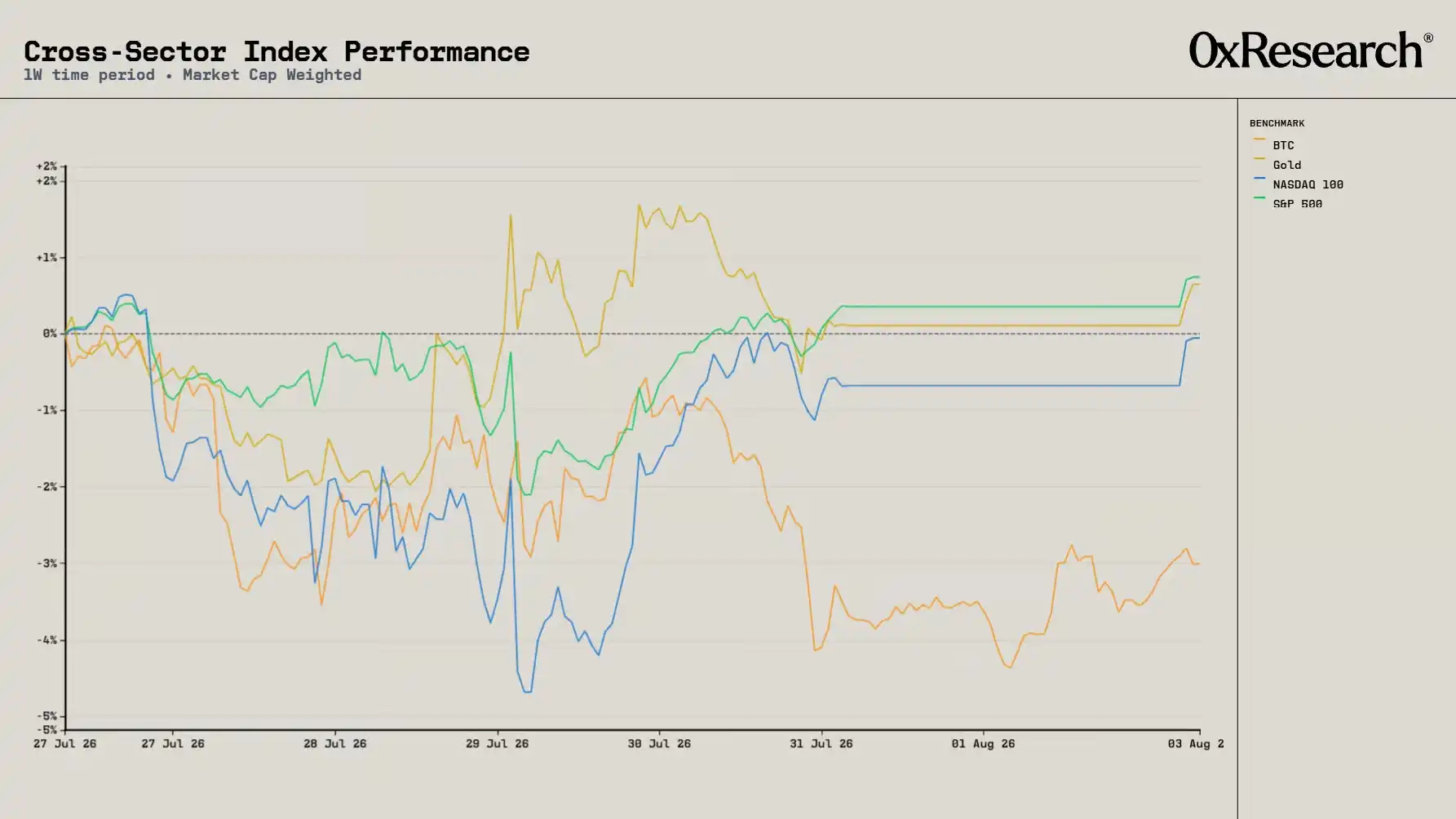
Major benchmarks diverged over the past week. The S&P 500 and gold rose modestly by 0.74% and 0.65% respectively, while the Nasdaq was largely flat. BTC was the weakest performer, declining 3.0% for the week.
AI giants released a dense batch of earnings reports last week. Amazon surged over 15%, recording its strongest quarterly revenue growth in over four years, with AWS revenue growing 37% year-over-year to $42.2 billion. Microsoft also rose over 15%, with cloud business growth exceeding expectations and capital expenditure guidance coming in below Wall Street estimates. In contrast, Meta fell 10%, with Q2 free cash flow plummeting 91%, as AI-related capital expenditures weighed on profitability. A theme this earnings season is becoming clearer: the market is no longer simply rewarding AI investment, but rather rewarding companies that can demonstrate return on investment without sacrificing cash flow.

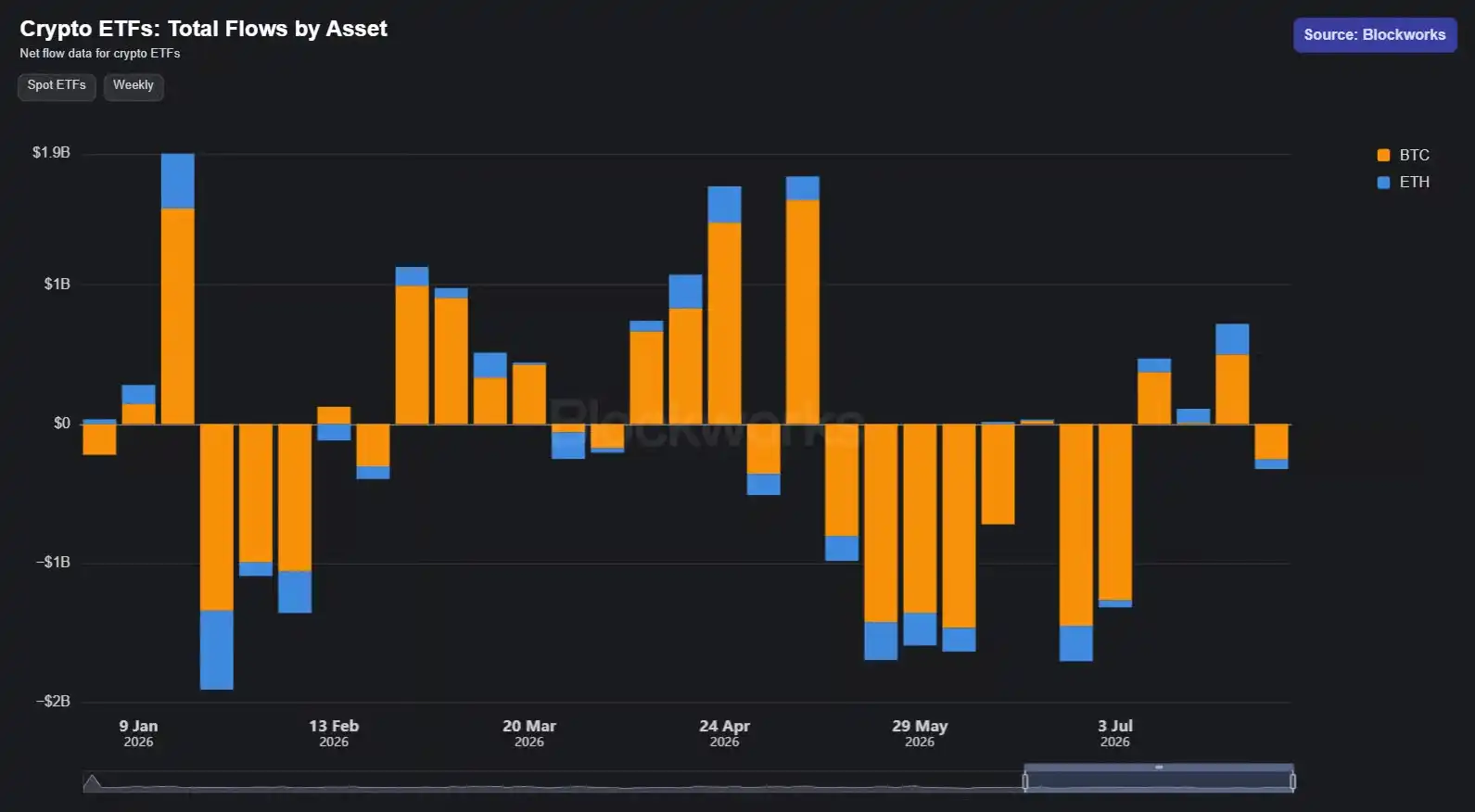
The crypto market remains under pressure. ETF flows turned net negative again, with BTC and ETH ETFs seeing net outflows of $255 million and $69 million respectively. Risk sentiment was also dampened by the bond market, with the US 30-year Treasury yield rising to 5.23%, its highest level since June 2007.
Leadership within crypto rotated once more. The Solana ecosystem performed best this week, rising 8.5%; the Ethereum ecosystem, after several strong weeks following the Robinhood Chain launch, fell 8.8%. The DEX sector came in second, rising 5.2%.

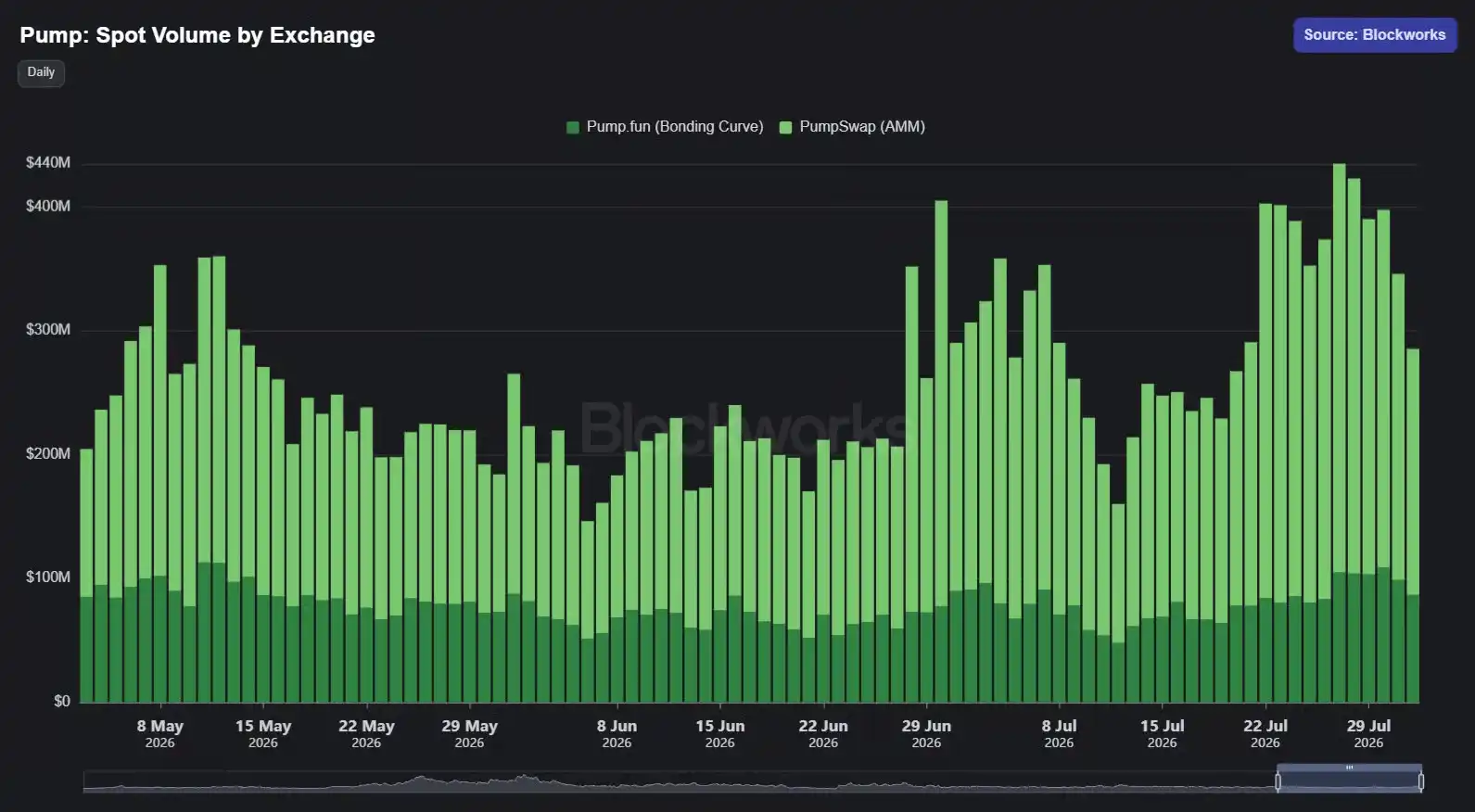
The Solana ecosystem was primarily driven by META, which surged 36% following its listing on Upbit; PUMP rose 3%, accounting for about one-third of the index's weight. More importantly, Pump.fun's trading volume and revenue continue to recover from their June lows, showing initial signs that "trench" activity may be returning.
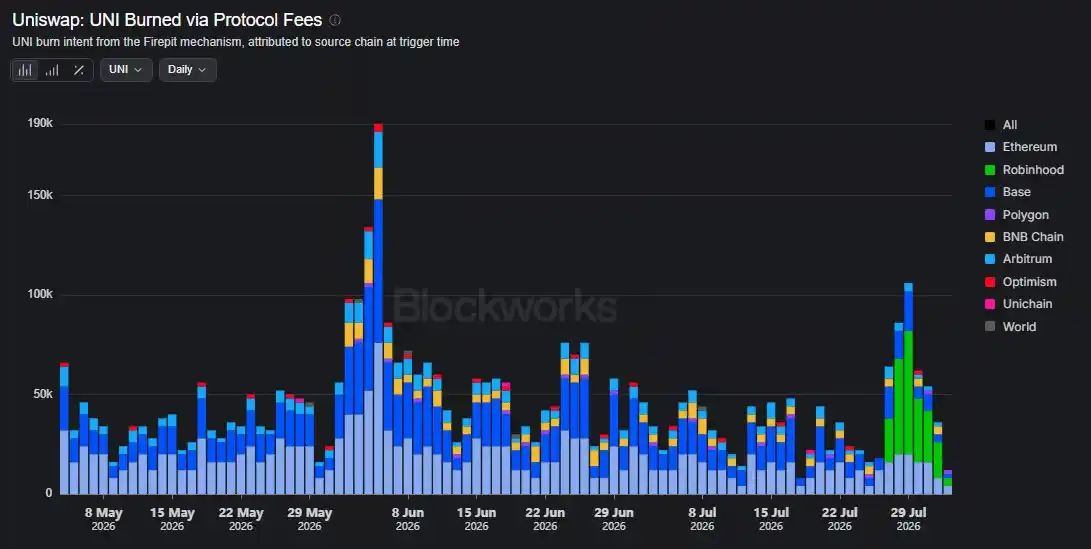
The DEX sector was led by Uniswap, which rose 6.5% for the week. UNI benefited from the fee switch expansion to Robinhood Chain, and the commencement of protocol fees for some v4 deployments.
Many interesting on-chain innovations recently (including the FWA we covered last week) are being built via Uniswap v4 hooks. Uniswap and its broader ecosystem are definitely worth watching.

The TradeXYZ Debate

As TradeXYZ continues to dominate crypto trading volume, with RWAs accounting for over 50% of Hyperliquid's trading volume, discussions about its alignment of interests and its high concentration on Hyperliquid have intensified. Concerns range from reasonable (how Hyperliquid monetizes HIP-3 in the long run) to rather far-fetched (TradeXYZ will leave Hyperliquid), so it's necessary to clarify the current relationship.

Let's be clear first: TradeXYZ is an independent team building on Hyperliquid. It is programmatically required to allocate 50% of its HIP-3 revenue to Hyperliquid, with the remaining half at its discretion. We've found that TradeXYZ (the same team as Unit) has consistently used, and continues to use, its HIP-1 spot revenue to buy back HYPE, but the HIP-3 revenue has not been used in the same way.
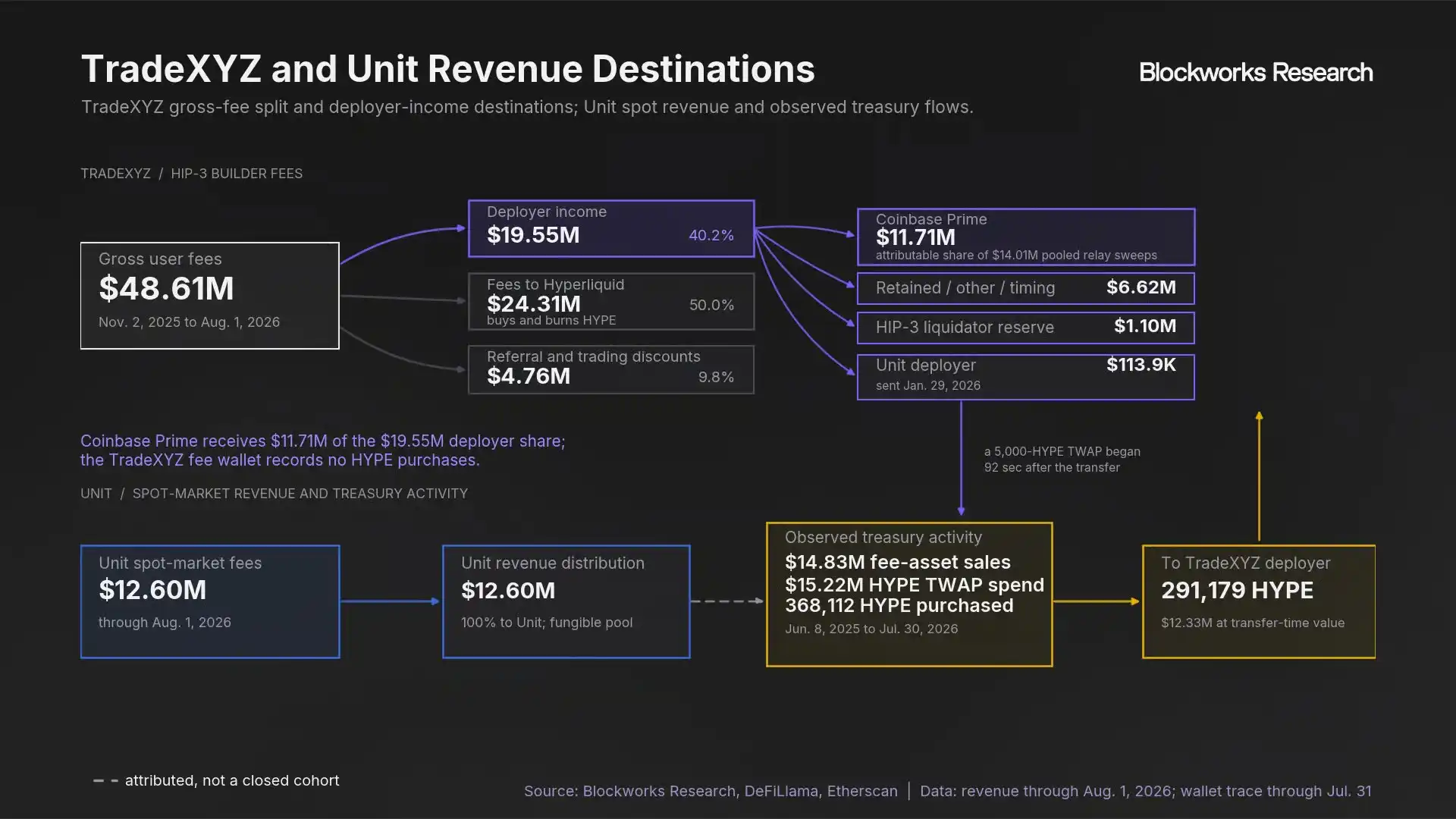
The first concern, and in our view the weakest, is that TradeXYZ might leave Hyperliquid because the 50% share is too high and it could capture more value on its own. As early as April, I argued the exact opposite: that Hyperliquid was outsourcing too much of the value from its largest market to its deployers. Look at what each side provides. Hyperliquid provides the infrastructure layer, collateral, and most importantly, the user base that underpins the vast majority of TradeXYZ's trading volume. To leave, TradeXYZ would need to rebuild the exchange layer (the hardest part of the entire tech stack), abandon almost its entire trader base, and commit reputational suicide in the process. For Hyperliquid, bringing RWA in-house would be equally suicidal for its reputation: weakening its dominant deployer that underpins so much of its success would send a signal to all future HIP-3 deployers and all builders on Hyperliquid—any team successful enough will be replaced. This is one of the most classic symbiotic relationships in crypto, and neither side has a reason to leave the other, from a reputational, economic, or architectural standpoint.

The second concern is about monetization, which holds more water but requires a closer look. First, it's dishonest to ignore TradeXYZ's execution; Hyperliquid's RWA markets could not have reached their current scale without it. Owning 100% of a much smaller pool is worth less than half of the current pool. Second, the 50% fee share is not Hyperliquid's only monetization avenue: it also profits from write priority fees and read fees paid by market makers.

It also benefits from second-order effects, such as increased USDC supply—the cost-adjusted revenue from on-chain balances, of which Hyperliquid retains 90%. Open interest is a proxy: since the launch of HIP-3, its open interest has grown by $3.68 billion, while USDC supply growth over the past year is $1.38 billion, and crypto open interest declined towards year-end. As more traders bring in USDC to go long on RWAs, the revenue from that supply also accrues to Hyperliquid. That revenue is estimated at around $30 million per month, already surpassing the entire HIP-3 perpetual fee pool that Hyperliquid splits evenly with TradeXYZ.

For us, the most interesting question is not the 50/50 split between TradeXYZ and Hyperliquid, but rather how both parties move out of growth mode and ultimately shift from low fees to a more stable, higher fee base.


Related Questions

QAccording to the article, what is the current financial relationship between TradeXYZ and Hyperliquid regarding HIP-3 revenue?

AThe article states that TradeXYZ is required to give 50% of its HIP-3 revenue to Hyperliquid. The remaining 50% is for TradeXYZ to keep and use at its discretion.

QWhat are the main reasons given in the article for why a split between TradeXYZ and Hyperliquid is considered highly unlikely?

AThe article presents three main reasons: 1) Reputation suicide for TradeXYZ, as leaving would mean abandoning its user base. 2) TradeXYZ would need to rebuild the complex trading platform infrastructure from scratch. 3) Reputation suicide for Hyperliquid, as absorbing RWA internally would signal to all builders that successful projects will be replaced, damaging trust in the ecosystem. The relationship is described as symbiotic.

QBesides the 50% fee split from TradeXYZ, what are other ways Hyperliquid monetizes from the success of the RWA market?

AHyperliquid also monetizes through: 1) Write priority fees. 2) Fees paid by market makers for reading data. 3) Second-order effects like increased USDC supply, where Hyperliquid retains 90% of the cost-adjusted revenue from on-chain balances. The article estimates this USDC-related revenue alone is about $30M per month.

QWhat key theme emerged from the recent earnings reports of AI giants like Amazon, Microsoft, and Meta, according to the article?

AThe market is no longer simply rewarding AI investment. It is rewarding companies that can demonstrate a return on that AI investment (growth) while not severely sacrificing cash flow in the process.

QWhich crypto sectors showed the strongest leadership in the week discussed, and what were the key drivers mentioned?

AThe Solana ecosystem performed best, rising 8.5%, largely driven by META token's 36% surge after listing on Upbit. The DEX sector was second, rising 5.2%, led by Uniswap (UNI) which gained 6.5% due to fee switch expansion to Robinhood Chain and initial v4 protocol fee deployments.

Related Reads

Stunning, Musk Joins Forces with Huang Jen-hsun to Deploy the Stellar Brain! AI Computing Center Launched into Space

SpaceX, in its first public earnings report, has announced a partnership with NVIDIA to launch Starmind, an orbital AI computing network. This initiative aims to move AI's computational foundation into space to solve the critical challenges of energy consumption and heat dissipation faced by terrestrial data centers. The core concept involves deploying data centers equipped with NVIDIA's advanced GPUs (like the upcoming Rubin) into sun-synchronous orbit. Key advantages include near-continuous solar power for energy, the vacuum of space for highly efficient radiative cooling, and the absence of terrestrial constraints like land use and grid capacity. The first computational node, the Starmind AI1 satellite, is described as a massive vehicle with a 75-meter wingspan, generating 210 kW of solar power to run a 150 kW computing payload—equivalent to a full NVIDIA GB300 supercomputer rack. These "compute satellites" will connect to users via SpaceX's existing Starlink constellation using high-speed laser links, promising low-latency access from anywhere on Earth. SpaceX's ability to realize this vision is underpinned by its Starship rocket, designed for low-cost, high-frequency launches to transport thousands of satellites, and massive planned manufacturing facilities like the Gigasat factory and the Terafab chip plant. Elon Musk framed the project within the context of the Kardashev Scale, proposing Starmind as humanity's first substantive step toward becoming a Type II civilization capable of harnessing a star's energy. The ultimate goal is to deploy one terawatt of computational power in space, with even more ambitious plans involving lunar-based manufacturing and launch systems. The report positions Starmind not merely as a commercial AI service, but as a foundational infrastructure project to expand human intelligence and capability beyond Earth, leveraging SpaceX's integrated strengths in rockets, satellites, and global connectivity.

marsbit4m ago

Stunning, Musk Joins Forces with Huang Jen-hsun to Deploy the Stellar Brain! AI Computing Center Launched into Space

marsbit4m ago

Despite the sell-off, Goldman Sachs remains bullish on Samsung and SK Hynix. Here's why.

Goldman Sachs maintains "Buy" ratings on Samsung Electronics and SK Hynix despite recent stock declines. Its bullish view centers on three core arguments. Firstly, it expects HBM (High Bandwidth Memory) pricing to re-establish a premium over conventional DRAM by 2027, with a projected blended ASP of around $2.9/Gb. This is driven by tight supply-demand dynamics, increasing manufacturing complexity for newer HBM generations, and the need to restore its historical price premium. Secondly, the volatility of the memory cycle is expected to moderate due to widespread adoption of 3-5 year Long-Term Agreements (LTAs) with key customers. These contracts, covering a significant portion of planned capacity, feature mechanisms like price floors, prepayments, and penalties, reducing supplier risk and improving earnings visibility. Thirdly, inventory levels remain low at key suppliers and major customers, providing a buffer against a sharp downturn. Furthermore, robust demand from enterprise SSDs for AI servers is seen offsetting weakness in consumer segments like smartphones and PCs, preventing NAND markets from slipping into oversupply in the near term. While risks exist—such as potential weaker AI demand or aggressive capacity expansion—Goldman Sachs believes the combination of HBM repricing, LTAs, and low inventory underpins a more stable earnings outlook for the leading Korean memory makers.

marsbit19m ago

Despite the sell-off, Goldman Sachs remains bullish on Samsung and SK Hynix. Here's why.

marsbit19m ago

Korean Cryptocurrency Market Platform Kimpga Integrates with Global Web3 Data Platform RootData, Providing Popularity and Growth Scores for Token Projects

South Korean cryptocurrency market data platform Kimpga (kimpga.com) has announced a data partnership with the global Web3 project data platform RootData. As a result, Kimpga has integrated comprehensive token project information directly into its platform services. The integration introduces a new "RD Score" column within Kimpga's market listings. Clicking the score opens a detailed data window that displays the "RD Popularity Index," the "RD Growth Index," and key fundamental project data such as leading investors, core team members, and project category tags. For example, for Solana (SOL), users can view its indices and identify major backers like Polychain Capital, a16z, and Multicoin Capital directly from the interface, with links to full RootData project pages for deeper research. Jin Jae-yong, a representative of Kimpga, stated that the partnership allows users to quickly assess a project's fundamental strength, including its development team and investor lineup, without leaving the market data screen. This addresses a key challenge for investors who previously had to rely solely on price and premium data. RootData is a widely used global platform providing Web3 project details on funding history, team composition, and investor portfolios for due diligence and investment analysis. Kimpga, which boasts 10 million cumulative users, is a leading Korean crypto market platform providing real-time data and price premiums from over 18 domestic and international exchanges. This collaboration with RootData follows Kimpga's previous partnership with the token rating platform APYWA, further enriching its data offering to support user investment decisions.

marsbit20m ago

Korean Cryptocurrency Market Platform Kimpga Integrates with Global Web3 Data Platform RootData, Providing Popularity and Growth Scores for Token Projects

marsbit20m ago

He Was the Hero of Shanghai's Two Major Industries, Yet Passed Away Quietly in Regret

He was a pivotal figure in the development of two major Shanghai industries—semiconductors and commercial aircraft—yet passed away in quiet regret. Jiang Shangzhou, son of a veteran revolutionary and a Swiss-educated technocrat, became Deputy Director of the Shanghai Economic Commission in 1997. Tasked with identifying strategic industries, he championed integrated circuits (ICs) despite a climate of skepticism. Countering a national plan for just two 8-inch chip production lines, he boldly declared Shanghai would build ten within five years. He masterminded the Zhangjiang microelectronics zone, personally recruited top talent like Morris Chang, and helped establish SMIC. Through innovative financing that circumvented Western embargoes, SMIC grew rapidly, with Shanghai exceeding its target by building 18 lines. Simultaneously, while battling lung cancer, Jiang led the push for China's large commercial aircraft program as head of a state major projects panel. He argued it was a strategic imperative that would drive advancements across multiple industries. His relentless advocacy culminated in the 2006 state approval that paved the way for the C919. Jiang's career was marked by foresight often deemed too超前. Earlier postings in Sanya and Yangpu saw his ideas for tourism and economic reform initially rejected, only to be validated years later. In 2009, he became Chairman of the embattled SMIC. Despite his deteriorating health, he steered the company until his death in 2011, leaving a final insight for the chip industry: China need not master every process but must lead in key areas. He did not live to see the C919 fly or SMIC's full recovery, but his foundational work made Shanghai a national leader in both semiconductors and aerospace. Colleagues remembered him as a visionary whose impact shaped the three decades that followed.

marsbit34m ago

He Was the Hero of Shanghai's Two Major Industries, Yet Passed Away Quietly in Regret

marsbit34m ago

Trading

Spot
活动图片