Tracking Digital Asset Markets Beyond Crypto-Native Venues

insights.glassnodePublished on 2026-05-21Last updated on 2026-05-21

Abstract

Glassnode has expanded its analytics platform to track digital asset markets beyond crypto-native venues. New data includes daily price and volume for U.S. spot ETFs and publicly-listed digital asset treasury (DAT) companies. This allows users to compare the behavior of these listed equities against underlying crypto assets, assessing which stocks act as strong proxies. ETF trading volume data provides insights into institutional participation and liquidity, helping to distinguish genuine market trends from thin, speculative moves. These new metrics offer a unified view of crypto exposure through traditional finance instruments, bridging the gap between on-chain and traditional market data.

Glassnode has continued to expand its Traditional Finance coverage in Studio, helping users connect crypto-native market activity with the growing universe of listed instruments tied to digital assets.

This expansion reflects the growing role of ETFs, treasury companies, and other listed vehicles in digital asset market analysis, as institutional exposure increasingly moves beyond spot markets.

Two new metric families are now live:

  • US Spot ETF Price & Volume
  • US Digital Asset Treasury Company Price & Volume.

For each selected crypto asset, users can now retrieve daily price and traded volume across the relevant US spot ETFs and publicly listed treasury companies, with one time series per ticker. This gives investors a more complete view of how crypto exposure is being expressed through traditional equity markets.

DATs: Analyzing Equity Behavior Relative to Crypto

For US Digital Asset Treasury (DAT) companies, the data makes it easier to compare how listed equities behave relative to the underlying crypto asset and assess which names exhibit stronger or weaker equity beta to crypto market movements.

For example, users can compare BTC performance against companies holding BTC on their balance sheet to identify which stocks behave more like direct crypto proxies, and which names trade with a more idiosyncratic equity profile.
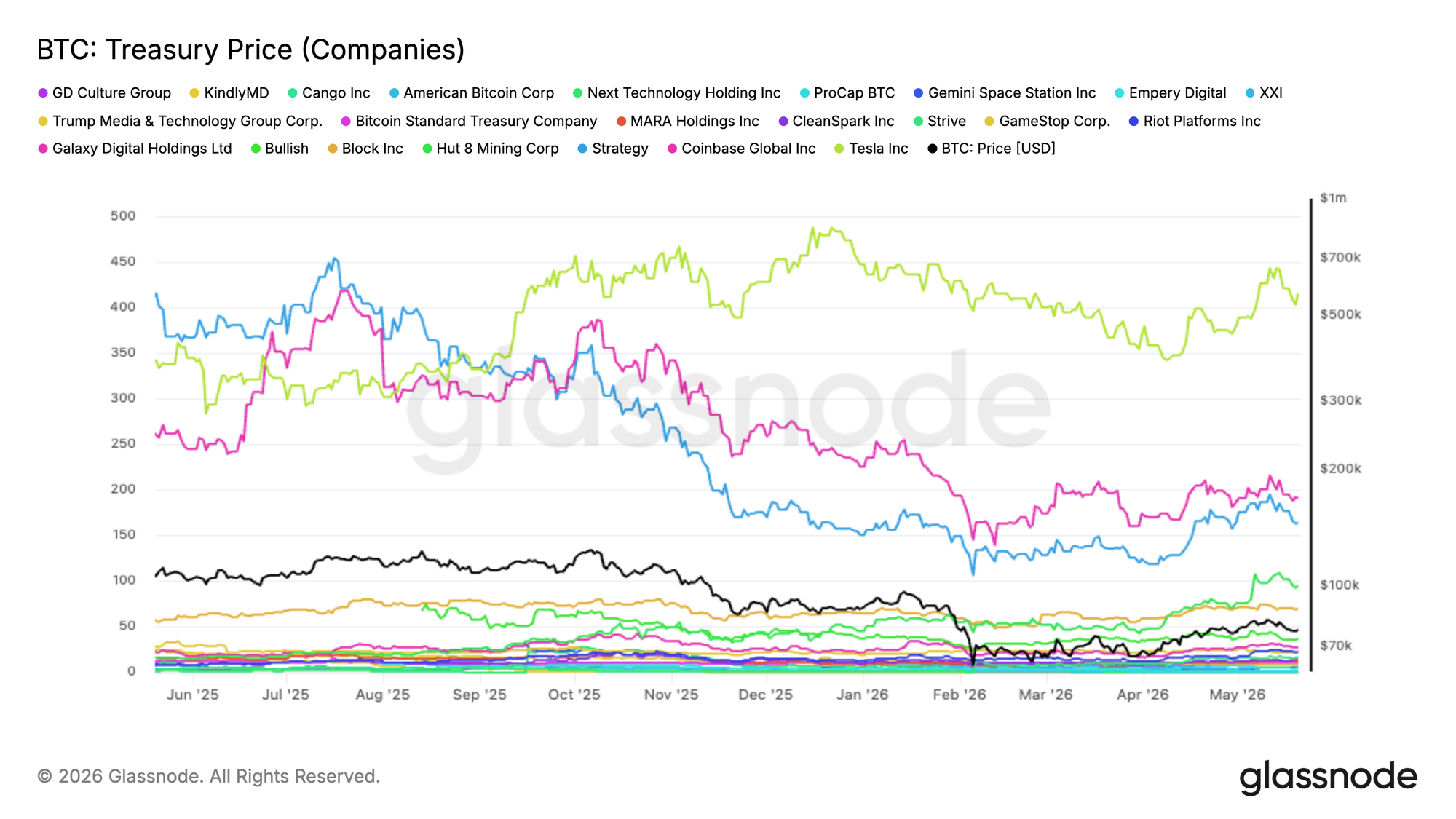
View live chart

US Spot ETF Volume: Assessing Participation and Liquidity Conditions

The addition of trading volume is particularly useful for US spot ETFs. Trading volume provides insight into liquidity, participation, and conviction.

For example, a sharp spike in ETF trading volume around a major price move or macro event can signal heavy institutional repositioning — and comparing ETF volume against the underlying spot market shows how much real flow is moving through TradFi venues versus crypto-native ones. Sustained volume can confirm genuine demand behind a price trend, while thin volume on a move may warrant more caution.
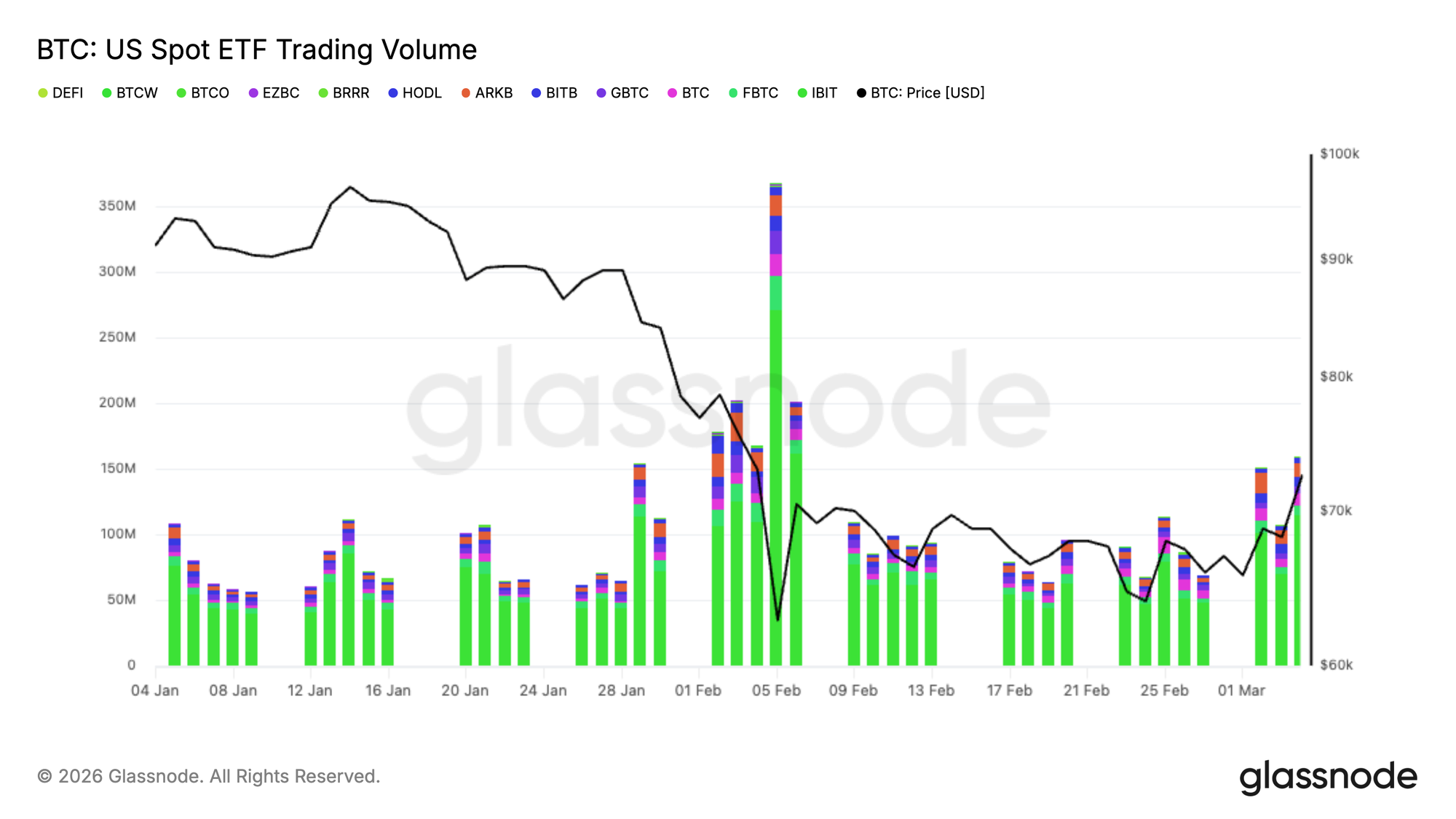
View live chart

Together, these new metrics strengthen Glassnode’s ability to bridge crypto-native data with traditional market instruments, giving users a unified view of spot assets, ETFs, and listed treasury vehicles directly in Studio.

Explore the new metrics in Studio

  • DAT Price Companies
  • DAT Trading Volume Companies
  • US Spot ETF Price
  • US Spot ETF Trading Volume

  • Follow us on X for timely market updates and analysis
  • Join our Telegram channel for regular market insights
  • For on-chain metrics, dashboards, and alerts, visit Glassnode Studio

Disclaimer: This report is for informational and educational purposes only. The analysis represents a limited case study with significant constraints and should not be interpreted as investment advice or definitive trading signals. Past performance patterns do not guarantee future results. Always conduct thorough due diligence and consider multiple factors before making investment decisions.


Related Questions

QWhat new metric families has Glassnode introduced in Studio?

AGlassnode has introduced two new metric families: US Spot ETF Price & Volume and US Digital Asset Treasury Company Price & Volume.

QWhat is the primary purpose of adding the US Spot ETF trading volume data?

AThe primary purpose of adding US Spot ETF trading volume data is to provide insight into liquidity, participation, and conviction, helping users assess the significance of price trends and the flow of capital between traditional and crypto-native venues.

QHow can the data for US Digital Asset Treasury (DAT) companies be used?

AThe data for US Digital Asset Treasury (DAT) companies can be used to compare how listed equities behave relative to the underlying crypto asset and to assess which stocks exhibit a stronger or weaker equity beta to crypto market movements, identifying which ones act more as direct crypto proxies.

QWhat overall capability do these new metrics strengthen for Glassnode?

AThese new metrics strengthen Glassnode's ability to bridge crypto-native data with traditional market instruments, giving users a unified view of spot assets, ETFs, and listed treasury vehicles directly within its Studio platform.

QWhat disclaimer does the article provide regarding its content?

AThe article provides a disclaimer stating that the report is for informational and educational purposes only, the analysis is a limited case study, it should not be interpreted as investment advice or definitive trading signals, and users should always conduct thorough due diligence before making investment decisions.

Related Reads

When Google Also 'Prints Stocks' to Build AI, Whose Narrative is Shattering the High Valuations of Neocloud?

Google has announced its first equity financing since 2005, a series of moves totaling $80 billion that signal a strategic challenge to Nvidia's GPU dominance in the AI compute market. This impacts "Neocloud" companies like CoreWeave, Nebius, and IREN, whose valuations are heavily tied to Nvidia's perceived uniqueness. Google's three-part strategy involves: launching new TPU chips (TPU 8t/8i) and selling them to third parties for the first time; forming a $25 billion compute-as-a-service joint venture with Blackstone; and raising ~$50 billion in new equity (part of an $80B package) to fund AI infrastructure, underscoring the massive capital demands even for tech giants. This marks a divergence from Microsoft's path. Microsoft, lacking a mature in-house AI chip, relies heavily on outsourcing to Neocloud providers using Nvidia GPUs. Google, with its proprietary TPU, is pursuing vertical integration—building its own data centers, selling chips, and competing directly with Neocloud services. While Neocloud firms have strong near-term revenue from locked-in Nvidia GPU contracts (e.g., CoreWeave's ~$100B backlog), Google's moves undermine their long-term valuation narrative based on Nvidia's sole supremacy and perpetual supply shortage. TPU performance claims and adoption by firms like Anthropic add credibility to Google's alternative. The AI compute market is transitioning from a uniform seller's market to a layered one: top AI labs are diversifying their hardware stacks; hyperscalers are pursuing different chip strategies; and financing costs will become a critical differentiator, favoring players like Google with lower capital costs. Key metrics to watch include the progress of the Google-Blackstone JV, expansion of the TPU customer base beyond Anthropic, and potential shifts in Microsoft's sourcing strategy. If Google succeeds on these fronts, the Neocloud investment thesis will require significant reassessment.

marsbit1h ago

When Google Also 'Prints Stocks' to Build AI, Whose Narrative is Shattering the High Valuations of Neocloud?

marsbit1h ago

Trading

Spot
Futures
活动图片



