Top Meme Coin Under $0.003: Why Little Pepe (LILPEPE) Is Gaining Attention in Presale

TheNewsCryptoPublished on 2026-04-07Last updated on 2026-04-07

Abstract

In the volatile 2026 crypto market, meme coins under $0.003 are drawing interest, with Little Pepe (LILPEPE) standing out in its presale. Currently in Stage 13 priced at $0.0022, the presale is 98% complete, having raised over $28.1M. Early buyers have seen 120% gains. LILPEPE differentiates itself with a Layer-2 Ethereum ecosystem offering zero transaction taxes, staking rewards, DAO governance, and a meme launchpad. Major drivers include a $777K giveaway and over 15 ETH in rewards tied to presale participation. In comparison, Shiba Inu (SHIB) remains stable but slow, while PEPE is active yet volatile. LILPEPE's strong presale performance and utility-focused approach make it a notable low-priced meme coin.

The crypto market in 2026 has been seesaw, with major assets like Bitcoin trading around the mid-$60K range and Ethereum holding near $1,900–$2,000 levels. At the same time, meme coins are showing mixed performance—larger tokens are moving slowly, while newer low-priced coins are attracting fresh attention.

Among meme coins trading under $0.003, three names stand out right now: Little Pepe (LILPEPE), Shiba Inu (SHIB), and PEPE. Each is at a different stage, but the contrast between them is what’s driving market interest.

Little Pepe (LILPEPE) Presale Nears Completion With Strong Numbers

Little Pepe is currently in Stage 13 of its presale, priced at $0.0022, with the next stage set at $0.0023. The ongoing presale stage is almost complete, with $28.1M raised out of a $28.77M stage target, and over 16.94 billion tokens sold out of 17.25 billion allocated, which is about 98% completion.
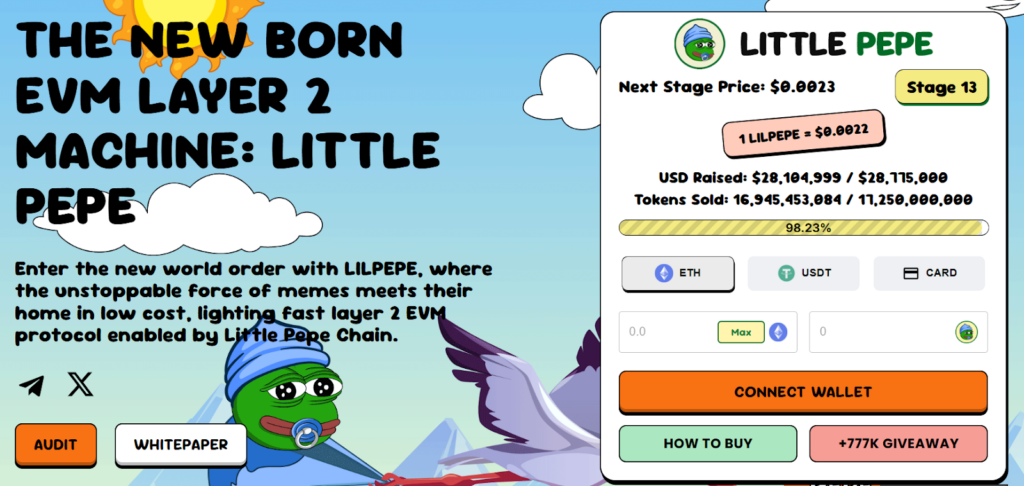
From a growth perspective, the token has already moved up significantly from its initial price of $0.001, delivering over 120% gains for early buyers.

There is still short-term upside built into the presale structure. With plans for listings on major centralized exchanges and a target of entering the top 100 on CoinMarketCap with a $1 billion market cap, buyers at the current level may see gains before launch based on stage pricing alone.

Features That Set LILPEPE Apart

Unlike typical meme coins, Little Pepe is built around a Layer-2 blockchain ecosystem on Ethereum. This gives it more than just hype-based value.

Key features include:

  • Zero tax on transactions
  • Sniper bot protection for fair trading
  • Staking rewards
  • DAO governance model
  • Meme launchpad for new projects

The project focuses on combining meme culture with actual utility, including faster transactions and lower fees through its Layer-2 setup.

$777K Giveaway and 15+ ETH Rewards Driving Demand

One of the biggest drivers of attention right now is the scale of its community campaigns.

Little Pepe has launched a $777,000 giveaway, where 10 winners receive $77,000 worth of tokens each.

Alongside that, there is a mega giveaway of over 15 ETH, structured as:

  • 5 ETH for the top buyer
  • 3 ETH for second place
  • 2 ETH for third place
  • 0.5 ETH each for 15 random participants

These incentives are directly tied to presale participation, which is helping maintain strong inflows as the project moves toward its final stages.

Shiba Inu (SHIB) Still Stable but Moving Slowly

Shiba Inu is one of the largest memecoin next to DOGE. SHIB is currently trading around $0.000005907, holding above a key support level near $0.000005283. Since the start of 2026 SHIB has faced selling pressure that pulled the token from $0.000010 to current price as the global market entered the red zone. But now SHIB has shown signs of stabilization after the first week of March.

On-chain indicators show that selling pressure is easing slightly, but the coin is still in a recovery phase rather than a strong uptrend.

Right now, the main resistance zone sits between $0.0000085 and $0.000009, and a breakout above that could push the price toward $0.000010 levels.Overall, SHIB remains a large-cap meme coin with strong community backing, but its growth pace has slowed compared to earlier cycles.

Pepe (PEPE) Remains Highly Active but Volatile

At the start of 2026, PEPE got an early rally as meme coins saw renewed speculative interest, with sharp gains in January and volume spikes during the first weeks of the year. After that initial bounce, PEPE has been trading in a range with volatile swings, struggling to break strong resistance while holding key support levels around its recent lows.

Right now PEPE is trading around $0.00000334, with a market cap near $1.37 billion, showing it’s still one of the biggest memecoins by community and volume. From a technical view, PEPE is holding support near $0.000003144, while facing resistance around $0.0000040.

If momentum continues, analysts are watching for a possible move toward the $0.0000045–$0.0000048 range, which suggests a 20–30% upside in the short term. However, due to its already large market cap, significant price jumps require much stronger market-wide momentum as it did previously since the launch.

Final Take

When comparing all three, the difference becomes clear. PEPE is active and driven by short-term momentum, SHIB is stable but slower, and Little Pepe is still in an early growth phase with structured price increases and strong presale demand.

With over 98% of its presale already completed, $28M+ raised, built-in price progression, and active giveaway campaigns, Little Pepe is currently one of the few low-priced meme coins showing both strong participation and ongoing development.

As the price moves toward the next stage at $0.0023 and the remaining allocation gets tighter, the project is entering a phase where timing is becoming more important for those looking at early-stage entries.

  • Website: https://littlepepe.com/
  • Twitter/X: https://x.com/littlepepetoken
  • Telegram: https://t.me/littlepepetoken

Disclaimer: TheNewsCrypto does not endorse any content on this page. The content depicted in this Press Release does not represent any investment advice. TheNewsCrypto recommends our readers to make decisions based on their own research. TheNewsCrypto is not accountable for any damage or loss related to content, products, or services stated in this Press Release.


TagsBlockchainCryptocurrencyLittle PEPE

Related Questions

QWhat is the current presale stage and price for Little Pepe (LILPEPE)?

ALittle Pepe is currently in Stage 13 of its presale, priced at $0.0022.

QWhat are some key features that differentiate Little Pepe from typical meme coins?

AKey features include zero tax on transactions, sniper bot protection, staking rewards, a DAO governance model, and a meme launchpad for new projects. It is built on a Layer-2 blockchain ecosystem on Ethereum.

QWhat is the total amount raised and the completion percentage of the current Little Pepe presale stage?

AThe ongoing presale stage has raised $28.1M out of a $28.77M target, with over 16.94 billion tokens sold out of 17.25 billion allocated, which is about 98% complete.

QWhat are the giveaway campaigns that Little Pepe is running to drive demand?

ALittle Pepe has launched a $777,000 giveaway with 10 winners receiving $77,000 each, and a mega giveaway of over 15 ETH, with rewards for the top buyers and random participants.

QHow does the article contrast the current state of Shiba Inu (SHIB) and Pepe (PEPE) with Little Pepe?

AThe article states that PEPE is active and driven by short-term momentum, SHIB is stable but slower in growth, and Little Pepe is in an early growth phase with structured price increases and strong presale demand.

Related Reads

AI "Transfer Station" Earning Millions Monthly? Five Questions Uncover the Truth of Token Arbitrage

The article "AI 'Transfer Station' Earns Millions Monthly? Five Questions Uncover the Truth of Token Arbitrage" explores the emerging business of API token transfer stations, which profit from global AI service price disparities and access barriers. These intermediaries purchase low-cost tokens from overseas AI providers (e.g., OpenAI, Claude) through grey-market methods—such as exploiting enterprise credits, bulk accounts, or subscription benefits—and resell them to Chinese users at a markup. Key drivers include the high cost of using top AI models (e.g., Claude Code costs ~$5 per million tokens), the performance gap between domestic and foreign models, and mismatches between subscription and API pricing. However, the practice carries significant risks: upstream token sources may be unstable or illegal; user data passing through intermediaries can be harvested or injected with hidden prompts; and models might be downgraded without disclosure. The market is evolving, with some operators now exporting cheaper Chinese models (e.g., Qwen3.5 at ~$0.11 per million tokens) to overseas users, leveraging price gaps. Yet, sustainability is low due to compliance crackdowns, instability, and reputational risks. Users are advised to employ detection methods (e.g., prompt adherence tests) and avoid sensitive data usage. The authors caution that while transfer stations offer short-term arbitrage, they lack long-term reliability and security compared to official APIs.

marsbit29m ago

AI "Transfer Station" Earning Millions Monthly? Five Questions Uncover the Truth of Token Arbitrage

marsbit29m ago

The Cost of an 11.5% Annualized Return: Will MicroStrategy's STRC Face a Moment of Reckoning?

This article analyzes the potential risks associated with MicroStrategy's (MSTR) use of structured financial products like STRC to leverage its BTC exposure. While these tools have enabled impressive returns (e.g., 11.5% annualized) and fueled significant capital inflows ($13.5B outstanding), they also create substantial annual dividend obligations (~$400M). The author argues that this structure, while effective in a bull market, could become a liability if BTC price stagnates or declines. The core risk is a potential negative feedback loop: the growing dividend burden from continued STRC issuance may eventually outweigh the benefits of increased BTC holdings. To meet these obligations, MicroStrategy might need to use new issuance proceeds for dividends instead of buying more BTC, which could disappoint equity investors. If the market capitalization (mNAV) falls below the value of its BTC holdings, the company could be forced to sell BTC instead of issuing new shares, potentially triggering a panic. The author estimates a potential inflection point in 6 months, where annual dividend costs reach $3-4B. At that stage, CEO Michael Saylor might face a difficult choice: sell BTC to meet obligations or sacrifice the credibility of the preferred shares by halting dividends. The article concludes that this financial engineering, while powerful, could ultimately "backfire" on MicroStrategy if market conditions turn.

marsbit1h ago

The Cost of an 11.5% Annualized Return: Will MicroStrategy's STRC Face a Moment of Reckoning?

marsbit1h ago

Trading

Spot
Futures

Hot Articles

Discussions

Welcome to the HTX Community. Here, you can stay informed about the latest platform developments and gain access to professional market insights. Users' opinions on the price of MEME (MEME) are presented below.

活动图片