Toncoin Fees To Drop 6x As Network Moves Toward Feeless Transactions

bitcoinistPublished on 2026-04-25Last updated on 2026-04-25

Abstract

Telegram founder Pavel Durov announced that the Toncoin (TON) network will reduce transaction fees by six times in one week, lowering the cost to just 0.00039 TON (approximately $0.0005). This fee reduction is part of the "Make TON Great Again" (MTONGA) roadmap and will remain fixed regardless of network congestion. The update follows a recent upgrade that made the network 10 times faster and transactions nearly instant. Durov also hinted that future steps aim to make most transactions fully feeless. Although Telegram discontinued formal involvement with TON due to regulatory issues, Durov remains a strong supporter. Currently, Toncoin is trading around $1.30, down over 8% in the past week.

The Telegram founder has revealed that the Toncoin network is set to see its transaction fees drop by sixfold in one week’s time.

Toncoin To Drop Transfer Fees As Part Of MTONGA

In a new post on X, Telegram founder and CEO Pavel Durov has shared that the Toncoin network will undergo a change related to transaction fees in one week. Previously, the blockchain already offered a relatively cheap transfer rate when compared to popular networks like Bitcoin and Ethereum, but the new update will further slash the fee on TON, bringing it down to just 0.00039 TON (worth about $0.0005).

The sixfold reduction in the transaction fees will hold regardless of network congestion. This is unlike many other networks, where the value of the transfer fees is dependent on blockchain conditions. Typically, a high amount of traffic tends to increase network fees, while low activity decreases the metric. On TON, however, the fees will remain fixed at its low value.

The initiative is part of Toncoin’s “Make TON Great Again” (MTONGA) roadmap, which is planned to involve a total of seven steps. Earlier in the month, the first step of the roadmap went into action as the TON blockchain underwent an upgrade. Durov talked about the update in an X post, noting that it made the network 10x faster and increased block rate by 6x. The upgrade also made transactions on the network practically instant.

In the same post, the Telegram founder had teased the next step of the roadmap, which is now finally getting implemented with the transaction fee reduction in one week.

In its early years, TON was developed by the Telegram team, and its full form stood for the Telegram Open Network. After a court order from the US Securities and Exchange Commission (SEC), however, the company was forced to pull its involvement from the network. TON rebranded to The Open Network and has since been supported by independent contributors, including the TON Foundation.

Despite the end of Telegram’s formal involvement, Durov has continued to be a vocal supporter of the blockchain, with the MTONGA roadmap being an example of his continued backing.

In the new X post related to the second step of MTONGA, the Telegram CEO also hinted at what’s coming up for the network once the upgrade is done. “Soon after most transactions go fully feeless,” noted Durov. “Zero commission. MTONGA!”

As mentioned earlier, Toncoin already offers cheaper transactions than other popular blockchains. Below is a chart from BitInfoCharts that puts into perspective the difference by showcasing the level of fees on the Bitcoin network.
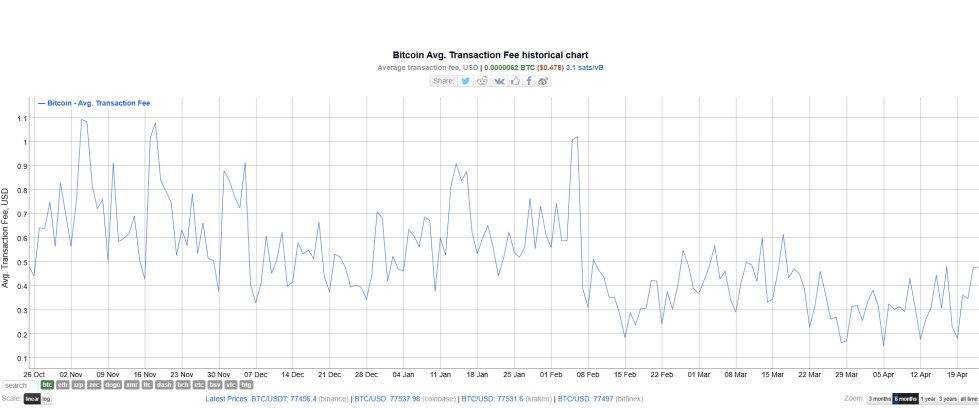
How the transfer fee on the BTC blockchain has fluctuated over the last six months | Source: BitInfoCharts

TON Price

At the time of writing, Toncoin is trading around $1.30, down more than 8% over the past week.

The price of the coin has retraced over the last couple of days | Source: TONUSDT on TradingView


Related Questions

QWhat is the expected reduction in Toncoin transaction fees and when will it happen?

AThe Toncoin network is set to see its transaction fees drop by sixfold in one week's time.

QWhat is the new transaction fee amount on the Toncoin network after the reduction?

AThe new transaction fee will be just 0.00039 TON, which is approximately $0.0005.

QWhat is the name of the roadmap initiative that includes this fee reduction?

AThe initiative is part of Toncoin's 'Make TON Great Again' (MTONGA) roadmap.

QHow does the Toncoin fee structure differ from other networks like Bitcoin and Ethereum?

AUnlike many other networks where fees depend on blockchain congestion, Toncoin's fees will remain fixed at a low value regardless of network traffic.

QWhat did Pavel Durov hint at for the future of the network after this fee reduction?

ADurov hinted that soon after the upgrade, most transactions will go fully feeless with zero commission.

Related Reads

L2 'Recalibration': When L1 Becomes Its Own Rollup, What Is Ethereum's Endgame?

The article discusses the evolving relationship between Ethereum's Layer 1 (L1) and Layer 2 (L2) solutions, moving beyond the initial "L2 for scaling" model. As Ethereum L1 itself scales (increasing Gas Limit, statelessness, zkEVM), the unique value proposition of L2s shifts from merely providing cheap execution to offering differentiated features like application-specific optimization, privacy, and flexible governance. The piece explores three key themes: 1. **L2's New Role:** L2s are transitioning from a pure scaling technology to a spectrum of execution environments with varying degrees of security inheritance from Ethereum L1. 2. **Interoperability as State Trust:** Solving L2 fragmentation is less about cross-chain bridges and more about enabling faster, trust-minimized state verification between environments. This involves initiatives like faster L1 finality, intent-based architectures (Open Intents Framework), and native account abstraction. 3. **Blurring Layers:** With the potential integration of zk-proofs into L1 validation (making L1 akin to its own "Rollup") and the concept of "Native Rollups," the rigid boundary between L1 and L2 may fade. The future could be a unified system with multiple execution domains (for DeFi, gaming, privacy, etc.) sharing a common security, settlement, and state framework. In conclusion, Ethereum's goal is not to abandon L2s or re-centralize everything on L1, but to re-integrate the fragmented user experience—liquidity, accounts, applications—while preserving the scaling benefits of a multi-environment ecosystem. The endgame is a cohesive "one chain" feeling for users, powered by diverse but securely interconnected execution layers.

marsbit23m ago

L2 'Recalibration': When L1 Becomes Its Own Rollup, What Is Ethereum's Endgame?

marsbit23m ago

The Encryption Bill Clarity's Challenge: A Thorny Path of Bipartisan Compromise in the U.S.

U.S. lawmakers are attempting to advance the Clarity Act, a significant crypto market structure bill, but its path is fraught with partisan hurdles. The process has been rocky since January, when a prior bipartisan deal in the Senate Banking Committee was upended. A key compromise in May on "yield" issues allowed the bill to move forward in committee, but only with the conditional support of two Democratic senators, Angela Alsobrooks and Ruben Gallego. They emphasized that their final vote depends on reaching an agreement on ethics provisions for elected officials. Ultimately, the Senate Agriculture Committee passed its version along party lines without Democratic support. As Republicans push for a full Senate vote in July, the demand for strong ethics language has expanded beyond Democrats. Additional controversies surround provisions related to yields (aligning some Republicans with large banks) and developer protections (opposed by enforcement agencies). Core concerns about illicit finance and consumer protection remain central to the debate. Despite consensus on the need for legislation, achieving the necessary bipartisan compromise is proving difficult. While momentum exists—including recent meetings between senators and White House officials—a reconciled bill text faces skepticism. Senator Gallego has stated that without ethics terms acceptable to Democrats, they will not provide the needed votes. The immediate goals for the crypto community in Congress are unclear: a symbolic Senate vote before the August recess, eventual passage into law by 2026, or forging a final compromise framework. The arduous, vote-by-vote effort to build bipartisan support continues, mirroring the traditional legislative grind the industry must now navigate.

Foresight News1h ago

The Encryption Bill Clarity's Challenge: A Thorny Path of Bipartisan Compromise in the U.S.

Foresight News1h ago

Trading

Spot
活动图片