TON Enters the Telegram Era: The On-Chain Experiment of Super Apps is Unfolding

marsbitPublished on 2026-05-08Last updated on 2026-05-08

Abstract

The TON token recently surged nearly 120% in 4 days, approaching $3. This rally is primarily driven by Telegram founder Pavel Durov's announcement that Telegram will become the core driver of the TON network, replacing the TON Foundation and serving as its largest validator. This move signals a fundamental shift: Telegram is no longer just supporting TON from a distance but is formally taking over its governance and operations. This changes TON's valuation narrative from being a crypto project with Telegram's user base to becoming the foundational blockchain infrastructure for Telegram's future commercial ecosystem—transitioning from a crypto narrative to an internet-platform-level story. TON's recent technical upgrades focus on 10x faster speeds, 6x lower fees, and near-instant confirmations. These optimizations target Telegram's internal high-frequency, micro-transaction scenarios like tipping, bot services, and Mini App purchases. The goal is to enable seamless, near-zero-cost transactions for its nearly 1 billion users, making blockchain usage almost invisible—akin to platforms like WeChat Pay. TON's path is unique: it already has a massive user base and is building the blockchain system to serve it, aiming to onboard users into Web3 without them realizing it. The vision is to integrate wallet, payment, bot, and Mini App functionalities into a closed loop within Telegram, positioning TON as the value-exchange infrastructure for a super-app. In essence, this surge refl...

Author: Climber, CryptoPulse Labs

Recently, the TON token has experienced consecutive increases, rising approximately 120% over 4 days and approaching the $3 mark. The primary reason behind this surge is the public endorsement by Pavel Durov, the founder of Telegram.

He stated that Telegram will replace the TON Foundation, becoming the core driving force behind TON, and will serve as the largest validator for the TON network. Meanwhile, the TON network has also been continuously advancing technical upgrades, such as announcing a 10x increase in network speed performance and a 6x reduction in transaction fees.

On the surface, this appears to be a round of technical upgrades and narrative revival for TON. However, what the market is truly reassessing is not TON itself, but the fact that Telegram has begun, for the first time, to fully embark on a comprehensive on-chain transformation in a real sense.

I. Telegram Takes the Helm: TON's Valuation Logic Begins to Shift

Over the past few years, TON has occupied a very unique position. It is deeply intertwined with Telegram, yet the two have always maintained a certain distance.

The reason is quite simple. Early on, Telegram launched the Gram fundraising plan, which ultimately faced regulatory intervention from the U.S. SEC, forcing the project to be terminated. The community subsequently took over the project, gradually evolving into the current TON ecosystem.

Therefore, for a long time, although Telegram continued to support TON—including gradually integrating its wallet, bots, mini-apps, and advertising system with TON—it never truly assumed the role of the official driver of TON publicly.
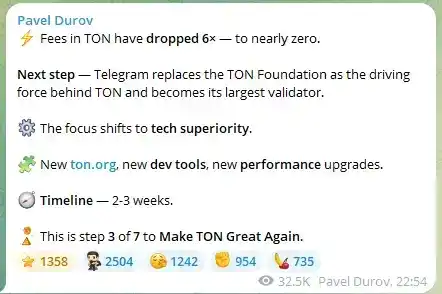
Pavel Durov's recent statements fundamentally alter market expectations. Particularly, the key points of Telegram replacing the TON Foundation and becoming the largest validator directly clarify that Telegram is now beginning to participate directly in the underlying governance and network operation of TON.

This is no longer just ecosystem support; it signifies Telegram formally reclaiming dominant control over TON's roadmap.

This shift is crucial because, in the past, the biggest question the market had about TON was not its technical capability but whether Telegram would truly go all-in on TON. Now, this question has a clear answer.

Simultaneously, this also means TON's valuation logic is changing. Previously, the market priced TON essentially as a public chain with Telegram's traffic support. But now, the market is beginning to reassess TON, as it is likely becoming the on-chain infrastructure within Telegram's future commercial ecosystem.

The difference between the two is significant. The former still belongs to the Crypto narrative, while the latter is beginning to enter the narrative of an internet-platform scale. This is also why TON's recent rise is not merely driven by sentiment but resembles a round of long-term expectation restructuring.

II. TON Reconstructs the Internet Payment Structure

Examining TON's recent rounds of upgrades closely reveals that its optimization direction is actually very clear: faster speed, lower fees, shorter confirmation times, and transaction fees approaching zero.

On the surface, these upgrades are optimizing chain performance, but what they are truly serving is not traditional DeFi but the large-scale payment application scenarios within Telegram.

Because Telegram itself has nearly 1 billion users, it inherently generates a vast amount of high-frequency, small-value transaction demand. Examples include content tipping, bot services, mini-app purchases, cross-border transfers, and digital goods consumption, among others.

These scenarios share a common need: users require extremely low costs and prioritize high speed.

If a payment takes tens of seconds to wait or incurs fees of several dollars, the entire user experience deteriorates significantly. Traditional blockchains have been particularly ill-suited for this type of scenario in the past.
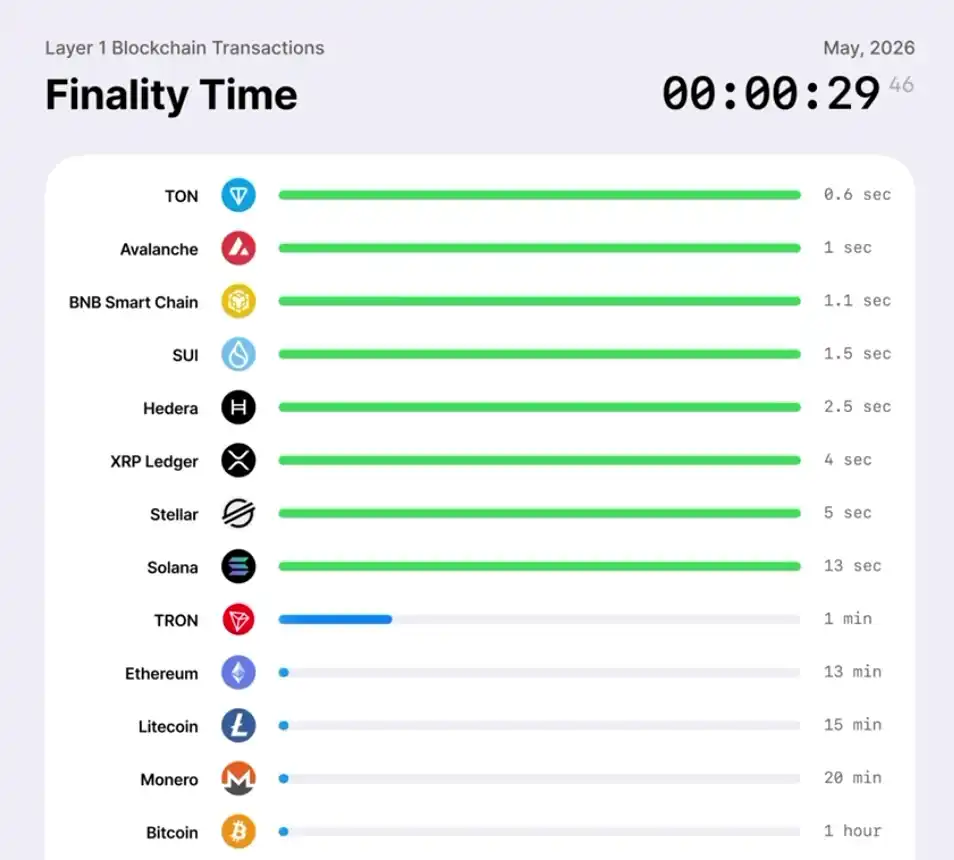
Therefore, TON's recent emphasis on fixed low fees and sub-second confirmations essentially revolves around redesigning blockchain for internet product experience. In other words, TON is attempting to solve a problem that Crypto has long failed to address: how to enable ordinary users to utilize on-chain systems almost imperceptibly.

This shift in logic is actually increasingly approaching the model of WeChat Pay.

Users don't need to understand blockchain, nor do they need to understand wallets, gas, or validation mechanisms. They only need to complete tipping, payments, purchases, transfers, and subscriptions, with all underlying settlements handled by TON.

This suggests that what TON truly aims to achieve may not be competition in the traditional L1 sense. What it is genuinely competing for is the global internet payment gateway.

Additionally, there is another crucial change. The logic of many public chains in the past has been: first build the infrastructure, then find users. But TON is the complete opposite. It first possesses a massive user base and then begins constructing the on-chain system.

Therefore, TON's challenge has never been how to get users into Web3, but rather how to enable users to complete on-chain actions without even realizing they are entering Web3. This represents a completely different development path.

III. TON's Future Blueprint: The On-Chain Transformation of Super Apps

Looking at all of TON's recent actions together, it becomes apparent that Telegram is gradually forming a complete closed loop. Functions that were originally separate—such as wallet, payments, bots, mini-apps, and on-chain settlements—are now gradually being integrated by TON.
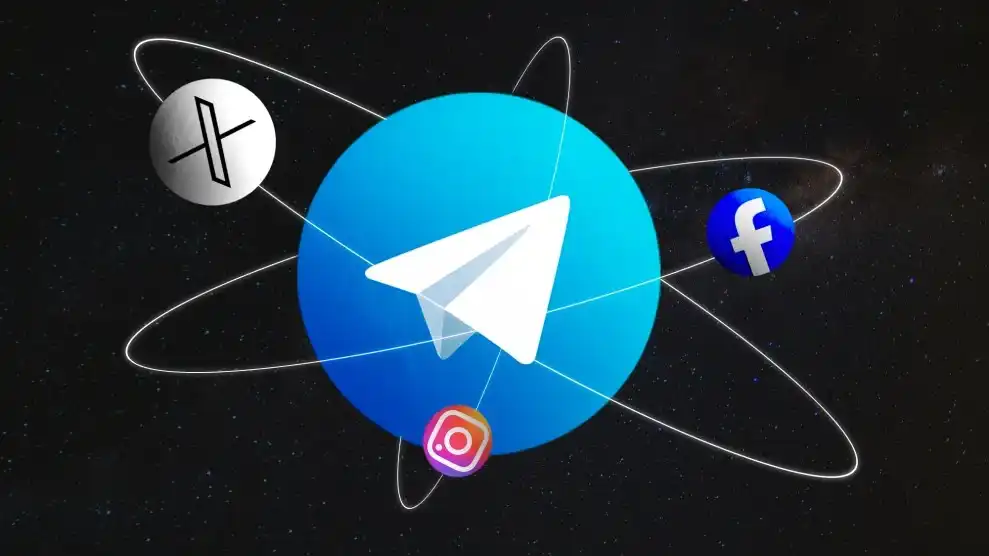
This also signifies that TON is no longer just an independent public chain; it is becoming the infrastructure for value circulation within Telegram. The true significance of this lies in the fact that, for the first time, the crypto industry is approaching the on-chain transformation of super applications.

Because over the past decade, the crypto industry has always lacked a genuine mass-market entry point. Most public chains have been striving to attract users into the crypto world, but Telegram itself already possesses global-scale traffic.

Especially in markets like the Middle East, Russia, Eastern Europe, Southeast Asia, and Latin America, Telegram often functions not merely as a messaging tool but also as a community platform, commercial platform, payment tool, and more.

Therefore, TON's true strategic focus is not DeFi but rather global digital commercial scenarios.

Areas such as low-cost cross-border payments, the creator economy, on-chain micro-payments, and similar directions are likely the true sources of large-scale growth for TON in the future.

Of course, this path is not easy. TON's ecosystem remains in its early stages, with many applications still lingering in phases like mini-games, airdrops, and short-term traffic acquisition. Additionally, after Telegram's renewed deep involvement with TON, it may once again face regulatory pressure in the future.

Nevertheless, the market has now begun to realize one thing: TON's competitors may never have been traditional L1s, but rather the global internet payment systems.

Conclusion

This round of TON's rise is not essentially the market speculating on a simple upgrade. What truly drives the repricing of capital is the growing awareness that the world's first on-chain ecosystem with a genuine super-app entry point may have already begun to take shape.

And this time, Pavel Durov is no longer just an observer. Telegram is finally preparing to take the field itself.

Related Questions

QAccording to the article, what was the main reason for the recent significant price surge of the TON token?

AThe primary reason for TON's recent price surge was Telegram founder Pavel Durov's public announcement that Telegram will become the core driver behind the TON network, replacing the TON Foundation and becoming its largest validator.

QHow has Pavel Durov's statement fundamentally changed the market's perception of TON's valuation logic?

AHis statement shifted TON's valuation logic from being a crypto-native public chain with Telegram's traffic support to potentially becoming the on-chain infrastructure for Telegram's future commercial ecosystem, moving from a crypto narrative to an internet platform-level narrative.

QWhat specific user needs is TON's recent technical optimization targeting, and what payment system is this approach compared to?

ATON's recent optimizations (faster speeds, lower fees, sub-second confirmation, near-zero costs) target the need for low-cost, high-speed, small-value transactions within Telegram (e.g., tipping, Bot services). This approach is compared to systems like WeChat Pay, aiming for users to use the on-chain system almost without awareness.

QWhat key advantage does TON possess compared to many other public blockchains regarding its development path?

AUnlike other blockchains that build infrastructure first and then seek users, TON already possesses a massive user base (Telegram's near 1 billion users) first, and is now building the on-chain system around that existing traffic.

QWhat does the article suggest is the true long-term competitor for TON, and what is its ultimate envisioned role?

AThe article suggests TON's true competitor is not traditional Layer 1 blockchains, but the global internet payment system. Its ultimate envisioned role is to become the on-chain value circulation infrastructure for the Telegram super-app, enabling global digital commercial scenarios like low-cost cross-border payments and the creator economy.

Related Reads

Standing in the Light: A Comprehensive Guide to the Optical Module and CPO Supply Chain

"Standing in the Light: Understanding the Optical Module and CPO Industry Chain" This article analyzes the critical role of optical communication technology, specifically optical modules and Co-Packaged Optics (CPO), as the "nervous system" for modern AI data centers. With exponential growth in AI computational demands (e.g., NVIDIA's Vera Rubin architecture), traditional electrical interconnects using copper cables face severe bottlenecks in bandwidth, power consumption, and signal integrity over distance. The core function of an optical module is to act as a "translator," converting electrical signals from chips into optical signals for transmission over fiber (and vice-versa). Key internal components include lasers, modulators, photodetectors, drivers, and DSP chips. The industry is currently transitioning from 800G to 1.6T modules. However, the future lies in CPO. This next-generation technology integrates the optical engine directly with the switch ASIC/XPU on the same package substrate, drastically reducing power consumption (by ~3.5x according to NVIDIA), overcoming bandwidth density limits, and minimizing signal attenuation compared to traditional pluggable modules. Key challenges for CPO include advanced packaging capacity (dominated by TSMC), thermal management, repairability, and standardization. The article details the broader technology landscape, including Near-Packaged Optics (NPO, a pragmatic intermediate step), Linear-drive Pluggable Optics (LPO), Optical I/O (OIO for chip-level integration), and Optical Circuit Switches (OCS). A comprehensive CPO industry chain is mapped, highlighting shifting power dynamics: * **Architecture Definers:** NVIDIA, Broadcom, and Marvell now hold greater influence. * **Advanced Packaging & Manufacturing:** TSMC is central; Fabrinet is a key EMS player. * **Lasers ("The Heart"):** A strategic bottleneck. EML lasers are led by Lumentum and Coherent (both receiving major NVIDIA investments). CW lasers, favored for CPO/silicon photonics, see strong Chinese players like Source Photonics and Sicoya. * **Silicon Photonics Chips:** The mainstream path for CPO engines, with key players like Broadcom, Intel, Marvell, and China's Accelink. * **Fiber Connectivity Components:** A major new, high-growth market created by CPO, including Fiber Array Units (FAU), Polarization-Maintaining Fiber (PMF), and MPO connectors. Companies like Tianfu Communication and US Conec are leaders. * **Fiber & Cable:** Experiencing a super-cycle (e.g., Corning, Yangtze Optical Fiber). * **PCB/Substrates:** Requiring advanced materials (e.g., Shengyi Tech). * **DSP & SerDes:** Functions are integrated into switch ASICs in the CPO era (e.g., Broadcom, Astera Labs). * **Optical Module Makers:** Transitioning from standalone module suppliers to providers of optical engines and NPO/LPO solutions while riding the current pluggable boom (e.g., Zhongji Innolight, Eoptolink). The investment timeline is segmented: Short-term (2026-2027) features the "last feast" for pluggable modules and CPO's initial rollout. Medium-term (2027-2029) will see CPO expand and NPO peak. Long-term (2029-2032+) involves CPO/OIO penetration into intra-rack scaling. In conclusion, optical interconnects are fundamental to AI infrastructure. The competitive landscape sees US firms leading in architecture and high-end chips, TSMC in advanced packaging, and Chinese firms holding strong positions in modules, connectivity components, CW lasers, and fiber/cable. The future belongs to companies that can navigate the technological shift from "selling shovels" (modules) to "building highways" (CPO/OIO infrastructure).

marsbit3m ago

Standing in the Light: A Comprehensive Guide to the Optical Module and CPO Supply Chain

marsbit3m ago

Trading

Spot
Futures

Hot Articles

How to Buy TON

Welcome to HTX.com! We've made purchasing TONCOIN (TON) simple and convenient. Follow our step-by-step guide to embark on your crypto journey.Step 1: Create Your HTX AccountUse your email or phone number to sign up for a free account on HTX. Experience a hassle-free registration journey and unlock all features.Get My AccountStep 2: Go to Buy Crypto and Choose Your Payment MethodCredit/Debit Card: Use your Visa or Mastercard to buy TONCOIN (TON) instantly.Balance: Use funds from your HTX account balance to trade seamlessly.Third Parties: We've added popular payment methods such as Google Pay and Apple Pay to enhance convenience.P2P: Trade directly with other users on HTX.Over-the-Counter (OTC): We offer tailor-made services and competitive exchange rates for traders.Step 3: Store Your TONCOIN (TON)After purchasing your TONCOIN (TON), store it in your HTX account. Alternatively, you can send it elsewhere via blockchain transfer or use it to trade other cryptocurrencies.Step 4: Trade TONCOIN (TON)Easily trade TONCOIN (TON) on HTX's spot market. Simply access your account, select your trading pair, execute your trades, and monitor in real-time. We offer a user-friendly experience for both beginners and seasoned traders.

14.4k Total ViewsPublished 2024.03.29Updated 2026.06.02

How to Buy TON

Discussions

Welcome to the HTX Community. Here, you can stay informed about the latest platform developments and gain access to professional market insights. Users' opinions on the price of TON (TON) are presented below.

活动图片