Tom Lee Signals Market Bottom: Why Smart Money Is Rotating Towards Quantum Security and BMIC

bitcoinistPublished on 2026-02-09Last updated on 2026-02-09

Abstract

Tom Lee, Head of Research at Fundstrat, suggests the crypto market has likely bottomed out, signaling a shift from survival to expansion. He points to cooling inflation and Bitcoin's resilience as key indicators. The next market cycle is expected to prioritize new infrastructure that addresses existential threats, particularly the looming risk of quantum computing to current encryption standards. This creates a significant opportunity for quantum-resistant security solutions. BMIC ($BMIC) is positioned as a key player, offering a fully quantum-proof financial stack. It uses post-quantum cryptography to protect assets from future attacks and integrates ERC-4337 smart accounts for enhanced security without complex seed phrases. The project's presale has raised over $444,000, indicating strong investor confidence. The $BMIC token powers its "Quantum Meta-Cloud," a decentralized network for quantum computing resources, and features a "Burn-to-Compute" mechanism. Analysts believe that as the market matures, the premium for quantum security will grow significantly, making BMIC a potential long-term investment as it aims to become the standard for secure, institutional-grade digital asset storage.

Fundstrat's Head of Research, Tom Lee, is known for predicting market reversals just when everyone else is still in the midst of panic-selling. His recent analysis suggests that the crypto market bottom has already been reached, or is at least dangerously close. Lee points to a "perfect storm" of indicators: cooling inflation, a market that has finally absorbed the excess supply from major failures, and Bitcoin's surprising resilience during geopolitical tensions. The "purge" phase of the cycle, it seems, is over.

But just watching price action means missing the main point. The importance of a market bottom lies not only in prices stopping their decline; it lies in the narrative shifting from survival to expansion. When liquidity returns (driven by the Fed's inevitable policy reversal and ETF inflows), it doesn't simply flow into the same old coins.

It seeks new infrastructure that solves existential threats. In previous cycles, we saw this capital flood scalability solutions and DeFi protocols. This time? The next big rotation might prioritize security layers capable of handling institutional-grade value.

This is important because the "next bull run" must face a technological chasm that previous rallies did not know: the looming threat of quantum computing. As the value of assets swells, the incentive to break current encryption standards grows exponentially.

This creates a huge blind spot where traditional wallets are essentially underestimated risks, while quantum-resistant infrastructure represents the "alpha" not yet detected. Investors following Tom Lee's "risk-on" signals are now hunting for projects that secure the digital future against next-generation threats.

And this is where BMIC ($BMIC) comes in, a project positioning itself as the fortified layer for this new liquidity cycle.

Institutional Inflows Require Post-Quantum Armor

The "harvest now, decrypt later" attack vector is perhaps the elephant in the room for the entire industry. State actors and sophisticated hacker groups are currently scraping encrypted data from blockchains, archiving it, and simply waiting for quantum computing power to break current standards like RSA and Elliptic Curve Cryptography (ECC).

If Tom Lee's prediction of six-figure Bitcoin comes true, the "honey pot" for these attackers would become a treasure trove worth trillions of dollars.

BMIC ($BMIC) addresses this problem by offering what it claims is the only platform with a fully quantum-proof financial stack. Unlike legacy crypto wallets that rely on 1990s encryption methods, BMIC uses post-quantum cryptography to ensure assets stored today remain secure against future brute-force computational attacks. (And no, it's not just paranoia; it's a mathematical necessity for any company planning to hold digital assets for more than five years).
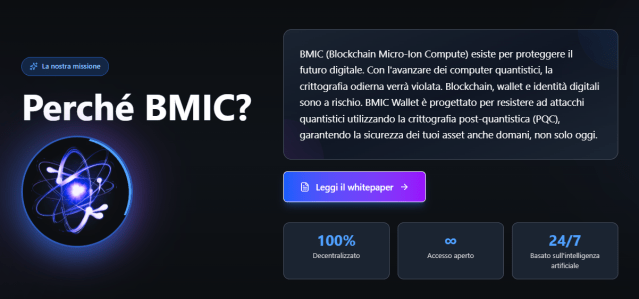
Beyond the encryption layer, the project integrates ERC-4337 smart accounts. This standard enables "account abstraction," meaning users get the robust security of quantum resistance without the headache of managing complex seed phrases, which often represent the biggest hurdle for institutional clients.

By combining AI-powered threat detection with no public key exposure, the protocol effectively creates a "moat" around user assets that not even a quantum computer can cross.

BMIC Presale Data Signals Early Investor Confidence

While the "mass" waits for confirmation of the reversal predicted by Tom Lee, smart money often moves into presales to maximize return asymmetry. Current BMIC fundraising data indicates a disconnect between general market apathy and the high conviction of security-focused investors. $BMIC has raised over $444,000, with tokens currently priced at $0.049474.

This capital raise is notable not only for the total but for the utility of the funding. The $BMIC token is not a simple governance tool; it acts as fuel for the "Quantum Meta-Cloud" ecosystem and powers the exclusive "Burn-to-Compute" mechanism.

How Does the Quantum Meta-Cloud Work?

The system aims to connect various quantum hardware providers under a single decentralized access layer. The goal is to make computing power available transparently without relying on a single centralized provider.

As the network grows, the demand for quantum-secure computing power drives the token's velocity. Thanks to this offering, we believe $BMIC is one of the best long-term crypto investments.

Why Do Investors Believe?

Those analyzing the risk-reward ratio are betting on a simple premise: as the crypto market matures, security-related premiums are destined to skyrocket.

  • Current Valuation: The market prices the gap between a standard wallet and a quantum-secure one at almost zero.

  • Potential: If BMIC manages to become the standard for post-quantum storage, that gap will close rapidly.

With the crypto presale still active, the entry point remains tied to the early stages of development rather than the immense speculative value the security narrative could generate in the future.


Related Questions

QWhat does Tom Lee's recent analysis suggest about the crypto market?

ATom Lee's recent analysis suggests that the crypto market bottom has already been reached or is dangerously close, pointing to a 'perfect storm' of indicators including cooling inflation, the market absorbing excess supply from major failures, and Bitcoin's resilience during geopolitical tensions.

QWhat is the 'harvest now, decrypt later' attack vector mentioned in the article?

AThe 'harvest now, decrypt later' attack is a threat where state-sponsored actors and sophisticated hacker groups are currently harvesting encrypted data from blockchains, storing it, and waiting for quantum computing power to break current encryption standards like RSA and Elliptic Curve Cryptography (ECC).

QHow does the BMIC ($BMIC) project aim to address the quantum threat?

AThe BMIC project aims to address the quantum threat by offering what it claims is the only platform with a fully quantum-proof financial stack. It uses post-quantum cryptography to secure assets and integrates ERC-4337 smart accounts for robust security without the complexity of managing seed phrases.

QWhat is the function of the $BMIC token within its ecosystem?

AThe $BMIC token acts as fuel for the 'Quantum Meta-Cloud' ecosystem and powers the exclusive 'Burn-to-Compute' mechanism. It is not just a governance token but is used to access decentralized quantum computing power.

QWhat does the current fundraising data for BMIC indicate, according to the article?

AThe current fundraising data for BMIC indicates a disconnect between general market apathy and high conviction from security-focused investors. It has raised over $444,000, with tokens priced at $0.049474, signaling strong belief in its long-term value proposition.

Related Reads

a16z: AI's 'Amnesia', Can Continuous Learning Cure It?

The article "a16z: AI's 'Amnesia' – Can Continual Learning Cure It?" explores the limitations of current large language models (LLMs), which, like the protagonist in the film *Memento*, are trapped in a perpetual present—unable to form new memories after training. While methods like in-context learning (ICL), retrieval-augmented generation (RAG), and external scaffolding (e.g., chat history, prompts) provide temporary solutions, they fail to enable true internalization of new knowledge. The authors argue that compression—the core of learning during training—is halted at deployment, preventing models from generalizing, discovering novel solutions (e.g., mathematical proofs), or handling adversarial scenarios. The piece introduces *continual learning* as a critical research direction to address this, categorizing approaches into three paths: 1. **Context**: Scaling external memory via longer context windows, multi-agent systems, and smarter retrieval. 2. **Modules**: Using pluggable adapters or external memory layers for specialization without full retraining. 3. **Weights**: Enabling parameter updates through sparse training, test-time training, meta-learning, distillation, and reinforcement learning from feedback. Challenges include catastrophic forgetting, safety risks, and auditability, but overcoming these could unlock models that learn iteratively from experience. The conclusion emphasizes that while context-based methods are effective, true breakthroughs require models to compress new information into weights post-deployment, moving from mere retrieval to genuine learning.

marsbit2h ago

a16z: AI's 'Amnesia', Can Continuous Learning Cure It?

marsbit2h ago

Can a Hair Dryer Earn $34,000? Deciphering the Reflexivity Paradox in Prediction Markets

An individual manipulated a weather sensor at Paris Charles de Gaulle Airport with a portable heat source, causing a Polymarket weather market to settle at 22°C and earning $34,000. This incident highlights a fundamental issue in prediction markets: when a market aims to reflect reality, it also incentivizes participants to influence that reality. Prediction markets operate on two layers: platform rules (what outcome counts as a win) and data sources (what actually happened). While most focus on rules, the real vulnerability lies in the data source. If reality is recorded through a specific source, influencing that source directly affects market settlement. The article categorizes markets by their vulnerability: 1. **Single-point physical data sources** (e.g., weather stations): Easily manipulated through physical interference. 2. **Insider information markets** (e.g., MrBeast video details): Insiders like team members use non-public information to trade. Kalshi fined a剪辑师 $20,000 for insider trading. 3. **Actor-manipulated markets** (e.g., Andrew Tate’s tweet counts): The subject of the market can control the outcome. Evidence suggests Tate’sociated accounts coordinated to profit. 4. **Individual-action markets** (e.g., WNBA disruptions): A single person can execute an event to profit from their pre-placed bets. Kalshi and Polymarket handle these issues differently. Kalshi enforces strict KYC, publicly penalizes insider trading, and reports to regulators. Polymarket, with its anonymous wallet-based system, has historically been more permissive, arguing that insider information improves market accuracy. However, it cooperated with authorities in the "Van Dyke case," where a user traded on classified government information. The core paradox is reflexivity: prediction markets are designed to discover truth, but their financial incentives can distort reality. The more valuable a prediction becomes, the more likely participants are to influence the event itself. The market ceases to be a mirror of reality and instead shapes it.

marsbit3h ago

Can a Hair Dryer Earn $34,000? Deciphering the Reflexivity Paradox in Prediction Markets

marsbit3h ago

Trading

Spot
Futures
活动图片




