Tokenization will disrupt finance faster than digital disrupted media: Crypto exec

cointelegraphPublished on 2025-12-21Last updated on 2025-12-21

Abstract

Tokenization will transform finance faster than digital technology disrupted media, according to MoonPay president Keith Grossman. He argues that real-world asset (RWA) tokenization will force traditional financial firms to adapt, citing examples like BlackRock and Franklin Templeton already offering tokenized funds. Major banks are also exploring onchain settlements. Grossman believes institutions that embrace this shift will succeed, while those resisting will fall behind. Benefits include 24/7 market access, global scalability, lower costs, and near-instant settlements. Regulatory progress, such as the SEC and CFTC working on round-the-clock market frameworks and the DTCC’s approval to launch tokenized U.S. Treasuries by 2026, signals accelerating adoption.

Tokenization will transform the financial industry faster than digital technology disrupted legacy media, such as print newspapers, physical copies of music and other analog formats, according to Keith Grossman, president of crypto payments company MoonPay.

“While many feared digitization would destroy media, what it actually did was force its evolution,” Grossman said, adding that real-world asset (RWA) tokenization, the process of representing traditional assets onchain, will force traditional institutions to adapt. He added:

“This is no longer hypothetical. BlackRock is offering tokenized funds. Franklin Templeton is running tokenized money market funds on public blockchains. Major global banks are piloting onchain settlement, tokenized deposits and real-time asset movement.”
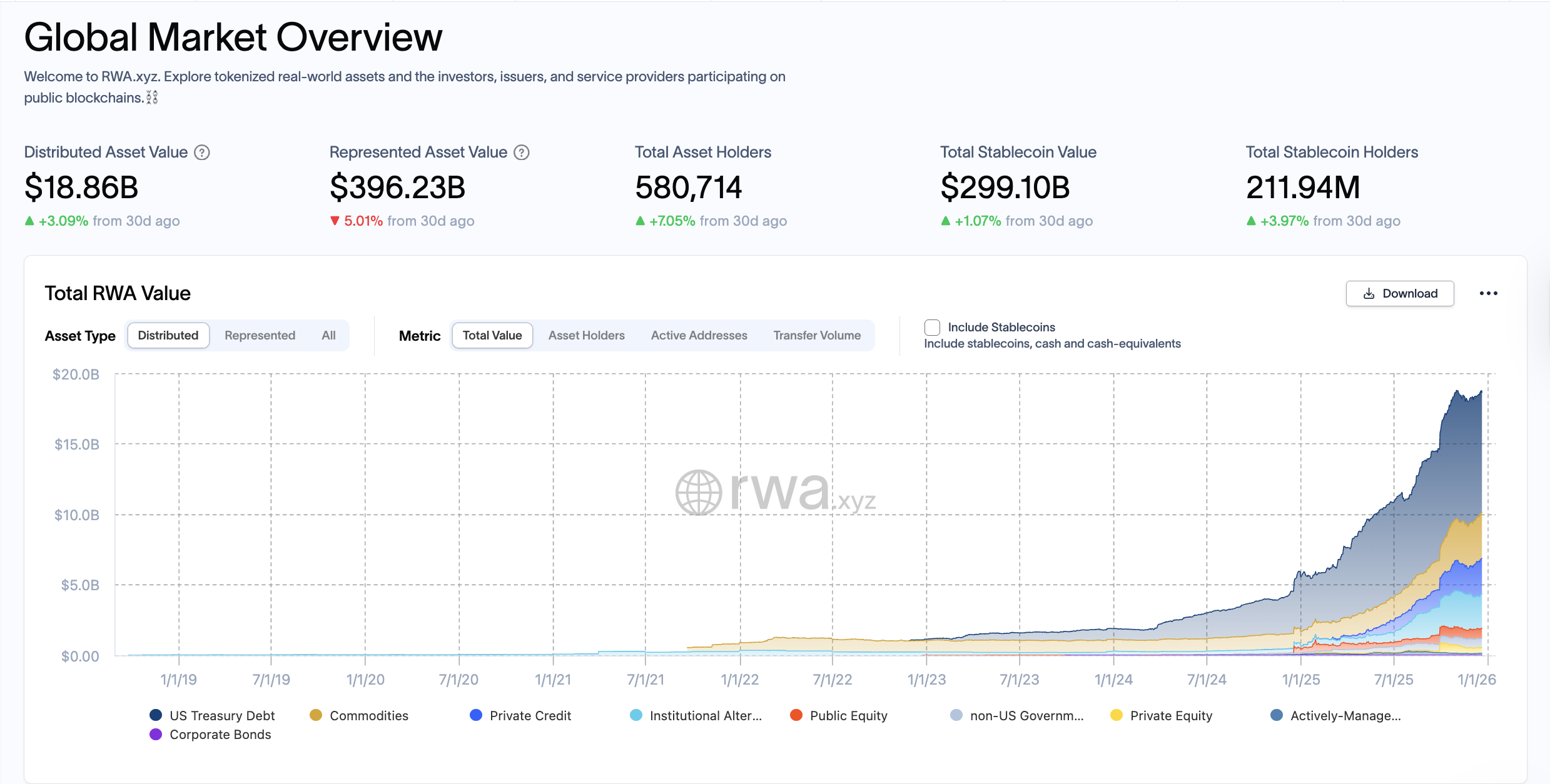
The market capitalization of the RWA sector, excluding stablecoins, is nearly $19 billion at the time of this writing. Source: RWA.XYZ

Financial incumbents like Citi, Bank of America, JPMorgan Chase and others will continue to exist in a different form, Grossman said, much like media companies continued to exist after the shift to digital distribution in the late 1990s and early 2000s, which disrupted business models that worked for decades.

Ultimately, the survivors and winners of the ongoing shift toward tokenized finance will be those companies that get ahead of the change and not those that attempt to stop the inevitable shift to a global financial system powered through blockchain rails, he said.

Related: Wall Street’s $4 quadrillion backbone to roll out tokenized US Treasurys

Why tokenized assets can change the game

Tokenizing real-world assets carries several benefits, including enabling 24/7 access to markets, making asset classes global in scale, cheaper transaction costs through disintermediation, and lowering settlement times to minutes, instead of days.

In September, the United States Securities and Exchange Commission (SEC) and the Commodity Futures Trading Commission (CFTC) issued a joint statement on creating a regulatory framework to enable 24/7 capital markets.
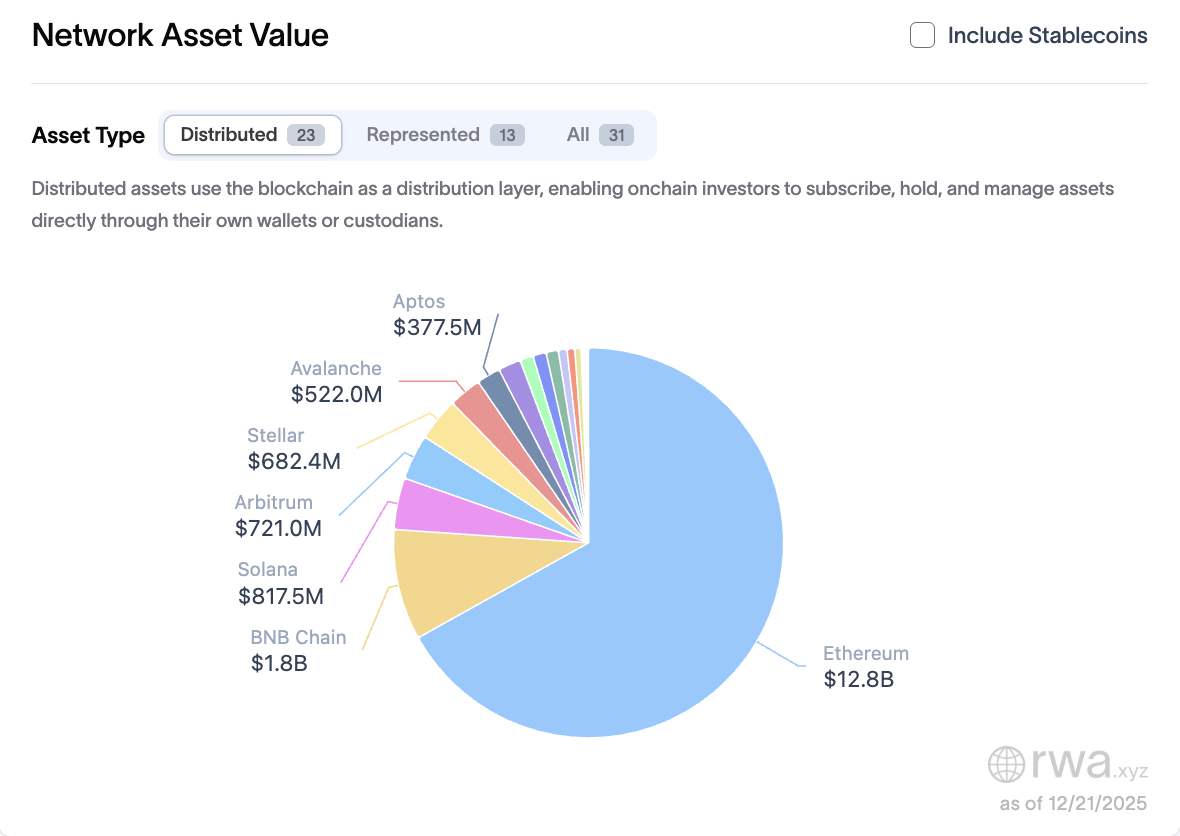
The overwhelming majority of tokenized RWA value has found its home on the Ethereum network. Source: RWA.XYZ

The financial system shifting to 24/7 trading represents a major departure from how traditional markets, which close on nights, weekends and holidays, currently operate.

In December, the Depository Trust and Clearing Corporation (DTCC), a settlement and clearing company that processed about $3.7 quadrillion in settlement volume in 2024, received approval from the SEC to start offering tokenized financial instruments.

The DTCC plans to roll out tokenized assets in the second half of 2026, starting with US Treasuries and stock indexes.

Magazine: Unstablecoins: Depegging, bank runs and other risks loom

Related Questions

QAccording to Keith Grossman, how will tokenization impact the financial industry compared to digital technology's effect on media?

AKeith Grossman believes that tokenization will transform the financial industry faster than digital technology disrupted legacy media, such as print newspapers and physical music copies.

QWhat are some examples of major financial institutions already involved in tokenization, as mentioned in the article?

ABlackRock is offering tokenized funds, Franklin Templeton is running tokenized money market funds on public blockchains, and major global banks are piloting onchain settlement, tokenized deposits, and real-time asset movement.

QWhat key benefits does tokenizing real-world assets provide, according to the article?

ATokenizing real-world assets enables 24/7 access to markets, makes asset classes global, reduces transaction costs through disintermediation, and lowers settlement times to minutes instead of days.

QWhich organization, responsible for processing about $3.7 quadrillion in settlement volume in 2024, received SEC approval to offer tokenized financial instruments?

AThe Depository Trust and Clearing Corporation (DTCC) received approval from the SEC to start offering tokenized financial instruments.

QOn which blockchain network is the overwhelming majority of tokenized RWA value located, as per the article?

AThe overwhelming majority of tokenized RWA value is on the Ethereum network.

Related Reads

Breaking: GPT-5.6 Prices Slashed Effective Today

OpenAI has announced significant price cuts for its GPT-5.6 model API, effective immediately. The entry-level **GPT-5.6 Luna** sees the most drastic reduction, with input prices dropping 80% to $0.20 per million tokens and output prices falling to $1.20 per million tokens. The mid-tier **GPT-5.6 Terra** is reduced by 20%, now costing $2.00 (input) and $12.00 (output) per million tokens. The flagship **GPT-5.6 Sol** maintains its original price but introduces a new **Fast mode**, offering speeds up to 2.5 times faster for double the cost. The company attributes these price reductions to efficiency gains achieved through **GPT-5.6 Sol's own involvement in optimizing its production systems**. The model assisted in rewriting GPU kernels and improving speculative decoding, leading to a 20% reduction in end-to-end service costs and over 15% improvement in token generation efficiency. OpenAI emphasizes this process remained human-led. A key focus of the降价 is to lower the barrier for running **AI agent workflows**. By making the capable, tool-calling Luna model significantly cheaper, OpenAI aims to enable more frequent use in cost-sensitive, high-volume tasks like code review and monitoring. This creates a potential feedback loop: model-assisted efficiency gains lead to lower costs, which enables broader agent deployment, which in turn drives further optimization. The new pricing and features will also apply to Codex and ChatGPT Work subscriptions. The changes intensify competition in the large language model market, with OpenAI directly challenging rivals like Anthropic to respond.

marsbit17m ago

Breaking: GPT-5.6 Prices Slashed Effective Today

marsbit17m ago

South Koreans' 'Gambling Nature' is Actually Forced by Life

This article explores how systemic pressures in South Korea, rather than inherent "gambling" tendencies, drive widespread speculative financial behavior. It begins by noting the high frequency of flights from South Korea to Macau, symbolizing the search for outlets beyond domestic restrictions. The core argument is that ordinary life goals—stable employment, home ownership, and financial security—have become increasingly tied to asset markets due to structural economic factors. South Korea's development model, historically reliant on corporate leverage (chaebols), has evolved into a society where household debt and personal leverage are normalized as pathways to social mobility. Key mechanisms discussed include: * **Housing Policy:** Government measures to improve affordability, like extending mortgage terms to 50 years and the unique *jeonse* (key money) rental system, embed high leverage into the housing market. * **Financial Products:** The recent approval and explosive popularity of single-stock 2x leveraged ETFs (e.g., on Samsung and SK Hynix), easily accessed via mobile apps, lowered barriers to high-risk trading. * **Social Pressure:** Media narratives around soaring corporate profits (e.g., SK Hynix) and employee bonuses create a fear of missing out, pushing individuals to use leverage to "catch up." The article concludes that this "leveraged life" is a product of institutional history and policy choices. When traditional paths to success feel constrained, and policy facilitates debt-based solutions for housing and investment, speculative behavior becomes a rational, if risky, strategy for many. The rapid cycle of regulatory approval for leveraged ETFs followed by a market crash and official apology in mid-2026 exemplifies the system's inherent contradictions. Ultimately, the "bet" is not just on assets, but on using future earnings to secure a place in the present society.

marsbit17m ago

South Koreans' 'Gambling Nature' is Actually Forced by Life

marsbit17m ago

Trading

Spot
活动图片