Token Packages Are Here, Are Telecom Operators in a Hurry?

marsbitPublished on 2026-05-22Last updated on 2026-05-22

Abstract

Major Chinese telecom operators are launching token-based AI computing packages, sparking public debate and highlighting a strategic shift amid slowing traditional revenue growth. In May, Shanghai Telecom introduced token plans (e.g., 9.9 RMB for 10 million tokens), quickly followed by nationwide offerings from China Telecom, China Mobile, and China Unicom. While priced higher than major AI firms like DeepSeek, these packages allow users to access multiple AI models via API using their phone bills, similar to purchasing universal mobile data. The move reflects operators' anxiety as traditional voice, SMS, and data services stagnate. With revenue growth hitting multi-year lows in 2025, AI and computing power represent a critical new frontier. However, current C端 offerings, such as AI photo editing or virtual pets, are seen as non-essential and highlight operators' role as "pipes" or integrators rather than creators of compelling AI products. Beyond consumer packages, operators aim to become key infrastructure players in China’s national computing power network. They position themselves as the "power grid" delivering AI算力, leveraging their vast network of base stations to ensure low-latency, reliable coverage, especially for applications like autonomous driving. This infrastructure role, coupled with unified national调度, could make算力 a ubiquitous utility, driving new consumption scenarios even if mass adoption of token packages remains uncertain.

"Explosive! Telecom and Mobile have launched token packages." "9.9 yuan for only 10 million tokens? I used to have 1 yuan for 1M of mobile data, so this is the cycle." "The new era of SMS bundles is here."...

On May 15th, Shanghai Telecom took the lead in launching a token (token) computing power service for users, with 1 yuan corresponding to 250,000 quota points. The internet exploded, with some complaining about the high cost and model shelling; others mocked themselves, "I feel like I've been left behind by the times, I don't even know what a token is."

Following closely, China Telecom launched a national-level token package, with China Mobile and China Unicom following suit. Upon the news, the stock prices of the three major operators collectively rose.

Information from the National Data Bureau shows that as of March, China's daily token call volume has exceeded 140 trillion, a more than 1000-fold increase compared to the 100 billion at the beginning of 2024. Meanwhile, "accelerating the construction of a national integrated computing power network" has been frequently mentioned recently. From enterprise-level decentralized construction to national-level unified scheduling, the infrastructure for the computing power "highway" is ready to be launched.

However, telecom operators' model capabilities and AI products have weak user perception in the C-end. Ordinary users chatting with large models and writing copy can be satisfied with free large models. Do they really need to spend a lot of money to buy tokens? What exactly is the telecom operators' strategy with this move?

Operators Rush to Sell Tokens

‍‍On May 15th, Shanghai Telecom took the lead in launching a token computing power package at the 2026 China Telecom Technology Festival. The packages are divided into two tiers: one is pay-as-you-go, with 1 yuan for 250,000 tokens; the other is a monthly subscription, with 9.9 yuan for 10 million tokens. To stimulate demand, Shanghai Telecom users can also receive a free 25 million token trial monthly package.

Two days later, China Telecom launched a series of trial commercial token packages nationwide, targeting developers and small and medium-sized enterprise customers, providing integrated services of "token + connection + security." At the same time, China Mobile and China Unicom successively launched token products for C-end users.
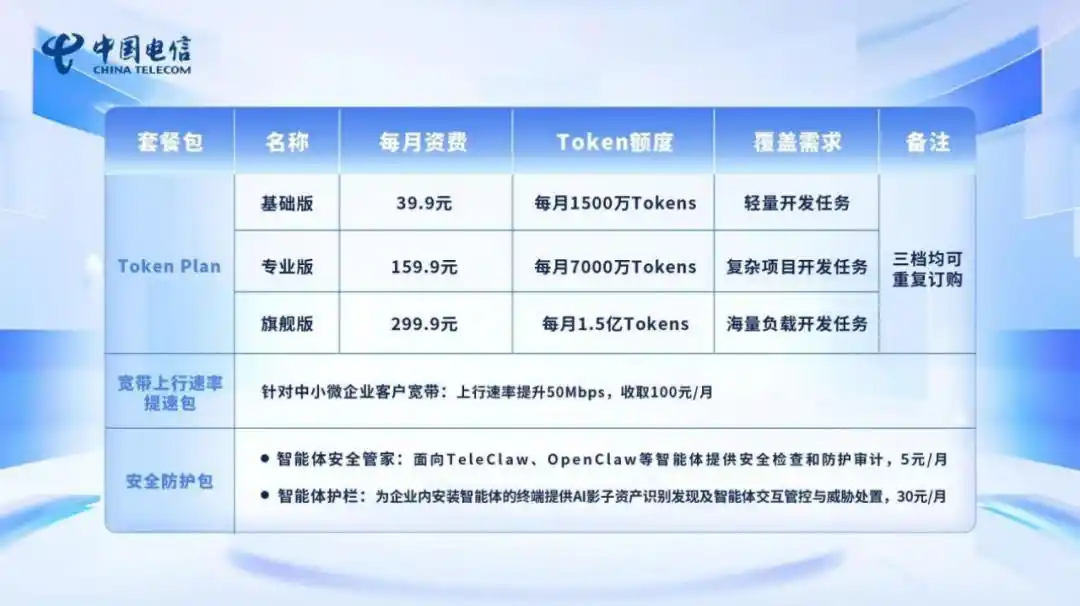
On social media, some netizens said: "Free trial first, then raise prices when you're hooked, I'm familiar with this routine." More people complained about the high cost. As a comparison, on April 26th, DeepSeek officially released an API price adjustment announcement, lowering the input cache hit price for its full suite of APIs. The V4Pro model's million token input cache hit price is as low as 0.025 yuan, about 1/40th of Telecom's price.

Although the top-level design is in place, in specific business promotion, the three major operators are not in sync. On May 20th, "Bao Bian" called Shanghai Telecom's customer service. From the call, the customer service seemed somewhat unfamiliar with the token package, needing to search for "token" in the backend to introduce the package price based on materials, but was not familiar with how to use tokens. During this process, English spelling mistakes even occurred multiple times.

Zhejiang Mobile's customer service, after searching for "token," began to introduce the "Cloud Computer" business: targeting B-end enterprises, employees can access the company's intranet and operate professional software through a virtual desktop in the cloud. However, the customer service was not familiar with the token package for C-end users. At a Wenzhou Unicom offline business hall, staff were also unaware of the token package, and there were no related materials displayed in the store.

Despite the market not yet being opened, compared to mainstream large models on the market, telecom token packages can be purchased directly with mobile phone credit and support cross-model use. After purchasing token credits, users can call over 30 mainstream large models on-demand through API interfaces, integrating AI capabilities into their own software or automated workflows. If directly recharging on a large model company's platform, the balance can only be used on that specific model. Different models have their own strengths. If a user needs to use another model, they have to recharge again, which may cause waste.

This is similar to users buying a general mobile data package from an operator, which can be used for apps like WeChat, Douyin, and Taobao; whereas if they buy Tencent's directed traffic package, they cannot open Taobao or Douyin.

For ordinary users, if they only engage in daily conversations with large models, write basic copy, etc., current mainstream large models can basically handle it. Token packages are more suitable for developers or heavy AI users who love to tinker, have programming basics, and know how to call APIs.

The Anxiety of Operators

From selling call and SMS packages, to internet data, and now to selling token packages, telecom operators' businesses are continuously evolving.

In recent years, as the growth of traditional mobile and broadband businesses has slowed, operators have fallen into growth anxiety. Looking at the 2025 financial reports released by Unicom, Telecom, and Mobile, their revenues increased by only 0.7%, 0.1%, and 0.9% respectively, hitting a six-year low. Mobile phone and broadband business growth has significantly slowed, with some core revenue indicators declining year-on-year. Among them, China Mobile's net profit attributable to the parent company even fell by 0.9% year-on-year.

On one hand, the traditional personal communication business market has reached its ceiling. Taking China Mobile as an example, the total number of users in 2025 was 1.005 billion, with only a net increase of 1 million for the whole year, indicating almost stagnant growth. On the other hand, under stock competition, operators are caught in homogeneous internal competition, competing on low prices, further depressing the tariff standards. In 2025, mobile ARPU (Average Revenue Per User) was 46.8 yuan, a year-on-year decrease of 3.5%.

When traditional telecom businesses fall into growth stagnation, emerging businesses become a breakthrough for new growth curves.

At the 2026 China Telecom Sixth Technology Festival, Shanghai Telecom General Manager Gong Bo stated in his speech that the "15th Five-Year Plan" period begins with fully embracing artificial intelligence, responding to the group's "Cloud Reform, Digital Transformation, Intelligence Benefits" strategy, and promoting the deep integration of AI with the economy, society, and people's livelihood.

Selling tokens to the C-end is essentially providing AI services to users. When the unfamiliar token is packaged into perceivable AI services, demand might be stimulated.

"Bao Bian" saw on the mobile APP that entering the AI trial zone on the homepage allows users to experience functions like smart cutout and smart removal. Cutting out a person from a photo consumes 31,000 tokens, while the token balance gifted in the backend is 500,000. This means that after users edit about a dozen photos, if they want to continue, they have to "pay more."
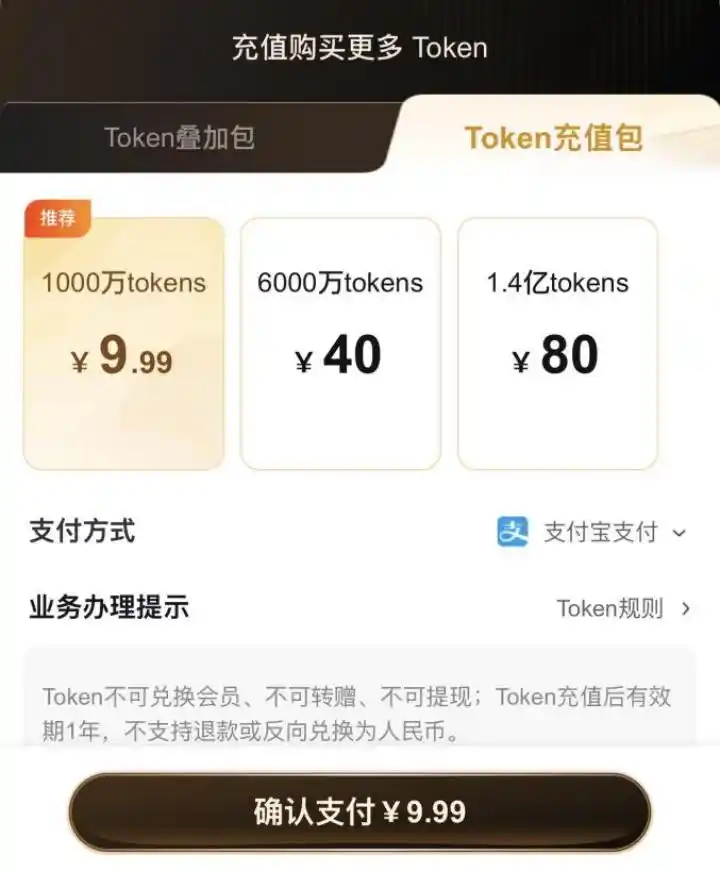
Token purchase page on China Mobile APP

During the cutout process, the system prompts that the specific service is provided by Meitu, with Mobile playing the role of a "channel." In the Meitu app, users can enjoy basic cutout services for free. If they want to experience advanced features, the continuous monthly subscription fee is 30 yuan/month. Therefore, if users have a large number of photo editing needs, buying a Meitu membership directly is clearly more cost-effective.

On the Unicom app, there is only a "Pet Ai" zone where users can use AI to generate images of pet cats and dogs, customizing exclusive electronic pets.

"Bao Bian" randomly surveyed several C-end users, all of whom gave feedback that these functions are not essential needs and they wouldn't specifically buy tokens from operators for this: "I already have a Meitu membership, bought cheaply on Xianyu," "Who keeps electronic pets nowadays?"...

Thus, even though operators are trying to transform into AI, their "pipeline" nature remains serious. They haven't been able to create sufficiently hardcore C-end products. Whether they can use AI to activate user consumption and reverse the decline still awaits market testing.

New Computing Power Infrastructure

When operators squeeze into the AI track, they no longer face only competition among themselves but have to "grab the rice bowl" from numerous cloud vendors.

On this track, mainstream players like Alibaba Cloud, Volcano Engine, Huawei Cloud, Tencent Cloud, and Baidu AI Cloud have already captured the most lucrative markets with their first-mover advantages.
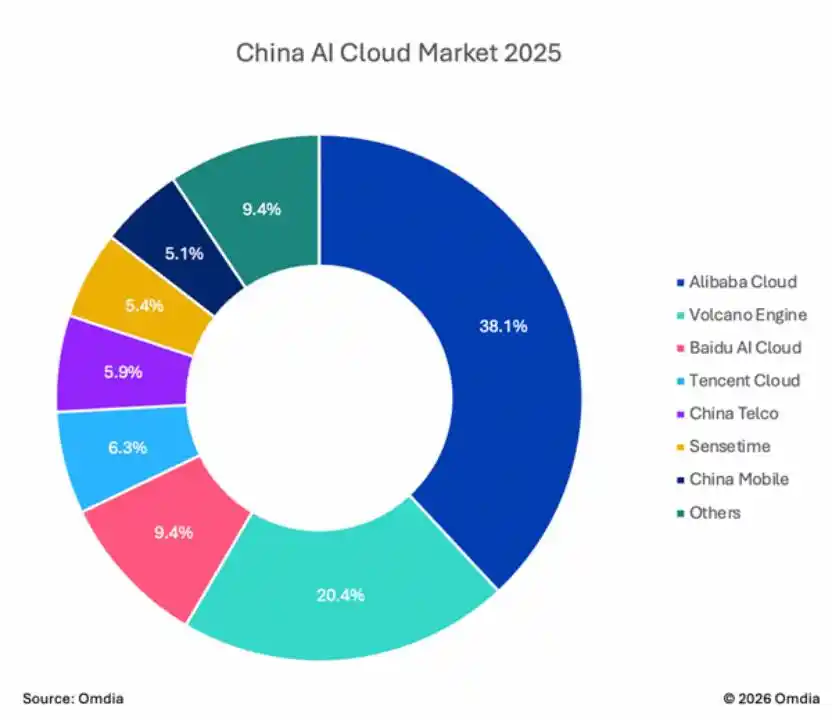
2025 China AI Cloud Market Share

At the same time, these cloud vendors' price echelons have matured. Facing a supply-demand imbalance market situation, they have recently intensively raised computing power prices, showing strong market performance.

Besides computing power advantages, Alibaba, ByteDance, and Tencent's Qwen, Doubao, Yuanbao large models have obvious advantages in C-end users. In contrast, operators' large models do not have advantages in product performance and developer ecosystems. Although China Telecom has its self-developed "Xingchen" large model, customer service, when introducing the token package, also highlighted support for models like DeepSeek and Zhipu GLM.

Essentially, telecom operators are doing the business of a "model supermarket," playing the roles of "pipeline" and "integrator." However, their advantages in offline base stations, networks, etc., are important cornerstones of the national unified computing power network.

Relevant policies indicate that AI must deeply integrate with advanced manufacturing, shifting focus from technological breakthroughs to large-scale, replicable, monetizable scenario penetration. Although cloud vendors' large models perform strongly, AI is far more than a cloud matter. The unique advantage of operators lies precisely in those ground-level capabilities that internet companies find difficult to replicate.

For example, autonomous driving is considered an important application scenario for AI + physical. High-speed movement of vehicles requires low-latency, high-reliability computing power. Operators' base stations spread across the country can become the frontier touchpoints for physical AI. Currently, China Telecom is focusing on building a "4+4+31+X" computing power network, creating a four-level computing power system of "center-province-edge-end." Whether for large models or physical AI, telecom operators participating in the unified scheduling of computing power resources can extend computing power coverage to the township level.

Especially when AI inference requires cross-regional scheduling of computing power, the stability, low latency, and high bandwidth of the network become particularly crucial. If cloud vendors' large models are imagined as "power plants," then operators are equivalent to the "power grid" covering the whole country. Power plants can be very strong in generating electricity, but delivering electricity to every household relies on the power grid.

A Vice President of Vipshop told "Bao Bian" that the computing power network is like the power grid over 100 years ago. In his view, when electricity was first born, many people didn't know how to use it. It wasn't until the power grid delivered electricity to every household that various electrical appliances emerged, creating new markets and application scenarios. Similarly, although most people are not familiar with tokens now, with the completion of the unified computing power network and the decline in computing power costs, entirely new computing power consumption scenarios will emerge.

From this perspective, operators entering the market to sell computing power is not just a showdown between large models but a reconstruction of computing power infrastructure. The competition for operators in the AI era is not to prove they can train models stronger than Alibaba or ByteDance. It is to prove that when AI computing power becomes infrastructure like water and electricity, operators with the "power grid" are the ones closest to delivering it to users.

This article is from the WeChat public account "Bao Bian" (ID: baobiannews), author: Chen Fashan

Related Questions

QWhy are China's major telecom operators starting to offer token packages, and what core issue are they trying to address?

AChina's telecom operators are launching token packages primarily to seek new growth drivers. Their traditional core businesses like mobile and broadband services have stagnated, with slowing revenue growth and declining user growth. By selling token (computing power) packages, they aim to transform into AI service providers. The goal is to stimulate new consumer demand and reverse their growth slowdown by offering packaged AI services, moving from being mere network 'pipes' to becoming AI infrastructure and service integrators.

QHow do the prices of telecom operators' token packages compare with major model providers like DeepSeek?

AThe telecom operators' token packages are significantly more expensive than those from leading AI model providers. For example, Shanghai Telecom offers 250,000 tokens for 1 yuan or 10 million tokens for 9.9 yuan per month. In contrast, DeepSeek's API pricing was adjusted in late April 2026, with its V4Pro model costing as low as 0.025 yuan per million tokens for cache hits, making it approximately 1/40th the price of the telecom operators' offerings.

QWhat unique advantages do telecom operators claim to have when entering the AI computing power market compared to cloud giants?

ATelecom operators position their unique advantage not in superior AI models, but in their nationwide physical infrastructure. They highlight their extensive network of base stations, vast user reach, and ability to ensure stable, low-latency, high-bandwidth connectivity—critical for real-time AI applications like autonomous driving. They compare themselves to a 'national power grid' that delivers computing power everywhere, whereas cloud giants are likened to 'power plants.' Their role is to integrate and deliver various AI models through a unified platform, supporting cross-model usage with mobile billing.

QWhat are the main user criticisms and practical challenges regarding the telecom operators' new token packages?

AMain criticisms include high prices, lack of clear necessity for average users, and poor frontline service awareness. Many users find the packages expensive compared to alternatives. Basic AI tasks can be handled by free models, making paid tokens seem unnecessary for non-developers. Practical challenges include inconsistent promotion among operators, with customer service staff often unfamiliar with the product, and a lack of compelling, exclusive C端 applications. The operators currently act more as channels for third-party services rather than offering unique, high-value AI features.

QWhat is the strategic vision behind building a 'national integrated computing power network,' and what role do telecom operators play in it?

AThe strategic vision is to transition from fragmented, enterprise-level computing power construction to a nationally unified, scheduled computing power infrastructure, akin to a high-speed 'computing highway.' This aims to make AI computing power a ubiquitous, affordable public utility like water and electricity. Telecom operators are seen as the foundational 'grid' for this network due to their existing nationwide coverage of base stations and networks. Their role is to participate in unified resource scheduling, extending computing power coverage down to the township level, enabling efficient cross-regional AI inference and supporting the deep integration of AI with physical industries and advanced manufacturing.

Related Reads

Blocked Its Own Treasure, WeChat AI Steps Up

Tencent's stock surged over 10% on June 2nd amid reports that WeChat, with 1.43 billion monthly users, is finalizing tests for a native AI Agent. The reported feature, accessible by swiping right from the main interface, allows users to issue commands in natural language. The AI then decomposes tasks and automatically calls upon relevant Mini Programs within WeChat to complete actions like ordering food, booking tickets, or making payments, creating a closed-loop service execution system. This strategic shift follows the internal conflict and subsequent "blocking" of Tencent's standalone AI app, Yuanbao, by WeChat for violating sharing rules during a 2026 Spring Festival promotion. The incident highlighted a lack of internal consensus and exposed the weakness of competing in the standalone AI assistant arena against rivals like ByteDance's Doubao (345M MAU) and Alibaba's Qianwen. The new WeChat AI Agent aims to leverage WeChat's unique assets—its massive user base, standardized Mini Program APIs, WeChat Pay, and identity system—to move from simple content generation to actual task execution. Analysts note this changes the competitive landscape from model benchmarks to which AI can connect to more real-world services. However, success depends on key variables: the capability of Tencent's underlying Hunyuan model, managing massive inference costs, and redesigning incentives for Mini Program developers whose traffic might be bypassed. The move is seen as an attempt to keep user service intent within WeChat's ecosystem as AI begins to redefine how users access services.

marsbit53m ago

Blocked Its Own Treasure, WeChat AI Steps Up

marsbit53m ago

ByteDance Adopts Arm CPUs, Jensen Huang: So Sad I Didn't Buy Arm

**Summary:** At Computex 2026, Arm CEO Rene Haas announced that ByteDance and Oracle have adopted Arm's self-designed Arm AGI data center CPU. The company expects significant revenue growth from this product, projecting $20 billion in demand for the 2027/2028 fiscal years. Haas noted that restricting AI-capable CPUs from the US to China is nearly impossible due to their widespread applications. Arm's stock has surged dramatically this year, notably rising 16% after NVIDIA's Arm-based Vera CPU and RTX Spark announcements. A highlight was the informal, humorous on-stage conversation between Haas and NVIDIA CEO Jensen Huang. Huang joked about NVIDIA's failed attempt to acquire Arm and playfully lamented selling his Arm shares. Both executives showed a clear sense of camaraderie and shared regret over the missed merger. Key technical topics were discussed: 1. **AI PC Design:** Huang explained NVIDIA's RTX Spark superchip (with a 20-core Arm CPU) is designed for future AI agents that will autonomously run and use tools on PCs, blending local and cloud processing. 2. **Agent vs. OS:** Huang emphasized the operating system remains crucial, as AI agents rely on its APIs and tools to function. 3. **Growth Constraints:** He identified the shift to "useful AI" that generates profitable tokens as a primary driver for immense, almost limitless, computational demand. Haas outlined Arm's strategy across PC and data centers. For PCs, Arm collaborates with partners like NVIDIA and MediaTek, offering its compute subsystem (CSS) for custom SoCs. In data centers, its Arm AGI CPU (built on TSMC's 3nm process) has gained major partners including OpenAI, Meta, and now ByteDance and Oracle. Arm presented a multi-year roadmap for its in-house CPU line. The article concludes that while GPUs dominated the AI training race, the explosion of AI agents is shifting significant focus to CPUs for inference, state management, and tool orchestration. The industry is trending towards vertical integration, with companies like cloud providers designing chips and chip/IP firms offering full solutions, all competing to deliver more efficient computing per watt.

marsbit1h ago

ByteDance Adopts Arm CPUs, Jensen Huang: So Sad I Didn't Buy Arm

marsbit1h ago

New Wall Street Play: Yen Shorts Still Adding, But Japan Stocks Don't Rely on Carry Trade Unwinding

On June 3rd, USD/JPY hit 160.44, its highest level since July 2024, while the Nikkei 225 surged past 68,000 points. Contrary to popular narratives of an imminent "carry trade unwind" akin to August 2024, data reveals a more complex picture. Speculative net short positions in yen futures have actually increased, reaching -114,667 contracts by late May, suggesting traders are doubling down rather than retreating. Meanwhile, Japan's Finance Ministry conducted its largest-ever single-round FX intervention (11.73 trillion yen) in April-May but failed to hold the 160 yen line. The Nikkei's rally is not driven by carry trade dynamics. Foreign investors are aggressively buying Japanese stocks, with net purchases in 2026 running nearly 16 times higher than 2025 levels. This inflow is concentrated in AI and semiconductor-related stocks like SoftBank and Socionext, fueled by positive sector outlooks, rather than being a flight from unwinding yen shorts. Furthermore, the Nikkei has continued climbing despite the Bank of Japan's (BOJ) rate hikes to 0.75%. This disconnect exists because the current equity boom is fueled by AI-driven foreign investment, not reliant on cheap yen funding. However, this relationship remains fragile. Should the BOJ hike rates further (e.g., to 1.0%) while dollar weakness increases carry trade costs, the trajectories of the yen and Japanese stocks could reconverge, potentially triggering volatility.

marsbit1h ago

New Wall Street Play: Yen Shorts Still Adding, But Japan Stocks Don't Rely on Carry Trade Unwinding

marsbit1h ago

Broadcom's Q3 Guidance Misses Expectations by $12 Billion, After-Hours Trading Plummets Over 13%, AI Narrative "Cooling"?

On June 3, Broadcom released record Q2 FY26 results with revenue of $22.19B, up 48% YoY, and AI chip sales of $10.8B, up 143%. Adjusted EPS of $2.44 beat estimates. However, its Q3 AI semiconductor revenue guidance of $16B, while up over 200% YoY, fell roughly $1.2B (7%) short of analyst consensus expectations of $17.2B. This miss, coupled with slightly weaker-than-expected software revenue, triggered a severe market reaction. CEO Hock Tan maintained the FY26 AI revenue outlook of over $100B but did not raise it, disappointing investors who had priced in more robust growth. The stock plummeted over 13% in after-hours trading, erasing roughly $270B in market cap. The sell-off extended to peers like Marvell. A key concern for markets, particularly for Chinese optical module suppliers, was Tan's comment that the contribution of AI networking (e.g., Ethernet switches, optical interconnect chips) to AI revenue, currently near 40%, is expected to normalize to around 30% over time, signaling a potential peak in growth for that segment. Despite the guidance shortfall, Tan reiterated that AI demand remains "insatiable" and reaffirmed the long-term target of exceeding $100B in AI revenue by FY27. The reaction highlights the heightened sensitivity and premium valuation placed on AI-exposed stocks, where anything less than stellar guidance can prompt significant profit-taking. The broader question is whether this represents a cooling AI narrative or a correction in overstretched valuations.

marsbit1h ago

Broadcom's Q3 Guidance Misses Expectations by $12 Billion, After-Hours Trading Plummets Over 13%, AI Narrative "Cooling"?

marsbit1h ago

Trading

Spot
Futures
活动图片





