The Big Breakthrough in Embodied Intelligence is HERE!!!
Since Generalist released the embodied brain Gen 1.5 last week, capable of learning actions from 3 to 12 seconds~
Just now, North American embodied startup Skild AI released a brand-new robot foundation model, S1, directly pushing the task length for robot in-context learning to over 10 minutes.
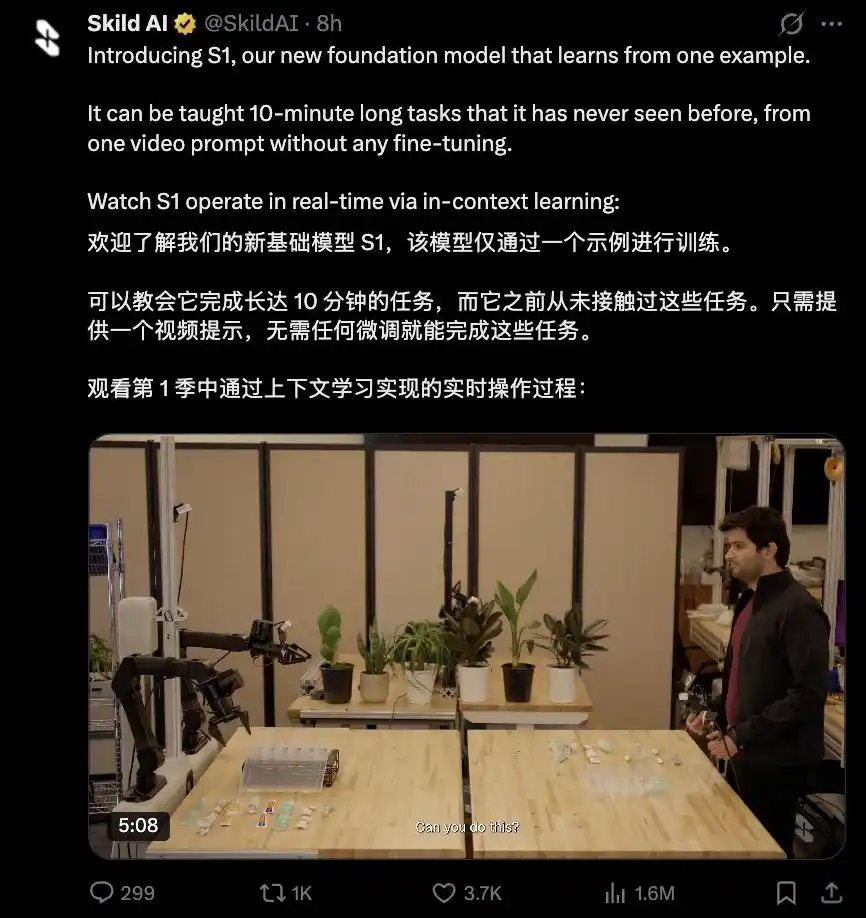
This S1 focuses on in-context learning (ICL):
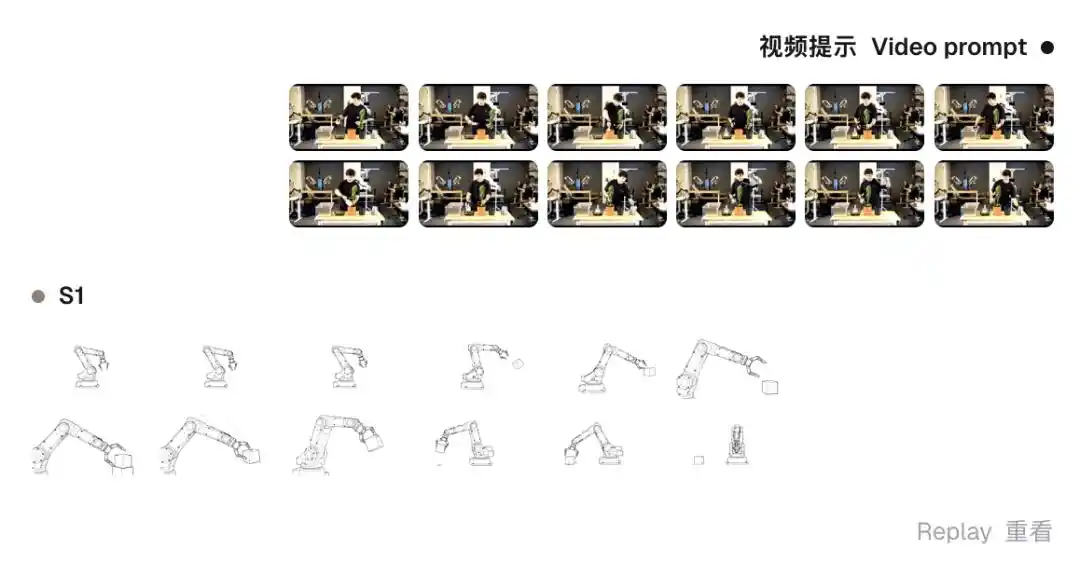
Without needing specialized learning of new manipulation data in a post-training phase, it can simply watch a human demonstration video and "copy the action," directly completing a whole set of complex, unseen operational procedures.
In official demos, the robot completed long-horizon tasks like making pancakes, brewing coffee, repotting a plant, and assembling equipment. On unseen tasks, it achieved a success rate of 66%, far exceeding language-prompted VLAs (only 9%).
Furthermore, even if going the traditional route of post-training fine-tuning, it would take roughly 380 task demonstrations to match S1's effect after watching just one demo.
Absolutely amazing!
It can be said that this recent wave of work focusing on in-context learning has reignited hope for embodied intelligence.
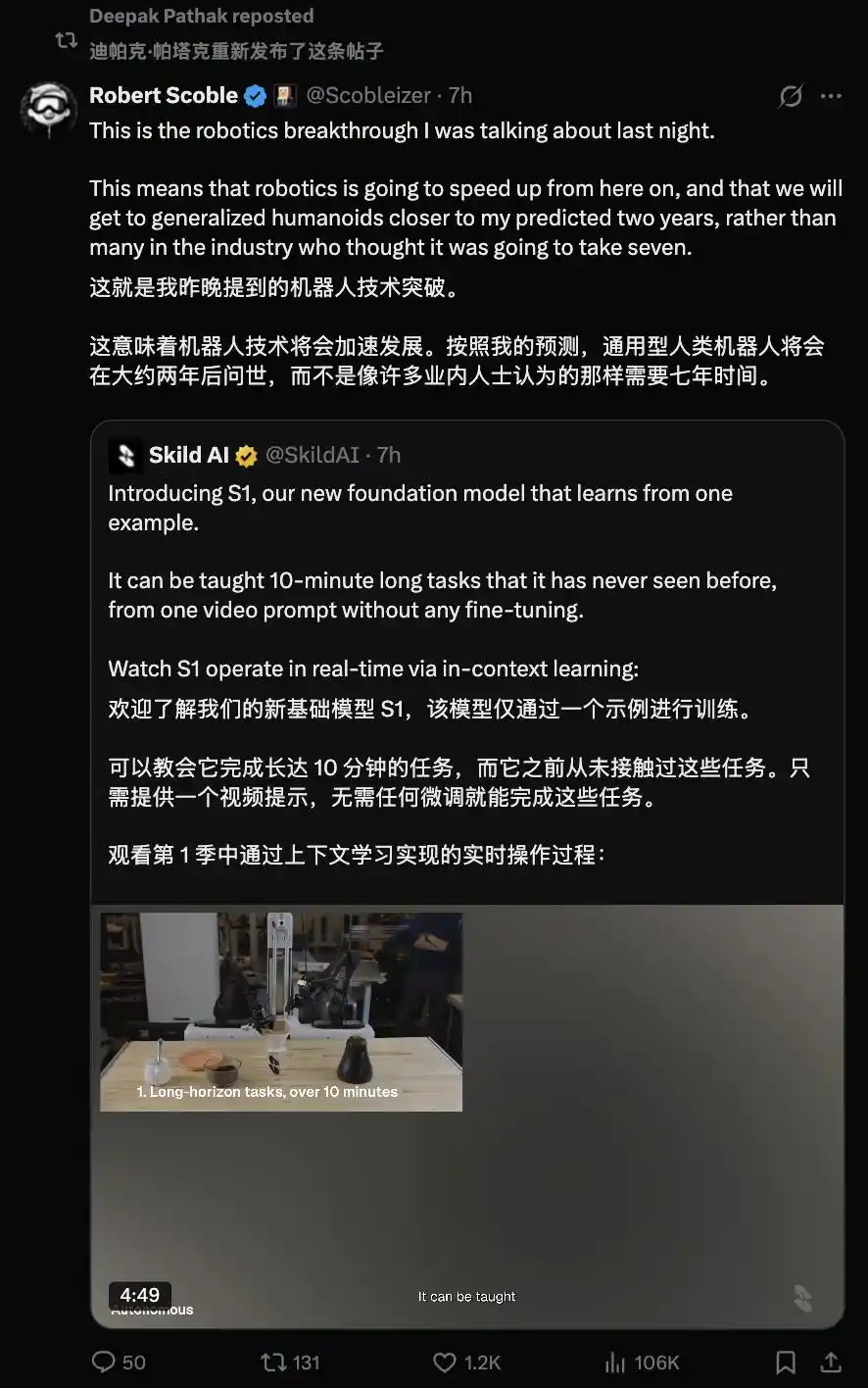
Some Twitter users believe general-purpose robots might appear in two years, not seven.
Others noted that from Rhoda, to Generalist last week, to Skild S1's 10-minute tasks now, the true GPT moment for robots seems to be arriving.
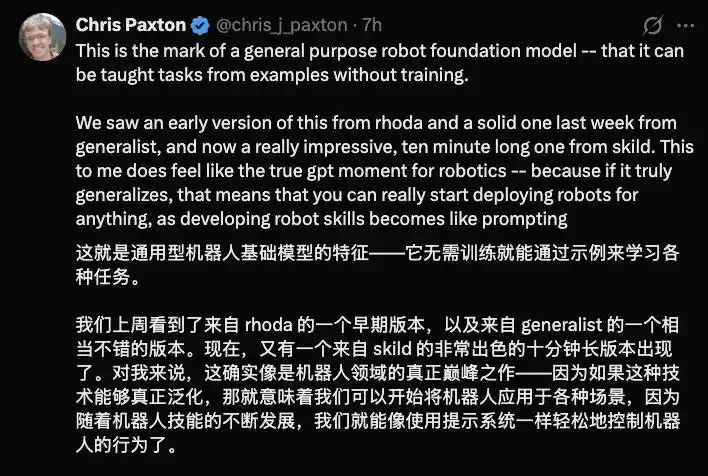
Because once this capability truly generalizes, developing robot skills in the future might indeed become as simple as writing a prompt for ChatGPT.

Is it really that magical? Let's take a closer look.
From the BERT Era, Towards the GPT Era
To understand how S1's in-context learning works, we first need to see how traditional robots learn a new skill.
In the traditional pipeline, robot learning is quite similar to large models:
First, pre-train on massive data to learn some foundational capabilities; then, for specific scenarios, collect data for a particular task and teach the robot specialized skills through post-training.
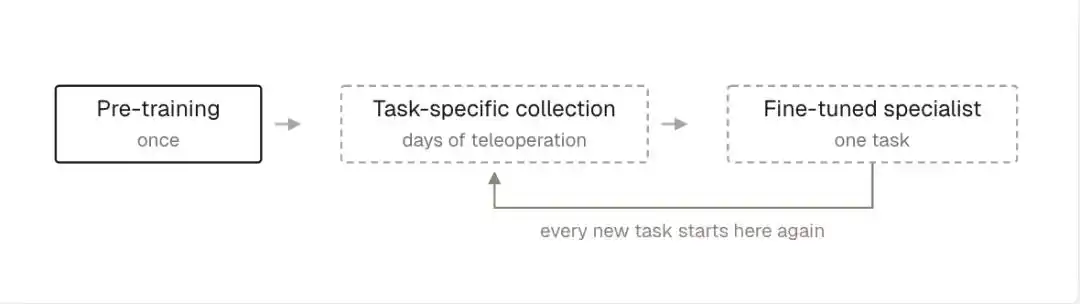
The problem is, while the process is similar for robots and large models, the data costs are completely different.
Large models' pre-training data comes largely from the internet; even for specialized scenarios like programming or agents, much post-training data can be quickly obtained online or even auto-generated.
But robots have it tough. Pre-training data must be collected in the real world, and post-training data still has to be collected in the real world.
So, in their technical blog, Skild AI doesn't hold back:
If a robot foundation model still requires dozens or hundreds of hours of real robot data and re-post-training to learn each new task, then I ask you, where is the "foundation" in this "foundation model"?
They even cite existing research suggesting that if there's already enough data for a new task, a model trained from scratch might even catch up to a foundation model that was pre-trained and then fine-tuned.
So, what's the point of embodied pre-training?
Skild's answer: In-context learning.
To have a reference point, Skild draws a parallel with the development path of large models.
Early BERT was already powerful, but each time it encountered a new task, it often required re-preparing data and fine-tuning again.
The real game-changer was the in-context learning ability that gradually emerged after GPT-3:
Without changing model weights, just by giving a few examples in the prompt, the model could temporarily "learn" a new task.
Based on this, Skild believes robots are currently stuck in a similar BERT era. What they truly want is for robots to undergo the same paradigm shift.
That is, the real value of pre-training shouldn't just be to reduce the data needed for post-training, but to ultimately give robots the ability to "learn directly from context."
In-Context Learning
So, what exactly does S1 learn from context this time?
Skild believes that two dimensions truly test a robot's in-context learning ability:
First, can it learn new skills never seen during training? Second, can it recombine existing skills to complete a long, complex new task.
For example, a robot can learn how to make pancakes simply by watching a video of flipping pancakes—
even though this skill never appeared in its training data before.
Meanwhile, compared to the second-long videos demonstrated by Gen-1.5 last week, S1 has now pushed in-context learning to a maximum of 10 minutes.
In tasks like repotting plants, each task requires continuously completing dozens of operational steps. In these long-horizon task demonstrations, the robot needs not only to copy the actions but also to know:
What step am I on now? What's next? How do I combine skills? And what to do if I mess up in the middle.
In other words, the robot needs to truly understand the task-action intent in the video demonstration, adapting and responding on the fly, not just simple behavior cloning.
Furthermore, in the plant repotting task, it took only 11 minutes from recording the demo to the robot performing the task itself, completely blowing traditional post-training out of the water in terms of efficiency.
Finally, throughout this entire process, S1 didn't use fine-tuning or post-training. The model weights remained completely unchanged. Using the same set of weights, it completed all the tasks shown in the blog.
This essentially aligns with the leap large models made from BERT needing scenario-specific fine-tuning to GPT-3 completing OOD tasks just by looking at demonstrations.
The only difference is that the prompt is no longer language, but action videos that better align with downstream tasks.
Experiment: Is ICL Really More Scalable?
In the experimental section, Skild first compared ICL video prompts with traditional language-prompt VLAs on tasks seen (in training data) and unseen tasks.
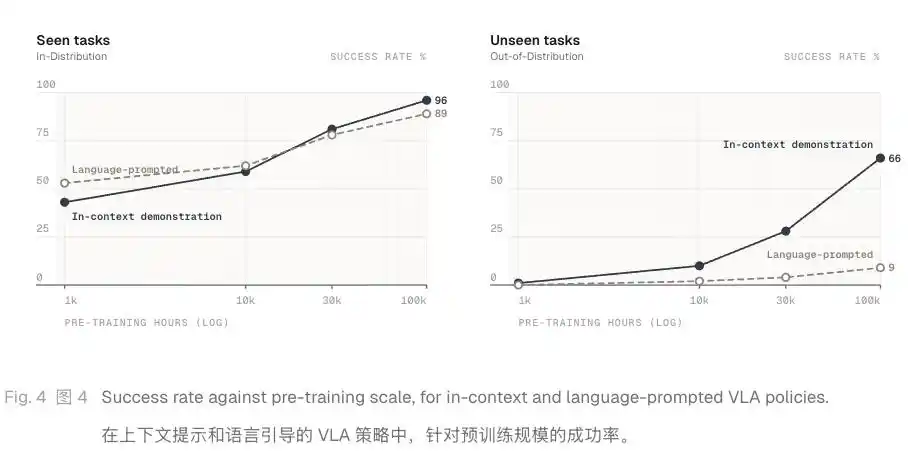
Test results show that with only 1,000 hours of training data, language prompts perform better. As data scale increases, ICL starts to surpass.
At 100,000 hours, on tasks seen during training: ICL 96%, Language Prompt 89%.
On the truly critical OOD tasks: ICL 66%, Language Prompt only 9%, opening a gap of over 7 times.
To verify S1's generalization, Skild conducted tests under different experimental conditions.
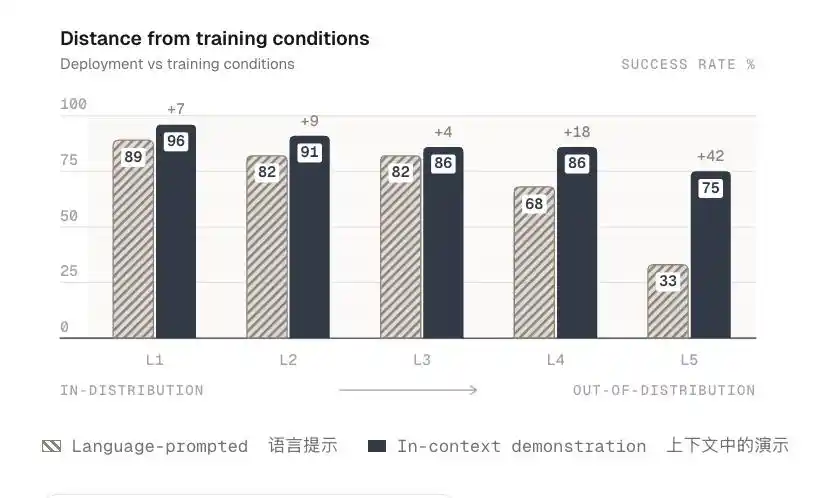
Results indicate that the performance drop for language-prompt VLAs can be up to 3 times that of ICL.
Meaning, what ICL learns isn't fixed-scene action repetition, but rather a greater ability to replan actions based on the current environment.
Finally, regarding one-shot learning.
Without any post-training on new tasks, S1 achieved a 66% success rate after watching just one video demonstration.
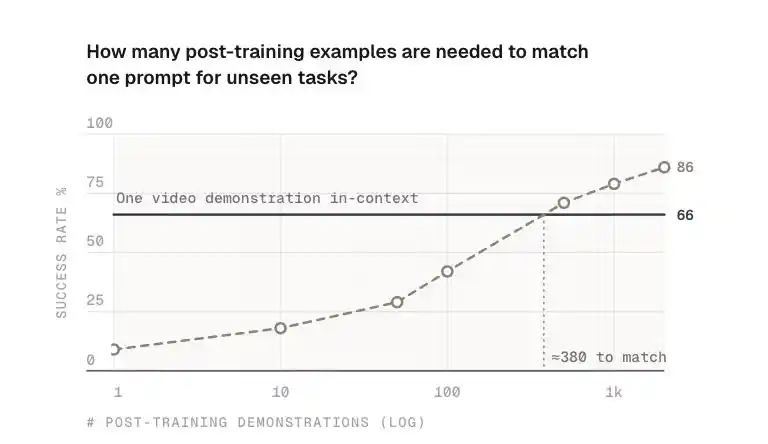
In contrast, traditional VLAs required about 380 demonstrations of post-training to reach a similar level.
Of course, after stacking up to 2000 demonstrations, traditional post-training can eventually reach 86%.
So the conclusion might not be "robots won't need training anymore," but rather:
Previously, a new skill might have required teaching hundreds of times; now, after watching once, it can directly perform at a 60-70% level.
This is what Skild calls the ICL scaling law:
The more data, the model doesn't just learn more skills, but increasingly learns how to "learn skills from demonstrations."
Who is Skild AI?
Skild was founded in 2023, backed by two familiar names from the CMU robotics circle: Deepak Pathak and Abhinav Gupta.
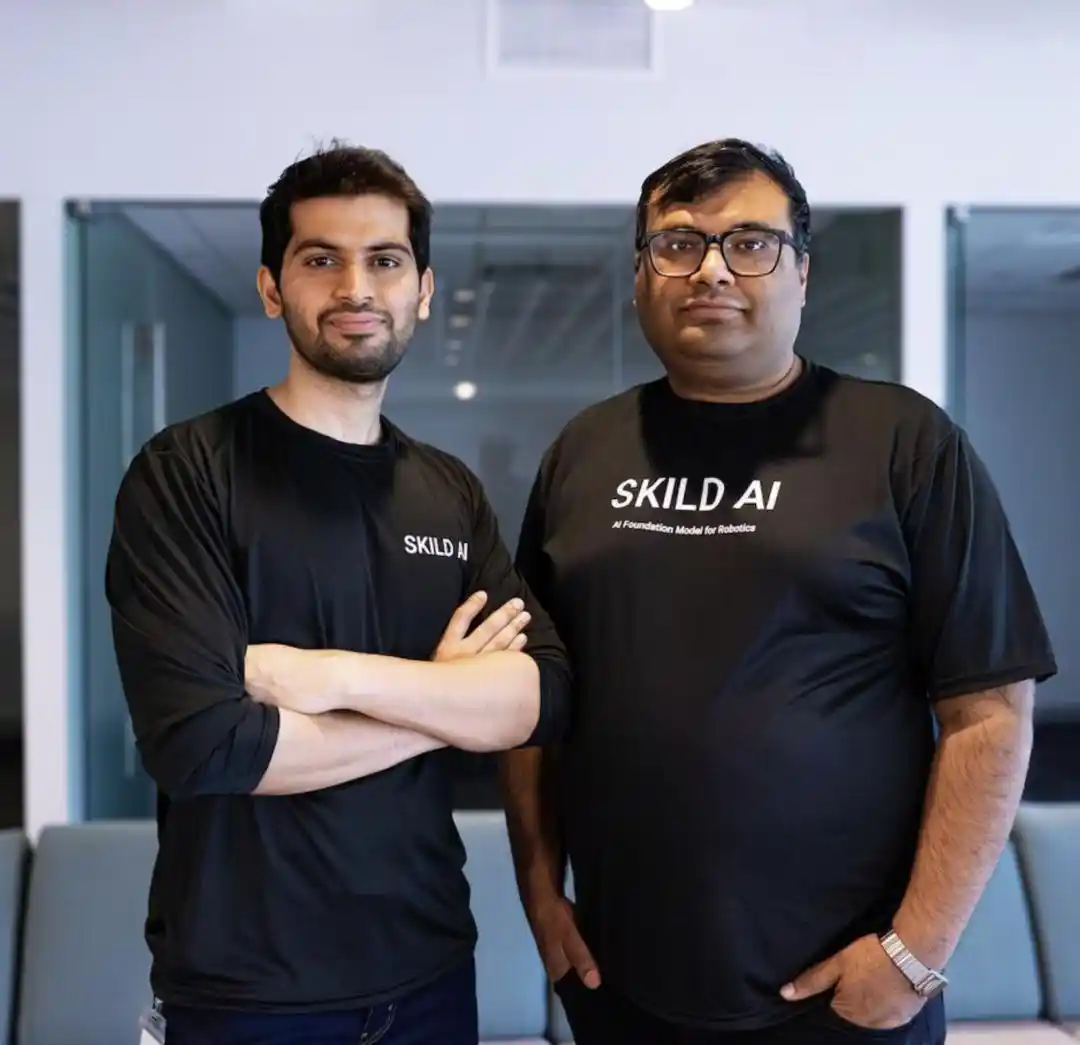
Both are professors at Carnegie Mellon University's Robotics Institute. Deepak primarily researches robot learning, reinforcement learning, and computer vision, while Abhinav is a leading figure in computer vision and self-supervised learning.
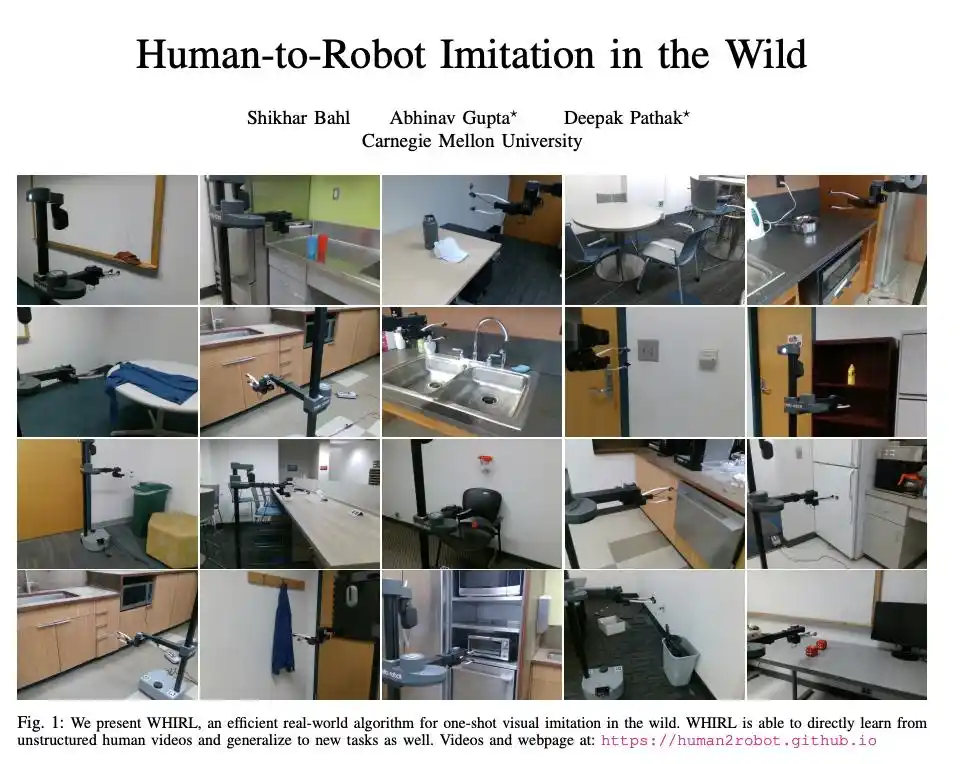
As early as 2022, the two collaborated on WHIRL, enabling robots to perform one-shot imitation by watching human videos. So the S1 path didn't just appear out of nowhere.
As a star company in the North American embodied scene, Skild raised a $300 million Series A at a $1.5 billion valuation upon emerging from stealth in 2024.
By January this year, it completed a $1.4 billion Series C funding round, pushing the valuation directly to over $14 billion, led by SoftBank, with Nvidia, Bezos, and others continuing to participate. In just over two years, the valuation increased nearly 10-fold.
Looking horizontally, Skild's positioning in the North American embodied scene is quite unique.
Compared to PI's focus on "Robot GPT," Generalist's recent emphasis on one-shot learning, and the full-stack momentum of Genesis AI or Sunday, Skild has consistently emphasized one phrase: Any robot, any task, one brain.
It emphasizes cross-embodiment more, hoping the same Skild Brain can run on different bodies like robotic arms, quadrupeds, and humanoids.
Put simply, it wants to become the Android of the robot era: an intelligence layer plugged into various bodies.
This also determines Skild's data strategy: Take it all.
Skild views robot data across three dimensions: hardware proximity, diversity, and scalability:
Real robot teleoperation is closest to hardware but expensive; first-person human videos are easiest to scale but far from robot bodies; simulation is cheap and can be mass-produced but has a sim-to-real gap.
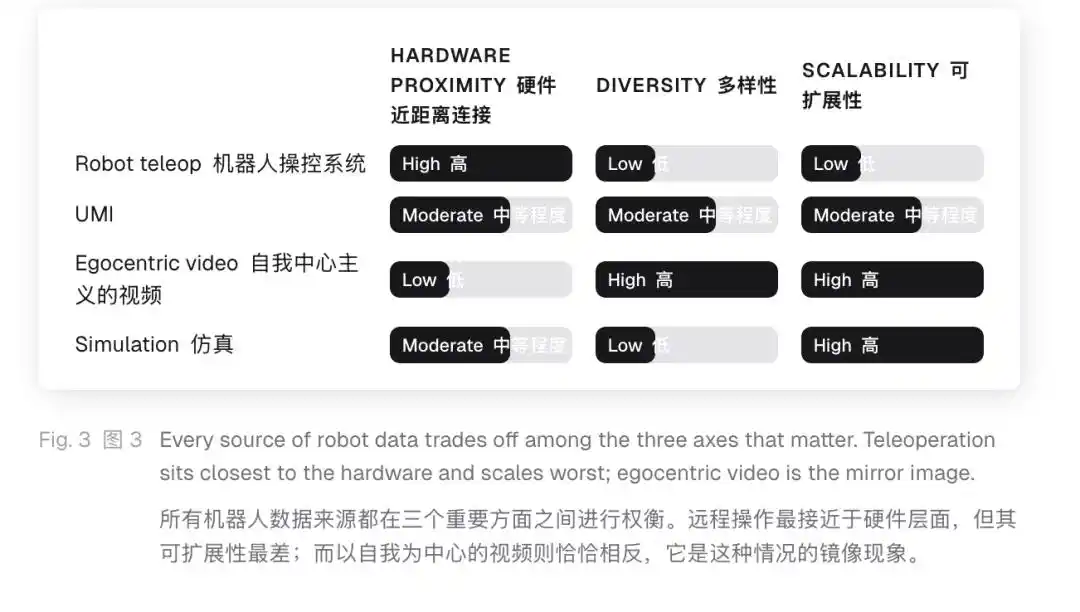
So their strategy for Robot Teleop, UMI, Egocentric Video, and Simulation is basically to use them all.
And S1's ICL is a natural extension of this path:
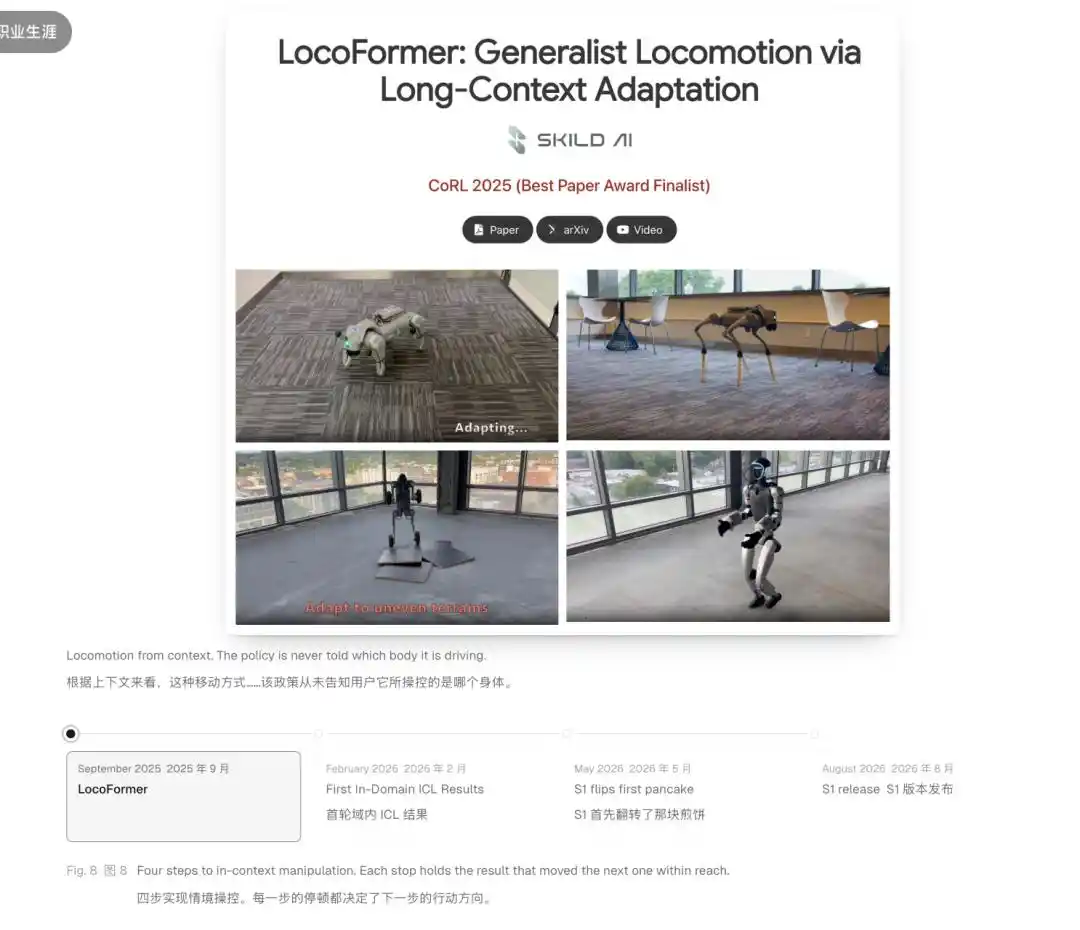
From LocoFormer in September 2025 → First In-Domain ICL in February 2026 → First pancake flip in May → S1 release in August, pushing in-context learning directly to OOD long-horizon tasks up to 10 minutes.
So the truly noteworthy question now might not be whether robots can learn more skills, but rather:
Can the cost of a robot learning a new skill really shift from "teaching hundreds of times" to "you do it once, it watches once."
If this scaling law continues to hold, then the so-called GPT moment for robots might really be more than just another marketing buzzword.
Reference link:[1]https://www.skild.ai/blogs/s1
This article is from WeChat public account "QbitAI," author: henry