Tiger Research: The Next Bull Market, Waiting for the Wind

比推Published on 2026-02-04Last updated on 2026-02-04

Abstract

Tiger Research analyzes whether the crypto market is currently in a "crypto winter" and outlines the conditions for the next bull run. Unlike previous bear markets triggered by internal crises (Mt. Gox hack, ICO crackdown, FTX collapse), the current downturn is driven by external factors like macro policies and tariffs, while internal fundamentals remain intact. The market has structurally split into three layers: a regulated sector (stable, institutional), an unregulated sector (speculative, experimental), and shared infrastructure (e.g., stablecoins, oracles). ETF inflows remain confined to Bitcoin and do not trickle down to altcoins. The next bull market requires: 1) a "killer app" emerging from the unregulated sector (e.g., AI agents, InfoFi), and 2) favorable macro conditions like liquidity injections. The era of broad-based rallies is over; growth will be segmented between regulated stability and unregulated volatility.

Source: Tiger Research

Author: Ryan Yoon

Original Title: Is This a Crypto Winter? Post-Regulation Market Shift

Compiled and Edited by: BitpushNew


As the market enters a downward cycle, skepticism towards the crypto market is growing. The core question at hand is: Have we entered a "crypto bear market"?

Core Views

  • The evolution path of a crypto winter: Major event → Collapse of trust → Brain drain.

  • The particularity of this cycle: Past winters were triggered by internal problems; the current surge and crash are both driven by external factors. It is neither a "winter" nor a "spring".

  • Three-tier market structure post-regulation: The market has split into a compliant zone, a non-compliant zone, and shared infrastructure; the past "Trickle-down effect" has disappeared.

  • Limitations of ETF funds: Funds remain within Bitcoin and do not flow outside the compliant zone.

  • Prerequisites for the next bull market: The birth of a "killer app," coupled with a favorable macroeconomic environment.

1. How Did Past Crypto Winters Evolve?
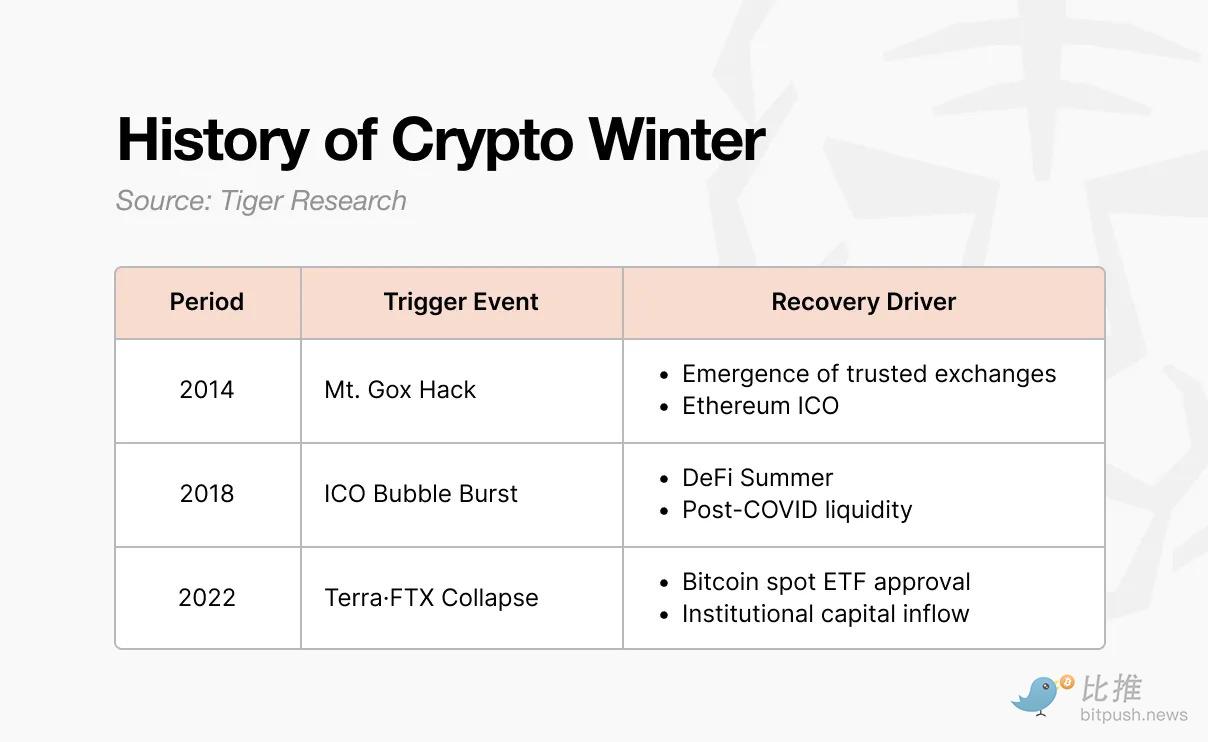
The first winter occurred in 2014. At that time, the Mt. Gox exchange handled 70% of global Bitcoin trading volume. Due to a hack, approximately 850,000 BTC vanished, leading to a complete collapse of market trust. Subsequently, various new exchanges with internal controls and audit functions emerged, and trust was slowly restored. Meanwhile, Ethereum was born through ICOs (Initial Coin Offerings), presenting a new vision and financing method for the industry.

This ICO model became the spark for the next bull market. When anyone could issue tokens and raise funds, the frenzy of 2017 was ignited. Projects raising billions with just a whitepaper were rampant, but most had no substance.

In 2018, South Korea, China, and the US successively introduced strict regulatory measures, the bubble burst, and the second winter arrived. This winter lasted until 2020. After the COVID-19 pandemic, liquidity began to pour in, and DeFi protocols like Uniswap, Compound, and Aave gained attention, leading to a return of funds.

The third winter was the most severe. The Terra-Luna collapse in 2022 triggered the successive failures of Celsius, Three Arrows Capital, and FTX. This was not just a simple price drop but a shake-up of the entire industry's structure. It wasn't until January 2024, when the U.S. Securities and Exchange Commission (SEC) approved the Bitcoin spot ETF, followed by the Bitcoin halving and Trump's pro-crypto policies, that funds began to flow in again.

2. The Pattern of Crypto Winters: Major Event → Collapse of Trust → Brain Drain

The first three winters all followed the same evolutionary logic: a major negative event triggered a collapse of the trust system, ultimately leading to a large-scale brain drain.

  • Starts with a major event: Whether it was the Mt.Gox hack, the ICO regulatory crackdown, or the Terra-Luna collapse and subsequent FTX bankruptcy, the scale and form varied, but the result was the same—the entire market was thrown into turmoil and panic.

  • Spreads to a collapse of trust: This shock quickly turned into a crisis of confidence. People who once discussed "what to build next" began to question whether crypto technology had real value. The collaborative atmosphere among builders disappeared, replaced by mutual blame.

  • Leads to brain drain: Doubts about the前景 led to an exodus of talent. The builders who had once created momentum in the blockchain space fell into pessimism. In 2014, they flowed into fintech and big tech companies; in 2018, they turned to traditional institutions and the AI field. They left here for places that seemed more certain.

3. Is This a Crypto Winter Now?

On the surface, some signs of past crypto winters are still clearly visible today:

  • Major events:

    • Trump memecoin: Its market cap once reached $27 billion in a single day, then plummeted by 90%.

    • The "10.10" liquidation event: The US announced 100% tariffs on China, triggering the largest liquidation wave in Binance's history ($19 billion).

  • Collapse of trust: Skepticism is spreading within the industry, and the focus of discussion has shifted from "building" to "blame-shifting."

  • Pressure of brain drain: The AI industry is growing rapidly, offering faster and more lucrative monetization paths than cryptocurrency.

However, it is difficult to define the current situation as a typical "crypto winter." Past winters erupted from within the industry—the Mt. Gox hack, ICOs going to zero, FTX blowing up—these were all cases of the industry destroying its own Great Wall.

The current situation is截然 different:

The approval of ETFs started the bull market, while tariff policies and interest rate changes drove the decline. External factors lifted the market, and external factors also dragged it down.
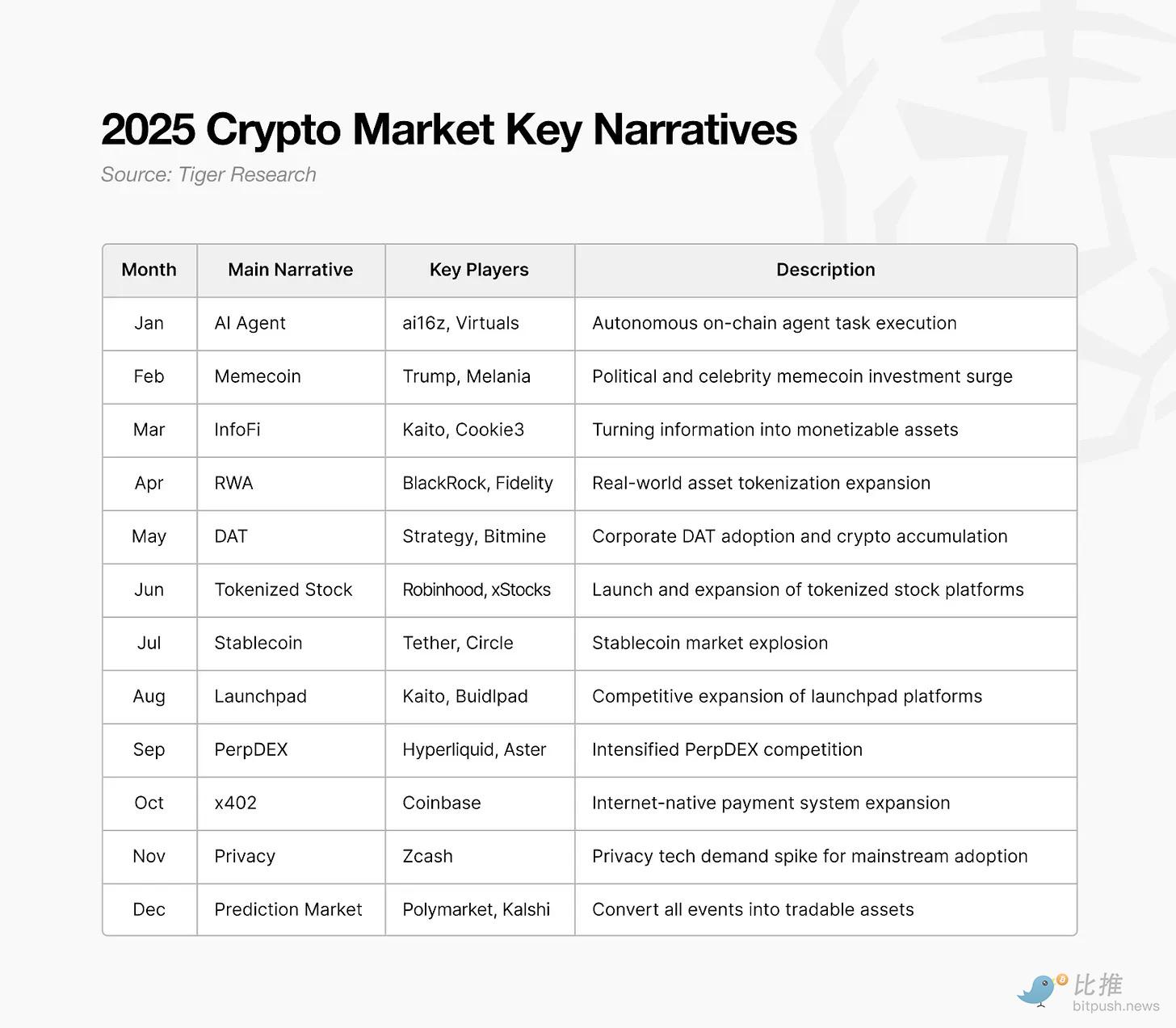
Builders have not left the field either:

New narratives such as RWA (Real World Assets), perpDEX (perpetual contract exchanges), prediction markets, InfoFi, and privacy protocols are emerging one after another and continue to iterate. Although they have not driven a full-market rally like DeFi did back then, they have not disappeared. The industry's fundamentals have not collapsed; only the external environment has changed.

Just as we did not personally create this "warm spring," there is currently no so-called "winter."

4. Fundamental Changes in Market Structure Post-Regulation

Behind this phenomenon lies the profound evolution of the market structure post-regulation. The market has now split into three levels: 1) The Compliant Zone, 2) The Non-Compliant Zone, and 3) Shared Infrastructure.
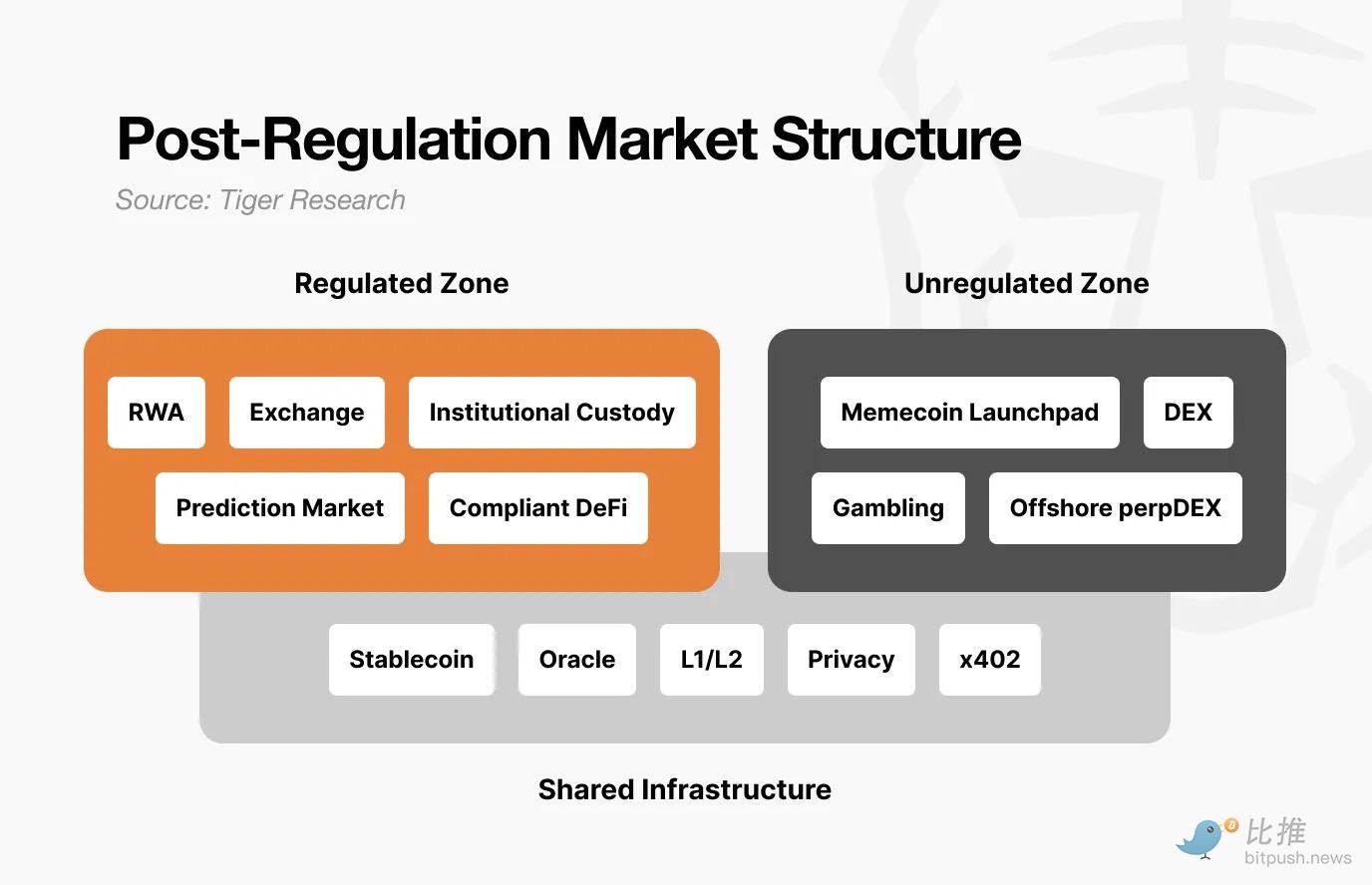
  • Compliant Zone: Includes RWA tokenization, licensed exchanges, institutional-grade custody, legal prediction markets, and compliant DeFi. These areas undergo audits, fulfill disclosure obligations, and are legally protected. Although growth is slower, the capital规模 is huge and stable.

    • Characteristics: After entering the compliant zone, it is difficult to expect the explosive 100x returns of the past. Volatility decreases, the上限 is limited, but the下限 is also guaranteed.

  • Non-Compliant Zone: This area will have an even stronger speculative色彩 in the future. Low barriers to entry, fast pace, surging 100x today and dropping 90% tomorrow will become the norm.

    • Significance: This space is not meaningless. The non-compliant zone is a cradle of creativity. Once a track is proven effective, it will migrate to the compliant zone (like DeFi back then and prediction markets now). It serves as an "experimental field," but itself will increasingly剥离 from compliant businesses.

  • Shared Infrastructure: Includes stablecoins and oracles. They serve both zones simultaneously. The same USDC can be used for institutional-grade RWA payments and for speculative trading on Pump.fun; oracles provide data verification for tokenized treasuries and support liquidations for anonymous DEXs.

This differentiation has changed the flow path of funds.

In the past, Bitcoin's rise would带动山寨币齐涨 through the "Trickle-down effect." Now it's different: institutional funds entering through ETFs stop dead within Bitcoin; funds in the compliant zone no longer flow to the non-compliant zone. Liquidity only stays where value is proven. Even Bitcoin itself, its属性 as a safe-haven asset has not yet been fully proven against risk assets.

5. Conditions for the Next Bull Market

The regulatory framework is being完善, and builders are still working hard. Two more conditions need to be met:

  1. A new "killer app" is born in the non-compliant zone: Something must emerge that can create全新 value, like the "DeFi Summer" of 2020. AI agents, InfoFi, and on-chain social are potential candidates, but they have not yet reached a scale that触动全局. The良性流动 of "non-compliant zone experiment → successful verification → migration to the compliant zone" must be formed again.

  2. Cooperation from the macroeconomic environment: Even if regulation is settled, builders are working hard, and infrastructure is perfect, if the macro environment is not supportive, the upside space is still limited. The 2020 DeFi boom erupted after the pandemic amid global massive liquidity injection; the post-ETF rise in 2024 also coincided with expectations of interest rate cuts. No matter how well the crypto industry does itself, it cannot control interest rates and liquidity. For the value built within the industry to gain widespread recognition, the macro environment must reverse.

A crypto season with "universal上涨" like in the past is unlikely to reappear. Because the market has彻底分裂. The compliant zone will grow steadily, while the non-compliant zone will continue to fluctuate剧烈.

The next bull market will eventually come, but it will not favor everyone.


Twitter:https://twitter.com/BitpushNewsCN

Bitpush TG Discussion Group:https://t.me/BitPushCommunity

Bitpush TG Subscription: https://t.me/bitpush

Original article link:https://www.bitpush.news/articles/7608772

Related Questions

QWhat are the three stages of evolution in a crypto winter according to the article?

AThe three stages are: 1) A significant negative event triggers the downturn, 2) This leads to a collapse of trust within the market, and 3) Ultimately results in a massive exodus of talent from the industry.

QHow does the current market downturn differ from previous crypto winters?

APrevious crypto winters were triggered by internal industry problems (e.g., Mt. Gox hack, ICO crackdown, FTX collapse). The current cycle is different because both the rally (driven by ETF approval) and the subsequent decline (driven by external factors like tariff policies and interest rates) were propelled by external factors, not internal industry failures.

QWhat are the three layers of the post-regulation market structure described in the article?

AThe market has split into three layers: 1) The Compliant Zone (e.g., tokenized RWA, licensed exchanges), 2) The Non-Compliant Zone (a space for speculation and experimentation), and 3) Shared Infrastructure (e.g., stablecoins, oracles that serve both zones).

QWhy has the 'trickle-down effect' of Bitcoin's price rally on altcoins disappeared?

AThe 'trickle-down effect' has disappeared because institutional capital entering through Bitcoin ETFs remains largely confined to Bitcoin itself within the Compliant Zone and does not flow into the Non-Compliant Zone where most altcoins reside. Liquidity now stays only in areas with proven value.

QWhat two conditions are necessary for the next crypto bull market to begin?

ATwo conditions are necessary: 1) A new 'killer app' must emerge from the Non-Compliant Zone, creating entirely new value (similar to DeFi Summer in 2020), and 2) There must be a favorable macroeconomic environment, such as lower interest rates and increased liquidity, which is outside the control of the crypto industry itself.

Related Reads

7 Months After the Collapse of Huiwang, Southeast Asia's Escrow Platforms Undergo a Major Reshuffle

Following the collapse of Huione Pay—dubbed the "Alipay of Southeast Asia"—seven months ago, the region's underground financial guarantee platform sector is undergoing a significant reshuffle. This power vacuum has been swiftly filled by emerging platforms such as XinBi, Tiger/Navigator, JinBei (renamed JinBo), Dali/Tiancheng, and FullyLight. These platforms, operating largely via Telegram and offering services like escrow for illicit transactions, have absorbed the vast user base and markets left behind by Huione. While positioning themselves as "trust intermediaries," their primary clientele consists of networks involved in online scams, money laundering, illegal gambling, and even human trafficking. For instance, the Tiger/Navigator platform explicitly provides "escrow" services for kidnapping-for-ransom operations ("强押车交易"). Data underscores the immense scale: Huione alone processed over $103 billion in cryptocurrency payments and facilitated over $31 billion through its escrow market before its downfall, linking it to Cambodia's notorious Prince Group. Since its collapse, competitors have seen explosive growth. For example, the XinBi platform has accumulated over $1.6 billion in total USDT revenue, while platforms like NewPay, OkPay (under Dali), and FullyLight Wallet collectively processed over $4.8 billion in USDT in a single year. This ecosystem thrives in regions like Cambodia and Myanmar, where regulatory gaps allow these platforms to act as critical financial infrastructure for sprawling cybercrime industries, from scam compounds to online casinos. The article concludes that the moniker "Southeast Asian Alipay" is a misnomer, obscuring the platforms' fundamental role in enabling serious criminal enterprises rather than representing legitimate financial innovation.

Odaily星球日报33m ago

7 Months After the Collapse of Huiwang, Southeast Asia's Escrow Platforms Undergo a Major Reshuffle

Odaily星球日报33m ago

The Changing Landscape: What Are Crypto VCs Experiencing?

Title: The Shifting Landscape of Crypto Venture Capital The era of dedicated crypto venture capital funds is undergoing a significant transformation. Once essential for navigating the sector's complexity and high risk, these specialized funds are now facing an identity crisis as the market matures. This shift mirrors historical patterns in other specialized investment classes like cleantech and SPACs, where initial information advantages dissipate as technologies become mainstream and integrated into existing industry frameworks. The article argues that crypto is reaching a critical inflection point, transitioning from a "building phase" to an "integration phase." Major players like Stripe, BlackRock, and Visa now engage with crypto not for its novel mechanics but as a foundational financial infrastructure. Their needs—regulatory compliance, banking partnerships, distribution channels—align with traditional fintech, a domain easily understood by large, generalist funds like Sequoia and Founders Fund. This evolution creates a "barbell effect" within the VC landscape. On one end are massive, diversified platforms that can incorporate crypto as one vertical among many. On the other are small, nimble funds focused on niche, experimental projects. The middle ground—medium-sized dedicated crypto funds—is being squeezed out. Their typical fund size makes it impossible to generate sufficient returns solely from early-stage crypto bets, yet they cannot compete with giants for later-stage deals. Consequently, leading crypto-native firms like Paradigm and Framework Ventures are expanding into AI, robotics, and other sectors, driven partly by LP pressure for better returns amid a broader VC DPI crisis. Others, like Dragonfly and a16z, have narrowed their crypto focus predominantly to financial infrastructure like stablecoins, reframing the sector's core narrative. For crypto entrepreneurs, this consolidation presents challenges. While generalist funds offer larger checks and broader resources, crypto projects now compete fiercely with AI for attention and capital within these firms. Furthermore, the long-term, non-commercial foundational work that built the ecosystem—funded by dedicated crypto VCs—is less likely to attract generalist capital focused on direct returns. The conclusion is that "crypto investor" as a standalone category is becoming obsolete, akin to "internet investor." Crypto is becoming a baseline infrastructure layer. The future will see a barbell structure: large-scale growth financing handled by generalist funds, while pioneering, speculative projects are funded by small, specialized vehicles. The dedicated crypto funds of the 2017-2021 boom, which incubated core infrastructure, are giving way to this new, bifurcated reality.

Foresight News50m ago

The Changing Landscape: What Are Crypto VCs Experiencing?

Foresight News50m ago

As Consensus Accelerates, What Are Young Investors Betting On?

Title: As Consensus Forms Faster, What Are Young Investors Betting On? In the rapid evolution of tech investment, a new generation of young investors is navigating a landscape where AI, robotics, commercial aerospace, and quantum computing are advancing simultaneously. Traditional investment logic based on financial models is giving way to a need for deep technical understanding and the ability to act before industry consensus forms. An analysis of trends from the "WAIC FUTURE TECH" list of young investment leaders reveals key shifts in focus. The first major trend is the movement of AI from the digital screen into the physical world. Investment is shifting from large language models and chatbots towards embodied AI, robotics, AI hardware, and edge computing. While demonstrations generate excitement, the real challenge lies in achieving scalable, reliable, and cost-effective delivery in complex real-world environments like factories and logistics. Success depends not just on algorithms but on the integration of sensors, actuators, and control systems. Second, the competitive focus for large models is moving beyond raw capability toward building an "intelligence flywheel." The goal is to create self-reinforcing systems where user interaction generates data, improving the model, which in turn enhances the user experience and attracts more engagement. Companies that successfully embed AI into workflows to create these closed-loop systems can build lasting value that isn't easily erased by the next model upgrade. Third, facing a potential bottleneck in high-quality human-generated data, investors are looking at new underlying technologies. Reinforcement learning and self-play, as demonstrated by AlphaGo Zero, offer paths for AI to generate its own experience. Scientific foundation models, which aim to build general AI capabilities for fields like life sciences and materials discovery, represent a non-consensus direction that could unlock new frontiers of knowledge and data. Finally, in deep-tech areas like quantum computing, commercial aerospace, and space-based infrastructure, patient capital is essential. These fields have long, uncertain development and validation cycles involving complex engineering, supply chains, and regulations. Investment here requires a long-term view, focusing on foundational team capabilities and the eventual emergence of market demand, even if commercial returns are distant. Collectively, these trends illustrate how young investors are adapting to a new era. They are learning to make earlier, technically-informed judgments, balance hype with real-world viability, and provide the patient capital needed to build the deep-tech foundations of the future.

marsbit1h ago

As Consensus Accelerates, What Are Young Investors Betting On?

marsbit1h ago

Trading

Spot
活动图片





