Three Months of Raising $6 Billion in Funding: What Are the Leading Crypto VCs Betting On?

marsbitPublished on 2026-05-08Last updated on 2026-05-08

Abstract

While the crypto bear market persists, top-tier venture capital firms are making significant moves by raising massive new funds, signaling a strategic bet on the industry's future. Haun Ventures and a16z recently announced funds totaling $1 billion and $2.2 billion, respectively. This follows other major raises from firms like Dragonfly, Paradigm, ParaFi, and Blockchain Capital. In under three months, these six VCs have amassed over $6 billion in fresh capital, a clear example of counter-cyclical investing during a quiet market phase. The fundraising landscape highlights a sharp divergence between large and small VCs. Many mid-sized and smaller funds are struggling with poor returns, limited exit options, and difficulty raising new capital, leading some to scale back or exit. In contrast, leading firms are strengthening their dominance due to structural advantages: superior access to high-quality deals, the ability to invest across all stages, greater capacity for long-term bets and risk, and stronger negotiation power. These new funds are largely converging on key investment themes. The strongest consensus centers on next-generation on-chain financial infrastructure, including stablecoins, real-world asset (RWA) tokenization, prediction markets, and on-chain payments. VCs are focusing on projects with validated demand that can attract traditional finance flows. Another major focus is artificial intelligence (AI), particularly AI agents, as crypto seeks to position its open...

Author: Azuma, Odaily Planet Daily

The bear market in cryptocurrencies continues, yet some highly significant moves have emerged in the primary market.

On May 4th, Haun Ventures, the venture capital firm founded by former U.S. federal prosecutor Katie Haun, announced the completion of a funding round totaling $1 billion. The early-stage and later-stage funds will each be allocated $500 million, primarily to be invested over the next 2 to 3 years in startups within the cryptocurrency and blockchain sectors, while also expanding into intersecting areas such as AI agents, fintech, and alternative assets.

Just one day later, a16z followed up by announcing the close of its fifth cryptocurrency fund, Crypto Fund 5, securing $2.2 billion in committed capital. The fund will continue to deepen its focus on the cryptocurrency market, concentrating on the often-overlooked yet most value-creating parts during cyclical shifts, transforming next-generation infrastructure into products people use daily.

Looking back further in the timeline reveals that this is not a coincidence but more like a "collective consensus" among leading VCs.

In February of this year, Dragonfly's Fund IV completed a $650 million raise. At the end of February, multiple media outlets reported that Paradigm was seeking to raise up to $1.5 billion for its next fund. In March, ParaFi announced the completion of a $125 million raise. In late April, sources revealed that Blockchain Capital was raising $700 million for two funds... Within less than three months, just these six VCs alone have quietly amassed over $6 billion in funding.
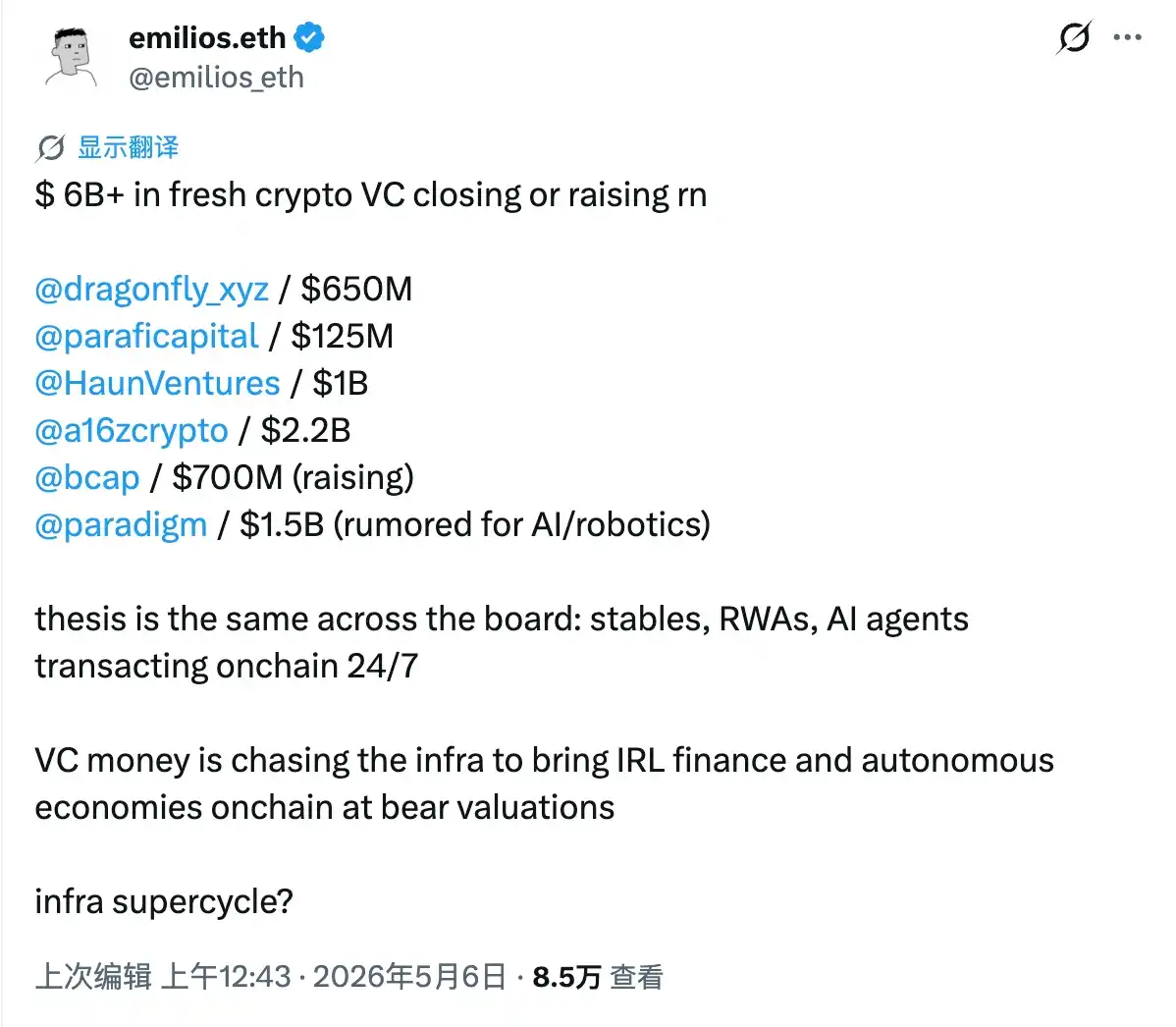
More crucially, this wave of fundraising did not occur at the market's peak but during the bearish phase characterized by depleted altcoin liquidity, declining primary market valuations, and persistently low industry sentiment. As a16z partner Chris Dixon stated, "We are in a relatively quiet stage." This is not a bullish follow-up but a typical counter-cyclical deployment.

The Primary Market is Diverging

Focusing solely on the $6 billion fundraising amount can easily create the illusion of "a primary market recovery," but the reality is far more complex. Surveying the current survival status of top-tier VCs versus mid-sized and smaller VCs reveals a clear trend of divergence in the primary market.

For most mid-sized and smaller VCs, this cycle is proving much tougher than anticipated. Due to the continued slump in altcoins (largely missing the entire bull run) coupled with tightening liquidity in the secondary market, exit channels for funds are severely obstructed. Paper profits often shrink or even turn negative over prolonged vesting periods. The disappointing investment returns have directly led to a decline in LP confidence, making fundraising for new funds increasingly difficult.

Consequently, we are witnessing the passive contraction of most mid-sized and smaller VCs during the bear market: some have chosen to downsize their funds and reduce deployment frequency; others have transitioned to pure secondary market funds; and some have exited the market entirely. Many mid-sized VCs that were highly visible during the last bull run have now vanished from the scene.

In stark contrast are the leading VCs still raising funds aggressively. Although their investment pace has also slowed with the market downturn, leveraging structural advantages, their dominance in the primary market is actually strengthening.

Regarding these structural advantages, firstly, top VCs typically possess stronger resource monopoly capabilities, enabling them to capture rare high-quality projects more effectively (prime examples include Kalshi backed by a16z and Paradigm, Polymarket backed by Dragonfly and ParaFi, Blockchain Capital which invested in Coinbase and Circle). Secondly, top VCs can cover the entire investment cycle, from early pre-seed and seed rounds to later Series A and B, offering more opportunities for late entry or amplified gains. Thirdly, top VCs have greater room for error, with larger AUM allowing them to withstand relatively higher failure rates and bet on longer-term narratives. Fourth, the brand power of top VCs translates to stronger bargaining power, often securing more favorable terms than mid-sized VCs even within the same funding round.

This structural disparity in advantages and disadvantages ultimately leads to market divergence, where the Matthew effect becomes increasingly pronounced. In a bull market, mid-sized VCs might still pull off a comeback with a few lottery-ticket wins, but during a bear cycle, this trend only intensifies.

What Are These $6 Billion Targeting?

Based on disclosures from these six VCs, the newly raised $6 billion is earmarked for the following sectors and directions.

  • Dragonfly: Bullish on crypto financialization trends, specifically mentioning stablecoins, prediction markets, agent payments, on-chain privacy, real-world asset tokenization.
  • Paradigm: Expanding beyond crypto into AI, robotics, and other frontier tech areas.
  • ParaFi: Stablecoins, asset tokenization, institutional-grade on-chain financial products.
  • Blockchain Capital: Focused on early-stage and growth-stage crypto startups.
  • Haun Ventures: Bullish on next-gen financial infrastructure, including stablecoins, asset tokenization, prediction markets, and also optimistic about the agent economy.
  • a16z: Mentions financial infrastructure like stablecoins, DeFi, prediction markets, asset tokenization. Also believes that in the era of the AI explosion, crypto networks' inherent properties can still address software transparency and verifiability issues.

Placing the public statements of these six VCs side by side, while differences in emphasis remain, overall they have converged significantly.

The core consensus undoubtedly centers on the new generation of on-chain financial infrastructure represented by stablecoins, asset tokenization (RWA), prediction markets, and on-chain payments. Whether it's Haun Ventures, a16z, Dragonfly, or ParaFi, these keywords are repeatedly mentioned in their new fund directions. To some extent, this signals a shift in the investment logic of the crypto industry. Compared to the more sentiment-driven bets of the last cycle, this time, leading VCs are placing greater emphasis on infrastructure-type projects that have preliminarily validated real demand and have the potential to capture traditional financial flows in the long term.

Additionally, leading VCs are significantly ramping up their AI-related investments. Paradigm has explicitly stated it will allocate part of its funds to AI and robotics, while Haun Ventures and Dragonfly have also mentioned agent-related directions. The reasons behind this trend are not complicated: on one hand, AI is currently the most certain major theme in the global tech industry, a space top VCs cannot afford to miss; on the other hand, the crypto industry is also trying to prove that it is not merely an old narrative marginalized by the AI hype but can become part of the underlying infrastructure for the AI era — especially as the agent economy gradually emerges, the inherent openness, composability, and permissionless nature of crypto networks are beginning to demonstrate renewed value.

Bear Market Fundraising is Essentially a Bet on the Next Cycle

For VCs, the bear market is often the stage that truly determines the future landscape.

While funds are easiest to raise during a bull market, project valuations and entry barriers are often also at their highest. It is only when market sentiment is low, liquidity dries up, and industry narratives falter that the opportunity for VCs to capture excess returns through judgment is truly amplified.

Looking back at past cycles, bear markets do not kill truly high-quality projects; instead, they accelerate market shakeouts, allowing the "gold to shine faster." This is why, even with current market sentiment remaining low, leading VCs are still raising funds counter-cyclically.

Because what they are truly betting on is never the "present," but rather who will become the next Circle, the next Hyperliquid, the next Polymarket once the next cycle begins.


Related Questions

QWhat is the most significant consensus among the six top-tier crypto VCs regarding their new investment focus, as mentioned in the article?

AThe core consensus among these VCs is a focus on the next generation of on-chain financial infrastructure, including stablecoins, asset tokenization (RWA), prediction markets, and on-chain payments. They are prioritizing projects with validated real-world demand and the potential to capture long-term traditional financial flows.

QWhy are major crypto VCs raising large funds during a bear market, according to the article?

AThey are practicing counter-cyclical investment. The primary reason is that bear markets offer the best opportunity to capture outsized returns. Valuations and entry barriers are lower, and the market washout allows truly high-quality projects to emerge more clearly. They are essentially betting on who will become the leading projects in the next market cycle.

QHow is the venture capital landscape in the crypto market currently diverging, as described in the article?

AThe market is experiencing significant divergence. While top-tier VCs are actively raising large funds, most small to mid-sized VCs are facing severe challenges. The latter are struggling with poor returns, dwindling LP confidence, and difficulties in raising new funds, leading many to downsize, pivot to secondary markets, or exit entirely. This is widening the gap and strengthening the dominance of major players.

QWhat structural advantages do leading crypto VCs possess that allow them to thrive even in a bear market?

ALeading VCs possess four key structural advantages: 1) Stronger resource monopolization to capture scarce, high-quality deals. 2) The ability to cover the full investment lifecycle from pre-seed to late-stage. 3) Larger fund sizes providing more room for error and enabling longer-term bets. 4) Stronger brand power and bargaining power to secure better deal terms.

QBesides financial infrastructure, what other major trend are top crypto VCs increasingly investing in, and why?

AThey are significantly increasing their investments in AI-related fields. This is because AI is the most certain trend in global tech, making it an unavoidable area for top VCs. Furthermore, the crypto industry aims to position itself as part of AI's foundational infrastructure. The inherent properties of crypto networks—openness, composability, and permissionless access—are seen as valuable for emerging areas like the Agent economy.

Related Reads

Agents Take Over Traffic Distribution Power: What Are Tencent, ByteDance, and Alibaba Competing For?

In the race to dominate the AI era's entry point, China's tech giants—Tencent, ByteDance, and Alibaba—are aggressively deploying AI Agents to control the future of traffic distribution. Alibaba is pursuing a dual-track "closed loop + openness" strategy. Its Qianwen app is evolving into a super-Agent integrated across its ecosystem (Taobao, Alipay, etc.) to handle complex tasks like travel planning. Concurrently, it is opening its platform to external brands (Luckin Coffee, KFC) and has launched a B2B Agent platform, "Wukong," targeting enterprise automation. Its other flagship, Quark, aims to be an "AI super search box" for information and tasks. ByteDance is executing an omnipresent "sprawl strategy." Its Doubao app boasts over 300 million monthly active users and is evolving into a default AI entry point for daily life, with plans for paid versions and e-commerce integration. Its core weapon is the Kouzi platform, a visual "AI assembly factory" for developers to build custom Agents. ByteDance is also pushing hardware integration, collaborating on AI phones and developing smart glasses to embed Doubao everywhere. Tencent is playing its long-held "ultimate card" by quietly embedding an AI Agent directly into WeChat. This Agent, accessible via a swipe, can understand user commands and automatically execute tasks by calling upon WeChat's millions of mini-programs (e.g., finding and ordering coffee). This leverages WeChat's unparalleled 1.4-billion-user ecosystem to position the app as an AI-powered "service operating system," a move that could dramatically reshape the competitive landscape. The core battleground is shifting from competing for "user screen time" to competing to be the "default execution layer" for user intent. The business model is evolving from an "attention economy" to an "intent economy," where the Agent that can most efficiently fulfill a user's need gains control over service access and token flow. This represents a fundamental change in how users connect with digital services, making the fight for the Agent入口 (entry point) a pivotal moment for redefining industry leadership in the AI age.

marsbit1h ago

Agents Take Over Traffic Distribution Power: What Are Tencent, ByteDance, and Alibaba Competing For?

marsbit1h ago

From Banning Doubao to Embracing Honor: Why Did WeChat Suddenly 'Change Its Face'?

The article explores the sudden shift in WeChat's strategy towards AI assistants from mobile phone manufacturers, transitioning from strict opposition to active collaboration. For over a year, WeChat fiercely resisted attempts by phone AI assistants (like ByteDance's Doubao in late 2025) to control its features via GUI automation ("simulated clicking"), citing security and data control concerns. This stance created a significant barrier for system-level AI integration. Now, Tencent has initiated A2A (Agent-to-Agent) partnerships with major phone brands like Honor, Xiaomi, OPPO, and vivo. This model allows a phone's system AI (e.g., Honor's YOYO) to parse a user's voice command and send a structured request directly to WeChat's own internal AI agent via secure APIs. WeChat then executes the action (e.g., sending a message) and returns the result. The article attributes Tencent's "change of face" to strategic pressure. While leading in social app usage, Tencent trails rivals like ByteDance and Alibaba in standalone AI app popularity. WeChat, with its vast mini-program ecosystem, is Tencent's key asset for an AI comeback. The upcoming WeChat AI agent aims to handle tasks like booking and payments within the app. However, phone system assistants remain the primary AI entry point for most users. The A2A collaboration allows Tencent to extend WeChat's AI reach to this crucial system layer while maintaining control over its core functions and data. For phone manufacturers, embracing A2A is a pragmatic move. The GUI route proved unviable due to WeChat's blocks. A2A offers a compliant path to integrate a vital service, enhancing their AI assistants' usefulness. It allows them to focus on developing their own AI ecosystems for other services while cooperating on WeChat access. The collaboration is framed as a mutual, strategic necessity: Tencent gains a distribution channel, and manufacturers gain a key functionality. The partnership relies on a "dual authorization" mechanism for security, requiring both user and app consent for each action. While questions about long-term data privacy practices remain, experts note A2A is more secure and compliant than GUI automation. Ultimately, this cooperation is seen as a tentative, calculated truce. Tencent's long-term goal is to make WeChat an AI-powered "service OS." Phone manufacturers aim to make their system AI the central user interface. Their paths may converge or clash in the future, but for now, the A2A deal represents the opening chapter in the battle for the AI-era user入口, driven by necessity and strategic calculus on both sides.

marsbit3h ago

From Banning Doubao to Embracing Honor: Why Did WeChat Suddenly 'Change Its Face'?

marsbit3h ago

Trading

Spot
Futures
活动图片




