Those Who Can't Buy Anthropic Are Driving Its Shadow Stock to 16 Times Its Value

marsbitPublished on 2026-03-25Last updated on 2026-03-25

Abstract

A new closed-end fund, VCX, listed on the NYSE, saw its share price surge to 16 times its net asset value due to high demand for exposure to Anthropic, which holds a 21% stake in the fund. Anthropic, recently valued at $380 billion in a private funding round, is not publicly traded, making VCX one of the few ways for retail investors to gain indirect access. The fund's limited liquidity, with most shares locked until September, amplified buying pressure. Similar funds without significant Anthropic or OpenAI stakes performed poorly, highlighting that the frenzy is specifically tied to AI-related FOMO. However, the premium is considered temporary, as it may vanish once Anthropic and other held companies like SpaceX go public, expected in 2026-2027. The phenomenon reflects broader investor anxiety about missing out on transformative AI companies that are reshaping industries while remaining private longer.

Author: David, TechFlow Deep Tide

Last Thursday, a new stock appeared on the NYSE with the ticker VCX.

It is actually a fund. The fund holds shares in companies like Anthropic, OpenAI, and SpaceX. Anthropic accounts for 21% and OpenAI for 10%.

These companies have one thing in common: none of them are publicly listed, and ordinary people cannot buy their shares.

VCX is one of the very few vehicles available on the market that allows ordinary investors to indirectly hold shares in Anthropic.

Its net asset value is $19 per share. On the first day of trading, it opened at $42, surged to $125 during the session, and closed at $76. On the fourth trading day, it hit a high of $315 intraday, triggering volatility halts twice.

Four days, from $19 to $315.
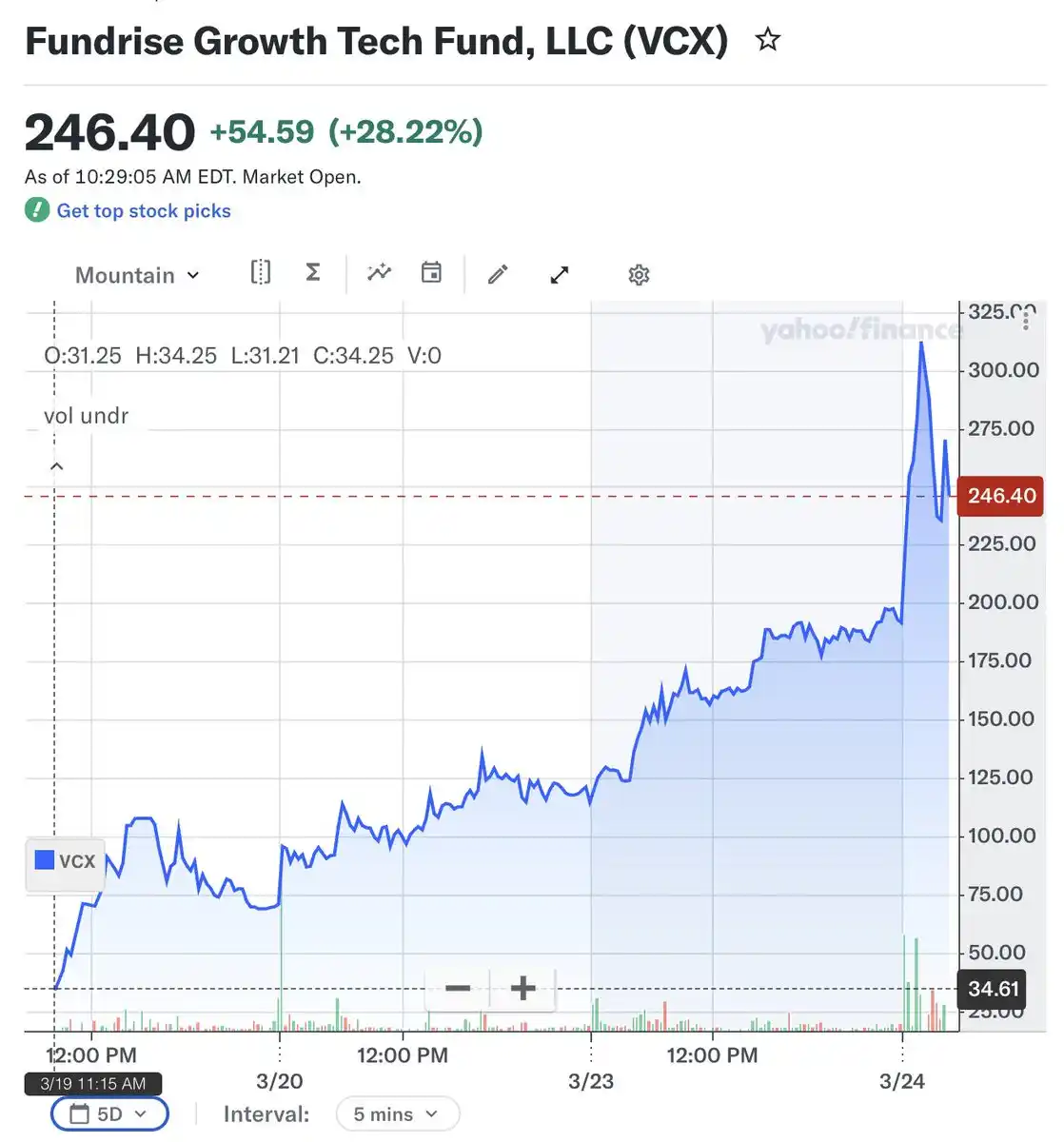
Investors are essentially paying 16 times the actual asset value to snap up this fund. Not because the fund manager is exceptionally skilled, but because it contains Anthropic.

A month ago, Anthropic just raised $30 billion at a valuation of $380 billion, making it the second-largest financing round globally this year. Its annualized revenue is $14 billion. But it is not publicly listed, has no stock ticker, and you cannot find it in any brokerage's search box.

If you can't buy the real thing, go for the shadow. VCX is currently the shadow of Anthropic, or rather, the shadow of AI FOMO.

Why is it so expensive?

VCX is not a traditional fund.

With ordinary funds, if you think it's expensive, you can wait for it to drop because the fund manager can issue more shares; supply is elastic. VCX is a closed-end fund. The number of shares was locked at the time of listing and will not increase.

More importantly, the vast majority of shares cannot be sold. Investors who bought before February 20 had their shares locked for six months and cannot trade until September. VCX has over 100,000 investors, but only a very small portion of shares are actually available for trading on the market right now.

What does this mean? Many people want to buy, but very few shares are available to buy. A small amount of buying pressure can twist the price out of shape.

So that 16x premium is essentially pricing "how many people want a piece of Anthropic and how narrow the door is." But this hunger wasn't created by VCX itself.
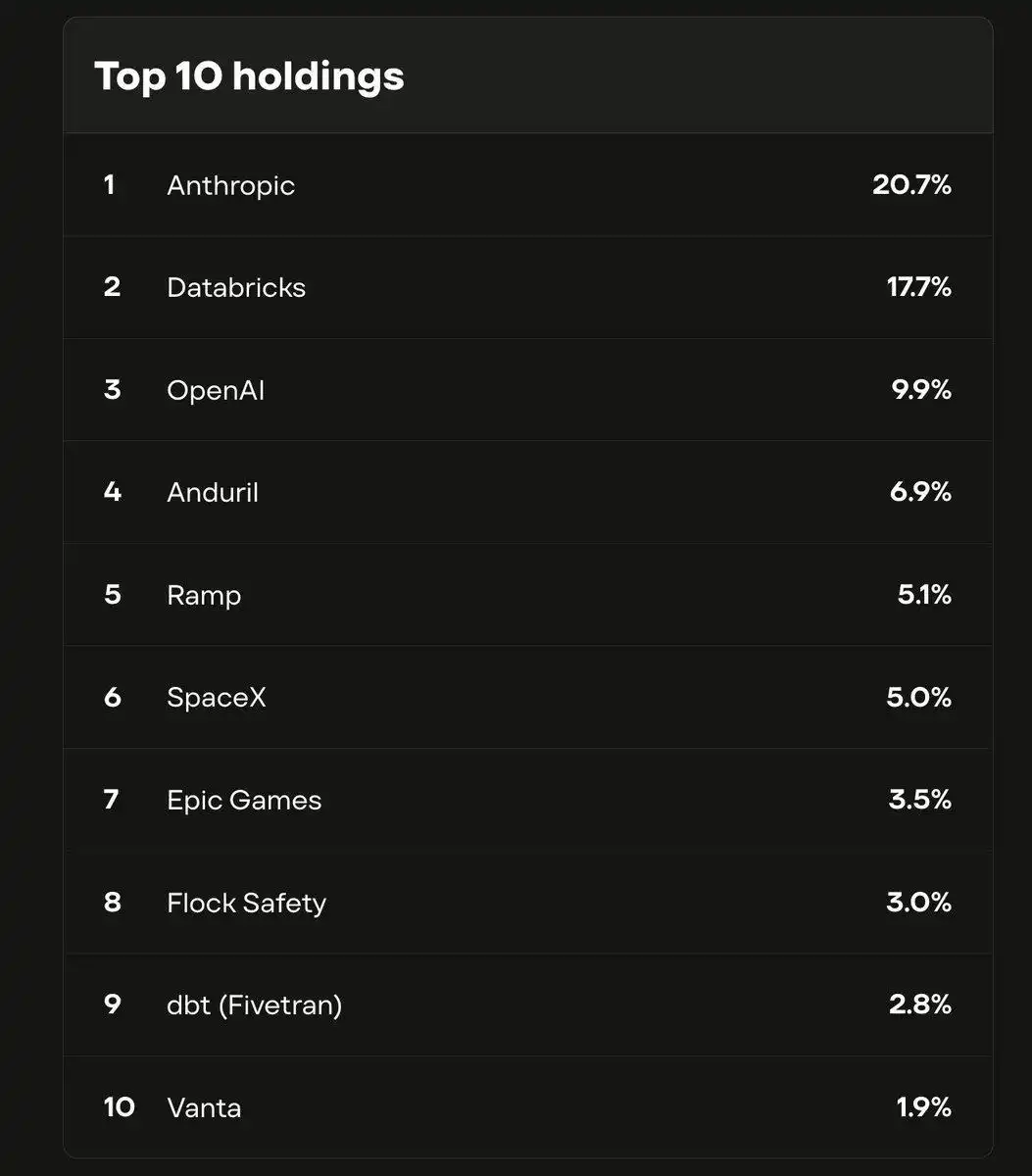
Chart: Top 10 Holdings of Fundrise's VCX Fund

Over the past decade, a structural change has occurred in the tech industry: the best companies are going public later and later, or not at all.

When Facebook went public in 2012, its valuation was $104 billion, which was an astronomical figure at the time. Today, Anthropic's private valuation is more than three times that of Facebook's IPO, but it previously had no clear plans to go public;

OpenAI is valued at $500 billion and is also not public. News about SpaceX preparing for an IPO has been circulating for over a year, with no confirmed date yet.

A decade ago, a company of this size would have long since rung the bell on the NYSE. Now they don't need to. The private market can provide almost unlimited capital, without the pressure of quarterly reports or dealing with retail investors and short sellers.

For founders, this is a rational choice. For ordinary investors, it means that the fastest-growing companies in history are behind a glass wall, out of reach.

VCX was originally scheduled to list on March 9 but was delayed for ten days due to the Iran war. In those ten days, nothing changed—Anthropic's price didn't go up or down, the fund's holdings didn't change a single share. But the delay itself brewed another ten days of anticipation.

When it finally listed, all the pent-up demand from those ten days squeezed through an extremely narrow passage.

Not all shadows are valuable

There are more ways to gain exposure to shares of unlisted companies than just the VCX fund.

But before discussing these avenues, there's a more fundamental question: Anthropic isn't public, so how did a publicly traded fund get its shares?

The answer is the back door.

Large private companies do a funding round every few months, from Series A to Series G, each time letting new investors in. Anthropic just closed a $30 billion Series G last month, with a long list of participating institutions from GIC to Sequoia to Goldman Sachs. These rounds are usually only open to institutional investors, with minimums often starting in the tens of millions of dollars.

But there is a second path.

Just because a company isn't public doesn't mean its shares can't be traded privately. Early employees and angel investors hold shares, and some of them want to cash out early. This creates a secondary market for private companies—not public, not transparent, but real trades happen.

Fundrise started buying on these two paths back in 2022, when valuations of private tech companies had just experienced a crash and prices were cheap. Over four years, they accumulated a portfolio including Anthropic, OpenAI, and SpaceX. Then they packaged it into VCX, listed it on the NYSE, and now ordinary people can buy it like a stock.

In the same month, at least three similar funds were trading on the NYSE, all selling the same concept:

Selling you, through the front door, what was bought through the back door.

Robinhood created a fund called RVI, listed on March 6 with an issue price of $25. Its holdings include Databricks, Revolut, Ramp—all good private companies. It fell 11% on its first day, closing at $21.

Destiny Tech100, ticker DXYZ, listed in 2024, is a pioneer in this space. Heavily weighted in SpaceX, with a 16% holding. It only added a small exposure to Anthropic indirectly in February of this year. Its price is now hovering around $24.

There's also XOVR, the first ETF approved to directly hold shares of private companies, with SpaceX making up about 21%.

Four funds, similar structures, similar concepts, all trading on the same exchange. But their fates are completely different.
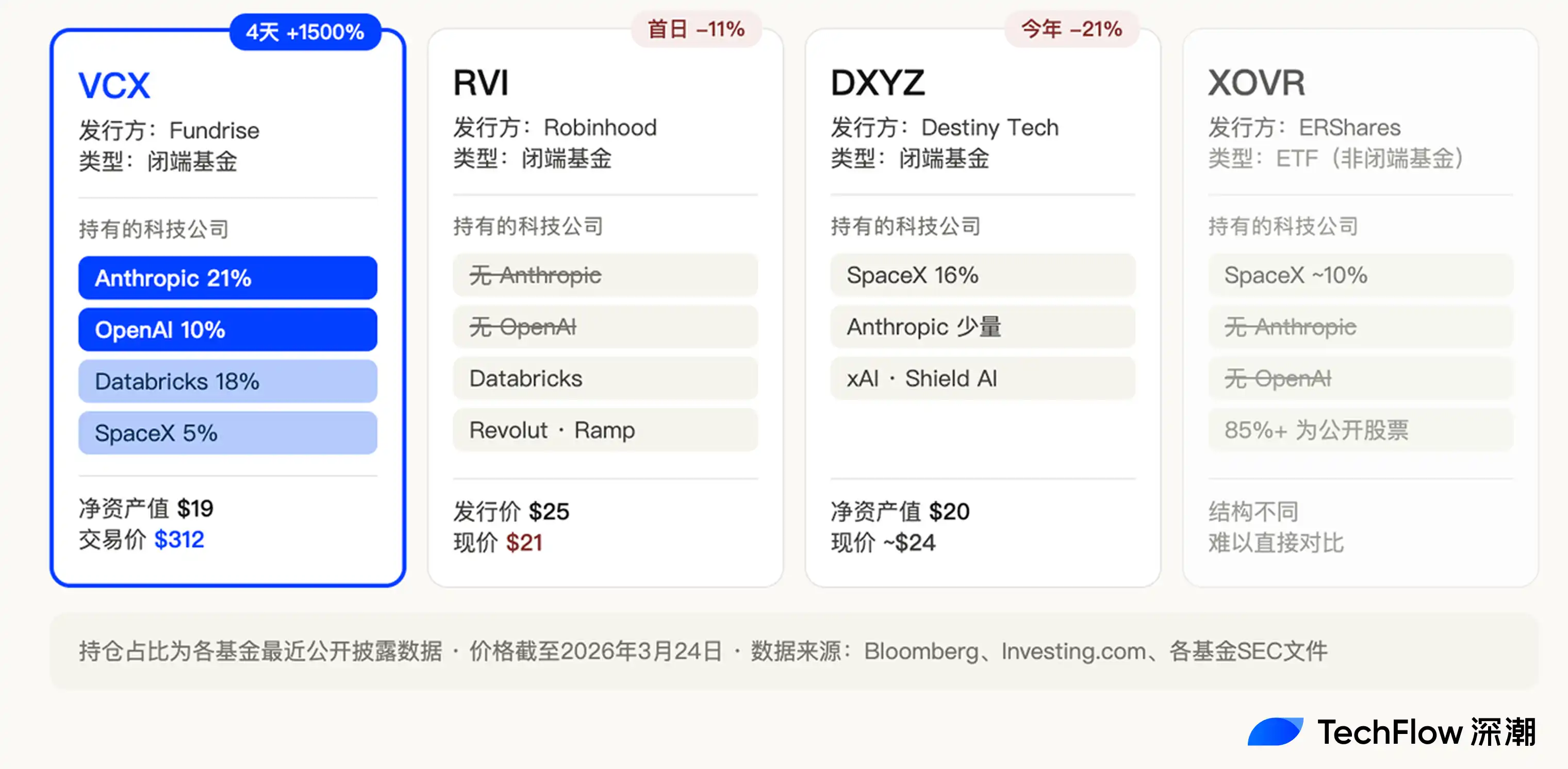
VCX rose 1500% in four days. RVI broke issue price on its first day. DXYZ is lukewarm.

VCX holds 21% Anthropic and 10% OpenAI. RVI's holdings include neither Anthropic nor OpenAI. DXYZ's exposure to Anthropic was added recently and is very small.

This shows that, at least for now, the market isn't chasing "shares in private companies." The market is chasing Anthropic.

Whoever is closest to them is valuable.

That's where Robinhood's RVI lost out. Databricks and Revolut are certainly good companies, but clearly, right now, they are not the name people are willing to pay a 16x premium for.

Shadows also have an expiration date

What are those who bought VCX at $312 betting on?

They are betting that before the door opens, someone else will be willing to pay an even higher price for the privilege of not being able to get Anthropic directly.

However, this door won't stay closed forever.

VCX has over 100,000 investors, and the vast majority of their shares are locked for six months. The lock-up period ends on September 19. At that time, a large number of shares will flood the market, and supply will change overnight from极度稀缺 (extremely scarce) to abundant.

The reason VCX can sell at a 16x premium is half because it contains Anthropic, and half perhaps because so few shares are available to sell. Once the lock-up period ends, the second condition disappears.

There is an even bigger variable.

Anthropic, OpenAI, SpaceX—all three are rumored to be targeting IPOs in the second half of 2026 to 2027. Anthropic just raised $30 billion last month at a $380 billion valuation and has already hired Silicon Valley law firm Wilson Sonsini for IPO preparations. SpaceX's CFO has been communicating with investors about an IPO since the end of last year, targeting mid-year.

Once the real thing goes public, the shadow becomes worthless.

If you can directly type Anthropic's stock ticker into your brokerage search box, why would you pay a 16x premium for a fund that indirectly holds it?

For example, DXYZ also surged wildly when it first listed in 2024, but as SpaceX's IPO was delayed, the hype faded, and its price fell by more than half from its high.

So, VCX investors are experiencing a classic countdown.

What they bought for 16 times the price is not shares in Anthropic, but a ticket with an expiration date. When the door opens depends on when Anthropic decides to go public.

Before that, the premium is maintained by scarcity; after that, the premium goes to zero.

But the phenomenon of shadow stocks itself is not accidental.

Every technological wave creates the same anxiety: you can't buy the most important companies. In the 2000s, before Google's IPO, Goldman Sachs employees fought fiercely internally for allocations. In 2020, it was SpaceX, and secondary market intermediaries in Silicon Valley became the most sought-after connections overnight.

Now it's AI's turn.

And this time the anxiety is deeper. Anthropic and OpenAI may not be profitable now, but they are rewriting the rules. Because of AI's impact, SaaS stocks crashed, security stocks crashed, and IBM lost $31 billion in a day.

Investors see not just "this company is very profitable," but "if I'm not on its side, I might be on the side it runs over."

The 16x premium of VCX isn't pricing just a fund; it's pricing this anxiety itself.

The ticket will expire, the premium will fade. But as long as AI keeps accelerating, as long as the most valuable companies keep their doors closed, there will be people willing to pay irrational prices for the shadow.

Not because the shadow is worth that much, but because the feeling of being locked out is too expensive.

Related Questions

QWhat is the VCX fund and why did its price surge dramatically upon listing?

AVCX is a closed-end fund listed on the NYSE that holds shares in private companies like Anthropic (21%) and OpenAI (10%). Its price surged to 16 times its net asset value due to extreme scarcity of tradable shares and high demand from investors seeking exposure to these coveted, pre-IPO AI companies.

QWhy are top tech companies like Anthropic and OpenAI delaying their IPOs, and how does this affect retail investors?

ALeading tech companies are delaying IPOs because private markets provide ample capital without the quarterly reporting pressures and scrutiny from public investors. This excludes retail investors from directly accessing the fastest-growing companies, fueling demand for indirect vehicles like VCX.

QHow did Fundrise's VCX fund acquire shares in private companies like Anthropic?

AFundrise acquired shares through secondary markets, where early employees and investors sell their stakes, and by participating in private funding rounds, assembling a portfolio of pre-IPO companies like Anthropic and OpenAI over four years.

QWhat risks do investors face when buying VCX at a significant premium to its net asset value?

AInvestors risk a sharp price decline when the six-month lockup period ends in September, flooding the market with shares, and if Anthropic or OpenAI IPO, making the indirect fund obsolete as direct ownership becomes available.

QHow does the market's reaction to VCX compare to other similar funds like RVI and DXYZ?

AVCX's 1500% surge dwarfed RVI's drop and DXYZ's stagnation because VCX held substantial Anthropic and OpenAI exposure, while others lacked these specific high-demand AI assets, highlighting that the frenzy is focused on Anthropic, not private equities broadly.

Related Reads

KOL's Perspective: Why Is SOL Set to Rise from This Point?

**Summary: Why SOL is Positioned for Growth at This Level** The article argues that SOL is poised for an upward move from its current price point, citing several key factors. Primarily, SOL has just broken out of a 4-month consolidation phase. This breakout signals a return of risk appetite to the broader crypto market, as SOL is seen as a key indicator of overall crypto health. The token's ownership has reportedly shifted from short-term traders and tourists to long-term accumulators, leading to low volume. Any meaningful increase in trading activity could thus trigger significant upward momentum. Fundamental strengths include strong institutional adoption, integration with DeFi and RWAs (Real-World Assets), and the potential benefits from the Clarity Act. Despite its high volatility—having dropped 70% from its all-time high but still up 12x from its bear market low—SOL is highlighted as one of the few tokens from the last cycle to reach new highs. It boasts a robust ecosystem of applications, users, and protocols. Future catalysts include the expected influx of AI developers following the Miami Accelerate conference, which focused on AI on Solana. Furthermore, Solana is positioned as the premier chain for memecoin activity, a trend expected to continue and drive network usage and fees. The article concludes that recent price action reflects a healthy transfer to long-term holders, setting the stage for growth.

marsbit3m ago

KOL's Perspective: Why Is SOL Set to Rise from This Point?

marsbit3m ago

Those Pre-Bitcoin PoW Protocols Have Recently Been Reimplemented

This article details a recent surge in replicating pre-Bitcoin Proof-of-Work (PoW) protocols, specifically focusing on Hal Finney's 2004 RPOW (Reusable Proofs of Work). Within five days in May 2026, multiple independent builders in the Bitcoin/cypherpunk community launched projects inspired by this early electronic cash proposal. The initiative began with Fred Krueger's `rpow2.com`, a centralized but auditable system that replaced RPOW's original IBM 4758 hardware with Ed25519 signatures. Initially a faithful replica, it later adopted Bitcoin-like features (21M supply cap, difficulty adjustment) and a controversial 5.24% founder allocation. This sparked rapid forks, including `rpow4.com` which incorporated full Bitcoin parameters, a prediction market (`rpowmarket.com`), and a DEX (`rpow2swap.com`). Concurrently, Mike In Space created a prototype of Wei Dai's 1998 b-money proposal (`b-money.replit.app`), pushing the historical exploration even further back. The article contrasts these centralized, server-dependent experiments with Bitcoin's core innovation of decentralized, trustless consensus. It also highlights a parallel development: the `HASH` project on Ethereum, which uses smart contract hooks to enable a purely fair-launch, browser-mineable PoW token with 0% allocations to team or VCs. The collective activity is framed as a meme-driven, educational exploration of cypherpunk history rather than a serious financial movement, with all projects heavily disclaiming any investment value.

marsbit8m ago

Those Pre-Bitcoin PoW Protocols Have Recently Been Reimplemented

marsbit8m ago

South Korean Exchanges 'Battle' Regulators, Challenging the Boundaries of Enforcement and Legislation

South Korea's cryptocurrency industry is engaged in a rare, direct confrontation with regulators. The Financial Intelligence Unit (FIU), the primary anti-money laundering (AML) watchdog, has recently imposed heavy penalties on major exchanges like Upbit and Bithumb for alleged violations involving unregistered overseas VASPs and AML procedures. However, exchanges are now actively challenging these actions in court and through industry associations. In a significant shift, the Seoul Administrative Court ruled in favor of Upbit's operator, Dunamu, overturning part of an FIU-ordered business suspension. The court found the FIU's penalty criteria and justification insufficiently clear. Similarly, the court suspended the enforcement of a six-month business suspension against Bithumb pending a final ruling, citing potential irreversible harm to the exchange. Beyond legal battles, the industry is contesting proposed legislative amendments. The Digital Asset eXchange Alliance (DAXA) strongly opposes a draft rule that would mandate Suspicious Transaction Reports (STRs) for all crypto transfers over 10 million KRW (~$6,800). DAXA argues this "poison pill" clause violates legal principles and would overwhelm the STR system, increasing reports from 63,000 to an estimated 5.45 million annually for major exchanges, thereby crippling effective AML monitoring. This conflict highlights a structural tension in South Korea's crypto governance: comprehensive digital asset laws are still developing, while regulators rely heavily on AML enforcement. The industry's move from passive compliance to active legal and legislative challenges signifies a new phase, pressing for clearer rules and more proportionate enforcement. While short-term disputes may intensify, this clash could ultimately lead to a more mature and sustainable regulatory framework for South Korea's vibrant crypto market.

marsbit1h ago

South Korean Exchanges 'Battle' Regulators, Challenging the Boundaries of Enforcement and Legislation

marsbit1h ago

After 50x Storage Surge, Justin Sun Always Looks to the Next Decade

Sun Yuchen, known for his controversial stunts like a $30 million lunch with Warren Buffett (canceled due to a kidney stone) and eating a $6.2 million duct-taped banana, is often overshadowed by a significant fact: his decade-long track record of spotting major investment trends. In 2016, he famously advised young people to invest in Bitcoin, Nvidia, Tesla, and Tencent instead of buying property. A hypothetical $20,000 investment in Nvidia and Tesla from that list would now be worth over 50 million RMB. His latest major call was on November 6, 2025, predicting a "50x storage opportunity" tied to the AI boom, which materialized with Sandisk's stock surging nearly 50-fold by 2026. Looking ahead, Sun now focuses on the next frontier: Physical AI. He identifies four key areas: 1. **Embodied AI/Robotics**: He sees this reaching its "iPhone moment," with companies like UBTech and Galaxy General leading in commercialization. 2. **Drones**: Viewed as the first commercially viable form of Physical AI, revolutionizing sectors from warfare (e.g., AeroVironment's Switchblade) to logistics. 3. **Spatial Computing**: Beyond VR, it's about AI understanding physical space, a foundational technology for robotics and autonomous systems, exemplified by Apple's Vision Pro. 4. **Space Exploration**: After a 2025 suborbital flight with Blue Origin, Sun advocates for space as the ultimate frontier, discussing blockchain's potential role in space asset management and data transactions. His investment philosophy involves betting on entire, inevitable trends rather than single companies. For robotics, he sees Tesla (the body/manufacturer) and Nvidia (the brain/AI platform) as complementary plays. In defense drones, he highlights companies making tanks obsolete (AeroVironment) and those augmenting fighter jets (Kratos). For space, he participated in Blue Origin's flight and anticipates SpaceX's potential IPO to redefine the sector's valuation. Sun Yuchen's vision frames the next two decades not as a revolution in information flow (like the internet), but in the fundamental operation of the physical world through AI-powered robots, autonomous systems, and spatial intelligence, ultimately extending human and AI activity into space. While many still focus on conventional assets, he continues to look toward the next technological horizon.

marsbit1h ago

After 50x Storage Surge, Justin Sun Always Looks to the Next Decade

marsbit1h ago

Trading

Spot
Futures
活动图片