They Knew the TGA Game of the Year Winner in Advance and Made Tens of Thousands of Dollars

marsbitPublished on 2025-12-12Last updated on 2025-12-12

Abstract

Summary: The 2025 TGA (The Game Awards) ceremony concluded with the indie game "Light & Shadow: Expedition 33" making history by winning both "Best Independent Game" and the coveted "Game of the Year (GOTY)" award, breaking a long-standing TGA curse. Prior to the event, the prediction market platform Polymarket had already listed the topic, with "Light & Shadow's" probability of winning GOTY consistently above 80% for over a month. Several traders, including users DieselDiesel, trumpnogo, and kasae, placed unusually large, concentrated bets on this outcome weeks in advance, a move that would have resulted in massive losses if wrong. Their bets appeared to be "all-in" convictions rather than calculated risks. Just three hours before the GOTY announcement, after the "Best Indie" award was given to the same game, a mysterious user (bobo9997) deposited $10,000 and bet it all on "Yes" for "Light & Shadow" winning GOTY at a price of $0.98 per share—a bet that would yield less than $200 in profit if correct. The final award confirmed the predictions. The early traders realized significant profits, with their winnings from this single event representing a large percentage of their total historical earnings on the platform (e.g., 176% for DieselDiesel). The article suggests these traders likely had insider knowledge of the results, using the prediction market as a anonymous, low-risk method to monetize their confidential information, turning a guaranteed outcome into thousands of d...

Today, the highly anticipated The Game Awards (TGA) ceremony finally concluded.

Let's jump back to 3 hours before the awards ended. At that time, the "Best Independent Game" had just been awarded to the popular title "Light & Shadow: Expedition 33," but this instead made many fans worried: historically, no game has ever won both the "Best Independent Game" and the "Game of the Year (GOTY)" awards at TGA. As a GOTY favorite, "Light & Shadow" now needed to break the curse that had existed since TGA's inception and create an unprecedented moment in gaming history.

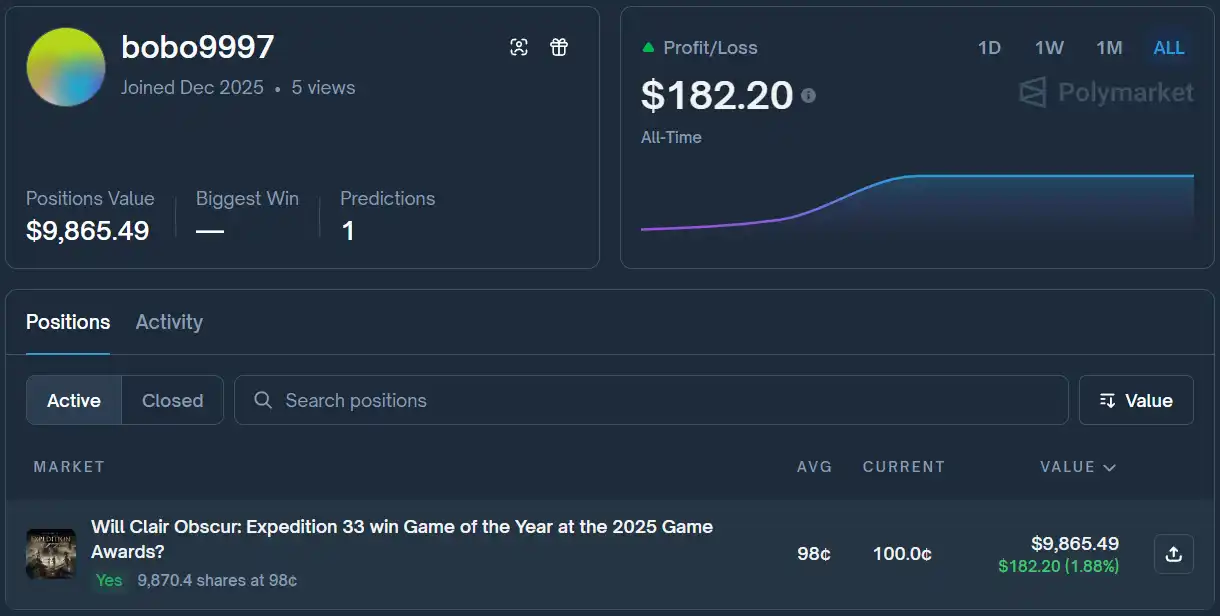
Just as everyone was filled with anxiety, a mysterious individual registered an account on a seemingly unrelated "prediction market" platform and deposited ten thousand dollars. He found the topic "Will Light & Shadow win the 2025 GOTY?" on the platform and bet the entire ten thousand dollars on "Yes." At that time, the price for "Yes" was $0.98 per share, meaning that even if "Light & Shadow" did indeed make gaming history by winning both awards, his ten-thousand-dollar bet would only yield a profit of less than two hundred dollars. However, if "Light & Shadow" failed to break the TGA curse, the probability of the topic would instantly drop to 0, which meant his newly deposited ten thousand dollars would be wiped out. What kind of狂热 fan of "Light & Shadow" would take such a reckless risk? And how do prediction markets attract game fans from around the world to guess the winners in advance?

The "Pre-Determined" Script

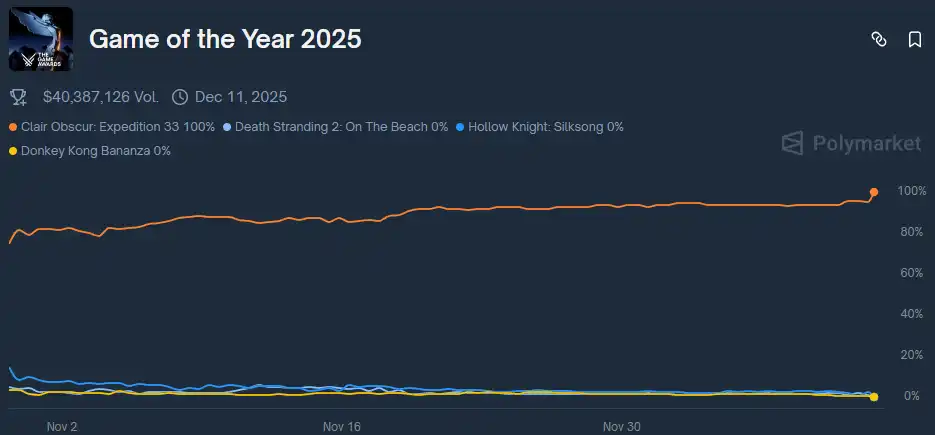
As early as October 30th, a month and a half before the awards ceremony, the prediction market Polymarket had already launched the topic for "2025 Game of the Year." The probability of "Light & Shadow" winning was firmly pinned above 80% from the start, while the probabilities of other highly anticipated AAA titles winning were suppressed below 10%. Because such a one-sided situation usually only occurs in events where the outcome is already certain, this anomaly made many traders smell something unusual: this wasn't just optimism, this was certainty.

Among these traders with a "certain" attitude, a few operated in an extremely unified style, hinting at the possibility of insider trading. DieselDiesel, trumpnogo, and kasae all bet on "Light & Shadow wins TGA 2025 GOTY" when the probability was around 85%, and the amounts they bet were dozens or even hundreds of times larger than their usual bets. This highly concentrated,反常 betting behavior meant they faced enormous risks: if "Light & Shadow" ultimately did not win, they would not only have to give up all past profits but also suffer huge losses.

As time progressed and the probability of "Light & Shadow" winning increased, they did not sell any of their held shares to realize profits. Even 3 hours before the award announcement, after the "Best Independent Game" award had been announced, they, already significantly浮盈, remained motionless as if they knew the future, betting their entire account balance alongside the mysterious individual mentioned at the beginning for that final, tiny profit.

The Historic Award Moment and the Cashing Out of Insiders

Amid doubts and unease, TGA played out exactly like the script these few traders had arranged over a month ago, dispelling the final suspense: the highly anticipated "Light & Shadow," having already won the "Best Independent Game" award, broke the historical curse and won the Game of the Year award.

And while players on one side cheered and celebrated, the mystery was solved in the prediction market on the other side: the three traders who had been convinced since a month ago that "Light & Shadow" would win confirmed their role of "foreseeing the future" and realized huge profits:

DieselDiesel made a profit of $5,357 in this event, accounting for 176% of all his other trading profits;

trumpnogo made a profit of $2,958 in this event, accounting for 62% of all his other trading profits;

kasae made a profit of $1,658 in this event, accounting for 220% of all his other trading profits.

And the mysterious individual (bobo9997) mentioned at the beginning, because he was certain that "Light & Shadow" would make history," used ten thousand dollars to win a "whopping" $200.
"Even Those Who Foresee the Future Need to Eat"

The most noteworthy common point among these four traders is that while many players doubted whether "Light & Shadow" could break the historical curse, they were "willing to risk" nearly $100,000 in positions to "gamble" on this historic moment happening, and this "gamble" brought them less than two thousand dollars in combined profits.

Now, let's assume these "foreseers" are TGA vote auditing staff. As insiders with an annual income of $100,000, if they wanted to monetize the information in a traditional way, they would need to sell the insider information to media platforms, but this represents various potential fines, dismissal, and even imprisonment. However, with the emergence of prediction markets, they can use anonymity to convert information asymmetry into real money equivalent to 1 to 3 months of their disposable income.

When we view them as assumed insiders who already knew the result in advance, everything becomes clear: being 100% sure that "Light & Shadow" would be GOTY, their final "bet" was just using the one-hour wait time before the announcement to换取 seemingly huge risks but实际上毫无变数的 two thousand dollars in profit. This kind of seemingly high-risk but实际上毫无变数的赚钱 "bet" was almost impossible to encounter before platforms like prediction markets appeared.

However, with the popularity of Polymarket, how many people can resist converting information into real money anonymously?
Related Questions

QWhat is the name of the prediction market platform mentioned in the article where users bet on the TGA 2025 Game of the Year outcome?

AThe prediction market platform mentioned is Polymarket.

QWhich game won both the 'Best Indie Game' and 'Game of the Year (GOTY)' awards at TGA 2025, breaking a historical curse?

AThe game that won both awards is 'Light and Shadow: Expedition 33'.

QWhat were the usernames of the three traders who made unusually large bets on 'Light and Shadow' winning GOTY and profited significantly?

AThe three traders were DieselDiesel, trumpnogo, and kasae.

QHow much did the mysterious user 'bobo9997' profit from betting $10,000 on 'Light and Shadow' winning GOTY at the last moment?

AThe user 'bobo9997' profited approximately $200 from the bet.

QWhat is the suggested explanation in the article for the traders' confident and large bets on 'Light and Shadow' winning GOTY?

AThe article suggests that the traders likely had insider information, possibly from being involved in the TGA vote auditing process, which they anonymously monetized through the prediction market.

Related Reads

2026 New Policy Interpretation: The "Mutual Pursuit" of Intelligent Agents and AI Terminals, and the Three Major Value Reconstructions in the AIoT Industry

In May 2026, China's national ministries released two pivotal policy documents that jointly establish a strategic "dual-track" framework for the AIoT industry. The "Intelligent Agent Standardized Application and Innovation Development Implementation Opinions" defines the "soul"—positioning intelligent agents as core AI products. The "Artificial Intelligence Terminal Intelligence Grading" national standard defines the "body"—establishing a four-tier capability ladder (L1 to L4) for AI hardware. This synchronized policy approach is globally unique, moving beyond market-led (US) or risk-focused (EU) models. It frames AIoT as a new type of "intelligent infrastructure," comparable to electricity or the internet in historical significance. The core analysis identifies a value evolution from IoT 1.0 (connection) to AIoT 4.0 (collaboration, represented by the forward-looking L4 level). This "L4" signifies a paradigm shift: from users operating tools to delegating tasks to agent-like devices ("Intelligent Action of All Things"). The article outlines three strategic paths for companies: becoming Standard Definers, Scenario Integrators (focusing on 19 specified application areas), or Infrastructure Builders. A critical 18-24 month window is identified for strategic positioning. A "Four Levers" strategy is proposed: leveraging Standards (L-level certification), leveraging Scenarios (deep vertical focus), leveraging Open Source (for cost reduction and ecosystem influence), and leveraging Momentum (engaging in global protocol ecosystems). In conclusion, these policies are a starting gun for a decade-long industrial transformation, shifting the industry narrative from "Intelligent Connection of All Things" to "Intelligent Action of All Things," with companies needing to choose their赛道and execution strategy decisively.

marsbit54m ago

2026 New Policy Interpretation: The "Mutual Pursuit" of Intelligent Agents and AI Terminals, and the Three Major Value Reconstructions in the AIoT Industry

marsbit54m ago

Splashing Out 27 Billion Yuan, OpenAI Establishes New Company to Accelerate AI Deployment

On May 11th, OpenAI announced the formation of a new company, "OpenAI Deployment Company," with an initial investment of over $4 billion (approximately 27.2 billion RMB). This venture aims to help businesses build and deploy AI solutions. OpenAI is also acquiring the AI consulting firm Toromo to rapidly scale the deployment company's capabilities. This new entity, majority-owned by OpenAI, brings together 19 investment, consulting, and system integration partners, led by TPG with co-lead founding partners including Advent International, Bain Capital, and Brookfield. OpenAI's Chief Revenue Officer, Denise Dresser, stated that while AI is becoming increasingly capable, the current challenge lies in integrating these systems into core business infrastructure and workflows. The deployment company is designed to bridge this gap and translate AI capabilities into operational impact. This move comes as OpenAI emphasizes the next competitive phase will depend on the efficiency of deploying AI in real business scenarios. The company reports over 1 million businesses already use its products and APIs. OpenAI is significantly increasing its investments in computing power, with co-founder Greg Brockman stating the company expects to spend $50 billion on compute this year, a dramatic increase from $3 million in 2017. The announcement follows OpenAI's recent completion of a record $122 billion funding round in late March, led by Amazon, Nvidia, and SoftBank, valuing the company at $852 billion post-money. Major strategic investors committed $110 billion as a base for this round. Concurrently, OpenAI is advancing its core model development. It has shifted focus from its Sora video generator to developing advanced robotics and AI models that interact with the physical world. It has also begun allowing select users access to a new model specialized in identifying software vulnerabilities and is reportedly preparing to launch an enhanced image generation model in the coming weeks. According to reports citing founder Sam Altman, OpenAI is considering an IPO as early as 2027, with a potential valuation around $1 trillion.

marsbit1h ago

Splashing Out 27 Billion Yuan, OpenAI Establishes New Company to Accelerate AI Deployment

marsbit1h ago

Trading

Spot
Futures
活动图片