These Vibe Coding Crypto Mini-Games Are So Addictive

marsbitPublished on 2026-01-20Last updated on 2026-01-20

Abstract

The article explores the rising popularity of "vibe coding" in the cryptocurrency space, focusing on small, addictive games that deliver rapid dopamine hits through instant feedback. Initially skeptical of such trends, the author was convinced after trying games like *Rug Pull Simulator* (a token launch simulation), a meme-trading escape game, and *Vesting Victim* (an FDV guessing game). These games thrive on immediate, repetitive rewards—whether through strategic decision-making, timing the market, or testing valuation intuition—rather than long-term value or complex narratives. Vibe coding leverages AI tools to quickly turn ideas into playable demos, capitalizing on low development costs and high social media virality. It represents a shift toward instant gratification in a market where long-term promises have lost credibility, offering a form of "industrialized dopamine" that is highly engaging, if not necessarily profound. The author concludes by embracing these fast-paced, addictive experiences as a product of the current environment, even if they lack lasting impact.

Dopamine release can happen in as fast as 0.2 seconds.

That's why vibe coding is so hot in the crypto space right now.

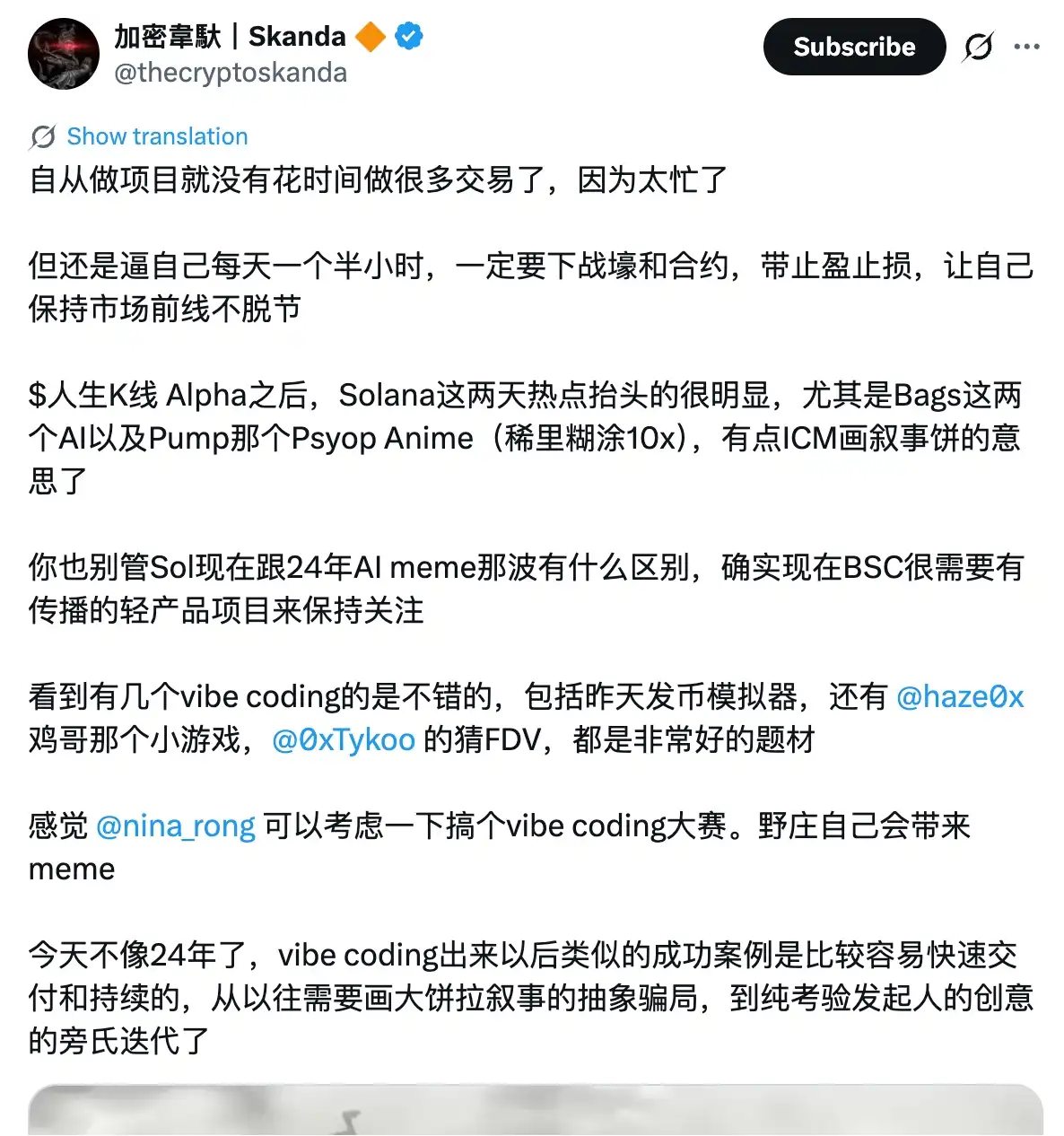
For a long time, the market environment hasn't been great, and I had lost interest in new things, like some of the "little toys" made by vibe coding. Even the "Life K-Line" game, which was so popular it made it to CCTV, didn't change my disappointed view on industry innovation.

In my original perception, the things vibe coding produces now could only be at the level of games like "Emperor's Growth Plan" made by the Flatfish Studio—having little to do with "doing serious work." They create buzz, not accumulation; emotion, not value. I preferred to believe what those who would still impact the world twenty years after their death said, and I'd rather spend my time on products that might still be great two decades from now, not on this noise that looks like it could be washed away by the next wave of trends.

Until today, after Crypto Veda's explanations and my colleagues practically forcing it on me, I spent a few hours playing Rug Pull Simulator (Token Launch Simulator), the meme exit game Rug Pull Simulator (a coincidental同名 with the previous one) by GMGN boss Haze (Brother Chicken), and Tykoo Muscle Bro's FDV guessing game Vesting Victim—all products of this vibe coding wave.
So addictive.

How to describe this kind of pleasure? It's like you've been watching long videos on Bilibili and suddenly try Douyin for the first time; or like being used to a slow-burning relationship and suddenly experiencing fast-food romance; or like someone long suppressed by life getting high on drugs for the first time.

Take the Token Launch Simulator, for example. You start from the perspective of a project side, which isn't exactly moral. You have a limited amount of startup capital, the product is still at the PPT stage, and you decide what to do next, how to play with your users and community.

One operational cycle is a month, and you can only do two things, so resources are limited. You invest your limited resources and money into product development, narrative spreading, community operations, etc. The game doesn't tell you which path is right. Then, uncertain events pop up one after another: sometimes funding comes through, sometimes regulators target you, sometimes the community suddenly spirals out of control, sometimes security risks explode.
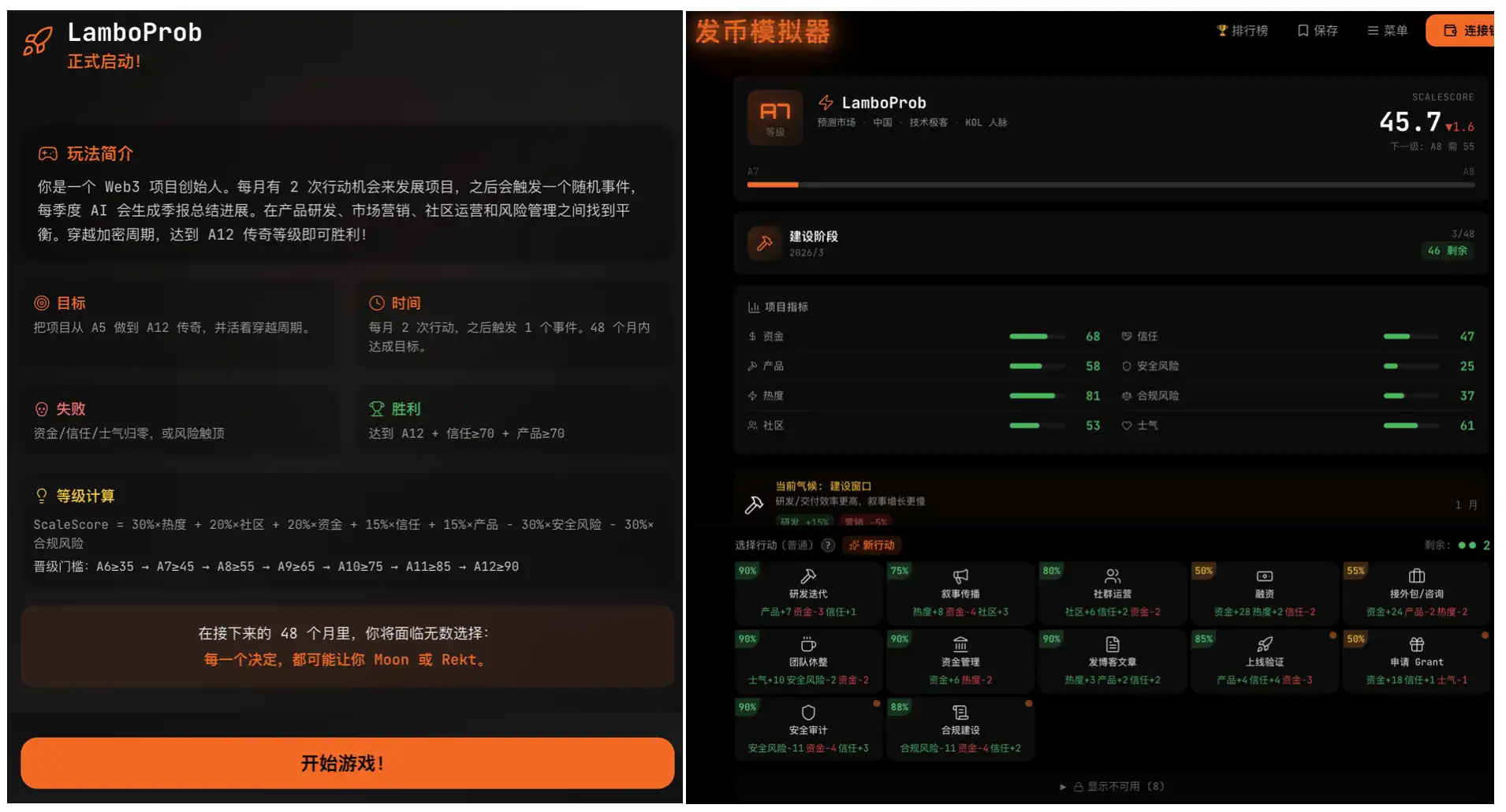
The pleasure emerges right here.

This pleasure doesn't come from eventually winning A9, A10 levels of wealth, but from the constant, continuous, never-ending immediate feedback. You just can't stop.

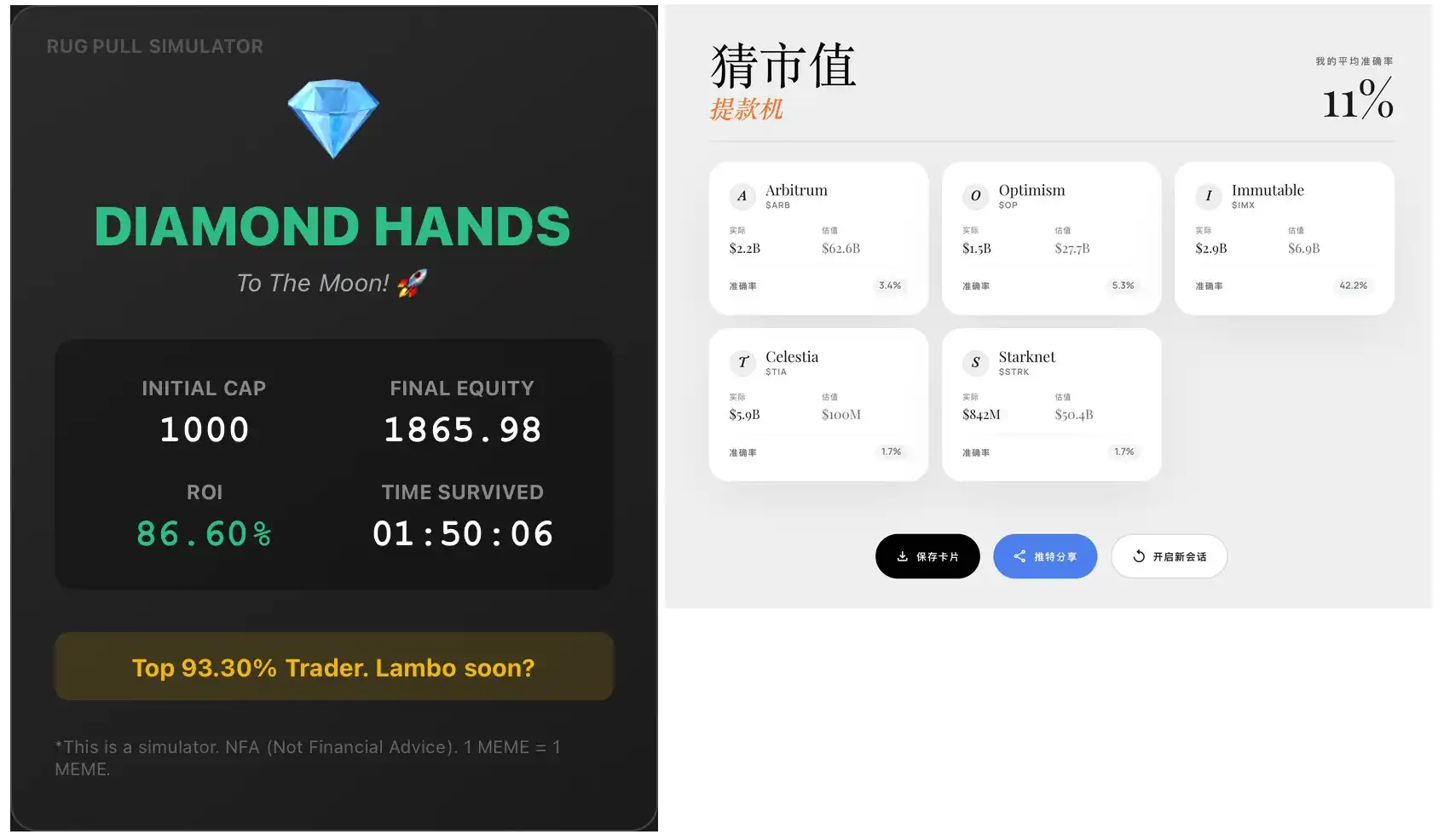
Another example is Brother Chicken's Rug Pull Simulator, a testing ground for trading memecoins, a speed-run version of GMGN's game. The pleasure lies in the rhythm of "exiting at the top." Buy low, spend marketing points to pump the price. If it pumps too fast, you fear a rug pull; if it's too slow, you get impatient. Successfully exit at the top, and profits are immediately credited—it feels like you've truly mastered the market's rhythm. Fail, and you can immediately try again.

Dopamine release in 0.2 seconds, faster than feedback in real trading.

Then there's Vesting Victim. While it doesn't have high-frequency clicking or the直观刺激 of price charts, it plays on your intuition about valuation. Based on a project's TVL, user count, funding situation, you judge its FDV, input the number, and the next second the system tells you the deviation. This "second-level verification" makes it impossible to stop. You unconsciously want to play another round—this time I'll guess more accurately—your nervous system directly receiving reward signals.
This is also the most addictive part of vibe coding. It doesn't need grand narratives or long-term investment. Copilot, Cursor, AI templates have drastically compressed the time from "an idea to a playable demo." It also doesn't rely on any future promises. No one expects today's vibe coding to produce great projects; being "fun today" is enough.

We just need to make choices in the present, get immediate feedback, and experience the pleasure of operations and results directly mapping onto our nerves. And this kind of pleasure is more direct, real, and easier to spread virally on social media than any complex economic model, long-term strategy, or whiteboard prediction.

The essence of vibe coding is, in a market where no one believes in long-term narratives anymore, monetizing attention with the lowest delivery cost.

It is, in a sense, the industrialization of dopamine—small doses, fast feedback, low addiction threshold, high repeat engagement; a form that is more brutal for project teams and more honest for users; and a natural product of today's market environment.

So when this era arrives, don't resist it, and stop lecturing about profound insights and morality. Let's indulge together in these fast-food toys, enjoy the pleasure of immediate feedback, enjoy the dopamine.

Even if it might never be great.

Related Questions

QWhat is the core appeal of Vibe Coding games in the crypto space according to the article?

AThe core appeal is the immediate, continuous feedback loop that triggers dopamine release in as fast as 0.2 seconds, offering a highly addictive and entertaining experience without the promise of long-term value or a grand narrative.

QName two specific Vibe Coding games mentioned in the article and describe their core mechanics.

A1. Rug Pull Simulator (by an unnamed team): Players assume the role of a project founder with limited resources, making monthly decisions on development, marketing, or community management, and dealing with random events. 2. Another Rug Pull Simulator (by Haze from GMGN): A memecoin trading sim where players buy low, use marketing points to pump the price, and attempt to sell at the top for instant profit.

QHow does the article describe the development process of Vibe Coding projects?

AThe article states that the development process is extremely compressed. Using tools like Copilot, Cursor, and AI templates, an idea can be turned into a playable demo very quickly, requiring no long-term investment or complex future promises.

QWhat does the article suggest is the 'essence' of Vibe Coding in the current market?

AThe essence of Vibe Coding is described as the industrialization of dopamine, using the lowest delivery cost to instantly monetize attention in a market where no one believes in long-term narratives anymore.

QWhat was the author's initial opinion on Vibe Coding, and how did it change?

AThe author initially viewed Vibe Coding products as mere noise, creating temporary hype and emotion rather than lasting value, comparable to simple games. Their opinion changed after trying the games themselves, finding the immediate feedback and addictive '爽感' (shuǎng gǎn - pleasurable feeling) to be incredibly compelling.

Related Reads

A Clod of Chinese Soil Chokes Two Japanese Giants

"Chinese Soil Chokes Japanese Giants" The production of a key electronic specialty gas, tungsten hexafluoride (WF6), vital for manufacturing AI chips, was halted by two leading Japanese producers—Kanto Denka and Central Glass. Their shutdown was not due to a technological failure but a sudden, critical shortage of a raw material they had long taken for granted: ultra-high-purity (6N-grade) tungsten powder, which is almost entirely sourced from China. Following a quiet Chinese export announcement in January 2026, tungsten powder shipments to Japan dropped to zero for months. Despite frantic efforts, Japanese companies found no viable alternative; imported powder was three times more expensive and lacked the required purity. Their existing stockpiles were exhausted by mid-2026. WF6 is essential for depositing tungsten into the microscopic contact holes of High Bandwidth Memory (HBM) chips, which are crucial for advanced processors like those from Nvidia. While Japanese firms had mastered producing ultra-pure WF6 gas, their entire supply chain relied on China's 6N tungsten powder—a dependency now revealed as a fatal vulnerability. China's dominance in this "soil" results from decades of painstaking R&D by companies like Xiamen Tungsten and China Tungsten & Hightech. They overcame immense technical hurdles, such as separating chemically similar molybdenum from tungsten, to achieve mass production of the world's purest tungsten powder. With their primary suppliers gone, Kanto Denka and Central Glass announced a permanent halt to WF6 production starting July 1, 2026. This immediately created a supply crisis for major semiconductor manufacturers like Samsung and SK Hynix, forcing them to urgently seek and certify new Chinese suppliers for WF6 itself. The reversal marks a dramatic shift: China has moved from exporting low-value raw materials to controlling the high-purity foundation of a critical global tech supply chain, upending a long-established industrial hierarchy.

marsbit25m ago

A Clod of Chinese Soil Chokes Two Japanese Giants

marsbit25m ago

Without Tencent, What's Left for Suiyuan?

The article centers on the crucial question posed in the title: what is Seyond Technology really worth if its dominant customer, Tencent, were to stop purchasing its AI chips? As the last of China's "Four AI Chip Dragons" to secure approval for a public listing, Seyond's IPO filing reveals a profound and controversial dependency. In 2025, 74.9% to over 80% of its revenue came from Tencent. The piece argues that this extreme customer concentration is not merely a vulnerability but a strategic outcome of China's AI industry evolution. It contrasts Seyond's path with its peers (Moore Thread, Biren Technology, and MetaX), noting that while others raced to market with ambitious stories, Seyond focused first on securing and delivering for a major client. Its explosive revenue growth—with Q1 2026 up 1474.85% year-on-year—is driven by concentrated orders from Tencent, which itself faces massive, escalating AI compute demands for products like its Yuanbao and Hunyuan models. The relationship is framed as a deliberate, symbiotic cultivation of a supply chain. As both a major shareholder (20.26%) and primary client, Tencent is actively fostering Seyond to build a controllable, stable alternative to NVIDIA, similar to how global tech giants historically nurtured key suppliers. The high switching costs—involving software stacks and deployed systems—create a deep "ecological moat" for Seyond within Tencent's ecosystem. The analysis positions the AI chip landscape in three tiers: NVIDIA as the global leader, Huawei's Ascend as the state-backed player, and commercial firms like Seyond competing for market orders. Seyond is increasingly seen as "Tencent's compute foundation," with its product roadmap closely aligned with the tech giant's needs. The conclusion is that the industry's metric for success is shifting from fundraising and technical specs to real orders, delivery capability, and ecosystem binding. Seyond's value, therefore, lies not just in its chips but in holding a massive, multi-year procurement order from China's largest internet company—a tangible asset arguably more telling than any technical whitepaper in the current climate. The core insight is that for domestic chips, the ultimate challenge isn't just catching up technologically with NVIDIA, but earning the trust, scenarios, and recurring orders from a major anchor client.

marsbit1h ago

Without Tencent, What's Left for Suiyuan?

marsbit1h ago

War Trade Unwinding | TradeXYZ Weekend Observations

Weekend markets saw a clear return of risk appetite. Major indices rose broadly, with significant gains in tech and precious metals, while energy sectors fell sharply on the "end of war" narrative. On June 14, oil prices initially rose on reports Iran had not yet finalized a memorandum of understanding. Later, YNET reported Trump might immediately lift the maritime blockade on Iran and the Strait of Hormuz. At 21:30, Trump confirmed on Truth Terminal that a deal with Iran was done, authorizing an immediate end to the US blockade and toll-free opening of the Strait. Iran's deputy foreign minister simultaneously announced an immediate and permanent halt to military actions on multiple fronts. Oil prices had already fallen to weekend boundaries, pre-pricing the news. The S&P 500 subsequently touched 7530. Markets will likely remain in a waiting period until the formal peace deal signing on June 19. At the moment of the deal announcement, gold jumped from ~4,221 to a high of 4,337, and silver from ~67.85 to 70.83, before stabilizing at higher levels. Individual stocks and ETFs like NBIS, RKLB, and LITE performed strongly. NBIS, added to the Nasdaq index, saw a target price increase due to strong AI cloud growth. RKLB, also added to the index, benefited from positive SpaceX valuation sentiment. LITE received a $1,130 target from JPMorgan. SPCX rose quickly after Musk tweeted SpaceX could potentially reach ~$1 trillion in revenue by 2030. In summary, the market shock from the multi-month war is beginning to dissipate. Israel's actions remain the key variable before the June 19 signing. Upcoming events like Fed Chair Warsh's debut and BoJ rate hike expectations will also significantly impact markets this week.

marsbit2h ago

War Trade Unwinding | TradeXYZ Weekend Observations

marsbit2h ago

Trading

Spot
Futures
活动图片