These Key Ethereum Metrics Point To A Potential Liquidity Trap – What To Know

bitcoinistPublished on 2026-03-21Last updated on 2026-03-21

Abstract

Ethereum has turned bearish following the Fed meeting but remains above $2,100. Key on-chain metrics suggest a potential liquidity trap, as large holders (whales) are closing long positions and opening shorts, while retail traders aggressively open long positions. This divergence indicates weakening underlying strength despite surface-level price firmness. Analysts note that recent buying pressure was absorbed by sell-side liquidity, and significant long buildups point to key liquidation levels near $1,850. Ethereum recently filled a CME gap at $2,117, which now acts as a support level. A rebound occurs, the next target could be around $2,686, which would fill another CME gap.

Ethereum has flipped bearish following the market’s reaction to the Federal Reserve (Fed) meeting, but its price remains firm above the $2,100 level. Given the bearish conditions, the market dynamics of ETH are starting to shift as key metrics signal a possible liquidity trap ahead at current levels.

An Ethereum Liquidity Trap Signal Emerges

After recent price action, an on-chain indicator is triggering fresh concerns around Ethereum and its market dynamics. These kinds of signals are typically seen during volatile periods and could play a crucial role in shaping the altcoins’ next price trajectory in the short term.

Combining signals from multiple metrics, Boris, a crypto trader and on-chain analyst, has outlined the potential formations of a liquidity trap for ETH. Even though price activity may seem stable on the surface, underlying data indicate that liquidity is being concentrated in a way that could surprise traders.

As ETH’s price climbed toward the $2,400 level, the Whale Vs Retail Delta continued to move into negative territory. This trend underscores a key divergence in activity between large holders and smaller investors in the market. Simply put, large holders or whales are reducing their relative activity or exposure, while small traders are becoming more active in the market.
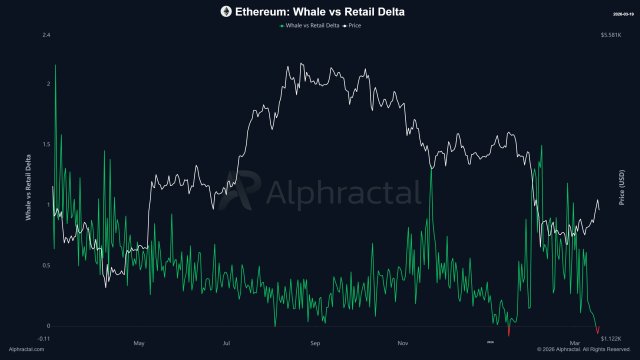
Source: Chart from Boris on X

Currently, whale investors are closing their long positions in Ethereum and opening more short positions. Meanwhile, retail holders are doing the opposite as they aggressively open long positions. When institutional players retreat while retail engagement increases, this imbalance frequently indicates a shifting mood under the surface. A trend of this kind is considered a classic liquidity illusion.

Boris highlighted that buying pressure saw robust strength for a period, but those buys were absorbed by sell-side liquidity. As a result, the market has entered a cooling phase. Historically, the current market setup hints at further downside pressure.

Adding to the market trend is the ETH Liquidation Levels metric. Data shows a significant long buildup over the past month, with key liquidity targets at $1,850 and below. While the price is moving up, the market is clearly demonstrating weakening strength underneath.

ETH Closes Recent CME Gap

Ethereum’s recent price action was met with a CME Gap. However, CW, a market expert and investor, reported that the leading action has filled the gap, which was located at $2,117. As the market tries to correct inefficiencies, these gaps, which are frequently created during times of intense price movement, may serve as magnets for subsequent price action.

After closing the gap, a buy wall has been formed around $2,100, and this level aligns with the Fibonacci level of 0.382. If a rebound occurs after reaching the $2,100 level, the next target is around $2,686, a price that corresponds to the 0.382 fib level. Meanwhile, if ETH rises to this level, another CME gap ahead will be filled.

ETH trading at $2,145 on the 1D chart | Source: ETHUSDT on Tradingview.com

Related Questions

QWhat key Ethereum metric is signaling a potential liquidity trap according to the article?

AThe Whale Vs Retail Delta moving into negative territory, indicating whales are reducing activity while retail traders are becoming more active.

QWhat are the two key liquidity targets mentioned for ETH below current price levels?

A$1,850 and below.

QWhat significant price level did Ethereum recently fill according to the CME gap analysis?

A$2,117.

QWhat is the next potential price target for ETH if it rebounds from the $2,100 support level?

AAround $2,686, which corresponds to the 0.382 Fibonacci level.

QWhat trading activity are whale investors currently engaged in with Ethereum according to the on-chain data?

AWhales are closing their long positions and opening more short positions.

Related Reads

In-Depth Report on the On-Chain Lending Market: When Off-Chain Credit Meets On-Chain Liquidation

The on-chain lending market has evolved from a peripheral DeFi niche into core financial infrastructure. As of early 2026, total value locked (TVL) in on-chain lending protocols has reached $64.3 billion, accounting for 53.54% of total DeFi TVL, making it the largest and most mature vertical within decentralized finance. Aave dominates the sector with approximately $32.9 billion in TVL, commanding nearly half of the market—a leadership position that is unlikely to be challenged in the foreseeable future. However, the path of on-chain lending forward is not without risk. Liquidation cascades, credit defaults, and cross-chain vulnerabilities remain systemic threats hanging over the industry. At the same time, a deeper structural transformation is underway: on-chain lending is shifting from a “leverage tool for crypto-native users” to a “compliant gateway for institutional capital”. The scale of RWA (Real World Asset) lending has surpassed $18.5 billion, with U.S. Treasuries and government securities increasingly serving as core collateral. Institutional capital inflows are reshaping both the user base and risk appetite of the sector. This report systematically analyzes the evolution of on-chain lending definitions, competitive dynamics, core risks, and future trends, providing a comprehensive industry outlook for investors and trade practitioners. Key findings suggest that the “one dominant player with several strong challengers” structure will persist in the short term, while fixed-rate lending, compliant collateral, and institutional credit underwriting will define the next phase of competition. For investors focused on DeFi infrastructure, three key opportunity tracks stand out, namely, the Aave ecosystem (Morpho, Spark), RWA lending protocols (Ondo, Maple) and fixed-rate innovation (Notional, Pendle).

HTX Learn1h ago

In-Depth Report on the On-Chain Lending Market: When Off-Chain Credit Meets On-Chain Liquidation

HTX Learn1h ago

Fu Peng's First Public Speech in 2026: What Exactly Are Crypto Assets? Why Did I Join the Crypto Asset Industry?

Fu Peng, a renowned macroeconomist and now Chief Economist at New火 Group, delivered his first public speech of 2026 at the Hong Kong Web3 Festival. He explained his perspective on crypto assets and why he joined the industry, framing it within the context of macroeconomic trends and financial evolution. Fu emphasized that crypto assets are transitioning from an early, belief-driven phase to a mature, institutionally integrated asset class. He drew parallels to the 1970s-80s, when technological advances (like computing) revolutionized traditional finance, leading to the rise of FICC (Fixed Income, Currencies, and Commodities). Similarly, current advancements in AI, data, and blockchain are reshaping finance, with crypto assets becoming part of a new "FICC + C" (C for Crypto) framework. He noted that institutional capital, including traditional hedge funds, avoided early crypto due to its speculative nature but are now engaging as regulatory clarity emerges (e.g., stablecoin laws, CFTC classifying crypto as a commodity). Fu predicted that 2025-2026 marks a turning point where crypto becomes a standardized, financially viable asset for diversified portfolios, akin to commodities or derivatives in traditional finance. Fu defined Bitcoin not as "digital gold" in a simplistic sense but as a value-preserving, financially tradable asset. He highlighted that crypto's future lies in regulated, institutional adoption, moving away from retail-dominated trading. His entry into crypto signals this maturation, where traditional finance integrates crypto into mainstream asset management.

marsbit2h ago

Fu Peng's First Public Speech in 2026: What Exactly Are Crypto Assets? Why Did I Join the Crypto Asset Industry?

marsbit2h ago

Trading

Spot
Futures

Hot Articles

Discussions

Welcome to the HTX Community. Here, you can stay informed about the latest platform developments and gain access to professional market insights. Users' opinions on the price of ETH (ETH) are presented below.

活动图片