Theft Is Just the Beginning: The Slow Collapse Behind Cyber Attacks

比推Published on 2026-03-23Last updated on 2026-03-23

Abstract

The article "Theft Is Just the Beginning: The Slow Collapse Behind Hacker Attacks" discusses the long-term impacts of cryptocurrency hacks beyond the initial financial loss. Based on Immunefi’s "2026 On-Chain Security Report," the analysis reveals that while attacks themselves are swift, the aftermath unfolds over months, causing prolonged damage such as declining token prices, reduced funding, halted hiring, and delayed development. Key findings include: - The median direct loss per attack is around $25 million, but tokens experience a median drop of 61% within six months, with 16% recovering to pre-attack levels. - Although the number of attacks remains steady (94 in 2024, 97 in 2025), the concentration of losses is alarming: the top five attacks accounted for 62% of total stolen funds. - Centralized platforms, though fewer in attack frequency, represent over half of the financial losses, highlighting persistent vulnerabilities in trusted intermediaries. The report emphasizes that the true crisis begins after the theft—projects face extended recovery periods, reputational harm, and operational disruption, making survival particularly challenging for less-resourced teams. The interconnected nature of DeFi ecosystems further amplifies risks, as single incidents can trigger broader market repercussions. Ultimately, the article underscores that resilience is not just about preventing hacks but enduring their prolonged secondary effects.

Author: Andjela Radmilac

Compiled by: Saoirse, Foresight News

Original title: Under the Shadow of Hackers, More Than Just the Demise of Funds


Cryptocurrency exploits can drain a wallet in minutes, but the full extent of the losses often takes months to fully materialize. Token prices continue to fall, project treasuries shrink, hiring freezes, and even projects that survive the theft may completely lose their future in the subsequent turmoil.

Cryptocurrency hacks never end the moment the wallet is emptied. The theft is swift and direct, followed by a slower collapse that begins to spread within the project.

Tokens continue to decline, funding pools shrink accordingly, hiring plans are cut, product development is delayed, and partners withdraw one after another. Projects that should be focusing on recovery end up spending months rebuilding credibility instead of building.

This is precisely the scene depicted in Immunefi's latest "2026 On-Chain Security Status Report." Its core argument applies to any market—whether in the crypto industry or traditional sectors: the initial loss is only part of the damage.

The more serious issue lies in the devastating impact of the exploit on the project's future. Immunefi data shows that the average direct amount stolen per attack in their sample was approximately $25 million, while the median drop in stolen tokens within six months was as high as 61%. During this period, 84% of the tokens failed to return to their pre-attack prices, and project teams spent at least three months on post-incident recovery, delaying normal development.

However, this data comes with a caveat: token declines have multiple causes, and many projects were already vulnerable before the attack—suffering from poor liquidity, overvaluation, or having already lost momentum.

Immunefi acknowledges that they cannot completely separate the impact of hacks from broader market weakness or the projects' own issues. Even so, the patterns revealed in the report are still noteworthy: hacker attacks are no longer isolated theft events but more like a long-tail corporate crisis.

The value of this report lies in its proof that, after the热点 news fades, the后续 effects of hacker attacks continue to cause long-term harm.

Median Attack Losses Are Decreasing, but Extreme Attacks Are Becoming More Dangerous

According to Immunefi's statistics, 191 crypto attacks occurred in 2024-2025, with total losses of $4.67 billion; over five years, 425 attacks累计 occurred, with total losses reaching $11.9 billion.

The number of attacks per year has hardly changed: 94 in 2024, 97 in 2025, roughly flat with 2023. This indicates that the overall security of the market has not significantly improved. Hacker attacks have become the norm in the crypto industry, and a few giant attacks are enough to define the industry's risk for an entire year.

The report reveals a core contradiction:

The median loss from attacks in 2024-2025 was $2.2 million, lower than the $4.5 million in 2021-2023. On the surface, this seems like progress. However, the average loss was still about $24.5 million, more than 11 times the median; previously, this gap was only 6.8 times. The top five attacks accounted for 62% of all stolen funds; the top ten accounted for 73%.

This is an extremely dangerous distribution pattern: the market appears stable and safe until a giant event tears it apart. The scale of ordinary attacks has become smaller, but the real致命 risk lies in the tail—a few特大 incidents absorb the vast majority of losses and冲击 the entire market in a single day.

The most typical case is Bybit. The exchange's $1.5 billion exploit became the most iconic hack of 2025, with this single incident accounting for 44% of all funds stolen that year.

It's easy to view such events as news spectacles, but they expose a deeper problem of risk concentration: a single failure at a core platform is enough to distort the annual loss structure of the entire industry, revealing that huge risks are still piled up on a few critical nodes.

The Protracted Decline Is Where the Project Truly Begins to Collapse

The data on stolen funds in the report is certainly noteworthy, but the most alarming part is the section on price impact.

In Immunefi's sample of 82 hacked tokens:

  • Within two days of the hack, the median drop was about 10%, roughly flat with the previous cycle;

  • But the real冲击 emerged later: the median drop expanded to 61% after six months, higher than the 53% in 2021-2023.

Six months later:

  • 56.5% of the hacked tokens had fallen more than 50%;

  • 14.5% had fallen more than 90%;

  • Only about 16% of tokens returned to or exceeded their pre-attack price levels.
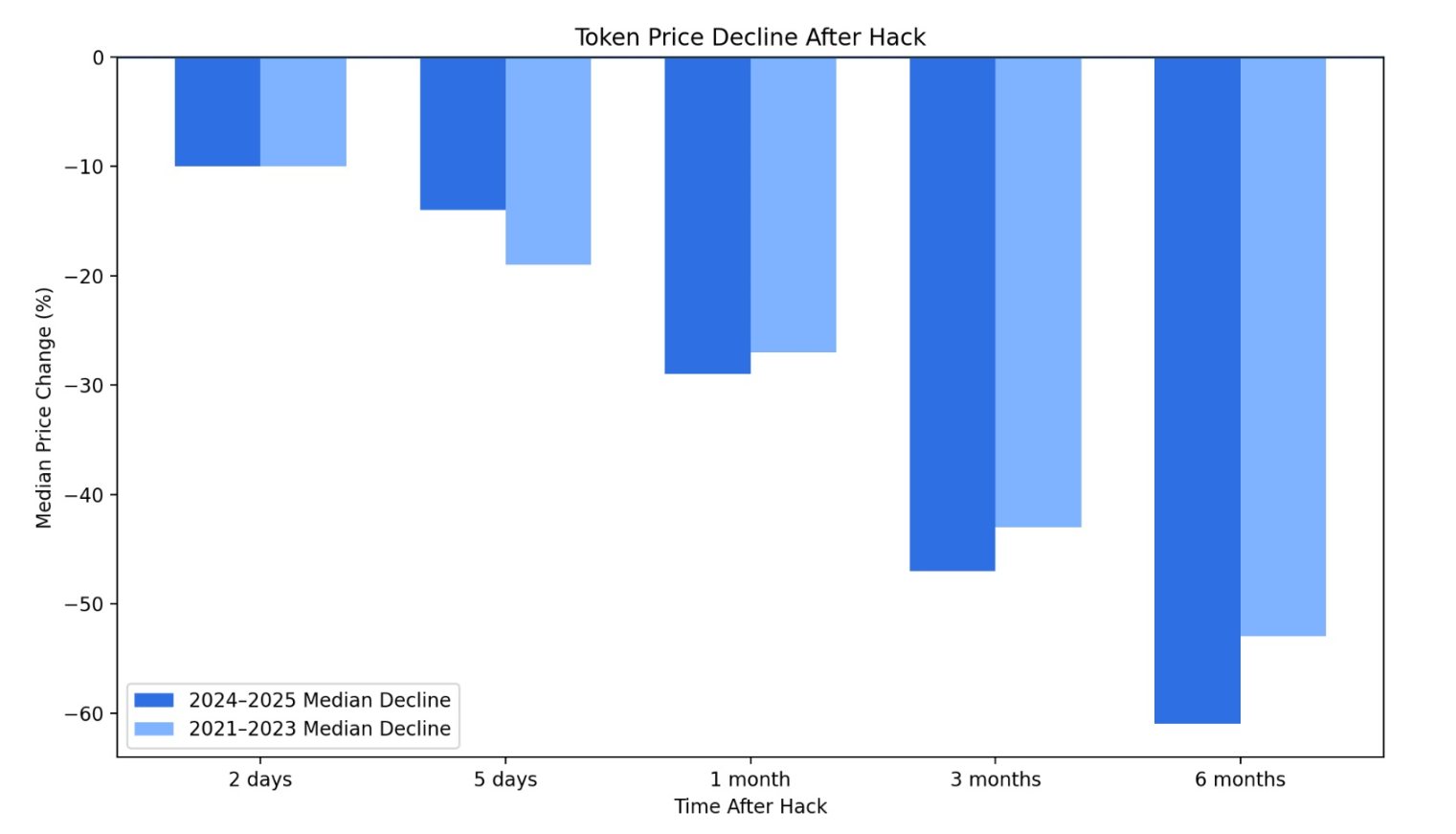
Chart shows the median token price decline for 82 hacked tokens in Immunefi's sample from 2024 and 2025 (Source: Immunefi)

To understand the full impact of a hack, we can no longer view token price as an isolated market indicator. For the vast majority of crypto projects, the token is the treasury, the foundation for fundraising, and the public report card of credibility. A prolonged暴跌 directly cripples the project's operational cycle, hiring ability, bargaining power in partnerships, and internal morale.

The report points out that projects that suffer attacks often lose their security lead within weeks and enter a recovery period of at least three months. Even if the timeline varies by project, the consequences are clear: projects with crashed tokens and damaged brands have almost no breathing room or chance for a turnaround.

Many markets can withstand a theft, a bad quarter, or even a reputation crisis. But the crypto industry often compresses all three into the same event: the attack empties the treasury → the token暴跌 publicly revalues the project → partners withdraw before the internal cleanup is even finished.

Recovery in this environment is extremely difficult, and致命 for teams that were not well-funded to begin with.

Interdependency makes the situation worse. Immunefi believes the DeFi ecosystem has become increasingly interconnected, forming longer, more fragile risk chains between cross-chain bridges, stablecoins, liquid staking, restaking, and lending markets.

Although some cases in the report require external verification, the overall trend is undeniable: today's crypto systems have more complex layers, meaning the impact of a single attack will extend far beyond the affected protocol itself.

Centralized platforms remain at the epicenter of explosions.

The report shows that out of the 191 attacks in 2024-2025, only 20 targeted centralized exchanges, but these 20 caused losses of $2.55 billion, accounting for 54.6% of the total losses.

This shifts the problem from smart contract vulnerabilities back to asset custody, key management, and over-concentrated infrastructure. For an industry that often sells itself on "decentralized risk resistance," most of the huge losses still occur on highly trusted, centralized nodes.

But this does not mean all hacked projects are doomed to fail. The industry has entered a new phase: a project's survival no longer depends on whether it can withstand an attack, but on whether it can withstand the six months *after* the attack.

Theft is just the beginning of the crisis. What truly determines whether a project has a future is the long, slow,持续的 secondary damage that follows the attack.


Twitter:https://twitter.com/BitpushNewsCN

Bitpush TG Discussion Group:https://t.me/BitPushCommunity

Bitpush TG Subscription: https://t.me/bitpush

Original link:https://www.bitpush.news/articles/7622471

Related Questions

QWhat is the main finding of Immunefi's '2026 On-Chain Security Status Report' regarding the impact of crypto hacks?

AThe main finding is that the initial theft is only part of the damage; the more severe problem is the devastating impact on a project's future, including prolonged token price declines, drained treasuries, halted hiring, and delayed development, which can lead to a slow, long-term collapse.

QAccording to the report, what was the median percentage drop in the price of hacked tokens after six months?

AThe median percentage drop in the price of hacked tokens after six months was 61%.

QWhat does the report reveal about the distribution of losses from crypto hacks between 2024 and 2025?

AThe report reveals a highly dangerous distribution: while the median attack loss decreased, the average loss was high, and a small number of extreme attacks accounted for the majority of the losses. The top 5 attacks represented 62% of all stolen funds, and the top 10 represented 73%.

QWhich type of platform was responsible for the majority of the financial losses from hacks in 2024-2025, despite having fewer incidents?

ACentralized exchanges were responsible for the majority of financial losses. Although only 20 attacks targeted CEXs, they resulted in losses of $2.55 billion, accounting for 54.6% of the total losses during that period.

QWhat key factor does the report suggest ultimately determines whether a project can survive a hack?

AThe report suggests that a project's survival is no longer determined by its ability to withstand the initial attack, but rather by its ability to withstand the subsequent six months of slow, prolonged secondary damage, including price collapse and reputational harm.

Related Reads

Wall Street's Most Famous 'Cassandra' Now Has His Sights Set on Nvidia

Michael Burry, the famed "Big Short" investor, has once again captured Wall Street's attention with a series of short positions against major tech and semiconductor stocks, most notably Nvidia. In late June and July, through his "Cassandra Unchained" newsletter, Burry disclosed short bets against Nvidia, Tesla, Applied Materials, Caterpillar, the SOXX semiconductor ETF, and later, Micron Technology. His core thesis revolves around potential distortions in the AI infrastructure boom, specifically questioning whether extended depreciation schedules (e.g., 6 years vs. a realistic 2-3 years for AI chips) by cloud giants like Microsoft and Google artificially inflate profits. He also raises concerns about possible "off-balance-sheet circular financing," where chip demand might be propped up by vendor-backed funding to clients. Nvidia's stock experienced volatility following these disclosures, briefly dipping but largely holding near Burry's reported entry points, leaving his positions roughly flat or slightly underwater as of late July. This move is part of a pattern for Burry, whose track record since his legendary 2008 bet is mixed. He has faced notable losses, such as on Tesla in 2021, while scoring on broader market turns like the 2020 pandemic crash. His methodology focuses intensely on free cash flow and scrutinizing original financial documents to spot overvaluation and structural risks, but it often struggles with timing the market. The article contrasts Burry's stance with other prominent investors. Steve Eisman, another "Big Short" figure, is not shorting Nvidia, citing strong fundamentals but expressing nervousness about sustainability. Jim Chanos agrees with the broad "accounting mismatch" concern—comparing it to the dot-com bubble—but targets financial leverage in private equity firms rather than the chip stocks themselves. While Nvidia's short interest remains relatively low at 1.3-1.4% of float, the massive stock size means absolute short losses have been significant, exceeding $5 billion earlier this year. The piece concludes that for ordinary investors, the key takeaway is not replicating specific short bets but learning from the critical frameworks these investors use: questioning rosy accounting, identifying structural vulnerabilities, and maintaining skepticism during market euphoria, even if pinpointing the exact catalyst for a downturn remains elusive.

marsbit24m ago

Wall Street's Most Famous 'Cassandra' Now Has His Sights Set on Nvidia

marsbit24m ago

Weekly Selection丨Epic Stock Market Volatility, Changxin Tech's IPO Reshapes Storage Landscape, Saylor Aims to Re-Anchor STRC Around September 8th

PANews Weekly Digest: Market Turmoil, Tech Breakthroughs, and Crypto Developments. The week saw significant volatility across global markets. South Korea's KOSPI index experienced extreme turbulence, including multiple trading halts, largely driven by sharp declines in AI hardware stocks like SK Hynix. In contrast, China's Changxin Xinqiao (CXC) achieved a landmark IPO with a market cap surpassing 4 trillion yuan, marking a major success for the domestic DRAM industry after a decade of losses. In the crypto and Web3 space, several key narratives emerged. AI is driving demand for new infrastructure, with projects like AI agent wallets and programmable payments gaining traction, attracting interest from firms like Coinbase. The Bitcoin mining sector is pivoting, with companies like MARA focusing on energy management as electricity becomes a core AI-era asset. Meanwhile, the RWA (Real World Assets) sector faces a "utilization puzzle," with hundreds of billions in on-chain assets remaining dormant. Notable market movements included a historic single-day surge of over 17% for the KOSPI index and a significant migration of $16.5 billion in staked ETH within the Lido ecosystem. Michael Saylor announced a target to re-peg the STRC stablecoin around September 8th. Other highlights include discussions on Ethereum's ambitious 2030 roadmap for scaling and privacy, analysis showing high protocol revenues not always translating to token price gains, and warnings from Citi about potential extreme commodity price shocks by late 2026.

marsbit29m ago

Weekly Selection丨Epic Stock Market Volatility, Changxin Tech's IPO Reshapes Storage Landscape, Saylor Aims to Re-Anchor STRC Around September 8th

marsbit29m ago

When the Market Begins to Question AI Capex: A Full Analysis of Q2 Earnings Reports from Five Tech Giants

In late July 2026, five major US tech giants—Alphabet, Intel, Microsoft, Meta, and Apple—released their Q2 earnings reports. While all companies exceeded revenue and profit expectations, driven by strong AI-related business growth, investor reactions diverged sharply due to concerns over escalating AI capital expenditures (capex) and their impact on free cash flow. Alphabet reported strong revenue growth and a surging cloud business, but its stock fell after announcing a doubled year-on-year capex and negative quarterly free cash flow for the first time. Intel posted its strongest revenue growth in over 15 years, but its stock experienced volatile trading after significantly raising its full-year capex guidance. Microsoft saw its stock surge after beating estimates and, crucially, lowering its capex forecast while projecting positive free cash flow. Meta faced the most severe sell-off as its profits declined despite revenue beats, with free cash flow plunging over 90% and its capex guidance raised. Apple reported record June-quarter results, but its stock plummeted after providing Q4 revenue guidance that fell short of expectations, citing supply chain constraints and forex headwinds. The overall takeaway is that the market's focus has shifted from validating AI demand to scrutinizing the timeline for returns on massive AI investments. Companies demonstrating a clearer path to managing capex and preserving free cash flow, like Microsoft, were rewarded, while those signaling continued aggressive spending faced investor skepticism.

Odaily星球日报39m ago

When the Market Begins to Question AI Capex: A Full Analysis of Q2 Earnings Reports from Five Tech Giants

Odaily星球日报39m ago

a16z: From Companies to DAOs, DUNA May Become the Next Generation Organizational Form

This article, "From Companies to DAOs: How DUNA Could Become the Next Organizational Form," traces the 500-year evolution of business collaboration. It begins with medieval structures like the *commenda* and Florentine *compagnia*, which exposed partners to personal risk. The modern corporation, exemplified by the Dutch East India Company (VOC), was a revolutionary leap, enabling large-scale, capital-intensive ventures by offering limited liability and reducing coordination costs. However, corporations introduced new challenges like principal-agent problems and bureaucratic overhead. The piece argues that software and internet-native protocols are now reducing these traditional overheads. Decentralized Autonomous Organizations (DAOs) emerged as a new model for coordination without centralized management. Yet, DAOs face a significant legal vacuum: they lack legal recognition, leaving members exposed to unlimited personal liability, and their tokens are vulnerable to being classified as securities under unclear regulations (e.g., the Howey Test). This has forced projects into suboptimal workarounds like offshore foundations. The article identifies the Decentralized Unincorporated Nonprofit Association (DUNA) as a potential solution. Recently legalized in states like Wyoming, the DUNA provides a legal wrapper for decentralized networks. It grants key protections—legal personality, limited liability, and perpetual existence—to a group without imposing a traditional hierarchical management structure. This allows token-holder communities to govern, hold assets, and contract as a single legal entity, aligning with their decentralized nature. While DUNA doesn't solve all governance challenges or magically resolve securities law questions, it represents a crucial step. It fills the legal recognition gap, offering a native legal form for internet-scale, decentralized collaboration and extending the separation of personal risk from organizational venture into a new domain.

marsbit1h ago

a16z: From Companies to DAOs, DUNA May Become the Next Generation Organizational Form

marsbit1h ago

2026 Mid-Year Report On-Chain RWA: Tokenized Stock Market Cap Doubles in a Year, But 90% of Rights Are Hollow Shells

The 2026 Mid-Year Report on On-Chain RWA highlights a significant growth in tokenized stock market capitalization, which nearly doubled from $951 million in March to $1.89 billion by July. However, the report reveals a fundamental contradiction in this "layer 2.5" ecosystem: products with the strongest legal foundation (like regulated U.S. infrastructure) lack liquidity and distribution, while freely tradable offshored wrapper products often lack substantive ownership rights. The increase is driven largely by a few products (SECZ, FGRS, STRCx) and platforms (Ondo, xStocks, Securitize collectively hold over 85% share). While distributed value across networks like Ethereum, Solana, and BNB Chain has grown, the market remains fragmented. Products referencing the same underlying asset (e.g., Apple stock) are distinct legal liabilities with different intermediaries and jurisdictional rules, offering varying degrees of legal claim. The report cautions that headline numbers are misleading, as they reflect changes in distributed token value—driven by issuance, conversions, and price movements—not pure investor inflows. True "canonical shares" with legal ownership, wide wallet distribution, institutional liquidity, and independent on-chain price discovery do not yet exist at scale. Tokenized treasuries show stronger product-market fit, and ETFs may be easier to scale than single stocks. The core takeaway is a trade-off: legal certainty versus liquidity and composability.

marsbit2h ago

2026 Mid-Year Report On-Chain RWA: Tokenized Stock Market Cap Doubles in a Year, But 90% of Rights Are Hollow Shells

marsbit2h ago

Trading

Spot
活动图片