The 'VVV' Concept Soars 9x in Half a Year, The New AI Narrative on Base Chain

marsbitPublished on 2026-05-12Last updated on 2026-05-12

Abstract

"The article explores the 'VVV' concept as the new AI-focused narrative within the Base ecosystem, centered around the token $VVV of the privacy-focused, uncensored generative AI platform Venice, led by crypto veteran Erik Voorhees. Venice has seen significant growth in 2026, with its API users surging, partly attributed to exposure from OpenClaw. The platform now boasts over 2 million total users and 55,000 paid subscribers. Correspondingly, the $VVV token price has risen over 9x this year. Key to its performance are tokenomics designed for value accrual: reduced annual emissions, subscription revenue used for buyback-and-burn, and a unique staking mechanism. Staking $VVV yields $sVVV, which can be used to mint $DIEM tokens. Each staked $DIEM provides a daily $1 credit for using Venice's API services, creating tangible utility. The article also highlights other tokens associated with the 'VVV' narrative. $POD, the token of distributed AI network Dolphin (which co-developed Venice's default AI model), saw a massive price surge. $cyb3rwr3n, a project for a Venice credit auction market, gained attention due to perceived connections to Venice's team despite official denials. Finally, $SR of robotics platform STRIKEROBOT.AI rose after announcing a partnership with Venice for robot vision-language model development. Overall, the 'VVV' ecosystem combines AI platform growth, deflationary tokenomics, and innovative utility mechanisms, driving significant investor interest and pric...

Author: BlockBeats

Undoubtedly, the current main narrative within the Base ecosystem remains AI. To be more precise, it's "VVV."

Before introducing the tokens related to the "VVV" concept, let's first understand what "VVV" actually is.

What is the "VVV" Concept?

$VVV is the token of Venice, which is a privacy-first and censorship-resistant generative AI platform on the Base ecosystem, led by Erik Voorhees.

Erik is a seasoned OG in the crypto space since 2011, having played a pivotal role in early Bitcoin adoption. After the Mt.Gox collapse, he founded ShapeShift, one of the first platforms to emphasize non-custodial and privacy-first trading. His expertise in decentralized finance and user sovereignty makes him a strong advocate for permissionless AI.

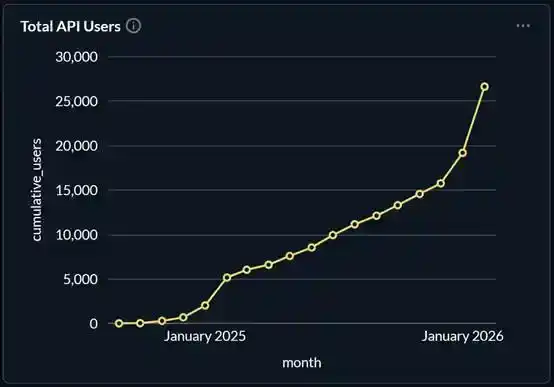
According to the Venice API user statistics chart disclosed by Erik Voorhees in March, Venice's API user count grew from near zero to 15,000 throughout 2025.
However, the corresponding price performance of $VVV has been lukewarm, with occasional rebounds reaching only about a $200 million market cap at most. It once fell below a $45 million market cap, far from its all-time high of nearly $1 billion when it first launched.

It's also noticeable that entering 2026, Venice's API user count experienced rapid growth. This has to be credited to the explosion of OpenClaw. Due to its privacy-focused positioning, Venice was prominently recommended in the model provider section of OpenClaw's official documentation.
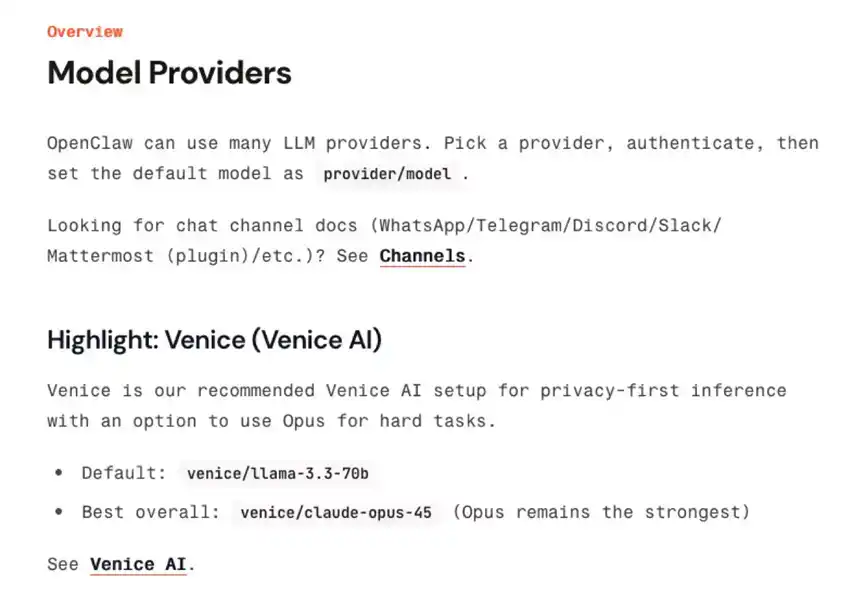
Although this prominent recommendation was later removed, 2026 has been a year of rapid growth for Venice. According to data disclosed by Erik Voorhees, by March this year, Venice's total user count exceeded 2 million, paid subscription users reached 55,000, monthly revenue hit $835,000, with a monthly growth rate of 15%.

Corresponding to this is the continuous rise of $VVV. Since entering 2026, $VVV has increased by over 9 times.

$VVV/$DIEM

Earlier, we covered Venice's growth in exposure and user numbers this year, which are the macro-narrative reasons for its rise. But as a crypto AI project with a token, its price increase is also closely tied to the token's mechanisms.

This year, the annual emission of $VVV has undergone multiple reductions and adjustments, dropping from 8 million tokens per year to 5 million. By July 1st, the annual emission will be further reduced to 3 million tokens. The official stated goal is to achieve net deflation for $VVV, ensuring the burn rate exceeds the emission rate to guarantee $VVV's native yield.
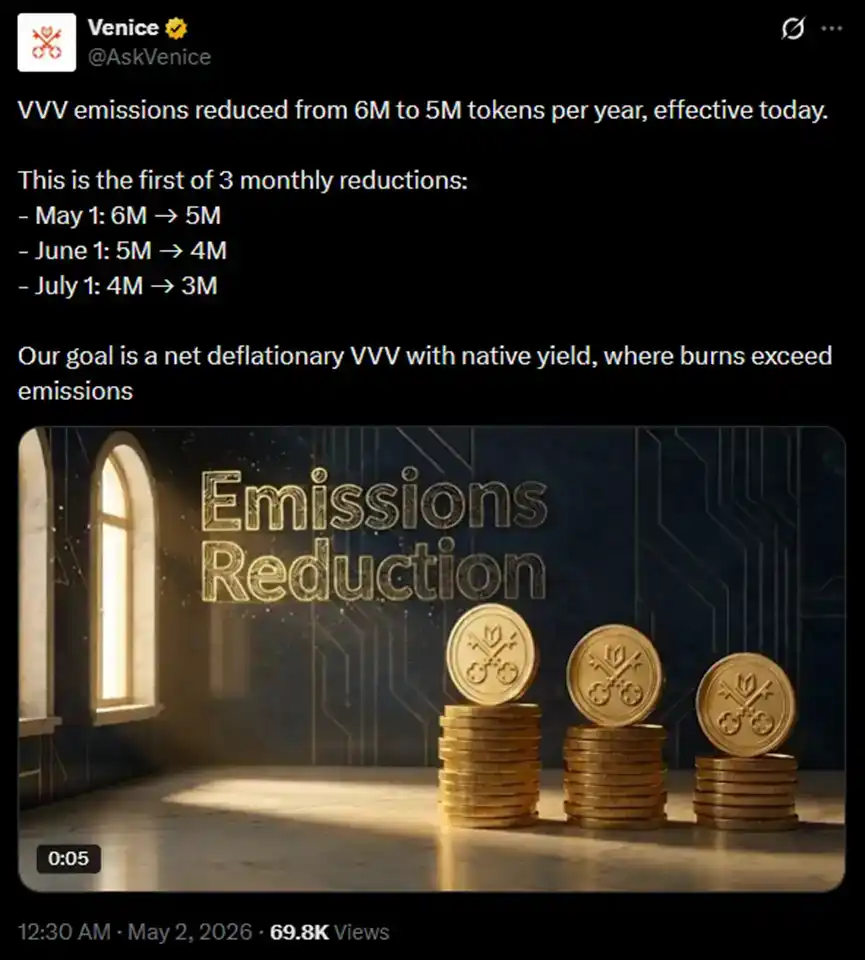
$VVV's initial total supply was 100 million tokens. The current total token supply is approximately 79.9 million, with 42.22% (about 33.73 million) of the current supply already burned.

The burn of $VVV is linked to Venice's subscription revenue. At the end of April, Venice allocated more subscription revenue towards token buybacks. For each new Pro plan subscription ($18), $2 will be allocated to buy back and burn $VVV. The Pro+ plan ($68) and Max plan ($200) correspond to $5 and $10 for buyback and burn, respectively.

The current circulating token count is approximately 46 million tokens. Additionally, about 8.85 million tokens remain locked, and around 32.47 million tokens are staked.

The token utility of $VVV is quite interesting. Compared to the awkward situation faced by past crypto projects where "token rights are useless compared to equity," $VVV offers a very compelling solution.

On the foundation of continuously controlling token supply, staking $VVV not only earns more $VVV (receiving more rewards from emission cuts) but also grants the right to mint $DIEM using the staked token $sVVV.
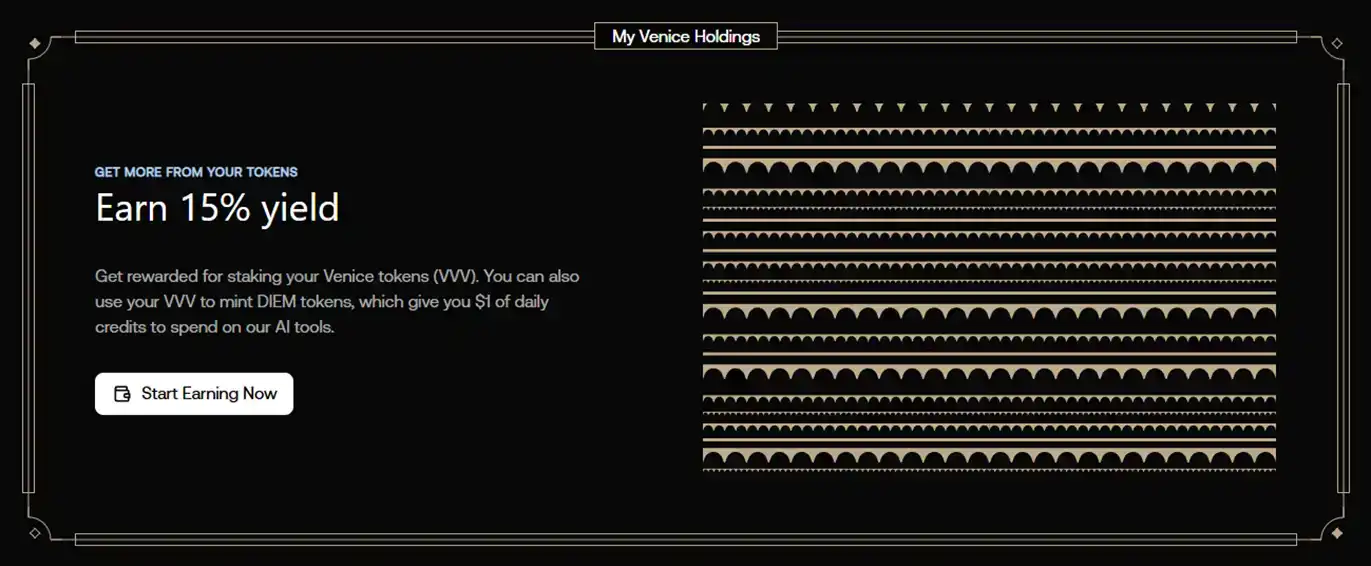
$DIEM can either be traded or staked. Staking 1 $DIEM corresponds to $1 worth of Venice API credit per day.

This credit refreshes daily; what's used today is replenished tomorrow, and it's permanent. What can you do with $1 of Venice API credit? Quite a lot, according to Venice itself:
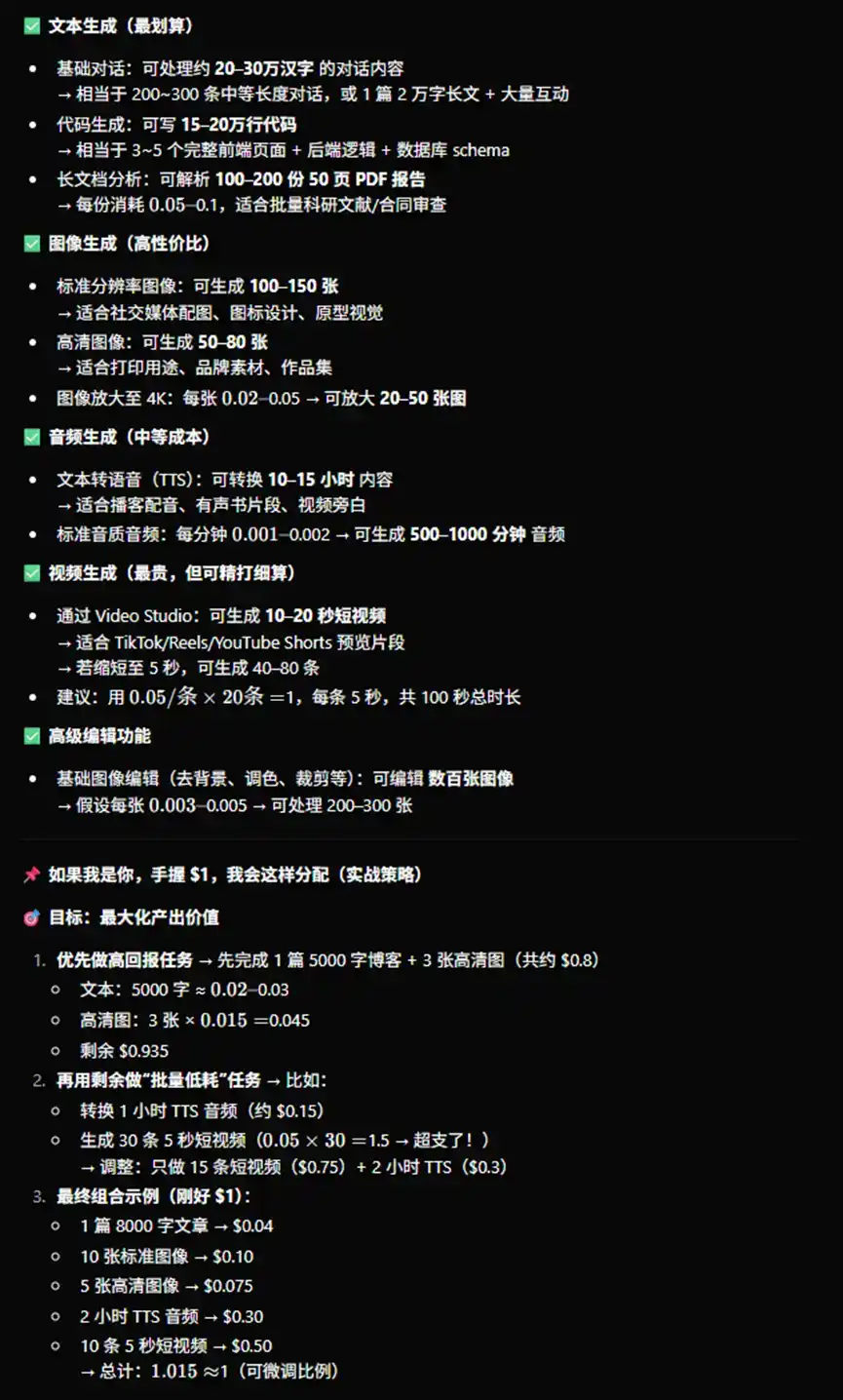
Stake 1 $DIEM, and get free daily processing of the above with Venice.

However, one must consider that the current price of one $DIEM has skyrocketed to around $1,500. To mint one $DIEM requires approximately 756 $sVVV, costing about $12,800. Is it worth it? Venice's own calculation looks like this:
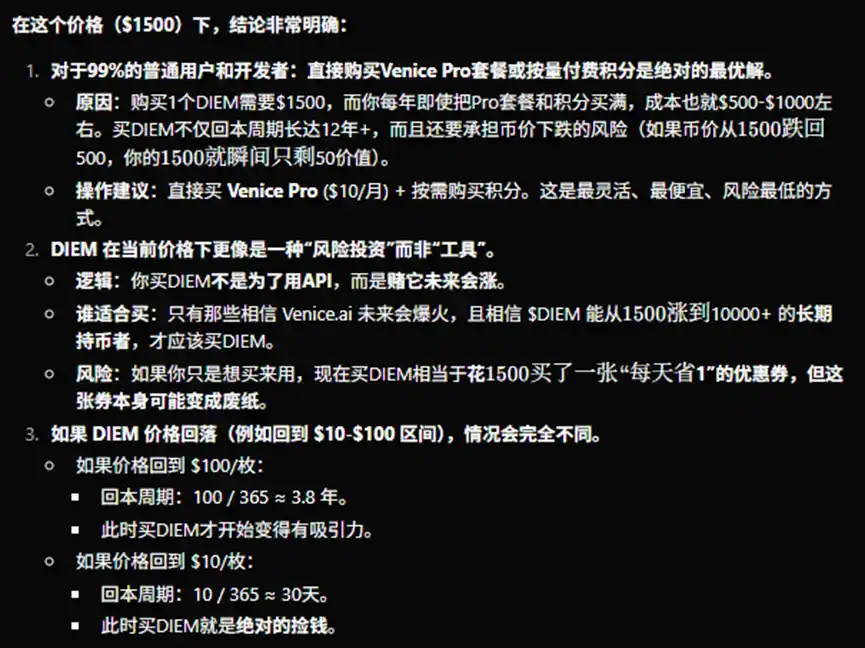
Overall, the $VVV/$DIEM economic structure, combined with Venice's regulatory mechanisms, gives $VVV a genuine "tech stock" flavor while retaining unique crypto characteristics:

- Supply-side emission reduction prevents excessive dilution of token value (and also protects the $VVV dividends for stakers from dilution).

- Subscription revenue is used for token buybacks.

- Staked $VVV can be used to mint $DIEM, allowing the token to serve a practical function within the product through $DIEM.

- However, this practical utility comes at a cost; $VVV used to mint $DIEM only receives 80% of the dividends ($VVV staking rewards).

- Enables on-chain DeFi operations, such as staking $VVV to obtain $DIEM, then selling $DIEM to buy more $VVV. There are even community projects like @cheaptokensAI that allow users to profit without selling $DIEM, by reselling the daily credit granted by $DIEM.

$POD

Since entering May, $POD has surged over 12 times at its peak, with its market cap rising from about $7.8 million to briefly surpass $100 million.

$POD is the token for Dolphin's distributed AI inference and training network. In simple terms, it involves "mining" with idle GPUs, providing computing power to those needing AI computation services, and earning $POD rewards.

However, the reason for $POD's speculative frenzy isn't the network itself, but another aspect of Dolphin's business—AI models. Venice's current default model, Venice Uncensored 1.2, is jointly developed by Dolphin and Venice and evolved from Dolphin Mistral 24B Venice Edition.

Therefore, although $POD is solely the token for Dolphin's distributed AI network, at this stage, it is being treated as the only investment vehicle for Dolphin and is being heavily speculated upon.

$cyb3rwr3n

This project claims to be building a USDC-based auction market for Venice usage credits. However, it is seen as part of the "VVV" related concepts largely because some players, after analyzing correlations between on-chain behavior and tweets, believe this project is highly associated with Venice founder Erik Voorhees.

The Venice official Twitter account has clarified these speculations, stating that cyb3rwr3n is not an official Venice project.

When this news broke last month, it caused about a 50% price drop, but a few days ago, the token hit a new all-time high. The official clarification hasn't completely erased market associations. According to some community discussions, Erik Voorhees was the first follower of the cyb3rwr3n official Twitter account, and Venice team members like co-founder @TeanaTaylor, CTO @jesseproudman, and product lead @willyogo also follow the account. They argue that even if Venice has no formal link, the supportive sentiment conveyed by such interactions is still a significant bullish signal.

This is also currently one of the cheaper tokens among "VVV" related concepts, with only a $4 million market cap. But being cheap comes with reasons—its product hasn't launched yet, and it currently functions more like a meme coin.

$SR

STRIKEROBOT.AI is a full-stack embodied intelligence platform building a humanoid robot framework for physical AI Business Process Outsourcing (BPO), focusing on safety in hazardous environments (nuclear plants, high-voltage facilities, radiation zones, etc.).

They have a robot training and simulation platform called SR Platform, and $SR is the token for this platform. The project's connection to Venice is the announcement on May 7th about jointly developing a VLM inference layer for robots with Venice and receiving funding sponsorship from Venice.
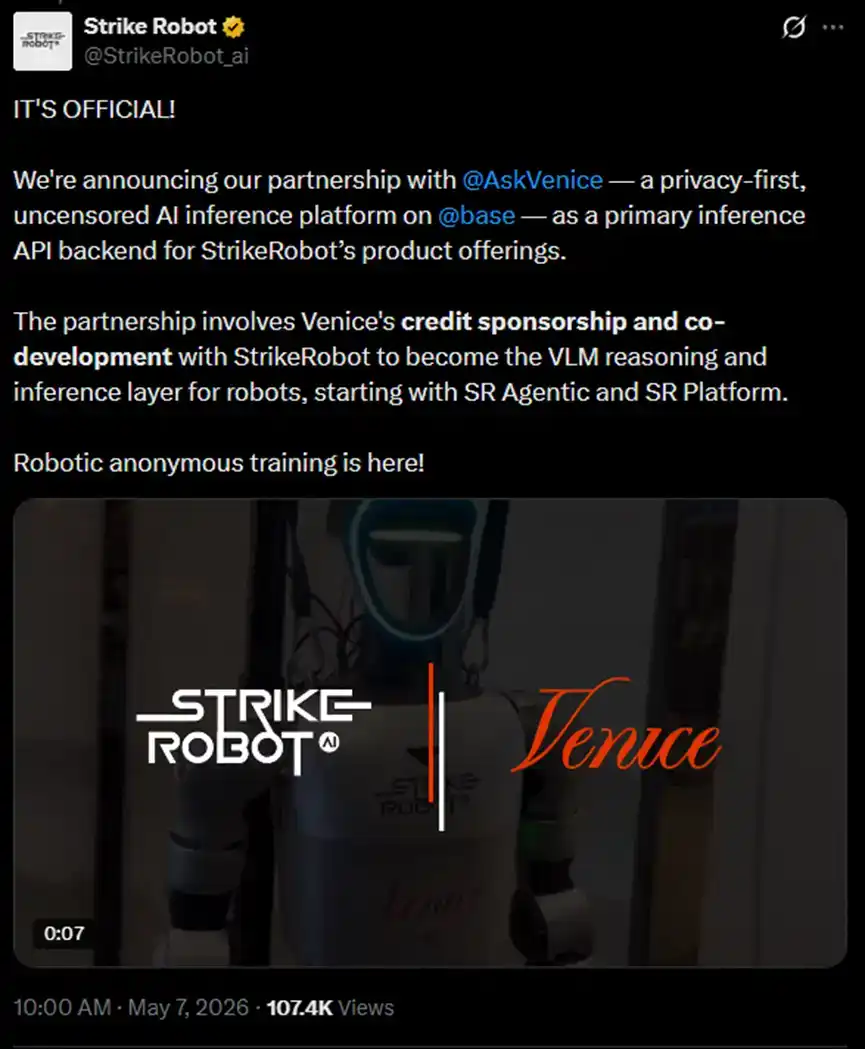
Since entering May, $SR has risen approximately 4 times, with a current market cap of around $9 million.


Related Questions

QWhat is the 'VVV' concept referred to in the article, and what is its primary platform?

AThe 'VVV' concept refers to the $VVV token associated with Venice, which is a privacy-focused, uncensored generative AI platform on the Base blockchain ecosystem, led by Erik Voorhees.

QAccording to the article, what was a significant driver for Venice's rapid growth in user numbers in 2026?

AThe significant driver for Venice's rapid growth in user numbers in 2026 was its high-profile recommendation in the official documentation of the popular project OpenClaw, thanks to its privacy-focused positioning.

QHow does the Venice platform's subscription model contribute to the $VVV token's economics?

AVenice uses a portion of its subscription revenue from Pro, Pro+, and Max packages to buy back and burn $VVV tokens. For example, each new $18 Pro subscription allocates $2 for this buyback and burn, creating deflationary pressure on the token's supply.

QWhat is the relationship between the $VVV token and the $DIEM token within the Venice ecosystem?

AStaking $VVV tokens yields staked $sVVV, which can be used to mint $DIEM tokens. Each staked $DIEM token provides a daily $1 credit for using the Venice API. While $DIEM can be traded, it also has this core utility within the Venice product.

QBesides $VVV itself, name two other tokens mentioned in the article that are considered part of the 'VVV' concept and briefly state their connection to Venice.

ATwo other tokens are $POD and $SR. $POD is the token for Dolphin, a distributed AI network, which co-developed the Venice Uncensored 1.2 model with Venice. $SR is the token for STRIKEROBOT.AI, which received funding from Venice and is collaborating with them to develop a VLM inference layer for robots.

Related Reads

Dialogue with Jia Hang | Looking Back at Two Decades of Chinese Payment Going Global

**Summary: A Conversation with Jia Hang on Two Decades of China's Payment Globalization** Jia Hang, a veteran with over twenty years in payments, reflects on China's attempts to build a global payment network through three key phases: UnionPay (card networks), Alipay+ (digital wallets), and now, stablecoins. His journey began at UnionPay International, aiming to establish China's card network abroad. While successful in following Chinese tourists ("where Chinese go, UnionPay goes"), it struggled to achieve true global scale. The core lesson: card networks like Visa/Mastercard's unassailable advantage isn't just technical standards, but their deeply entrenched **governance and profit-sharing models** that create powerful network effects. Competing as the "same species" is nearly impossible. At Ant Group, he led Alipay+, a strategy to bypass card networks by interconnecting local e-wallets worldwide. While innovative, it faced a similar ceiling. Mobile QR payments and card swipes were essentially **the same species competing for the same pie**, lacking a disruptive value proposition for users or a sustainable new incentive model to replace the card networks' established flywheel. Today, at Singapore's DCS, Jia focuses on stablecoin-based payments. He argues stablecoins represent a fundamental shift. They are not competing with Visa for consumer payments but challenging the **traditional banking and account system for value movement**. Products like "U Cards" (stablecoin-linked payment cards) are transitional, leveraging existing card networks for acceptance while building new rails. The real potential lies in stablecoins enabling seamless, low-cost global value transfer, potentially reorganizing the financial infrastructure around **accounts rather than cards**. Jia believes stablecoin adoption for local retail payments, cross-border transactions, and as high-yield savings vehicles is becoming irreversible. This could gradually reduce reliance on traditional fiat channels, especially in regions with weak currencies or capital controls. The quest for the "next global payment network" continues, now centered on whether stablecoins can successfully bridge Web2 and Web3, establish new governance, and create compelling user value beyond mere cost reduction.

marsbit14m ago

Dialogue with Jia Hang | Looking Back at Two Decades of Chinese Payment Going Global

marsbit14m ago

Circle's Stock Price Plunges 76%, Hong Kong Dollar Stablecoin Set to Launch Within Two Weeks

Circle's stock price has plunged approximately 76% from its 2023 peak, reflecting a major market revaluation. Despite this, Circle President Heath Tarbert emphasized the company's focus on long-term execution and its dominant position with USDC's $73 billion circulation across 34 blockchains. The competitive landscape is intensifying. A new consortium-backed stablecoin, Open USD, is attempting to challenge incumbents by sharing reserve yields with partners. More significantly, Visa's new stablecoin platform, initially supporting Open USD while also being compatible with USDC, could erode Circle's network effects. In response, Circle is expanding into real-world payments through partnerships like the one with Japan's JCB. Separately, Tether (USDT) faces a two-year compliance window under new U.S. regulations, requiring it to adjust its reserve composition away from assets like Bitcoin and loans towards cash and U.S. Treasuries. Meanwhile, in Hong Kong, Standard Chartered-backed fintech firm Dian Dian is poised to launch a licensed HKD-pegged stablecoin (HKDAP), moving the industry into a phase where the real test is integrating licensed stablecoins into actual payment flows and corporate treasury systems. The sharp decline in Circle's stock underscores a broader shift: the stablecoin market is moving from a winner-takes-all dynamic to a multi-player competitive arena where execution, compliance, and real-world utility are becoming paramount.

marsbit15m ago

Circle's Stock Price Plunges 76%, Hong Kong Dollar Stablecoin Set to Launch Within Two Weeks

marsbit15m ago

Amidst Capital's Encirclement, Decentralization is the Sole Defense for Public Blockchains

In a landscape dominated by power and profit motives, the author argues that decentralization is not merely one desirable feature among many in blockchain design—it is the singular, non-negotiable defense against corporate and capital capture. The article adopts a Machiavellian, realist perspective on human institutions, positing that businesses will inevitably attempt to co-opt any valuable network to protect their profits and dominance. While external attacks like 51% forks are often discussed, the greater existential risk is internal capture—the gradual erosion of a protocol’s neutrality by vested interests, as seen historically with platforms like Visa and Google. The piece critiques permissioned chains, highly centralized “permissionless” layer-1s, and layer-2s without sufficient decentralization (e.g., single sequencers) as inherently vulnerable. These compromised systems, promoted by established financial players, are framed as delaying tactics to stifle truly open networks that threaten existing high-fee, inefficient business models. Real-world examples, such as closed enterprise consortiums that exclude competitors, illustrate how such systems cement oligopolies rather than foster innovation. The author concludes that while decentralized protocols like Ethereum are imperfect and costly to operate, they represent the only viable long-term equilibrium. In a market where value naturally flows to the most secure and neutral settlement layer, only maximally decentralized public blockchains can resist being subsumed by capital and powerful incumbents.

Foresight News25m ago

Amidst Capital's Encirclement, Decentralization is the Sole Defense for Public Blockchains

Foresight News25m ago

Trading

Spot
活动图片