The Standard-Bearer of a Trillion-Dollar Industry Falls on the Eve of Victory

marsbitPublished on 2026-05-26Last updated on 2026-05-26

Abstract

Ondo Finance CEO Nathan Allman, a key figure in the RWA (Real World Assets) sector, has passed away unexpectedly. The company announced on May 26, 2026, that longtime president Ian De Bode will succeed him as CEO. Allman, a former Goldman Sachs digital assets executive, founded Ondo Finance in 2021. The company became a leader in tokenizing securities, starting with U.S. Treasury funds (OUSG/USDY) and expanding to a platform for tokenized U.S. stocks and ETFs (Ondo Global Markets). Its total value locked (TVL) surpassed $4 billion, capturing about 58% of the tokenized stock market. A major focus for Allman was navigating regulatory challenges. He personally led engagements with the SEC, which later closed a confidential investigation into Ondo without charges. Recently, Ondo achieved significant milestones: obtaining an SEC no-action letter for tokenized securities on Ethereum, partnering with DTCC in its tokenization initiative alongside BlackRock and Goldman Sachs, and completing a pilot for near-instant cross-border redemption of tokenized Treasuries with J.P. Morgan, Mastercard, and Ripple. The company emphasized that De Bode, a former McKinsey digital assets lead who has overseen strategy and operations for over two years, has the full support of the management team to continue Allman's vision. The ONDO token saw a relatively muted market reaction, dropping approximately 6% following the news.

Original Author: ChandlerZ, Foresight News

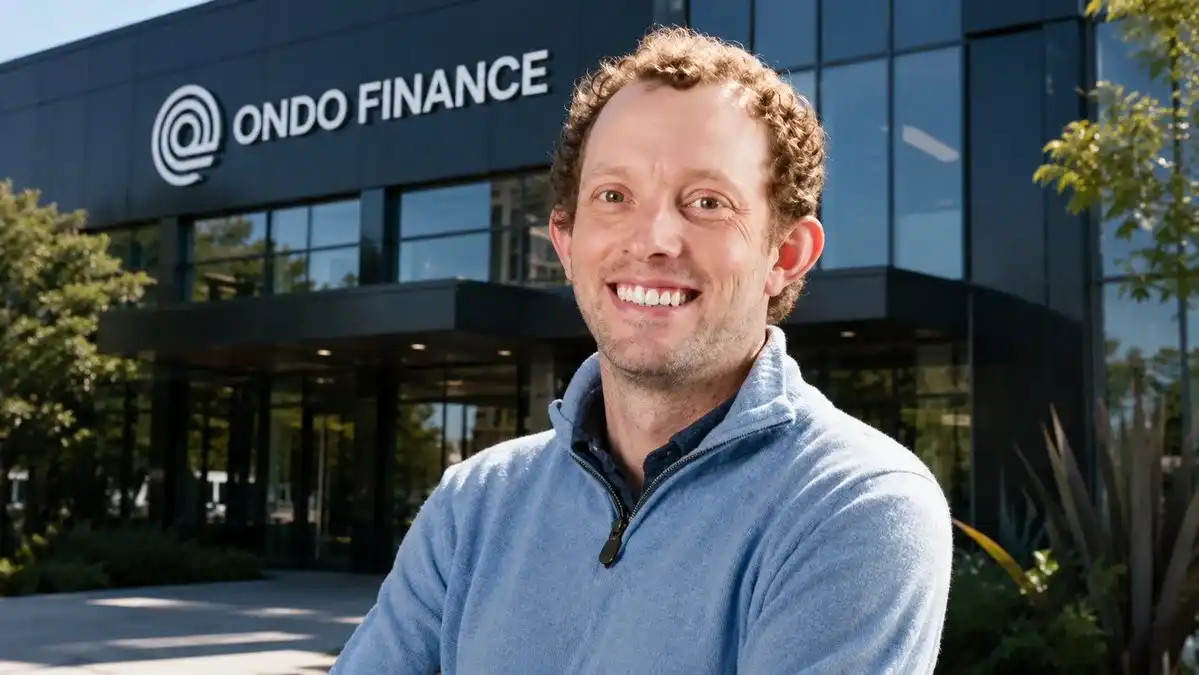
On May 26, 2026, Ondo Finance announced via its official Twitter account that its founder and CEO, Nathan Allman, had passed away unexpectedly. The company appointed its long-serving President, Ian De Bode, as the new CEO. The announcement stated that Allman's family and loved ones would receive the company's full support, but no further details regarding the cause of death were disclosed.

The announcement also emphasized that Allman had built a management team capable of independent operation. Ian De Bode had been effectively responsible for the company's strategy, products, and daily operations for over two years and had received the full backing of the management team. The company made clear its intention to continue in the direction Allman had set.
From Goldman Sachs to the Regulatory Negotiation Table for Tokenized Securities

Nathan Allman was widely recognized as a core driving force in the RWA (Real World Assets) sector. He earned his bachelor's degree from Brown University, majoring in Economics and Biology, before pursuing an MBA at Stanford Graduate School of Business.

In 2018, he ran his own crypto hedge fund, ChainStreet Capital. In 2019, he joined Goldman Sachs' Digital Asset business within the Global Markets Division, focusing on building cryptocurrency market services for institutional investors and using blockchain infrastructure to transform the issuance and trading processes of traditional securities. This experience provided a direct methodological foundation for his later product designs. Two years later, he left Goldman Sachs to found Ondo Finance.
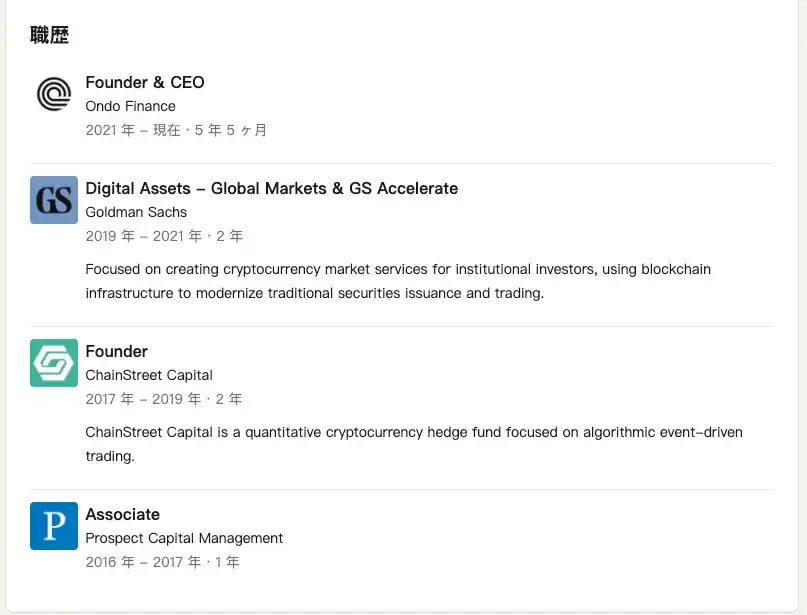
In 2021, Allman founded Ondo Finance, clearly positioning the project as a "compliant channel connecting traditional finance and on-chain infrastructure." Ondo's core product lines were developed along this path.

Initially, Ondo focused on DeFi structured yield products. In 2023, it pivoted towards tokenizing real-world assets. Its first product after this shift was OUSG (Ondo Short-Term US Treasuries Fund). Users could deposit stablecoins like USDC, which Ondo would then use to purchase short-term U.S. Treasury bonds, distributing the returns to holders in token form. USDY, another product, packaged the yields from short-term Treasuries into a perpetual token, made available to non-U.S. accredited investors.

At the time, the largest tokenized Treasury product on the market was BlackRock's BUIDL fund, which had a minimum investment of $5 million—far out of reach for ordinary investors. In early 2024, Allman made a key decision to integrate BUIDL into OUSG's underlying assets. This allowed Ondo users to indirectly hold Treasuries managed by BlackRock through OUSG, while lowering the investment threshold from $5 million to $100,000 and enabling 24/7 subscriptions and redemptions. This move solidified Ondo's position in the RWA space. Throughout 2024, Ondo's Total Value Locked (TVL) grew from $40 million to $534 million, a 13-fold increase.

Following Treasuries came stocks. In September 2025, Allman launched Ondo Global Markets, expanding the tokenized assets from U.S. Treasuries to U.S. stocks and ETFs. The logic behind this product was that a large number of global investors were unable to directly invest in U.S. stocks due to geographical restrictions, account opening barriers, or trading time zone differences. Ondo created on-chain tokens representing over 260 U.S. securities, including Apple, NVIDIA, and S&P 500 ETFs, enabling non-U.S. users to trade these tokenized versions 24/7 on Solana, Ethereum, and BNB Chain. In an interview with CNBC, Allman stated that much of the demand came from crypto users who hadn't yet ventured into traditional asset investing, with ETFs being their easiest entry point.

Ondo Global Markets saw its TVL exceed $240 million within 48 hours of launch, and it surpassed $1 billion within eight months, becoming the first tokenized stock platform to reach that scale. Combined with OUSG and USDY, the platform's total TVL at one point exceeded $4 billion, capturing about 58% of the tokenized stock market.
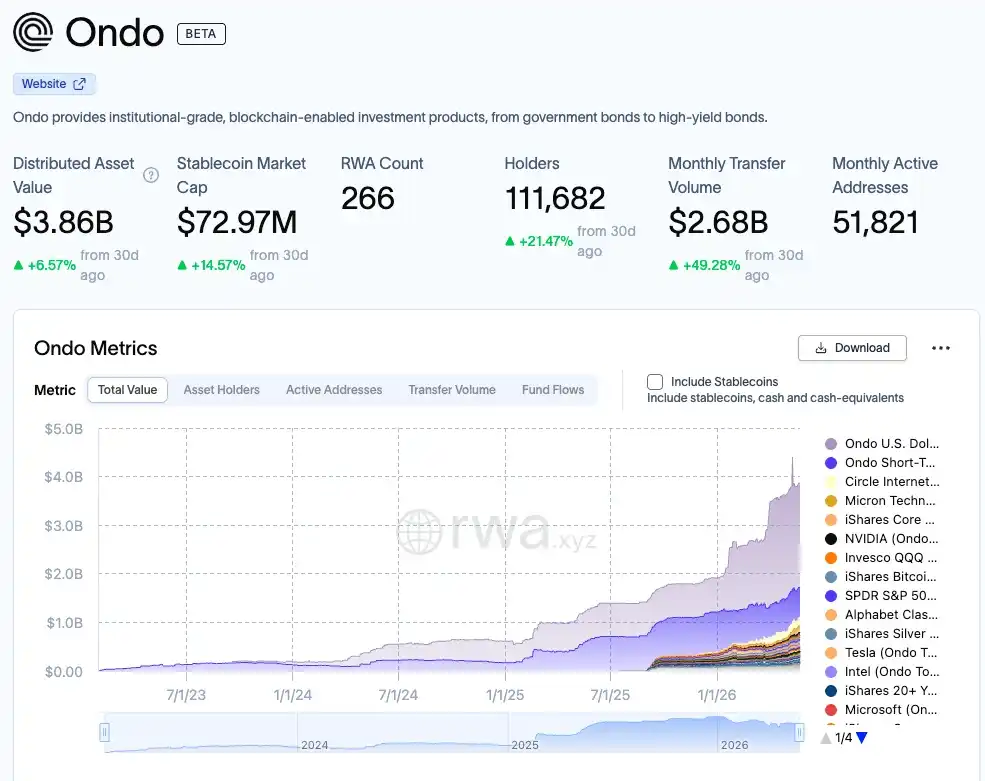
However, the biggest obstacle for tokenized securities was never technology, but regulation. In the United States, the issuance and trading of securities are strictly regulated by the SEC, and turning stocks into on-chain tokens operates in a legal gray area. Allman's chosen path was direct engagement.

In April 2025, he led a team to meet with the SEC's Crypto Working Group to discuss a compliant framework for tokenized U.S. securities. In December of the same year, Ondo submitted a tokenized securities roadmap to the SEC, with a core request for the SEC to formally recognize the legal status of public blockchains in the tokenized securities market, thereby opening channels for retail investors. That same month, the SEC quietly closed its confidential investigation into Ondo's tokenized U.S. Treasuries and the ONDO token without bringing any charges. For a crypto company operating in a regulatory gray area, this amounted to receiving a tacit approval.

In terms of funding, Ondo raised a total of $46 million. Founders Fund and Pantera Capital jointly led the Series A round, with Coinbase Ventures, Tiger Global, and Wintermute participating. In July 2025, Allman and Pantera jointly established the $250 million Ondo Catalyst Fund, dedicated to investing in RWA infrastructure projects.

The Final Pieces of the Puzzle Left by Allman

In December 2025, Ondo Finance announced that it had submitted its tokenized securities roadmap to the U.S. Securities and Exchange Commission (SEC). Ondo stated that direct registration, beneficial ownership, and wrapped/associated security ownership models all coexist in today's financial markets and play important roles on-chain. In the letter, Ondo urged the SEC to allow these three models by: 1. Supporting both direct and intermediary ownership models; 2. Accepting permissioned, permissionless, and hybrid blockchains; 3. Providing targeted regulatory clarity for tokenization based on transfer agents; 4. Allowing broader tokenization of securities deposited at DTC.

In the weeks preceding Allman's passing, Ondo successively accomplished several industry-first feats.

On May 6, Ondo Finance's official blog disclosed that it, in collaboration with Kinexys by J.P. Morgan, Mastercard, and Ripple, had completed the first near real-time cross-border, cross-bank redemption of a tokenized U.S. Treasury fund. Traditional cross-border security redemption processes typically take several days, involving investors submitting redemption requests, custodian banks confirming holdings, initiating fund transfers via interbank networks like SWIFT, and multiple intermediaries confirming step-by-step.

In this pilot project, Ripple redeemed its holdings of Ondo Short-Term US Government Bonds (OUSG) on the XRP Ledger. After processing the redemption, Ondo sent fiat payment instructions via the Mastercard Multi-Token Network. Kinexys by J.P. Morgan's blockchain infrastructure executed the fund settlement and delivered USD funds to Ripple's bank account in Singapore through its correspondent banking network.

Concurrently, Ondo received a No-Action Letter from the SEC, clearing the compliance path for issuing tokenized securities on Ethereum. Ondo officially stated that the scope of this application was limited, with the OGM product's positioning unchanged—it remains tokenized notes providing non-U.S. investors with exposure to U.S. stocks and ETFs. The underlying securities and official book records are maintained within the existing custody system, held by custodian BitGo. The core change is that, under limited circumstances, the relevant security interests can be synchronously recorded in tokenized form on the Ethereum mainnet to optimize collateral monitoring, subscription/redemption processes, and reconciliation operations.

On May 5, The Depository Trust & Clearing Corporation (DTCC) announced that its DTC Tokenization Service was collaborating with over 50 financial institutions, including Ondo, in a tokenized securities alliance alongside BlackRock and Goldman Sachs. The service will support the tokenization of RWAs held at DTC, providing exactly the same rights and investor protections as traditional forms. DTCC plans to initiate the first limited production transactions in July 2026 and formally launch the service in October.

A crypto-native team founded just five years prior now has a partner list featuring J.P. Morgan, BlackRock, Goldman Sachs, DTCC, and Mastercard. While many projects in the RWA space are involved in tokenization, only Ondo has managed to simultaneously sit at both the SEC's negotiation table and within DTCC's alliance. The establishment of these partnerships was inseparable from Allman's personal efforts.

The Successor Has Been in Place for Two Years

In its announcement, Ondo stated that Allman had helped them build a durable organization. The concrete meaning of this statement points to the successor, Ian De Bode.

Before joining Ondo, De Bode was the Global Head of Digital Assets at McKinsey & Company, having spent over a decade in consulting on institutional digital transformation. He also holds an MBA from Stanford. He joined Ondo as Chief Strategy Officer at the end of 2023, was promoted to President in November 2025, and had been leading the company's strategy, products, and daily operations for over two years. Ondo's announcement specifically emphasized that De Bode had the "full trust" of the management team.
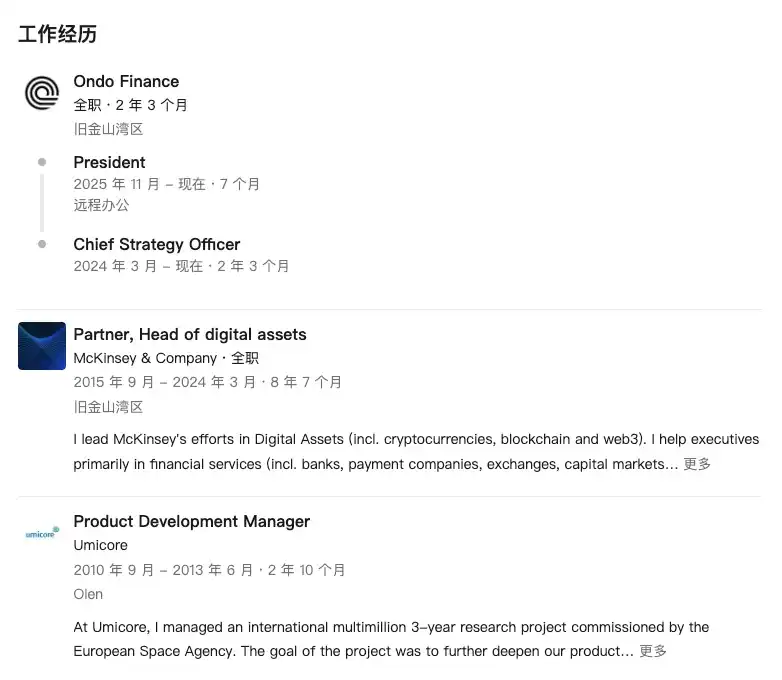
For a crypto company, it is extremely rare to have a successor who has been in place for over two years, is familiar with all aspects of the business, and can take over immediately upon the founder's unexpected death. Crypto projects are often highly reliant on the founder's personal influence and community appeal; the departure of a founder typically signals directional risks and a crisis of trust. However, the test left by Allman is also clear. He personally led the team in negotiations with the SEC last April. The personal relationship networks he accumulated with regulators and Wall Street institutions are something De Bode will need to prove he can inherit.

The ONDO token fell approximately 6% following the announcement and is currently trading around $0.413. The market reaction has been relatively restrained, with no signs of panic selling.

There were no publicly recorded health issues for Allman at the time of his death. Ondo's announcement used the term "unexpected passing" and did not disclose specific reasons. The DTCC tokenized securities pilot scheduled for July was a new milestone he had planned, but he will not see it go live.


Related Questions

QWho was Nathan Allman and what was his role in the cryptocurrency industry?

ANathan Allman was the founder and CEO of Ondo Finance, a company in the Real-World Asset (RWA) tokenization space. He was a core driver in the RWA sector, bridging traditional finance with on-chain infrastructure through compliant channels.

QWhat were the key products developed by Ondo Finance under Nathan Allman's leadership?

AUnder Nathan Allman's leadership, Ondo Finance developed key products including OUSG (tokenized short-term US Treasuries fund), USDY (perpetual token for US Treasury yield), and Ondo Global Markets, which tokenized US stocks and ETFs for global non-US investors.

QWhat significant regulatory milestone did Ondo Finance achieve shortly before Nathan Allman's passing?

AShortly before his passing, Ondo Finance received a No-Action Letter from the U.S. Securities and Exchange Commission (SEC), which cleared a key compliance hurdle for issuing tokenized securities on the Ethereum blockchain.

QWho has been appointed as the new CEO of Ondo Finance, and what is his background?

AIan De Bode, who had been President of the company, has been appointed as the new CEO. He previously served as the Global Head of Digital Assets at McKinsey & Company and has a Stanford MBA. He had been leading Ondo's strategy, product, and daily operations for over two years prior to his appointment.

QWhat was the significance of Ondo Finance's involvement with the DTCC's tokenized securities service?

AOndo Finance was included in the Depository Trust & Clearing Corporation's (DTCC) Tokenized Securities Service alliance, alongside major institutions like BlackRock and Goldman Sachs. This service will support tokenizing real-world assets held at the DTC, marking a significant step in legitimizing and integrating tokenized securities into the mainstream financial infrastructure.

Related Reads

Half of Nvidia's Workforce Are Millionaires, No Wonder the Turnover Rate Is Low

Nvidia is often hailed as a chip-making giant, but a recent internal survey suggests it's equally prolific at creating millionaires and billionaires. According to the findings, approximately half of Nvidia's employees have a net worth exceeding $25 million (over 250 million RMB), while more than three-quarters are millionaires. This pervasive wealth is a key factor behind the company's remarkably low annual attrition rate of just 3.7%, significantly below the 13% average for the U.S. tech industry. CEO Jensen Huang has claimed he has created more billionaires than any other CEO, a statement seemingly supported by the fortunes of top executives like CFO Colette Kress. The wealth generation engine is powered by Nvidia's long-term employee stock programs. Initiatives like the Employee Stock Purchase Plan (ESPP), launched after the 2008 financial crisis, and substantial Restricted Stock Units (RSUs) granted as core compensation have paid off massively. The company's stock has soared over 22,000% in the past decade, turning early RSU grants worth hundreds of thousands into fortunes worth tens of millions today. This creates a "golden handcuff" effect, where leaving means forfeiting massive potential gains. The momentum continues with new products like the Groq 3 LPX, a dedicated inference accelerator chip for AI agents now entering production, aiming to fuel the next phase of growth and, potentially, further employee wealth.

marsbit5m ago

Half of Nvidia's Workforce Are Millionaires, No Wonder the Turnover Rate Is Low

marsbit5m ago

‘Vitalik’s First Investment in Two Years’ Narrative Supports a $100M Valuation: How Far Can This Privacy Protocol Go?

Amid a thriving market, Vitalik Buterin has made his first notable public investment in two years, allocating 16 ETH (approximately $28,000) to the $FOLD token during The Interfold protocol's initial CCA auction on Uniswap. This move, coupled with his repeated public endorsements of the project, has fueled a significant "Vitalik bought it" narrative. Following its TGE on August 19, $FOLD's price surged over 7x, driven largely by this narrative, pushing its market cap from around $28 million to a peak of $140 million before a major exchange listing. A subsequent listing on Upbit caused a temporary spike, after which the price stabilized back to levels supported primarily by the Vitalik narrative, with a current fully diluted valuation (FDV) around $100 million. The Interfold is a privacy-focused protocol developed by Gnosis Guild, enabling multiple untrusting parties to perform verifiable computations without exposing private inputs, relying on a single operator, or using trusted hardware. Its use cases, such as private DAO voting, are technically complex compared to simpler privacy assets like ZEC, making the "Vitalik endorsement" a primary driver of attention and investment for many traders. Analysts view $FOLD optimistically in the short to medium term, noting that Vitalik has historically held similar investments without selling. While the project has legitimate technology, its current market dynamics are heavily influenced by attention-driven factors like Vitalik's support, a favorable market, and the Upbit listing. However, with a circulating market cap already near $30 million on the currently less-trendy Ethereum chain, some question whether the risk-reward ratio remains compelling compared to other high-momentum opportunities across different ecosystems.

marsbit8m ago

‘Vitalik’s First Investment in Two Years’ Narrative Supports a $100M Valuation: How Far Can This Privacy Protocol Go?

marsbit8m ago

Asia-Pacific Stocks Under Pressure, South Korean Shares Lead Declines with SK Hynix Down 6% at One Point, Bitcoin Breaches $80,000, U.S. Treasuries Volatile at High Levels

Asia-Pacific stock markets faced pressure, with South Korean equities leading the decline. Shares of Samsung Electronics and SK Hynix fell sharply, dragging down the KOSPI index by over 4% at one point. The drop in tech stocks mirrored a sell-off in U.S. semiconductors, with investors adopting a cautious stance ahead of Nvidia's earnings report, seen as a key signal for the AI trade outlook. Samsung's recent shareholder return plan, while large, fell short of some market expectations. Meanwhile, SK Hynix faces internal pressure as its union rejected a provisional wage agreement. Japanese stocks initially fell but later recovered, with the Nikkei 225 turning positive. Former Bank of Japan board member Seiji Adachi suggested a rate hike is likely next month, warning that inaction could trigger renewed yen weakness. In other markets, U.S. Treasury yields remained elevated near 4.71%. Bitcoin broke above $80,000 for the first time since mid-May, while gold eased slightly after recent gains. Analysts note the simultaneous strength in gold and crypto points to market concerns about long-term dollar weakness. The focus this week is dual: Nvidia's earnings are critical for stabilizing the AI-driven tech sector, while Fed Chair Kevin Warsh's speech at the Jackson Hole symposium is expected to provide clarity on the interest rate path.

华尔街日报9m ago

Asia-Pacific Stocks Under Pressure, South Korean Shares Lead Declines with SK Hynix Down 6% at One Point, Bitcoin Breaches $80,000, U.S. Treasuries Volatile at High Levels

华尔街日报9m ago

Top Trader Explains the Logic Behind Bitcoin's Surge: What Is the Market Actually Trading?

Summary: On August 19th, the U.S. Treasury announced an increase in its long-term bond repurchase program from $2 billion to at least $4 billion. While the direct scale is small relative to the overall market, the move triggered a decline in long-term Treasury yields and a weaker dollar, with Bitcoin subsequently breaking above $70,000. In an interview, Arthur Hayes argues this Bitcoin rally is not primarily driven by internal crypto regulatory news (like the CLARITY Act), but by a shift in macro expectations regarding U.S. liquidity policy. Hayes interprets the Treasury's timing—acting as long-term yields hit multi-decade highs—as a signal that policymakers are sensitive to rising financing costs. He posits that Bitcoin acts as a "pressure release valve" for global liquidity shifts. The market is not trading the $4 billion repurchase itself, but the *expectation* of further, more aggressive interventions (like yield curve control or Fed balance sheet expansion) should long-term interest rates continue to rise threateningly. His logic follows a chain: unsustainable U.S. debt requires stable Treasury market function; if yields rise too high, policymakers will intervene to provide liquidity; increased dollar liquidity ultimately benefits scarce assets like Bitcoin. Hayes speculates on more extreme scenarios, such as foreign central banks selling Treasuries back to the Fed via facilities like FIMA Repo, further expanding liquidity. The key takeaway is that Bitcoin's price action is being driven by anticipation of future monetary policy responses to debt and yield pressures, rather than immediate liquidity injections or crypto-specific regulation. The critical indicator to watch is long-term Treasury yields (e.g., 10-year near 5%). If they rise again, prompting further Treasury/Fed action and dollar weakness, Hayes's thesis strengthens. If yields stabilize without major policy escalation, the current bullish narrative may be an overreaction. Bitcoin is effectively trading on the probability of renewed, significant liquidity expansion by U.S. authorities.

marsbit12m ago

Top Trader Explains the Logic Behind Bitcoin's Surge: What Is the Market Actually Trading?

marsbit12m ago

Trading

Spot
活动图片