Datong, Shanxi—once a city propped up by coal—has shaken off its dust and now wields a sharp pickaxe, striking down upon another invisible mine.
In the office buildings of Jinmao International Center in Pingcheng District, there are no more elevator shafts or coal trucks. Instead, thousands of tightly packed computer workstations fill several floors. The Shanghai Runxun Yunzhong Shengu Big Data Smart Service Base occupies entire levels, where thousands of young employees, wearing headphones, stare at screens, clicking, dragging, and boxing.
According to official data, as of November 2025, Datong had put into operation 745,000 servers, attracted 69 call center and data labeling companies, created over 30,000 local jobs, and generated 750 million yuan in output value. In this digital mine, 94% of the workers are local residents.
It’s not just Datong. Among the first batch of data labeling bases designated by the National Data Administration, counties in central and western China like Yonghe in Shanxi, Bijie in Guizhou, and Mengzi in Yunnan are prominently listed. In Yonghe County’s data labeling base, 80% of the employees are women, mostly rural stay-at-home moms or returning youth who couldn’t find suitable jobs.
A hundred years ago, Manchester’s textile mills were filled with landless farmers. Today, the computer screens in these remote counties are manned by young people who found no place in the real economy.
They are engaged in a job that feels both futuristic and primitive—piecework—producing the essential data feed for AI giants in Beijing, Shenzhen, and Silicon Valley.
No one sees anything wrong with this.
The New Assembly Line on the Loess Plateau
At its core, data labeling is about teaching machines to recognize the world.
Self-driving cars need to identify traffic lights and pedestrians; large models need to distinguish cats from dogs. Machines have no innate common sense; humans must first draw boxes on images, telling them “this is a pedestrian,” so that after digesting millions of pictures, they can learn to recognize on their own.
This job doesn’t require advanced degrees—just patience and an index finger that can click incessantly.
In the golden year of 2017, a simple 2D box could fetch over ten cents, with some companies even offering fifty cents. Fast labelers, working over ten hours a day, could earn five to six hundred yuan. In a small town, this was undoubtedly a high-paying, respectable job.
But as large models evolved, the brutal side of this assembly line began to show.
By 2023, the price for simple image labeling had plummeted to 3-4 cents—a drop of over 90%. Even for more complex 3D point cloud images—dense point matrices that require extreme zoom to discern edges—labelers must draw a 3D box in space, encompassing length, width, height, and yaw angle, to tightly wrap around vehicles or pedestrians. Yet such a intricate 3D box earns only five cents.
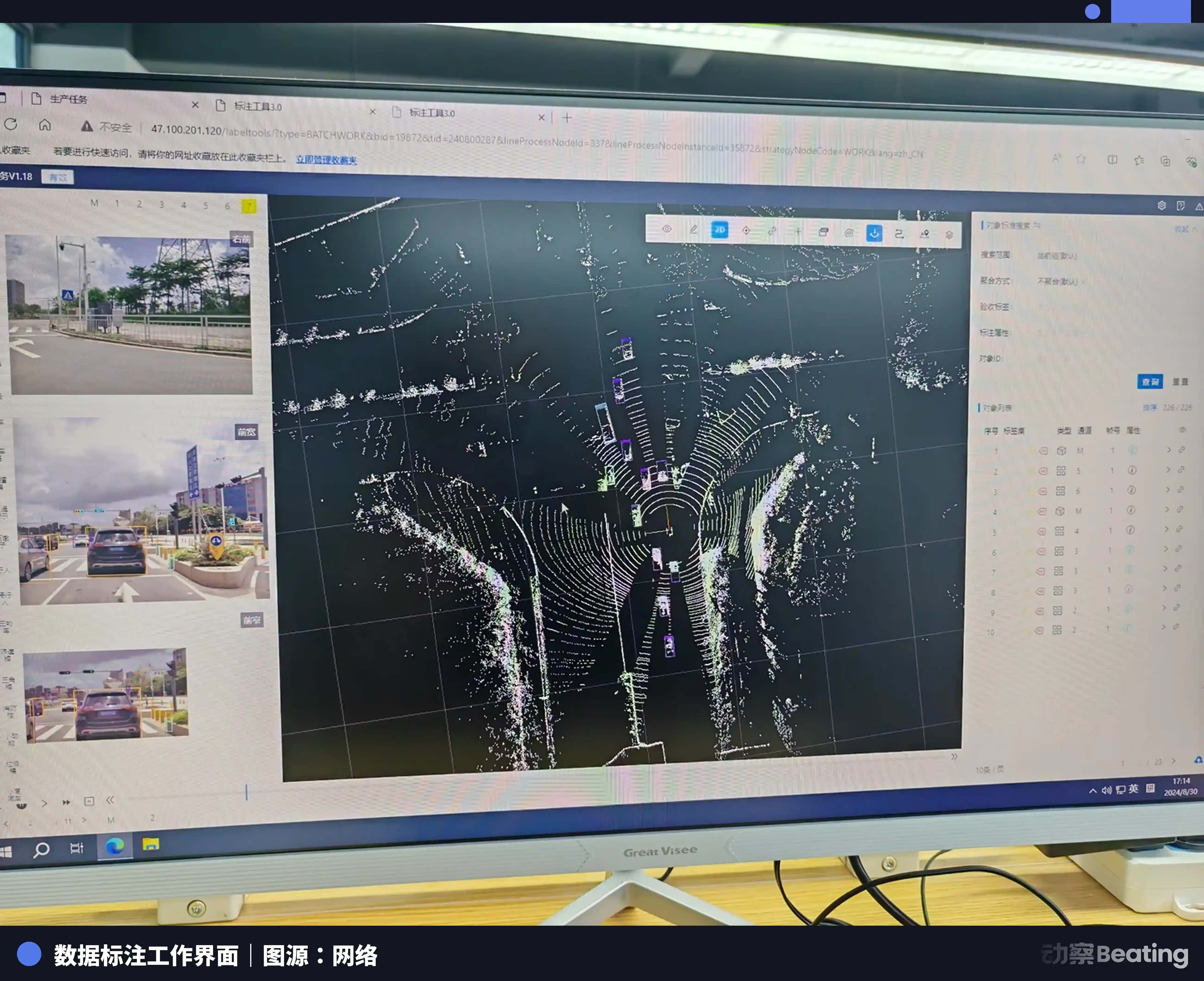
The direct consequence of the unit price crash is a dramatic increase in labor intensity. To cling to a base salary of two to three thousand yuan a month, labelers must constantly, relentlessly, increase their speed.
This is no easy white-collar job. In many labeling bases, management is stiflingly strict: no phone calls allowed during work hours, phones must be locked in storage compartments. The system meticulously tracks each employee’s mouse movements and idle time. If you stop for more than three minutes, a warning from the backend lashes out like a whip.
Even more crushing is the error rate. The industry’s passing threshold is usually above 95%, with some companies demanding 98%-99%. This means if you draw 100 boxes and just 2 are wrong, the entire image is sent back for rework.
Dynamic images are frame-linked; changing lanes, vehicles get occluded, and labelers must use inference to find them one by one. In 3D point cloud images, any object with over 10 points must be boxed. For a complex parking space project, lines drawn too long, labels missed—quality checks always find flaws. An image being sent back four or five times is commonplace. In the end, after an hour’s work, the pay might be just a few dimes.
A labeler from Hunan posted her settlement slip on social media: after a day’s work, she drew over 700 boxes at 4 cents each, totaling 30.2 yuan.
It’s a profoundly split reality.
On one side, glamorous tech giants at press conferences talk about how AGI will liberate humanity; on the other, young people in counties on the Loess Plateau and southwestern mountains stare at screens for eight to ten hours a day, mechanically drawing boxes—thousands, tens of thousands—so many that at night, their fingers twitch in the air, tracing lane lines in their dreams.
Someone once said, the exterior of artificial intelligence is a luxury car speeding by, but if you open the door, you’ll find a hundred people inside, pedaling bicycles furiously, gritting their teeth.
No one sees anything wrong with this.
Piecework Labor Teaching Machines "How to Love"
As the bottlenecks of image recognition were broken, large models evolved deeper, needing to learn to think, converse, and even show "empathy" like humans.
This gave rise to the most core, yet expensive, part of large model training—RLHF (Reinforcement Learning from Human Feedback).
Simply put, it involves real people scoring AI-generated responses, telling it which answer is better, more aligned with human values and emotional preferences.
ChatGPT seems "human-like" precisely because countless RLHF labelers are teaching it.
On crowdsourcing platforms, such labeling tasks are often priced clearly: 3 to 7 yuan per task. Labelers must assign highly subjective emotional scores to AI responses, judging whether an answer is "warm," "empathetic," or "attentive to the user's emotions."
A low-wage worker, struggling in the mire of reality, with no time to tend to their own emotions, must now serve as the AI's emotional tutor and values judge within the system.
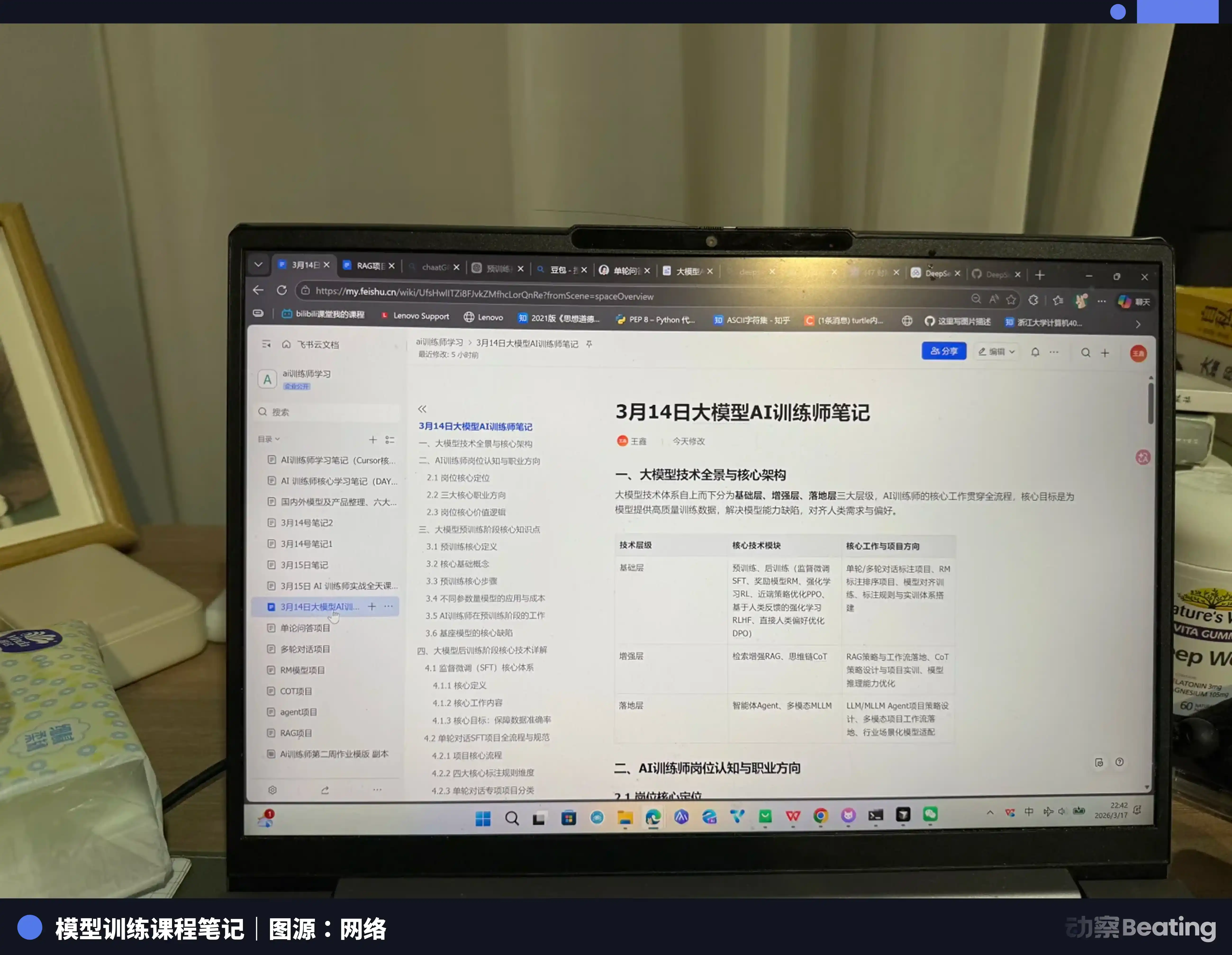
They must break down complex, subtle human emotions like warmth and empathy, forcibly quantizing them into cold scores of 1 to 5. If their scores don’t match the system’s preset standard answers, they are marked as below accuracy standards, deducting from their already meager piece-rate pay.
This is a cognitive voidance. The intricate, profound human emotions, morality, and compassion are being dragged into the algorithm's funnel. In the icy quantification and standardization, they are drained of their last warmth. While you marvel at the cyber behemoth on screen learning to write poetry, compose music, offer comfort, even donning a sentimental skin; outside the screen, those once-vibrant humans, through daily mechanical judgments, are regressing into emotionless scoring machines.
This is the most hidden side of the entire industry chain, never appearing in any funding news or technical white papers.
No one sees anything wrong with this.
The Master's Graduate and the Small-Town Youth
As底层 (low-level) boxing work is being crushed by AI’s treads, this cyber assembly line is expanding upward, beginning to吞噬 (devour) higher-level intellectual labor.
The appetite of large models has changed. They are no longer satisfied with chewing simple常识 (common sense); they need to devour human expertise and advanced logic.
Major recruitment platforms are频繁闪烁 (frequently flashing) with special part-time jobs, such as "Large Model Logical Reasoning Labeling" or "AI Humanities Trainer." These roles have extremely high barriers, often requiring "Master's degree or above from 985/211 universities," involving specialized fields like law, medicine, philosophy, and literature.

Many top-university graduates are attracted, flooding into these outsourcing groups for big tech companies. But they soon discover this is no轻松的脑力体操 (light mental exercise)—it’s mental torture.
Before officially taking tasks, they must read dozens of pages of scoring dimensions and evaluation criteria, undergoing two or three rounds of trial labeling. After meeting the standard, during正式标注 (formal labeling), if their accuracy falls below the average, they lose eligibility and are kicked out of the group.
The most suffocating part is that these standards are not fixed. Facing similar questions and answers, using the same reasoning to score, the results can be completely opposite. It’s like taking an endless exam with no standard answer. There’s no way to improve accuracy through self-effort or study; you can only spin in place, consuming mental and physical energy.
This is the new exploitation of the large model era—class folding.
Knowledge, once seen as a golden ladder to break barriers and climb upward, has now become (沦为) more complex digital fodder chewed up for the algorithm. Before the absolute power of algorithms and systems, the 985 master’s graduate in the ivory tower and the small-town youth on the Loess Plateau have reached the most bizarre convergence.
They fall together into this bottomless cyber mine pit, stripped of their光环 (halo), their differences flattened, all reduced to cheap, replaceable cogs on the conveyor belt.
It’s the same abroad. In 2024, Apple directly cut an AI voice labeling team of 121 people in San Diego. These employees were responsible for improving Siri’s multilingual processing. They once thought they were on the edge of the core business of a major company, but instantly fell into the abyss of unemployment.
In the eyes of tech giants, whether it’s the boxing auntie in a county town or the logic trainer graduated from a prestigious school, they are essentially disposable "consumables."
No one sees anything wrong with this.
The Trillion-Dollar Babel, Built with Pennies of Sweat
According to data released by the China Academy of Information and Communications Technology, China’s data labeling market reached 6.08 billion yuan in 2023, with projections of 20-30 billion yuan by 2025. It is predicted that by 2030, global data labeling and service market sales will soar to 117.1 billion yuan.
Behind these numbers lies the valuation狂欢 (狂欢狂欢狂欢狂欢狂欢狂欢狂欢狂欢狂欢狂欢狂欢狂欢狂欢狂欢狂欢狂欢狂欢狂欢狂欢狂欢狂欢狂欢狂欢狂欢狂欢狂欢狂欢狂欢狂欢狂欢狂欢狂欢狂欢狂欢狂欢狂欢狂欢狂欢狂欢狂欢狂欢狂欢狂欢狂欢狂欢狂欢狂欢狂欢狂欢狂欢狂欢狂欢狂欢狂欢狂欢狂欢狂欢狂欢狂欢狂欢狂欢狂欢狂欢狂欢狂欢狂欢狂欢狂欢狂欢狂欢狂欢狂欢狂欢狂欢狂欢狂欢狂欢狂欢狂欢狂欢狂欢狂欢狂欢狂欢狂欢狂欢狂欢狂欢狂欢狂欢狂欢狂欢狂欢狂欢狂欢狂欢狂欢狂欢狂欢狂欢狂欢狂欢狂欢狂欢狂欢狂欢狂欢狂欢狂欢狂欢狂欢狂欢狂欢狂欢狂欢狂欢狂欢狂欢狂欢狂欢狂欢狂欢狂欢狂欢狂欢狂欢狂欢狂欢狂欢狂欢狂欢狂欢狂欢狂欢狂欢狂欢狂欢狂欢狂欢狂欢狂欢狂欢狂欢狂欢狂欢狂欢狂欢狂欢狂欢狂欢狂欢狂欢狂欢狂欢狂欢狂欢狂欢狂欢狂欢狂欢狂欢狂欢狂欢狂欢狂欢狂欢狂欢狂欢狂欢狂欢狂欢狂欢狂欢狂欢狂欢狂欢狂欢狂欢狂欢狂欢狂欢狂欢狂欢狂欢狂欢狂欢狂欢狂欢狂欢狂欢狂欢狂欢狂欢狂欢狂欢狂欢狂欢狂欢狂欢狂欢狂欢狂欢狂欢狂欢狂欢狂欢狂欢狂欢狂欢狂欢狂欢狂欢狂欢狂欢狂欢狂欢狂欢狂欢狂欢狂欢狂欢狂欢狂欢狂欢狂欢狂欢狂欢狂欢狂欢狂欢狂欢狂欢狂欢狂欢狂欢狂欢狂欢狂欢狂欢狂欢狂欢狂欢狂欢狂欢狂欢狂欢狂欢狂欢狂欢狂欢狂欢狂欢狂欢狂欢狂欢狂欢狂欢狂欢狂欢狂欢狂欢狂欢狂欢狂欢狂欢狂欢狂欢狂欢狂欢狂欢狂欢狂欢狂欢狂欢狂欢狂欢狂欢狂欢狂欢狂欢狂欢狂欢狂欢狂欢狂欢狂欢狂欢狂欢狂欢狂欢狂欢狂欢狂欢狂欢狂欢狂欢狂欢狂欢狂欢狂欢狂欢狂欢狂欢狂欢狂欢狂欢狂欢狂欢狂欢狂欢狂欢狂欢狂欢狂欢狂欢狂欢狂欢狂欢狂欢狂欢狂欢狂欢狂欢狂欢狂欢狂欢狂欢狂欢狂欢狂欢狂欢狂欢狂欢狂欢狂欢狂欢狂欢狂欢狂欢狂欢狂欢狂欢狂欢狂欢狂欢狂欢狂欢狂欢狂欢狂欢狂欢狂欢狂欢狂欢狂欢狂欢狂欢狂欢狂欢狂欢狂欢狂欢狂欢狂欢狂欢狂欢狂欢狂欢狂欢狂欢狂欢狂欢狂欢狂欢狂欢狂欢狂欢狂欢狂欢狂欢狂欢狂欢狂欢狂欢狂欢狂欢狂欢狂欢狂欢狂欢狂欢狂欢狂欢狂欢狂欢狂欢狂欢狂欢狂欢狂欢狂欢狂欢狂欢狂欢狂欢狂欢狂欢狂欢狂欢狂欢狂欢狂欢狂欢狂欢狂欢狂欢狂欢狂欢狂欢狂欢狂欢狂欢狂欢狂欢狂欢狂欢狂欢狂欢狂欢狂欢狂欢狂欢狂欢狂欢狂欢狂欢狂欢狂欢狂欢狂欢狂欢狂欢狂欢狂欢狂欢狂欢狂欢狂欢狂欢狂欢狂欢狂欢狂欢狂欢狂欢狂欢狂欢狂欢狂欢狂欢狂欢狂欢狂欢狂欢狂欢狂欢狂欢狂欢狂欢狂欢狂欢狂欢狂欢狂欢狂欢狂欢狂欢狂欢狂欢狂欢狂欢狂欢狂欢狂欢狂欢狂欢狂欢狂欢狂欢狂欢狂欢狂欢狂欢狂欢狂欢狂欢狂欢狂欢狂欢狂欢狂欢狂欢狂欢狂欢狂欢狂欢狂欢狂欢狂欢狂欢狂欢狂欢狂欢狂欢狂欢狂欢狂欢狂欢狂欢狂欢狂欢狂欢狂欢狂欢狂欢狂欢狂欢狂欢狂欢狂欢狂欢狂欢狂欢狂欢狂欢狂欢狂欢狂欢狂欢狂欢狂欢狂欢狂欢狂欢狂欢狂欢狂欢狂欢狂欢狂欢狂欢狂欢狂欢狂欢狂欢狂欢狂欢狂欢狂欢狂欢狂欢狂欢狂欢狂欢狂欢狂欢狂欢狂欢狂欢狂欢狂欢狂欢狂欢狂欢狂欢狂欢狂欢狂欢狂欢狂欢狂欢狂欢狂欢狂欢狂欢狂欢狂欢狂欢狂欢狂欢狂欢狂欢狂欢狂欢狂欢狂欢狂欢狂欢狂欢狂欢狂欢狂欢狂欢狂欢狂欢狂欢狂欢狂欢狂欢狂欢狂欢狂欢狂欢狂欢狂欢狂欢狂欢狂欢狂欢狂欢狂欢狂欢狂欢狂欢狂欢狂欢狂欢狂欢狂欢狂欢狂欢狂欢狂欢狂欢狂欢狂欢狂欢狂欢狂欢狂欢狂欢狂欢狂欢狂欢狂欢狂欢狂欢狂欢狂欢狂欢狂欢狂欢狂欢狂欢狂欢狂欢狂欢狂欢狂欢狂欢狂欢狂欢狂欢狂欢狂欢狂欢狂欢狂欢狂欢狂欢狂欢狂欢狂欢狂欢狂欢狂欢狂欢狂欢狂欢狂欢狂欢狂欢狂欢狂欢狂欢狂欢狂欢狂欢狂欢狂欢狂欢狂欢狂欢狂欢狂欢狂欢狂欢狂欢狂欢狂欢狂欢狂欢狂欢狂欢狂欢狂欢狂欢狂欢狂欢狂欢狂欢狂欢狂欢狂欢狂欢狂欢狂欢狂欢狂欢狂欢狂欢狂欢狂欢狂欢狂欢狂欢狂欢狂欢狂欢狂欢狂欢狂欢狂欢狂欢狂欢狂欢狂欢狂欢狂欢狂欢狂欢狂欢狂欢狂欢狂欢狂欢狂欢狂欢狂欢狂欢狂欢狂欢狂欢狂欢狂欢狂欢狂欢狂欢狂欢狂欢狂欢狂欢狂欢狂欢狂欢狂欢狂欢狂欢狂欢狂欢狂欢狂欢狂欢狂欢狂欢狂欢狂欢狂欢狂欢狂欢狂欢狂欢狂欢狂欢狂欢狂欢狂欢狂欢狂欢狂欢狂欢狂欢狂欢狂欢狂欢狂欢狂欢狂欢狂欢狂欢狂欢狂欢狂欢狂欢狂欢狂欢狂欢狂欢狂欢狂欢狂欢狂欢狂欢狂欢狂欢狂欢狂欢狂欢狂欢狂欢狂欢狂欢狂欢狂欢狂欢狂欢狂欢狂欢狂欢狂欢狂欢狂欢狂欢狂欢狂欢狂欢狂欢狂欢狂欢狂欢狂欢狂欢狂欢狂欢狂欢狂欢狂欢狂欢狂欢狂欢狂欢狂欢狂欢狂欢狂欢狂欢狂欢狂欢狂欢狂欢狂欢狂欢狂欢狂欢狂欢狂欢狂欢狂欢狂欢狂欢狂欢狂欢狂欢狂欢狂欢狂欢狂欢狂欢狂欢狂欢狂欢狂欢狂欢狂欢狂欢狂欢狂欢狂欢狂欢狂欢狂欢狂欢狂欢狂欢狂欢狂欢狂欢狂欢狂欢狂欢狂欢狂欢狂欢狂欢狂欢狂欢狂欢狂欢狂欢狂欢狂欢狂欢狂欢狂欢狂欢狂欢狂欢狂欢狂欢狂欢狂欢狂欢狂欢狂欢狂欢狂欢狂欢狂欢狂欢狂欢狂欢狂欢狂欢狂欢狂欢狂欢狂欢狂欢狂欢狂欢狂欢狂欢狂欢狂欢狂欢狂欢狂欢狂欢狂欢狂欢狂欢狂欢狂欢狂欢狂欢狂欢狂欢狂欢狂欢狂欢狂欢狂欢狂欢狂欢狂欢狂欢狂欢狂欢狂欢狂欢狂欢狂欢狂欢狂欢狂欢狂欢狂欢狂欢狂欢狂欢狂欢狂欢狂欢狂欢狂欢狂欢狂欢狂欢狂欢狂欢狂欢狂欢狂欢狂欢狂欢狂欢狂欢狂欢狂欢狂欢狂欢狂欢狂欢狂欢狂欢狂欢狂欢狂欢狂欢狂欢狂欢狂欢狂欢狂欢狂欢狂欢狂欢狂欢狂欢狂欢狂欢狂欢狂欢狂欢狂欢狂欢狂欢狂欢狂欢狂欢狂欢狂欢狂欢狂欢狂欢狂欢狂欢狂欢狂欢狂欢狂欢狂欢狂欢狂欢狂欢狂欢狂欢狂欢狂欢狂欢狂欢狂欢狂欢狂欢狂欢狂欢狂欢狂欢狂欢狂欢狂欢狂欢狂欢狂欢狂欢狂欢狂欢狂欢狂欢狂欢狂欢狂欢狂欢狂欢狂欢狂欢狂欢狂欢狂欢狂欢狂欢狂欢狂欢狂欢狂欢狂欢狂欢狂欢狂欢狂欢狂欢狂欢狂欢狂欢狂欢狂欢狂欢狂欢狂欢狂欢狂欢狂欢狂欢狂欢狂欢狂欢狂欢狂欢狂欢狂欢狂欢狂欢狂欢狂欢狂欢狂欢狂欢狂欢狂欢狂欢狂欢狂欢狂欢狂欢狂欢狂欢狂欢狂欢狂欢狂欢狂欢狂欢狂欢狂欢狂欢狂欢狂欢狂欢狂欢狂欢狂欢狂欢狂欢狂欢狂欢狂欢狂欢狂欢狂欢狂欢狂欢狂欢狂欢狂欢狂欢狂欢狂欢狂欢狂欢狂欢狂欢狂欢狂欢狂欢狂欢狂欢狂欢狂欢狂欢狂欢狂欢狂欢狂欢狂欢狂欢狂欢狂欢狂欢狂欢狂欢狂欢狂欢狂欢狂欢狂欢狂欢狂欢狂欢狂欢狂欢狂欢狂欢狂欢狂欢狂欢狂欢狂欢狂欢狂欢狂欢狂欢狂欢狂欢狂欢狂欢狂欢狂欢狂欢狂欢狂欢狂欢狂欢狂欢狂欢狂欢狂欢狂欢狂欢狂欢狂欢狂欢狂欢狂欢狂欢狂欢狂欢狂欢狂欢狂欢狂欢狂欢狂欢狂欢狂欢狂欢狂欢狂欢狂欢狂欢狂欢狂欢狂欢狂欢狂欢狂欢狂欢狂欢狂欢狂欢狂欢狂欢狂欢狂欢狂欢狂欢狂欢狂欢狂欢狂欢狂欢狂欢狂欢狂欢狂欢狂欢狂欢狂欢狂欢狂欢狂欢狂欢狂欢狂欢狂欢狂欢狂欢狂欢狂欢狂欢狂欢狂欢狂欢狂欢狂欢狂欢狂欢狂欢狂欢狂欢狂欢狂欢狂欢狂欢狂欢狂欢狂欢狂欢狂欢狂欢狂欢狂欢狂欢狂欢狂欢狂欢狂欢狂欢狂欢狂欢狂欢狂欢狂欢狂欢狂欢狂欢狂欢狂欢狂欢狂欢狂欢狂欢狂欢狂欢狂欢狂欢狂欢狂欢狂欢狂欢狂欢狂欢狂欢狂欢狂欢狂欢狂欢狂欢狂欢狂欢狂欢狂欢狂欢狂欢狂欢狂欢狂欢狂欢狂欢狂欢狂欢狂欢狂欢狂欢狂欢狂欢狂欢狂欢狂欢狂欢狂欢狂欢狂欢狂欢狂欢狂欢狂欢狂欢狂欢狂欢狂欢狂欢狂欢狂欢狂欢狂欢狂欢狂欢狂欢狂欢狂欢狂欢狂欢狂欢狂欢狂欢狂欢狂欢狂欢狂欢狂欢狂欢狂欢狂欢狂欢狂欢狂欢狂欢狂欢狂欢狂欢狂欢狂欢狂欢狂欢狂欢狂欢狂欢狂欢狂欢狂欢狂欢狂欢狂欢狂欢狂欢狂欢狂欢狂欢狂欢狂欢狂欢狂欢狂欢狂欢狂欢狂欢狂欢狂欢狂欢狂欢狂欢狂欢狂欢狂欢狂欢狂欢狂欢狂欢狂欢狂欢狂欢狂欢狂欢狂欢狂欢狂欢狂欢狂欢狂欢狂欢狂欢狂欢狂欢狂欢狂欢狂欢狂欢狂欢狂欢狂欢狂欢狂欢狂欢狂欢狂欢狂欢狂欢狂欢狂欢狂欢狂欢狂欢狂欢狂欢狂欢狂欢狂欢狂欢狂欢狂欢狂欢狂欢狂欢狂欢狂欢狂欢狂欢狂欢狂欢狂欢狂欢狂欢狂欢狂欢狂欢狂欢狂欢狂欢狂欢狂欢狂欢狂欢狂欢狂欢狂欢狂欢狂欢狂欢狂欢狂欢狂欢狂欢狂欢狂欢狂欢狂欢狂欢狂欢狂欢狂欢狂欢狂欢狂欢狂欢狂欢狂欢狂欢狂欢狂欢狂欢狂欢狂欢狂欢狂欢狂欢狂欢狂欢狂欢狂欢狂欢狂欢狂欢狂欢狂欢狂欢狂欢狂欢狂欢狂欢狂欢狂欢狂欢狂欢狂欢狂欢狂欢狂欢狂欢狂欢狂欢狂欢狂欢狂欢狂欢狂欢狂欢狂欢狂欢狂欢狂欢狂欢狂欢狂欢狂欢狂欢狂欢狂欢狂欢狂欢狂欢狂欢狂欢狂欢狂欢狂欢狂欢狂欢狂欢狂欢狂欢狂欢狂欢狂欢狂欢狂欢狂欢狂欢狂欢狂欢狂欢狂欢狂欢狂欢狂欢狂欢狂欢狂欢狂欢狂欢狂欢狂欢狂欢狂欢狂欢狂欢狂欢狂欢狂欢狂欢狂欢狂欢狂欢狂欢狂欢狂欢狂欢狂欢狂欢狂欢狂欢狂欢狂欢狂欢狂欢狂欢狂欢狂欢狂欢狂欢狂欢狂欢狂欢狂欢狂欢狂欢狂欢狂欢狂欢狂欢狂欢狂欢狂欢狂欢狂欢狂欢狂欢狂欢狂欢狂欢狂欢狂欢狂欢狂欢狂欢狂欢狂欢狂欢狂欢狂欢狂欢狂欢狂欢狂欢狂欢狂欢狂欢狂欢狂欢狂欢狂欢狂欢狂欢狂欢狂欢狂欢狂欢狂欢狂欢狂欢狂欢狂欢狂欢狂欢狂欢狂欢狂欢狂欢狂欢狂欢狂欢狂欢狂欢狂欢狂欢狂欢狂欢狂欢狂欢狂欢狂欢狂欢狂欢狂欢狂欢狂欢狂欢狂欢狂欢狂欢狂欢狂欢狂欢狂欢狂欢狂欢狂欢狂欢狂欢狂欢狂欢狂欢狂欢狂欢狂欢狂欢狂欢狂欢狂欢狂欢狂欢狂欢狂欢狂欢狂欢狂欢狂欢狂欢狂欢狂欢狂欢狂欢狂欢狂欢狂欢狂欢狂欢狂欢狂欢狂欢狂欢狂欢狂欢狂欢狂欢狂欢狂欢狂欢狂欢狂欢狂欢狂欢狂欢狂欢狂欢狂欢狂欢狂欢狂欢狂欢狂欢狂欢狂欢狂欢狂欢狂欢狂欢狂欢狂欢狂欢狂欢狂欢狂欢狂欢狂欢狂欢狂欢狂欢狂欢狂欢狂欢狂欢狂欢狂欢狂欢狂欢狂欢狂欢狂欢狂欢狂欢狂欢狂欢狂欢狂欢狂欢狂欢狂欢狂欢狂欢狂欢狂欢狂欢狂欢狂欢狂欢狂欢狂欢狂欢狂欢狂欢狂欢狂欢狂欢狂欢狂欢狂欢狂欢狂欢狂欢狂欢狂欢狂欢狂欢狂欢狂欢狂欢狂欢狂欢狂欢狂欢狂欢狂欢狂欢狂欢狂欢狂欢狂欢狂欢狂欢狂欢狂欢狂欢狂欢狂欢狂欢狂欢狂欢狂欢狂欢狂欢狂欢狂欢狂欢狂欢狂欢狂欢狂欢狂欢狂欢狂欢狂欢狂欢狂欢狂欢狂欢狂欢狂欢狂欢狂欢狂欢狂欢狂欢狂欢狂欢狂欢狂欢狂欢狂欢狂欢狂欢狂欢狂欢狂欢狂欢狂欢狂欢狂欢狂欢狂欢狂欢狂欢狂欢狂欢狂欢狂欢狂欢狂欢狂欢狂欢狂欢狂欢狂欢狂欢狂欢狂欢狂欢狂欢狂欢狂欢狂欢狂欢狂欢狂欢狂欢狂欢狂欢狂欢狂欢狂欢狂欢狂欢狂欢狂欢狂欢狂欢狂欢狂欢狂欢狂欢狂欢狂欢狂欢狂欢狂欢狂欢狂欢狂欢狂欢狂欢狂欢狂欢狂欢狂欢狂欢狂欢狂欢狂欢狂欢狂欢狂欢狂欢狂欢狂欢狂欢狂欢狂欢狂欢狂欢狂欢狂欢狂欢狂欢狂欢狂欢狂欢狂欢狂欢狂欢狂欢狂欢狂欢狂欢狂欢狂欢狂欢狂欢狂欢狂欢狂欢狂欢狂欢狂欢狂欢狂欢狂欢狂欢狂欢狂欢狂欢狂欢狂欢狂欢狂欢狂欢狂欢狂欢狂欢狂欢狂欢狂欢狂欢狂欢狂欢狂欢狂欢狂欢狂欢狂欢狂欢狂欢狂欢狂欢狂欢狂欢狂欢狂欢狂欢狂欢狂欢狂欢狂欢狂欢狂欢狂欢狂欢狂欢狂欢狂欢狂欢狂欢狂欢狂欢狂欢狂欢狂欢狂欢狂欢狂欢狂欢狂欢狂欢狂欢狂欢狂欢狂欢狂欢狂欢狂欢狂欢狂欢狂欢狂欢狂欢狂欢狂欢狂欢狂欢狂欢狂欢狂欢狂欢狂欢狂欢狂欢狂欢狂欢狂欢狂欢狂欢狂欢狂欢狂欢狂欢狂欢狂欢狂欢狂欢狂欢狂欢狂欢狂欢狂欢狂欢狂欢狂欢狂欢狂欢狂欢狂欢狂欢狂欢狂欢狂欢狂欢狂欢狂欢狂欢狂欢狂欢狂欢狂欢狂欢狂欢狂欢狂欢狂欢狂欢狂欢狂欢狂欢狂欢狂欢狂欢狂欢狂欢狂欢狂欢狂欢狂欢狂欢狂欢狂欢狂欢狂欢狂欢狂欢狂欢狂欢狂欢狂欢狂欢狂欢狂欢狂欢狂欢狂欢狂欢狂欢狂欢狂欢狂欢狂欢狂欢狂欢狂欢狂欢狂欢狂欢狂欢狂欢狂欢狂欢狂欢狂欢狂欢狂欢狂欢狂欢狂欢狂欢狂欢狂欢狂欢狂欢狂欢狂欢狂欢狂欢狂欢狂欢狂欢狂欢狂欢狂欢狂欢狂欢狂欢狂欢狂欢狂欢狂欢狂欢狂欢狂欢狂欢狂欢狂欢狂欢狂欢狂欢狂欢狂欢狂欢狂欢狂欢狂欢狂欢狂欢狂欢狂欢狂欢狂欢狂欢狂欢狂欢狂欢狂欢狂欢狂欢狂欢狂欢狂欢狂欢狂欢狂欢狂欢狂欢狂欢狂欢狂欢狂欢狂欢狂欢狂欢狂欢狂欢狂欢狂欢狂欢狂欢狂欢狂欢狂欢狂欢狂欢狂欢狂欢狂欢狂欢狂欢狂欢狂欢狂欢狂欢狂欢狂欢狂欢狂欢狂欢狂欢狂欢狂欢狂欢狂欢狂欢狂欢狂欢狂欢狂欢狂欢狂欢狂欢狂欢狂欢狂欢狂欢狂欢狂欢狂欢狂欢狂欢狂欢狂欢狂欢狂欢狂欢狂欢狂欢狂欢狂欢狂欢狂欢狂欢狂欢狂欢狂欢狂欢狂欢狂欢狂欢狂欢狂欢狂欢狂欢狂欢狂欢狂欢狂欢狂欢狂欢狂欢狂欢狂欢狂欢狂欢狂欢狂欢狂欢狂欢狂欢狂欢狂欢狂欢狂欢狂欢狂欢狂欢狂欢狂欢狂欢狂欢狂欢狂欢极 (extreme) valuations of OpenAI, Microsoft, ByteDance, and other tech giants, reaching trillions of dollars.
But this泼天的财富 (immense wealth) does not flow to those who truly "feed" the AI.
China’s data labeling industry exhibits a typical inverted pyramid outsourcing structure. At the very top are the tech giants死死捏着 (firmly grasping) the core algorithms. The second tier consists of large data service suppliers. The third tier is made up of data labeling bases and small-to-medium outsourcing companies scattered across the country. At the very bottom are the piece-rate labelers, the "muddy-legged" workers.
Each layer of outsourcing skims off a hefty portion. When the big company pays 50 cents per unit, after层层盘剥 (layers of exploitation), what reaches the county labeler might be less than 5 cents.
Yanis Varoufakis, former Finance Minister of Greece, in his book "Technofeudalism," presents a penetrating view: today’s tech giants are no longer traditional capitalists but "Cloudalists."
They don’t own factories and machines but algorithms, platforms, computing power—these are the digital territories of the cyber age. In this new feudal system, users are not consumers but digital serfs; our every like, comment, and browse on social media is免费上供 (offering up for free) data to the云领主 (cloud lords).
And those data labelers in下沉市场 (downstream markets) are the lowest digital serfs in this system. They not only produce data but also清洗 (clean), classify, and score massive amounts of raw data, turning it into high-quality feed digestible by large models.
This is a隐秘的认知圈地运动 (hidden cognitive enclosure movement). Just as the 19th-century English enclosure movement drove farmers into textile mills, today’s AI wave drives youth who find no place in the real economy to screens.
AI has not leveled the class divide; instead, it has built a "data and sweat conveyor belt" stretching from counties in central and western China straight to the headquarters of tech giants in Beijing, Shanghai, Shenzhen, and Guangzhou. The narrative of technological revolution is always grand and华丽 (splendid), but its underlying color is always the规模化消耗 (large-scale consumption) of cheap labor.
No one sees anything wrong with this.
The Tomorrow That No Longer Needs Humans
The cruelest outcome is coming, faster and faster.
As large model capabilities leap, those labeling tasks that once required human day-and-night labor are being taken over by AI itself.
In April 2023, Li Xiang, founder of Li Auto, revealed on a forum that in the past, the company did about 10 million frames of manual自动驾驶图像标定 (autonomous driving image calibration) per year, with外包成本 (outsourcing costs)接近 (approaching) 100 million yuan. But when they used large models for automated labeling, what used to take a year could be done in basically 3 hours.
The efficiency is 1000 times that of humans, and this was back in 2023. Just this past March, Li Auto also released its new-generation MindVLA-o1 automatic labeling engine.
A painfully true industry自嘲 (self-mockery) goes: "As much intelligence, as much manual labor." But now, big tech companies’ investment in data labeling outsourcing has seen a断崖式下降 (cliff-like drop) of 40%-50%.
The small-town youth who sat countless days and nights before computers, straining their eyes red, have亲手喂大 (personally fed) a giant beast. And now, this beast is turning around to smash their rice bowls.
Night falls, and the office buildings in Datong’s Pingcheng District remain starkly white. Young people changing shifts silently exchange weary shells in the elevator. In this folded space禁锢 (imprisoned) by countless polygonal boxes, no one cares about the epic leaps in the Transformer architecture across the ocean, nor can anyone understand the roar of computing power behind billions of parameters.
Their gaze is welded solely to the red and green progress bar in the backend representing the "qualifying line," calculating whether the piece-rate pennies and dimes can piece together a decent life by month’s end.
On one side, Nasdaq bell rings and tech media coverage abound, giants raising glasses to celebrate the advent of AGI; on the other, these digital serfs who fed the AI mouthful by mouthful with their flesh and blood can only wait战战兢兢 (trepidatiously) in aching sleep for the beast they亲手饲养 (personally raised) to, on some ordinary morning, casually kick away their rice bowls.
No one sees anything wrong with this.