Author: Colossus
Compiled by: Deep Tide TechFlow
Deep Tide Intro: This article uses U.S. government data to reveal an uncomfortable truth: over the past 30 years, all the bestselling books on startup methods—Lean Startup, Customer Development, Business Model Canvas—have shown no statistical improvement in the survival rate of startups.
The problem isn't necessarily that the methodologies themselves are wrong, but that once everyone uses the same playbook, it loses its advantage.
This argument holds true for crypto and Web3 entrepreneurs as well, and is worth reading especially for those currently perusing various "Web3 Startup Guides."
Full Text Below:
Any method for building a startup, once widely disseminated, causes founders to converge on the same answers. If everyone follows the same bestselling startup techniques, everyone will end up building the same companies, and without differentiation, most of these companies will fail. The fact is, whenever someone insists on teaching a method for building a successful startup, you should do something different. This paradox is self-evident once you think it through, but it also contains the way forward.
Twenty-five years ago, before the rise of the new wave of "startup evangelists," the startup advice it replaced was, frankly, worse than useless. That advice was a naive mix of Fortune 500 company strategy and small business tactics, with five-year plans running alongside daily operational management. But for high-growth potential startups, long-term planning is meaningless—the future is unpredictable, and focusing on daily operations exposes founders to faster competitors. The old advice was built for a world of incremental improvement, not for fundamental uncertainty.
The advice from the new generation of startup evangelists was different: intuitively reasonable, seemingly well-argued, providing founders with a step-by-step process for building a business amidst real uncertainty. Steve Blank, in "The Four Steps to the Epiphany" (2005), proposed the Customer Development method, teaching founders to treat business ideas as a set of falsifiable hypotheses: go out, interview potential customers, validate or refute your assumptions before writing any code. Eric Ries built on this in "The Lean Startup" (2011), proposing the Build-Measure-Learn loop: release a Minimum Viable Product, measure real user behavior, iterate quickly, rather than wasting time polishing a product nobody wants. Osterwalder's Business Model Canvas (2008) gave founders a tool to map out the nine core components of a business model and quickly pivot when one part didn't work. Design Thinking—promoted by IDEO and Stanford's d.school—emphasizes empathy for the end-user and rapid prototyping to identify problems early. Saras Sarasvathy's theory of Effectual Reasoning advises starting from the founder's own skills and network, rather than reverse-engineering a plan to achieve a grand goal.
These evangelists consciously tried to build a science of startup success. By 2012, Blank stated that the U.S. National Science Foundation was calling his Customer Development framework "the scientific method for entrepreneurship," and claimed "we now know how to make startups fail less." The Lean Startup website claims "The Lean Startup provides a scientific approach to creating and managing startups," and his book's back cover quotes IDEO CEO Tim Brown saying Ries "has created a science where previously there was only art." Meanwhile, Osterwalder claimed in his doctoral thesis that the Business Model Canvas was rooted in design science (the precursor to Design Thinking).
Academic entrepreneurship research departments also study startups, but their science is closer to anthropology: describing the culture of founders and the practices of startups to understand them. The new evangelists had a more practical vision—the one articulated by natural philosopher Robert Boyle back when modern science was first budding: 'I dare not call myself a true naturalist, unless my skill can make my garden yield better herbs and flowers.' In other words, science should seek fundamental truths, but it must also be effective.
Whether it is effective, of course, determines whether it deserves to be called science. And the one thing we can be sure about regarding startup evangelism is: it hasn't worked.
What Have We Actually Learned?
In science, we judge whether something works through experimentation. When Einstein's theory of relativity was gradually accepted, other physicists invested time and money designing experiments to test whether its predictions were accurate. We learned in elementary school that the scientific method is science itself.
However, due to some flaw in our human nature, we also tend to resist the idea that "this is how truth is found." Our minds expect evidence, but our hearts need to be told a story. An ancient philosophical stance—explored brilliantly by Steven Shapin and Simon Schaffer in "Leviathan and the Air-Pump" (1985)—holds that observation cannot give us truth; real truth can only be derived from other things we know to be true through logical principles, i.e., from first principles. While this is standard in mathematics, in fields where the data is slightly noisier or the axiomatic foundation less solid, it can lead to seemingly appealing but absurd conclusions.
Before the sixteenth century, doctors used the works of the second-century Greek physician Galen to treat patients. Galen believed diseases were caused by an imbalance of the four humors—blood, phlegm, yellow bile, and black bile—and recommended therapies like bloodletting, purging, and cupping to restore balance. Doctors followed these therapies for over a thousand years, not because they worked, but because the academic authority of the ancients seemed to far outweigh the value of contemporary observation. But around 1500, the Swiss physician Paracelsus noticed that Galen's therapies didn't actually make patients better, and some therapies—like using mercury to treat syphilis—worked even though they made no sense within the humoral framework. Paracelsus began advocating listening to evidence rather than submitting to long-dead authority: "The patient is your textbook, the sickbed is your study." In 1527, he even publicly burned Galen's works. His vision took centuries to be accepted—nearly three hundred years later, George Washington died after an aggressive bloodletting treatment—because people preferred to believe Galen's neat, simple story rather than face the messy, complex reality.
Paracelsus started from what worked and worked backward to the cause. First-principles thinkers assume a "cause" first and then insist it works, regardless of the outcome. Are our modern startup thinkers more like Paracelsus, driven by evidence? Or more like Galen, sustained by the elegance of their own story? In the name of science, let's look at the evidence.
Below is the official U.S. government data on startup survival rates. Each line shows the probability of survival for companies founded in a given year. The first line tracks one-year survival, the second two-year survival, and so on. The chart shows that from 1995 to the present, the proportion of companies surviving one year has basically not changed. The same goes for two-year, five-year, and ten-year survival rates.
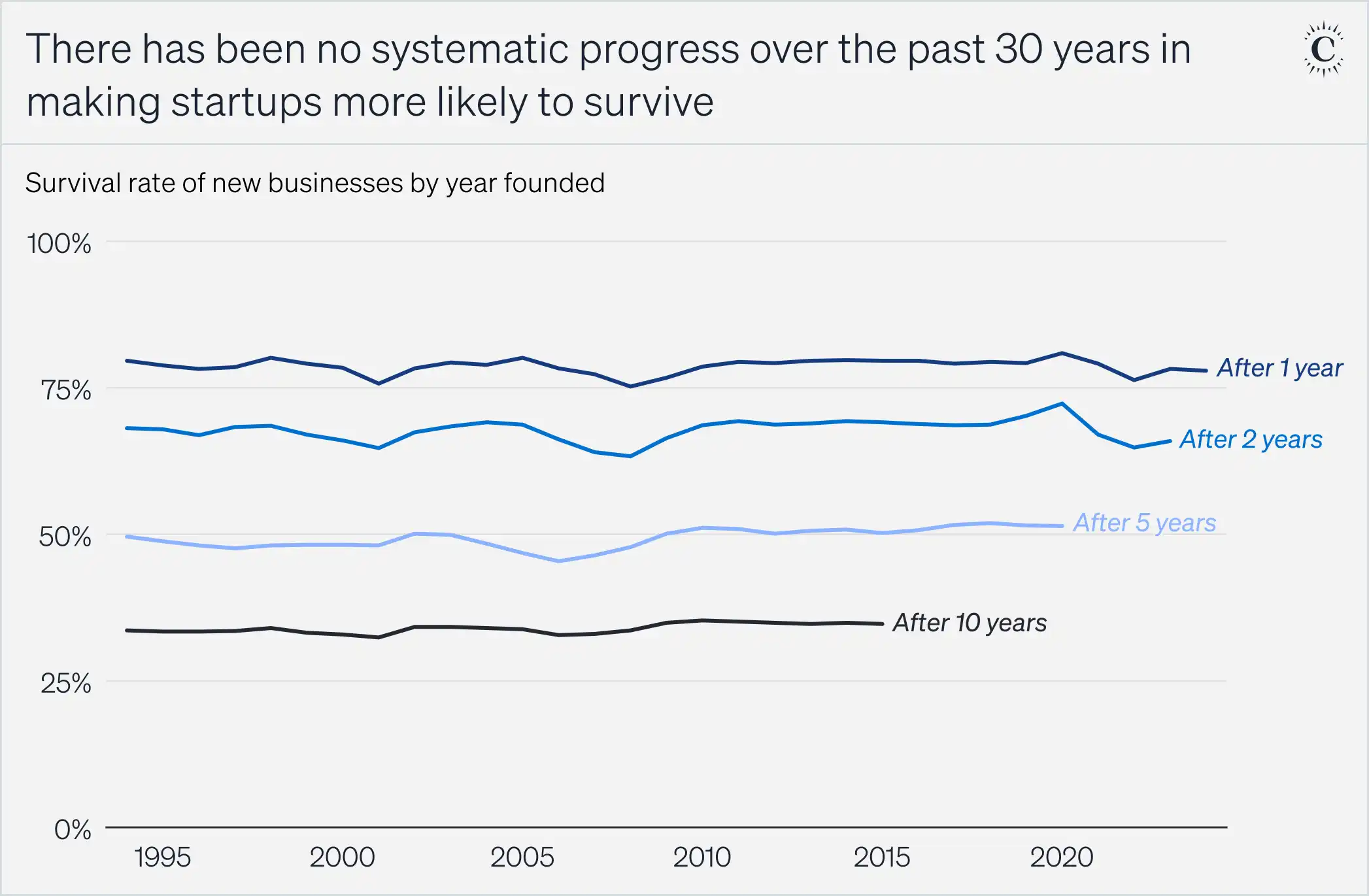
The new evangelists have been around long enough and are well-known enough—their books have sold millions of copies combined, and they are taught in almost every university entrepreneurship course. If they worked, it would be reflected in the statistics. Yet, over the past thirty years, there has been zero systemic progress in making startups easier to keep alive.
Government data counts all U.S. startups, including restaurants, dry cleaners, law firms, and landscape design companies—not just venture-backed, high-growth-potential tech startups. The evangelists don't claim their methods are only for Silicon Valley-type companies, but these techniques are most often tailored to the extreme uncertainty that founders are only willing to endure if the potential payoff is large enough. Therefore, let's use a more targeted metric: the proportion of U.S. venture-backed startups that complete a follow-on funding round after an initial round. Given how venture capital works, we can reasonably assume that most companies that fail to secure follow-on funding do not survive.
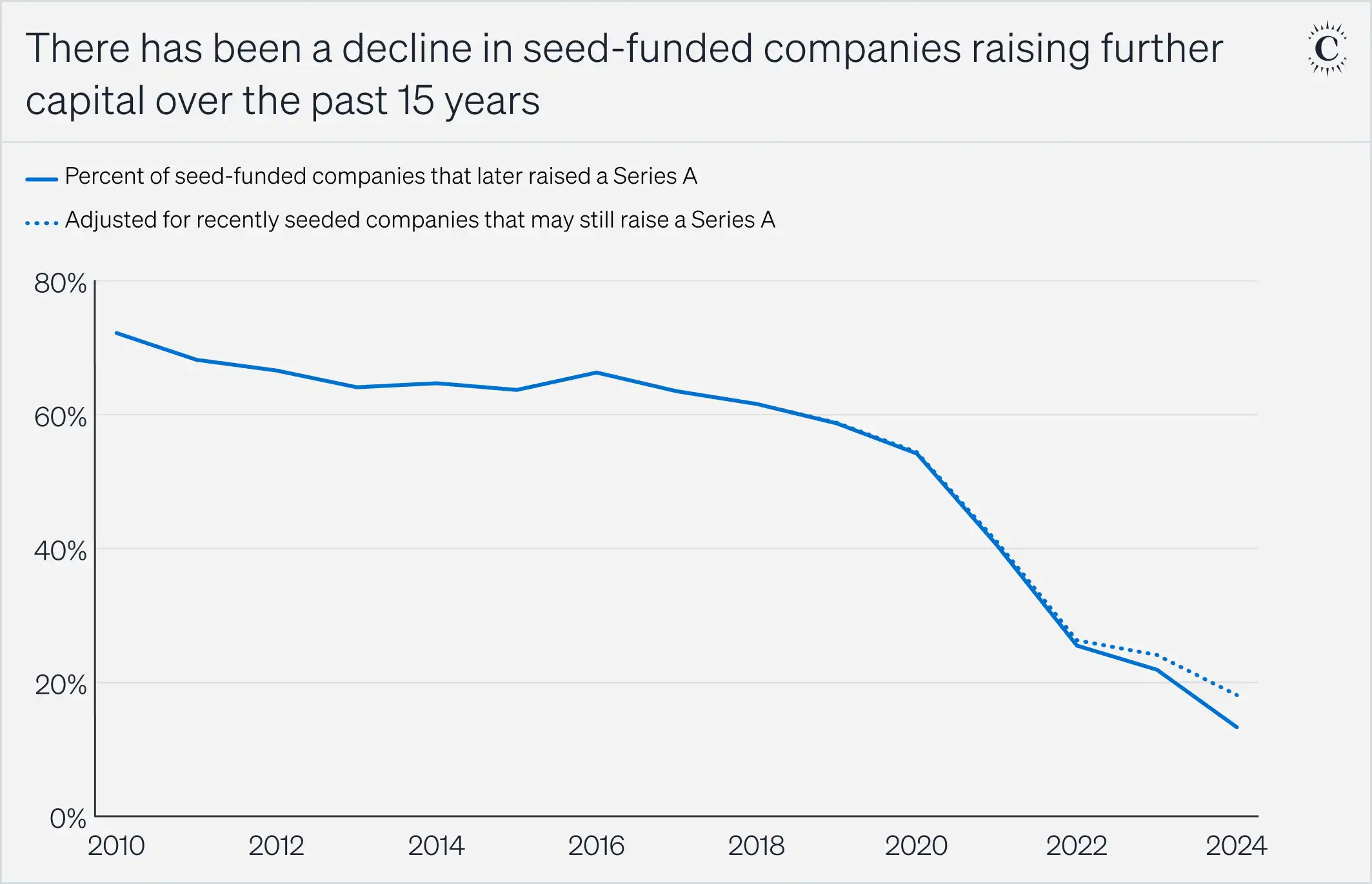
The solid line is the raw data; the dotted line adjusts for recent seed-round companies that might still complete a Series A.
The sharp decline in the proportion of seed-funded companies going on to secure follow-on funding does not support the claim that venture-backed startups have become more successful over the past 15 years. If anything, they seem to be failing more frequently. Of course, venture capital deployment isn't determined solely by startup quality: the impact of COVID-19, the end of the zero-interest-rate era, the highly concentrated capital needs of AI, etc.
One might also argue that the growth in total venture capital has flooded the market with less qualified founders, offsetting any improvement in success rates. But in the chart below, the decline in success rates occurred during both periods of growth and contraction in the number of funded companies. If an oversupply of unskilled founders was dragging down the average, the success rate should have rebounded when the number of funded companies declined after 2021. It did not.
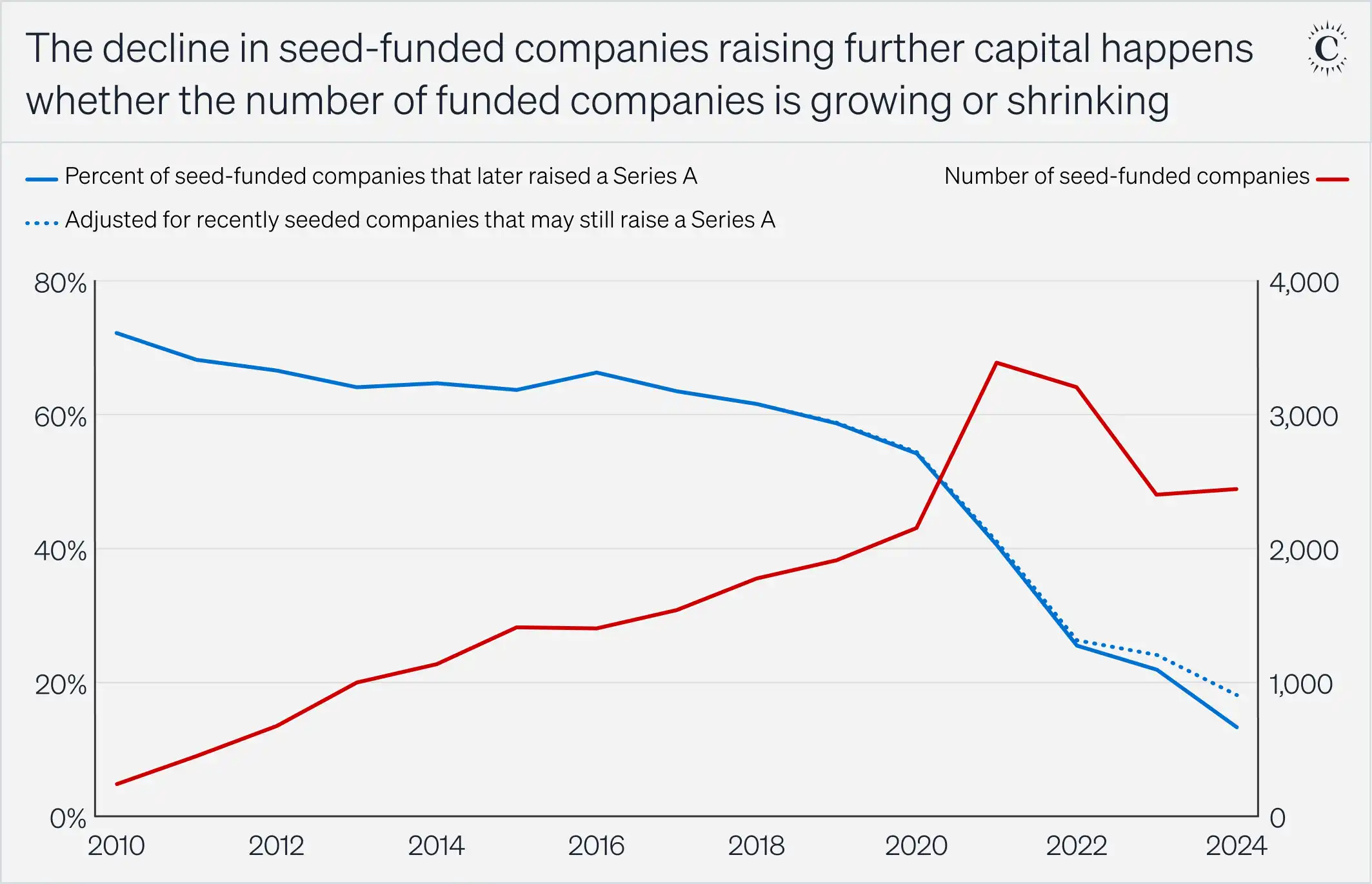
But isn't the increase in the number of founders itself a form of success? Try saying that to the entrepreneurs who followed the evangelists' advice and still failed. These are real people, staking their time, savings, and reputations; they have a right to know what they're up against. Top VCs might be making more money—there are more unicorns now—but this is partly because exit timelines are longer, and partly because the power law distribution of exits mathematically means that the more companies started, the higher the probability of an outsized success. For founders, this is cold comfort. The system might be producing more jackpots, but it hasn't improved the odds for the individual entrepreneur.
We must take seriously the fact that the new evangelists have failed to make startups more likely to succeed. The data suggests that, at best, they have had no effect. We have spent untold time and billions of dollars on a framework of thought that simply doesn't work.
Toward a Science of Startups
The evangelists claimed they were giving us a science of startups, but by their own clearly stated standard, we have made no progress: we do not know how to make startups more successful. Boyle would say that if our garden isn't yielding better herbs or flowers, there is no science. This is disappointing and puzzling. Given the time invested, the widespread adoption, and the apparent intellectual caliber behind these ideas, it seems hard to imagine they do nothing. Yet the data suggests we have indeed learned nothing.
If we want to build a true science of startups, we need to understand why. There are three possibilities. First, maybe the theories are simply wrong. Second, maybe the theories are so obvious that systematizing them is pointless. Third, maybe once everyone uses the same theory, it no longer confers any advantage. After all, the essence of strategy is doing something different from your competitors.
Maybe the Theories Are Simply Wrong
If the theories are simply wrong, then as they spread, startup success rates should have declined. Our data suggests this is not the case for startups overall, and the failure rate for venture-backed companies appears to have risen for other reasons. Data aside, the theories don't seem wrong. Talking to customers, experimenting, and iterating constantly all seem obviously beneficial. But Galen's theories didn't seem wrong to doctors in 1600 either. We can't know for sure unless we test these frameworks like we test other scientific hypotheses.
This is the standard Karl Popper set for science in "The Logic of Scientific Discovery": a theory is scientific if and only if it is, in principle, falsifiable. You have theories, you test them. If experiments don't support them, you discard them and try something else. A theory that cannot be falsified is not a theory at all; it is an article of faith.
Few have attempted to apply this standard to startup research. There are a handful of randomized controlled trials, but they often lack statistical power and define "effective" as something different from actual startup success. Given that venture capital bets tens of billions of dollars annually, not to mention the years founders invest trying their ideas, it seems strange that no serious effort is made to validate whether the techniques startups are taught to use actually work.
But evangelists have little incentive to test their theories: they make money and gain influence by selling books. Startup accelerators profit by funneling large batches of entrepreneurs into the power law funnel, harvesting a few outlier successes. Academic researchers face their own distorted incentives: proving their theory wrong loses them funding with no compensatory reward. The entire industry has the structure of what physicist Richard Feynman called "cargo cult science": an edifice that mimics the form of science without its substance, deriving rules from anecdotes without establishing fundamental causality. Just because a few successful startups did customer interviews doesn't mean yours will succeed if you do them.
But unless we admit that the existing answers aren't good enough, we won't have the motivation to pursue new ones. We need to discover what works and what doesn't through experimentation. This will be expensive because startups are terrible test subjects. It's hard to force a startup to do or not do something (can you stop a founder from iterating, or talking to customers, or asking users which design they prefer?), and keeping rigorous records is often a low priority when a company is fighting for survival. There are also myriad nuances within each theory to test. Practically, these experiments might simply not be doable well. But if that's the case, then we need to admit what we would say without hesitation about any other unfalsifiable theory: this is not science, it is pseudoscience.
Maybe the Theories Are Too Obvious
To some extent, founders don't need to formally learn these techniques. Long before Blank coined "Customer Development," founders were developing customers by talking to them. Likewise, they were building minimum viable products and iterating on them before Ries gave the practice a name. They were designing for the user before someone called it "Design Thinking." The logic of business often forces these behaviors, and millions of businesspeople independently reinvented these practices to solve the problems they faced daily. Perhaps the theories are obvious, and the evangelists are merely putting old wine in new bottles.
This isn't necessarily a bad thing. Having effective theories, even if they are obvious, is the first step toward better theories. Contrary to Popper, scientists don't simply discard a promising theory the moment it is falsified; they try to improve or augment it. The historian and philosopher of science Thomas Kuhn argued this powerfully in "The Structure of Scientific Revolutions": more than 60 years after Newton published his theory of gravity, its predictions about the motion of the Moon were wrong, until the mathematician Alexis Clairaut recognized it as a three-body problem and corrected it. Popper's standard would have had us discard Newton. But that didn't happen because the theory was sufficiently supported in other ways. Kuhn argued that scientists are stubborn within a framework of beliefs, which he called a paradigm. Because it provides a structure that allows scientists to build upon and improve existing theories, scientists don't abandon a paradigm lightly unless forced to. A paradigm provides a path forward.
Startup research does not have a paradigm. Or rather, it has too many paradigms, none compelling enough to unify the field. This means that those thinking of entrepreneurship as a science have no common guide to which problems are worth solving, what observations mean, or how to improve theories that aren't quite right. Without a paradigm, researchers are just spinning their wheels, talking past each other. For entrepreneurship to become a science, it needs a dominant paradigm: a common framework compelling enough to organize collective effort. This is a harder problem than simply deciding to test theories, because for a set of ideas to become a paradigm, it must answer some pressing open questions. We can't achieve this out of thin air, but we should encourage more people to try.
Maybe the Theories Are Self-Negating
Economics teaches us that if you are doing the same thing as everyone else—selling the same product to the same customers, manufactured with the same production process and the same suppliers—direct competition will drive your profits to zero. This concept is the cornerstone of business strategy, from George Soros's theory of "reflexivity"—where market participants' beliefs change the market itself, eroding the advantage they sought to exploit—to Peter Thiel's Schumpeterian assertion that "competition is for losers." Michael Porter codified this in his landmark "Competitive Strategy" as the necessity of finding an unoccupied market position. W. Chan Kim and Renée Mauborgne took this idea a step further in their "Blue Ocean Strategy," arguing that firms should create entirely uncontested market spaces rather than fight over existing ones.
However, if everyone is using the same method to build their companies, they will typically compete head-on. If every founder is interviewing customers, they will converge on the same answers. If every team is releasing a minimum viable product and iterating, they will all iterate toward the same final product. Success in a competitive market must be relative, meaning that what works must be different from what everyone else is doing.
Reductio ad absurdum makes this obvious: if there existed a flowchart that guaranteed startup success, people would mass-produce successful startups 24/7. It would be a perpetual money machine. But in a competitive environment, such a flood of new companies would cause most to fail. The premise that must be wrong is: such a flowchart could exist.
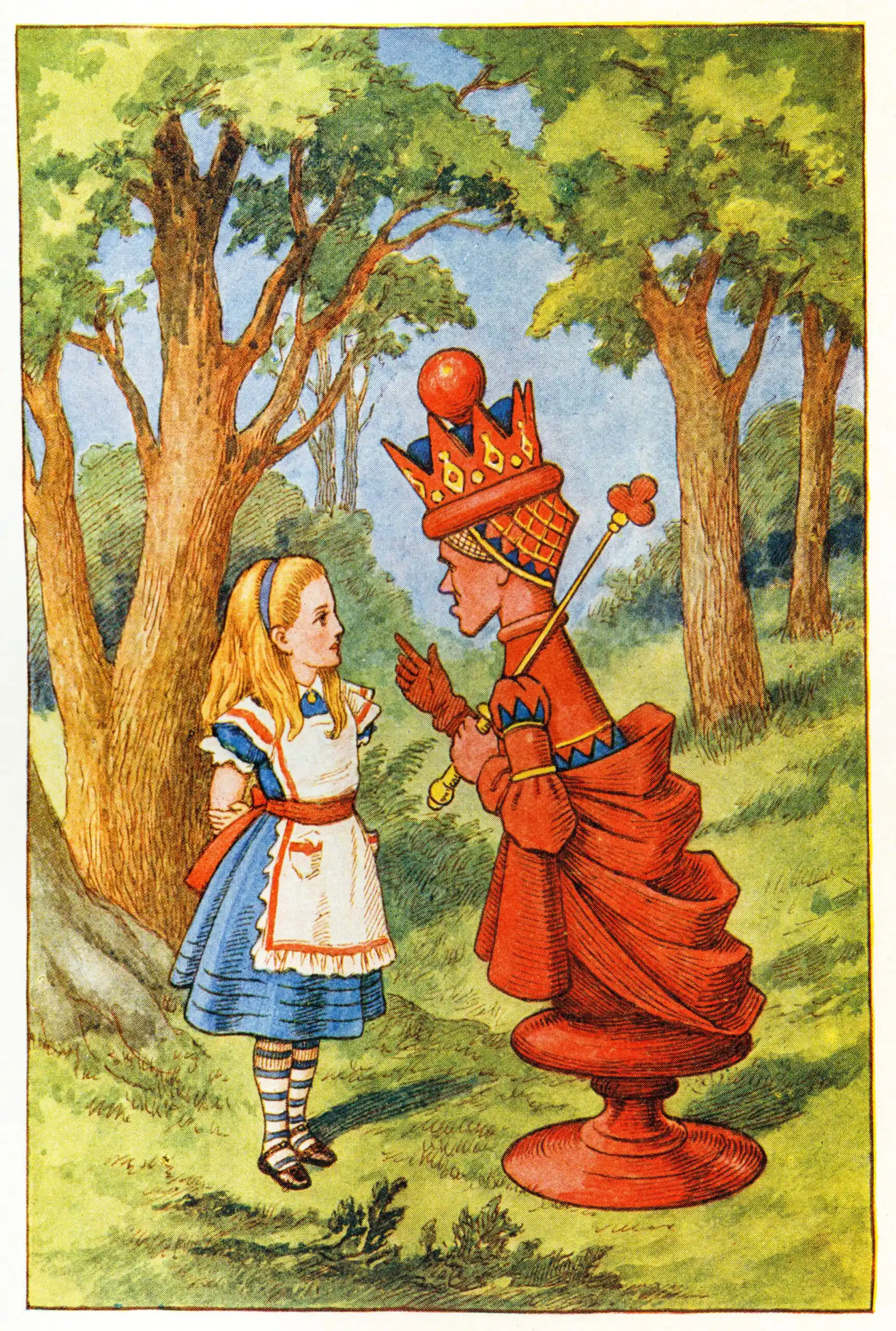
There is a precise analogy in evolutionary theory. In 1973, evolutionary biologist Leigh Van Valen proposed what he called the Red Queen Hypothesis: in any ecosystem, when one species evolves an advantage at the expense of another, the disadvantaged species will evolve to counteract the improvement. The name comes from Lewis Carroll's "Through the Looking-Glass," where the Red Queen tells Alice: "It takes all the running you can do, to keep in the same place." Species must constantly innovate with a diversity of strategies just to survive the innovative strategies of their competitors.
Similarly, when new startup methods are rapidly adopted by everyone, no one gains a relative advantage, and success rates remain flat. To win, a startup must develop a novel, differentiated strategy and build sustainable barriers to imitation before competitors catch up. This often means the winning strategy is either developed internally (not found in a public publication anyone can read) or is so idiosyncratic that no one would think to copy it.
This sounds like a difficult thing to build a science around......