The On-Chain Evolution of Private Credit: From Ledgers to Investable Products

深潮Published on 2025-12-18Last updated on 2025-12-18

Abstract

Private credit is undergoing a significant on-chain evolution, transitioning from a ledger-based operational upgrade to a distributable, investable product. While the total value of tokenized private credit has surged to around $24 billion, only 12% of the $19.3 billion in active loans tracked on RWA.xyz are held in transferable tokenized form. The market is split between "representative" tokenization—where blockchain serves as a transparent record-keeping system for off-chain loans—and "distributable" tokenization, where loans are natively issued and held as transferable tokens on-chain. The latter is growing rapidly, offering benefits like enhanced liquidity, faster settlement, and improved transparency. Figure dominates the market with a 73% share but uses blockchain only for record-keeping. In contrast, platforms like Maple are driving the shift toward fully distributable tokenized credit. This shift could standardize and scale private credit distribution by reducing intermediation, enabling programmable compliance, and improving portability—key advancements for an asset class that represents less than 2% of the $1.6 trillion global private credit market.

Author: Prathik Desai

Compiled by: Block Unicorn
Preface

On tokenized real-world asset (RWA) platforms, private credit is at a pivotal moment. Over the past year, tokenized private credit has been the fastest-growing category, surging from less than $50,000 to approximately $2.4 billion.

If stablecoins (whose payment channels cover all on-chain activities) are excluded, tokenized private credit ranks second only to on-chain commodities. Top tokenized commodities include Tether and Paxos's gold-backed currencies, as well as Justoken's tokens backed by cotton, soybean oil, and corn. This appears to be a serious category, with real borrowers, cash flows, underwriting mechanisms, and yields—and it is less dependent on market cycles compared to commodities.

But the story only becomes complex when you dig deeper.

This $2.4 billion in outstanding tokenized private credit represents only a small fraction of the total outstanding loans. This suggests that only a portion of these assets can truly be held and transferred on-chain in tokenized form.

In today's article, I will examine the reality behind the numbers of tokenized private credit and what these numbers mean for the future of this category.

Let's dive right in.

The Dual Nature of Tokenized Private Credit

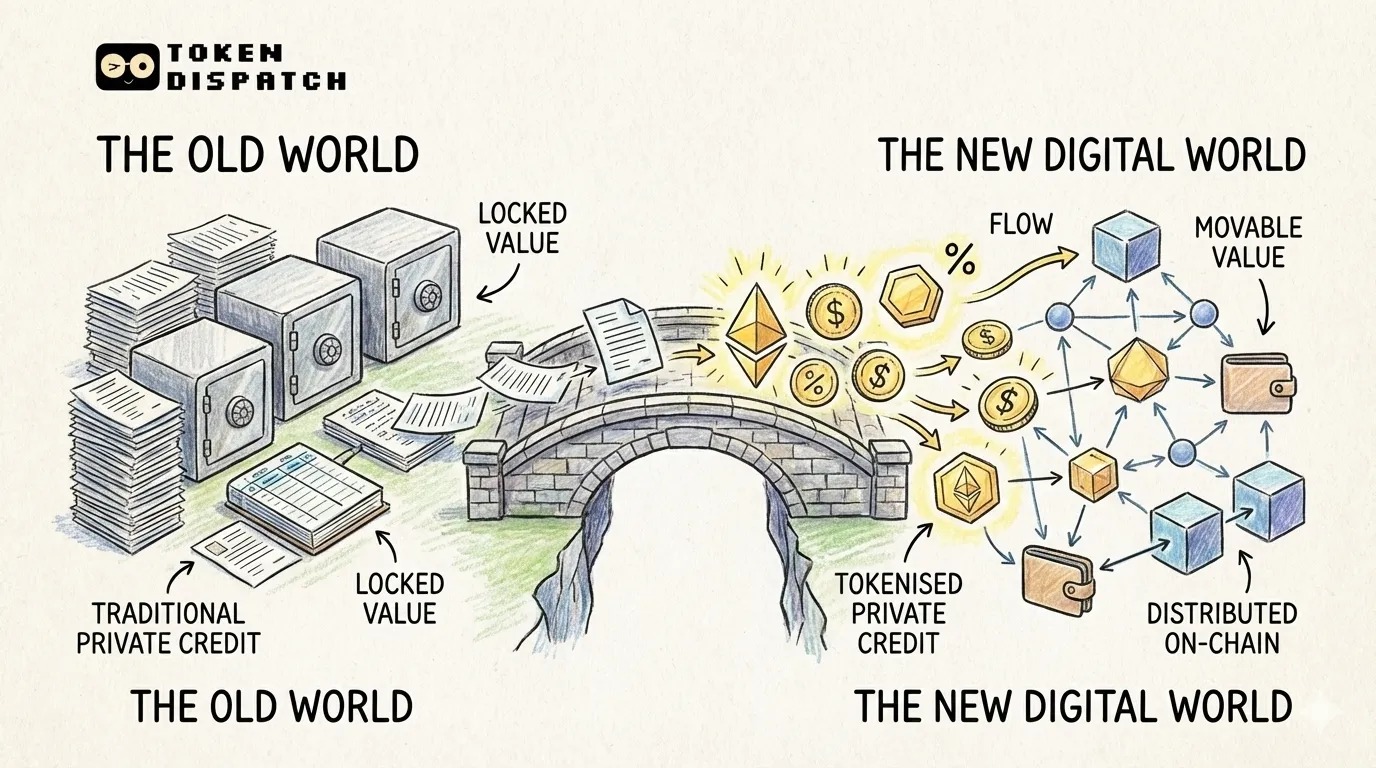
The total active loans on the RWA.xyz platform are slightly over $19.3 billion. However, only about 12% of these assets can be held and transferred in tokenized form. This highlights the dual nature of tokenized private credit.

One aspect is "representative" tokenized private credit, where the blockchain merely provides operational upgrades by establishing an on-chain ledger of outstanding loans recorded from the traditional private credit market. The other aspect is the distribution upgrade, where blockchain-driven markets coexist with traditional (or off-chain) private credit markets.

The former is used solely for recording and reconciliation, documented on a public ledger. The latter, however, can be transferred to wallets for transactions.

Once you understand this classification system, you won't ask whether private credit is on-chain. Instead, you'll pose a sharper question: How much private credit originates from the blockchain? The answer to this question might offer some insights.
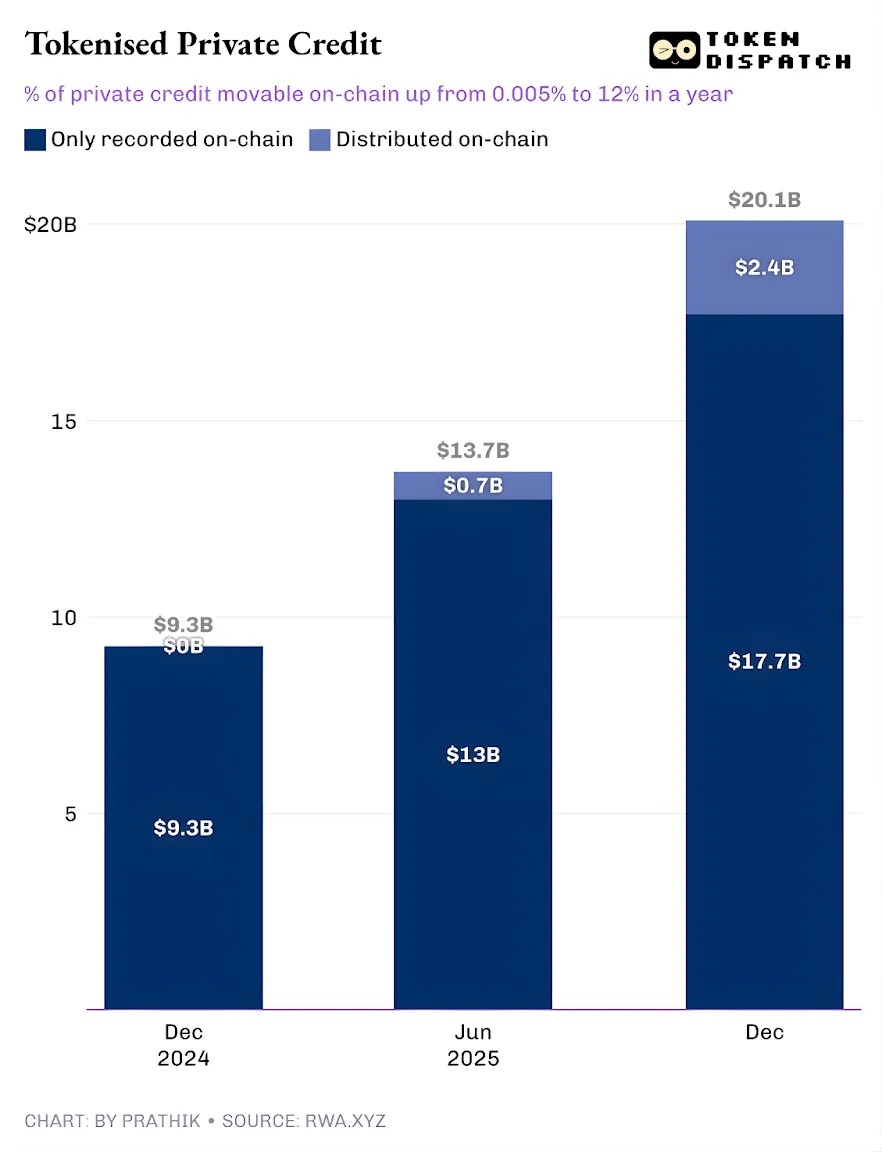
The trajectory of tokenized private credit is encouraging.

Until last year, almost all tokenized private credit was merely an operational upgrade. The loans already existed, borrowers made timely payments, platforms operated normally, and the blockchain simply recorded these activities. All tokenized private credit was only recorded on-chain and could not be transferred as tokens. Within a year, this share of on-chain transferable assets has climbed to 12% of the total trackable private credit.

It showcases the growth of tokenized private credit as a distributable on-chain product. This enables investors to hold fund shares, pool tokens, notes, or structured investment exposures in tokenized form.

If this distributed model continues to expand, private credit will no longer resemble a loan ledger but rather an investable on-chain asset class. This shift will change the benefits lenders derive from transactions. Beyond yields, lenders will gain a tool with greater operational transparency, faster settlement, and more flexible custody. Borrowers will access funding that isn't dependent on a single distribution channel, which could be highly beneficial in risk-averse environments.

But who will drive the growth of the distributable private credit market?

The Figure Effect

Currently, the majority of outstanding credit comes from a single platform, while the rest of the ecosystem forms a long tail.

Since October 2022, Figure has dominated the tokenized private credit market, but its market share has dropped from over 90% in February to 73% today.
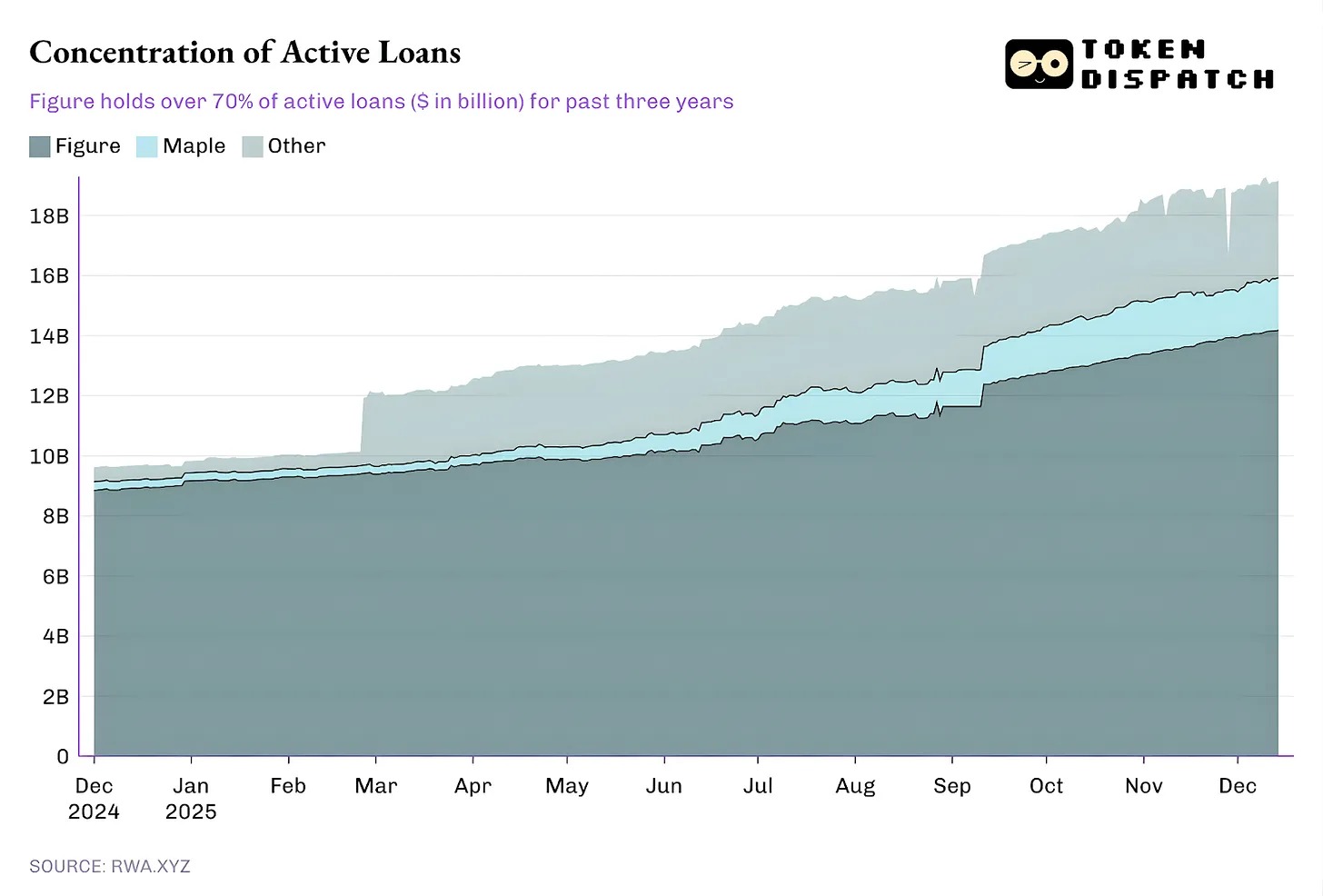
But what's more interesting is Figure's private credit model.

Although tokenized private credit now exceeds $14 billion, all the value of this industry leader is reflected in "representative" asset value, while the distributed value remains zero. This indicates that Figure's model is an operational pipeline that records loan issuance and ownership on the Provenance blockchain.

Meanwhile, some smaller players are driving the distribution of tokenized private credit.
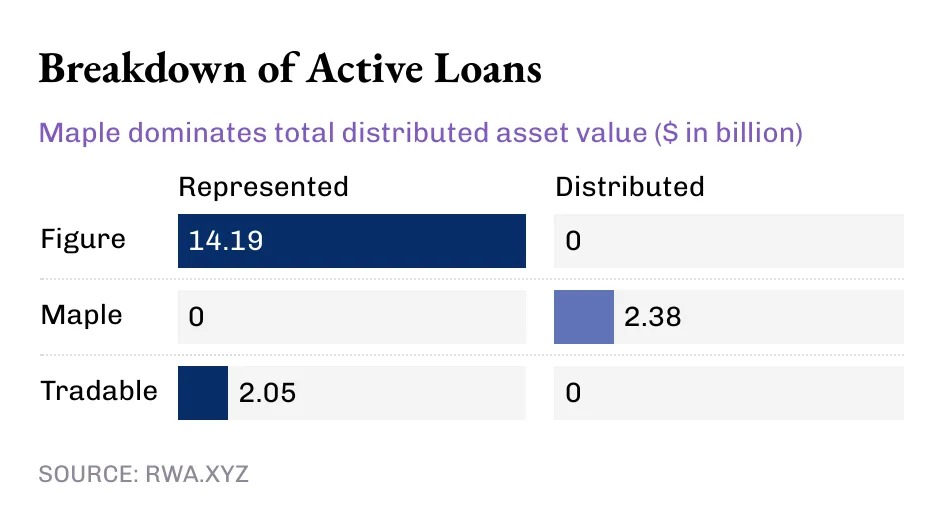
Figure and Tradable hold all their tokenized private credit as representative value, while Maple's value is entirely distributed via the blockchain.

From a macro perspective, the vast majority of the $19 billion in active on-chain loans are recorded on the blockchain. But the trend over the past few months is undeniable: more and more private credit is being distributed via blockchain. Given the immense growth potential of tokenized private credit, this trend will only intensify.

Even at $19 billion, RWAs currently account for less than 2% of the total $1.6 trillion private credit market.

But why is "movable, not just recorded" private credit important?

Movable private credit offers more than just liquidity. Gaining exposure to private credit off-platform through tokens provides portability, standardization, and faster distribution speed.

Assets acquired through traditional private credit channels trap holders within a specific platform's ecosystem. Such ecosystems have limited transfer windows and cumbersome secondary market trading processes. Additionally, secondary market negotiations are slow and primarily led by professionals. This gives existing market infrastructure far more power than asset holders.

Distributable tokens can reduce these frictions by enabling faster settlement, clearer ownership changes, and simpler custody.

More importantly, "movability" is a prerequisite for the large-scale standardized distribution of private credit, which has historically been lacking. In the traditional model, private credit appears in the form of funds, business development companies (BDCs), and collateralized loan obligations (CLOs), each adding multiple layers of intermediaries and opaque fees.

On-chain distribution offers a different path: programmable wrappers enforce compliance (whitelisting), cash flow rules, and information disclosure at the tool level, rather than through manual processes.


Related Questions

QWhat is the current size of the tokenized private credit market, and how does it compare to the total outstanding private credit market?

AThe tokenized private credit market has grown to approximately $24 billion. However, this represents only a small fraction, about 1.2%, of the total $1.6 trillion private credit market.

QWhat is the key difference between 'representative' and 'distributable' tokenized private credit?

A'Representative' tokenized private credit uses the blockchain solely as an operational upgrade to record and reconcile loans from the traditional market on a public ledger. 'Distributable' tokenized private credit allows the assets to be held and transferred as tokens, enabling them to be portable and traded in a blockchain-driven market.

QWhich company is the current market leader in tokenized private credit, and what is unique about its model?

AFigure is the current market leader, holding 73% of the tokenized private credit market. Its model is unique because its entire $14+ billion in value is classified as 'representative' value, meaning the loans are recorded on the Provenance blockchain for operational purposes but are not distributable as transferable tokens.

QWhat are the potential benefits of 'distributable' tokenized private credit over traditional private credit instruments?

ADistributable tokenized private credit offers benefits such as portability, faster settlement, clearer ownership changes, simpler custody, and the potential for standardized, large-scale distribution. It reduces reliance on a single platform's ecosystem and the complex, slow processes of traditional secondary markets dominated by intermediaries.

QWhat does the growth of the distributable segment indicate for the future of private credit?

AThe growth of the distributable segment indicates a shift where private credit is evolving from being a simple on-chain ledger of loans into a true, tradable asset class. This transformation promises greater operational transparency, faster settlement, and more flexible custody options for lenders, while providing borrowers with access to capital that is not reliant on a single distribution channel.

Related Reads

Misjudged A-Shares: Resilience, Expectations, and Confidence

China's A-share market recently faced selling pressure, especially in tech sectors, initially triggered by a global tech sell-off that began in South Korea. However, the article argues this is a case of "mistaken injury" and highlights the market's underlying resilience. This resilience stems from three main pillars: **1) Tech Sector Fundamentals:** Unlike Korea's market dominated by a few memory chip stocks, China's tech sector is diversified across computing, communications, electronics, and semiconductors, supported by dual narratives of global AI supply chains and domestic substitution. Core areas like optical modules and fiber optics continue to show strong earnings growth. **2) "National Team" Support:** State-backed institutions and large corporations have made significant market purchases and announced buybacks, providing liquidity and signaling confidence. This is seen as a stabilizing policy signal, often associated with market bottoms. **3) Broader Market Pillars:** Other major sectors are showing endogenous recovery momentum. Consumer stocks benefit from stabilizing CPI and signs of sector recovery (e.g., liquor price hikes). Cyclical sectors like aluminum have high earnings, potential price increases due to tight supply, and low valuations. The financial sector offers stable dividends and low valuations. The conclusion is that the sell-off was driven by external contagion, not a collapse in fundamentals. With strong policy support and recovering momentum across key sectors, the A-share market possesses the toughness to regain stability.

marsbit12m ago

Misjudged A-Shares: Resilience, Expectations, and Confidence

marsbit12m ago

The Clarity Act's Journey Through Congress: The Thorny Path of Bipartisan Compromise in the U.S.

The U.S. Congress is struggling to advance the crypto market structure bill known as the Clarity Act, with bipartisan compromise proving difficult. Key hurdles include unresolved disputes over "yield" products and, more critically, the inclusion of strong ethics provisions for elected officials—a non-negotiable demand for many Democrats. While a compromise on yield was reached in May, securing only limited Democratic support in committee, the separate Senate Agriculture Committee version later passed with no Democratic votes due to the ethics impasse. As Republicans push for a full Senate vote in July, demands for ethics rules have expanded, and other contentious issues like developer protections and concerns from law enforcement and large banks further complicate negotiations. Despite consensus on the need for legislation, the path forward is unclear. Recent discussions between senators and White House officials aim to find acceptable ethics language. Some lawmakers question whether a compromise text can garner enough bipartisan support, with one Democrat stating the current proposal lacks the strong ethics provisions required for their vote. Potential short-term goals for the crypto community include symbolic Senate action before the August recess, a longer-term aim for passage by 2026, or establishing a detailed framework that addresses ethics and other compromises. The process remains arduous, relying on the traditional, vote-by-vote effort to build bipartisan support.

marsbit31m ago

The Clarity Act's Journey Through Congress: The Thorny Path of Bipartisan Compromise in the U.S.

marsbit31m ago

Are Kalshi and Polymarket Founders at Odds? This Business Rivalry Is More Brutal Than You Think

"The Rivalry Between Kalshi and Polymarket Founders Turns Bitter and Litigious" The intense feud between Tarek Mansour, CEO of Kalshi, and Shayne Coplan, founder of Polymarket, has escalated far beyond typical business competition into personal animosity and regulatory battles. Both lead billion-dollar prediction market platforms, but their approaches differ sharply. Kalshi positions itself as the compliant operator, securing U.S. regulatory approval before launching. In contrast, Polymarket initially operated offshore, allowing U.S. users to access its platform via VPN, which drew regulatory scrutiny. The conflict reached a peak in November 2024 when FBI agents raided Coplan's New York apartment. While Coplan publicly blamed political motives, his team privately suspected Kalshi was involved. According to sources, Kalshi's lawyers had previously reported Polymarket's operations to federal prosecutors, highlighting its accessibility to U.S. users despite a ban. This incident fueled mutual accusations and underhanded tactics, including social media smear campaigns and attempts to sabotage each other's major business deals. Their rivalry also played out in Washington, influencing regulatory debates. Kalshi actively lobbied against Polymarket's practices, framing them as illegal and unethical. Polymarket, after facing a CFTC fine and investigation, later acquired a licensed U.S. firm to launch a domestic app, regaining a foothold. Despite the hostility, both companies have seen massive growth, with combined trading volumes soaring. However, increased regulatory scrutiny, particularly around insider trading on Polymarket's platform, continues to pose challenges. The founders' deep-seated mutual disdain ensures their battle for market dominance remains as much a personal vendetta as a commercial one.

marsbit40m ago

Are Kalshi and Polymarket Founders at Odds? This Business Rivalry Is More Brutal Than You Think

marsbit40m ago

Trading

Spot
活动图片




