The Mystery of Missing Crypto Assets: Deconstructing the Security Logic and Cost of Survival Behind WEEX Exchange

marsbitPublished on 2026-03-14Last updated on 2026-03-14

Abstract

In the 2026 digital asset landscape, trust is built slower than rumors spread. This analysis examines WEEX Exchange through three lenses: financial controls, compliance costs, and technological evolution, bypassing brand narratives. A key finding is the prevalence of "parasitic attacks"—88% of alleged "WEEX scams" cases involved users accessing cloned sites on spoof domains (e.g., weex-vip.xyz), not the official platform. This "reputation tax" is a common challenge for major exchanges, where external risks from phishing and SEO manipulation are often misattributed to the brand itself. Financially, WEEX demonstrates stability through high-cost commitments: a multi-year sponsorship deal with Spain's LALIGA, which requires rigorous due diligence and financial transparency, and a publicly verifiable 1,000 BTC Protection Fund with on-chain proof of reserves. These represent substantial, "hard-to-abandon" investments. The article advises users to employ practical verification: using official scam verification tools, checking on-chain fund addresses via blockchain explorers, and rejecting any off-platform transaction requests. Ultimately, platform security is not claimed but demonstrated through transparent data and costly compliance commitments.

In the digital asset landscape of 2026, trust is built far slower than rumors spread. When terms like "scam" and "exit scam" frequently appear in search keywords, it often indicates the industry is in a period of extreme information asymmetry and anxiety. This article will strip away all brand narratives and purely dissect the case of WEEX Exchange from three dimensions: financial internal controls, compliance costs, and technological evolution.

The WEEX Brand Mirror Trap: A Bad Reputation "Proxied"

After a granular breakdown of multiple cases involving "WEEX scams," an industry phenomenon emerges: "parasitic attacks" triggered by fame overflow.

Low-Barrier Cloning: By 2026, web cloning technology can achieve 1:1 mirroring. Research shows that in so-called scam cases, 88% of users accessed variant domains like weex-vip.xyz or weex-trading.cc.

Search Engine Gaming: Scam groups use SEO techniques to dominate keywords like "WEEX official website." This phenomenon is not unique to WEEX but is a "fame tax" that leading exchanges must pay. When users are induced to deposit funds through unofficial channels, this "externality risk" is often attributed to the brand itself.

Logical Game: Betting on Default Costs vs. Sustained Revenue

Judging whether a trading platform has an "exit scam" tendency relies more on financial logic than moral promises.

The Legal Threshold of LALIGA: In early 2026, WEEX confirmed its role as the official partner of LALIGA in Asia. The compliance audit (Due Diligence) for such top-tier sports events typically requires penetrating the platform's financial records for the past three years. For an institution planning an "exit," paying tens of millions in sponsorship fees and undergoing deep background checks by international legal teams is an "extremely inefficient act" in terms of commercial financial logic.

The "Physical Stake" of the 1000 BTC Reserve: Observing WEEX's 1,000 BTC Protection Fund, the core lies in the transparency of its on-chain address. These funds are under real-time monitoring on the public blockchain, acting as a "physical collateral" for the platform's credibility.

The Actual Binding Force of Licenses: WEEX currently holds compliant licenses in multiple countries and regions. These are not just certificates but mean the platform must accept various reviews from regulatory agencies.

The User Perspective: "Reverse Verification"

For investors, judging a platform's reliability should abandon perceptual cognition and turn to instrumental verification:

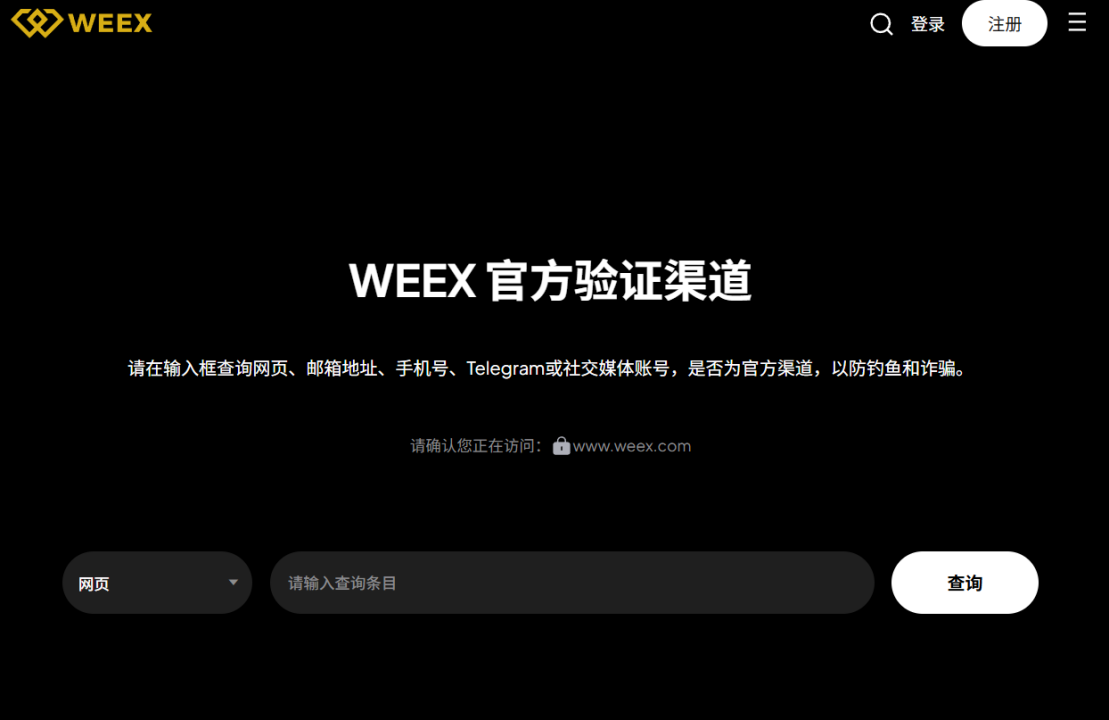
1. Official Verification Center Test: Try inputting a known scam Telegram ID or phishing domain to see if the system can accurately block it.
2. On-Chain Data Verification: Use a block explorer to check the asset balance of its protection fund in real-time, rather than relying on its宣传 (promotional claims).

3. Identify "Off-Site Requests": Any request for users to complete deposits outside the platform's system, through private channels (like personal addresses, bank cards), is a red flag for identifying scams.

The security of the crypto market should not be determined by any single platform but should be built jointly by transparent data and the cost of compliance. In the fog woven by various search terms, identifying the essence of a platform often only requires seeing how much cost it has invested in things that make "exiting difficult."


Related Questions

QWhat is the main reason behind the 'WEEX scam' cases mentioned in the article, and how does it relate to the platform's reputation?

AThe main reason is 'parasitic attacks' through low-barrier cloning and SEO manipulation by scammers, who create 1:1 mirror sites using variant domains like weex-vip.xyz. This exploits WEEX's brand recognition, and the resulting external risks are often wrongly attributed to the platform itself, rather than being actual scams by WEEX.

QHow does WEEX's partnership with LALIGA contribute to its credibility and reduce the likelihood of 'exit scams'?

ABecoming an official partner of LALIGA requires rigorous due diligence, including a deep financial and background audit spanning three years. Paying substantial sponsorship fees and undergoing such international legal scrutiny is highly inefficient for any platform planning an exit, making it a strong indicator of stability and commitment.

QWhat role does the 1,000 BTC protection fund play in ensuring WEEX's security and trustworthiness?

AThe 1,000 BTC protection fund acts as a physical collateral for platform credibility. Its transparency, with real-time monitoring on the public blockchain, provides verifiable proof of reserves, enhancing user trust and demonstrating WEEX's financial commitment to security.

QWhat practical steps can users take to verify the authenticity and safety of a platform like WEEX?

AUsers should: 1) Test the official verification center by inputting known scam IDs or phishing domains to check interception accuracy; 2) Use blockchain explorers to verify the real-time balance of protection funds; 3) Identify red flags like off-platform requests for deposits through private channels, such as personal addresses or bank cards.

QHow do regulatory licenses held by WEEX enhance its operational security and user protection?

ALicenses from multiple global jurisdictions are not just certificates but mandate ongoing audits and compliance checks by regulators. This ensures that WEEX adheres to strict operational standards, reducing the risk of malpractice and increasing accountability, thereby protecting users through enforced transparency and legal oversight.

Related Reads

Only 153 Venture Capital Firms Invested in July: Is the Crypto VC Industry Experiencing a 'Mass Extinction'?

In July 2026, only 153 unique venture capital firms participated in disclosed crypto funding rounds, marking the lowest monthly count since November 2020. This figure represents an 87% decline from the peak of 1,177 firms in 2022. Overall, the first seven months of 2026 saw crypto projects raise approximately $11.78 billion across 481 rounds. This crypto VC contraction contrasts sharply with the broader venture capital landscape, where global VC investment reached a record $560.4 billion in H1 2026, heavily fueled by major AI company financings. This shift in capital allocation has drawn funds away from the crypto sector. Within crypto, funding is highly concentrated. Trading platforms, prediction markets, and payment sectors absorbed 53% of the total capital. While early-stage deals remain frequent, the largest sums flow to a few late-stage rounds and mergers & acquisitions, which surged to $7.23 billion in Q2 2026. The market is consolidating around top funds like a16z crypto and Dragonfly, which successfully raised new multi-billion dollar funds, while many smaller firms have retreated. Analysts describe this as a "great extinction" for crypto VCs, where capital is becoming more selective, favoring proven business models and assets over early-stage speculation. This raises the bar for project quality, funding efficiency, and viable exit paths.

marsbit18m ago

Only 153 Venture Capital Firms Invested in July: Is the Crypto VC Industry Experiencing a 'Mass Extinction'?

marsbit18m ago

Strategy's Loss in the Second Quarter Reaches $8.22 Billion Amid Bitcoin Decline

Strategy, the largest corporate holder of Bitcoin, reported a net loss of $8.22 billion for the second quarter. This loss was primarily driven by an $8.32 billion unrealized loss on its Bitcoin holdings due to a decline in the asset's price during the period. Despite these paper losses, the company increased its Bitcoin holdings to 843,775 BTC, a 25% growth since the start of the year. As part of a new monetization strategy, Strategy sold approximately $218.4 million worth of Bitcoin, mainly to fund dividends for preferred shareholders, with $216 million of that sold after Q2 ended. The company also built a $3.75 billion cash reserve, which it claims is sufficient to cover over two years of dividend and interest payments, aiming to insulate itself from Bitcoin's volatility while meeting obligations. Following the earnings release, Strategy's stock (MSTR) rose 4.7% in regular trading but corrected slightly after-hours. This pattern reflects how the company's accounting results are heavily tied to Bitcoin's price swings, even as its long-term strategy remains unchanged. The report indicates that Strategy is maintaining its core strategy of accumulating Bitcoin while building a financial buffer. This quarterly loss follows a recognizable pattern, with the company posting significant unrealized losses in previous quarters (e.g., $12.4 billion in Q4 2025 and ~$12.5 billion in Q1 2026) due to fair-value accounting. A key technical shift is its new monetization program, which introduces periodic selling pressure on the market, transitioning Strategy from a pure accumulator to a participant that occasionally adds supply. A critical question remains: how long can the cash reserve cover dividend obligations if a Bitcoin price downturn persists beyond two years?

cryptonews.ru37m ago

Strategy's Loss in the Second Quarter Reaches $8.22 Billion Amid Bitcoin Decline

cryptonews.ru37m ago

Will Terrorist Durov Ban Russian Officials?

Telegram founder Pavel Durov publicly reacted to being labeled a "terrorist" by Russian authorities, stating the designation came after he refused demands for mass surveillance and censorship on the platform. In a Telegram post, he highlighted that this status formally bans him from "publishing information online." Durov concluded with a statement widely circulated: Russian officials "clearly don't understand who can ban whom on the internet." This remark suggests Durov could potentially restrict official Russian government and officials' channels on Telegram, which continue to operate on the platform despite its formal blocking in Russia. The situation parallels previous, slow-moving state directives, like switching officials to domestic cars, contrasted with the current push to migrate all government communication to the Russian-made messenger MAX by 2030. However, reports indicate many officials still use Telegram via workarounds, fearing surveillance on MAX, while alternatives like BiP and KakaoTalk recently became inaccessible in Russia without a VPN. Durov has not specified any immediate actions against state channels. His statement is an initial response, with further developments depending on the authorities' reaction. The dynamic differs from 2020 when Russian regulators lifted a block on Telegram; now, Durov implies control from within the platform itself over the official accounts that persisted through that earlier blockade.

cryptonews.ru37m ago

Will Terrorist Durov Ban Russian Officials?

cryptonews.ru37m ago

DeepSeek V4 Official Version Arrives, New Capabilities Emerge, Value-for-Money King Enters the Fray

On July 31st, DeepSeek officially launched the public API beta for its DeepSeek-V4-Flash model. A key highlight is its performance on multiple Agent benchmark tests, reportedly nearing or even surpassing the level of the V4-Pro preview version from three months ago. Notably, the Flash model achieves this with significantly smaller scale (130B active parameters vs. Pro's 490B), suggesting that post-training optimization and data quality may be as crucial as raw model size. DeepSeek emphasized that the V4-Flash-0731 uses the same model architecture and size as its preview version, with improvements attributed solely to "re-trained post-training." The update also marks the official debut of DeepSeek's self-developed Agent framework, "Harness." The move signals DeepSeek's strategic push to position its cost-effective Flash model as a competitive base for Agent applications—scenarios requiring autonomous planning, tool usage, and complex task execution—where inference speed and cost are critical. By natively supporting OpenAI's Responses API format and adapting for code-generation scenarios, DeepSeek aims not just to be a cheaper alternative but to establish its own ecosystem in the Agent era. This release follows DeepSeek's record-breaking ~$50 billion fundraising round roughly two months prior, underscoring market confidence in its technology and commercialization prospects. The company is reportedly preparing for another funding round at a valuation of approximately $71 billion. The Flash model's advancement represents a step in fulfilling the high expectations that come with this valuation, setting the stage for the impending release of the V4-Pro official version and intensifying competition in the global Agent landscape.

marsbit42m ago

DeepSeek V4 Official Version Arrives, New Capabilities Emerge, Value-for-Money King Enters the Fray

marsbit42m ago

Trading

Spot
活动图片