The Largest Market for Stablecoins Is Not Cross-Border Payments

比推Published on 2026-03-09Last updated on 2026-03-09

Abstract

Stablecoins are experiencing significant growth, with their circulating supply more than doubling and adjusted transaction volume tripling over the past two years. However, the nature of this growth is shifting. Data from Allium’s latest report indicates that stablecoins are increasingly being used as a payment rail rather than a savings or speculative asset. Key metrics show that transaction velocity has increased from 2.6x to over 6x, indicating that stablecoins are being used more frequently for transactions rather than held as stores of value. While consumer-to-consumer (C2C) transactions remain the largest category by volume, their growth has slowed. In contrast, consumer-to-business (C2B) and business-to-business (B2B) payments are growing rapidly—131% and 87% respectively—suggesting increased adoption in commercial use cases like subscriptions, invoices, and supply chain payments. Notably, the narrative that stablecoins are primarily used for cross-border remittances is contradicted by the fact that about 74% of transactions are domestic. The declining average transaction size further supports the idea that stablecoins are being used for routine, lower-value payments rather than large international transfers. This shift positions stablecoins as competitors to domestic payment systems like ACH, rather than as tools for global remittances. The maturation of stablecoin infrastructure is evident as usage moves beyond experimental peer-to-peer transfers toward consisten...

Author: Prathik Desai

Original Title: The Maturity Fingerprint

Compiled and Edited by: BitpushNews


Everyone believes stablecoins are growing. In just two years, their circulating supply has more than doubled, while adjusted transaction volume has more than tripled. Last month, the monthly adjusted transaction volume of stablecoins hit a record high. Some people scoff at these numbers, while Crypto Twitter (CT) celebrates.

But numbers alone are insufficient to explain the nature of this growth. Equally important is the context in which growth occurs—such as who is using stablecoins, for what purposes, and whether usage patterns are changing. Allium gave us a preview of their latest report on stablecoin infrastructure—'Stablecoins: The Rise of a New Payment Rail.' This is a very important report because the charts show that the use of stablecoins is shifting from enabling low-cost cross-border remittances to supporting general commerce and supplier payments between businesses.

Most current debates about stablecoins focus on whether they are financial products (like banks, Treasury wrappers, yield vehicles) or merely payment infrastructure. Policy-level debates about stablecoin interest assume that stablecoins primarily function as financial instruments. But the data in the report tells a different story: the recent composition of stablecoin activity increasingly resembles a payment rail rather than a savings product.

This mirrors the evolution pattern we saw with the Automated Clearing House (ACH) network: from initially replacing paper checks in payroll to becoming the backbone of general commerce, B2B payments, and consumer bill payments.

This article will combine data from Allium's stablecoin infrastructure report to explain why it changes our perspective on the direction of stablecoins.

The Differentiation of Velocity

Since January 2024, the circulating supply of stablecoins (total supply minus non-circulating supply) has grown by over 100%. During the same period, adjusted transaction volume (excluding wash trading, internal entity transfers, and round-tripping) increased by 317%.

In the accumulation phase of any new asset, supply growth typically outpaces usage growth. As the asset matures, usage growth outpaces supply growth. This is because asset holders are spending the asset more frequently. Here, since adjusted transaction volume is growing much faster than the circulating supply of stablecoins, it indicates that stablecoins are maturing from a store of value asset to a more popular medium of exchange or value transfer tool.

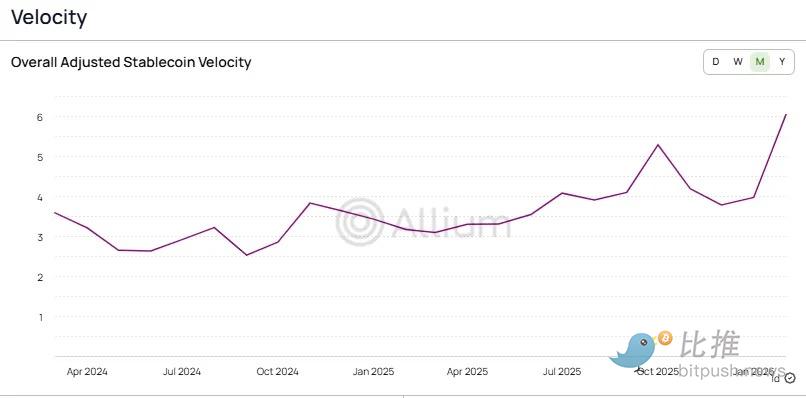
This shift is reflected in the velocity of stablecoins, calculated as adjusted transaction volume divided by circulating supply.
Allium

The velocity of stablecoins has increased from 2.6x to over 6x in the past two years, reflecting that each dollar of stablecoin supply is now turning over 2.3 times more actively than in January. Benchmarking this against traditional payment rails shows how mature stablecoin usage has become.

Another metric that establishes the maturity of stablecoin usage is the number of transactions. It is least affected by large-value noise. Therefore, when the growth in the number of payment transactions outpaces the growth in transaction value, it indicates that the average payment amount is decreasing. This behavior is typical of a payment rail gaining traction, rather than an experimental tool shuttling between exchanges.

This raises the question: who is making these payments, and what are they paying for?

In 2025, the consumer-to-consumer (C2C) category remained the largest channel, ahead of consumer-to-business (C2B), business-to-business (B2B), and business-to-consumer (B2C). But its growth rate was the slowest among the four categories.
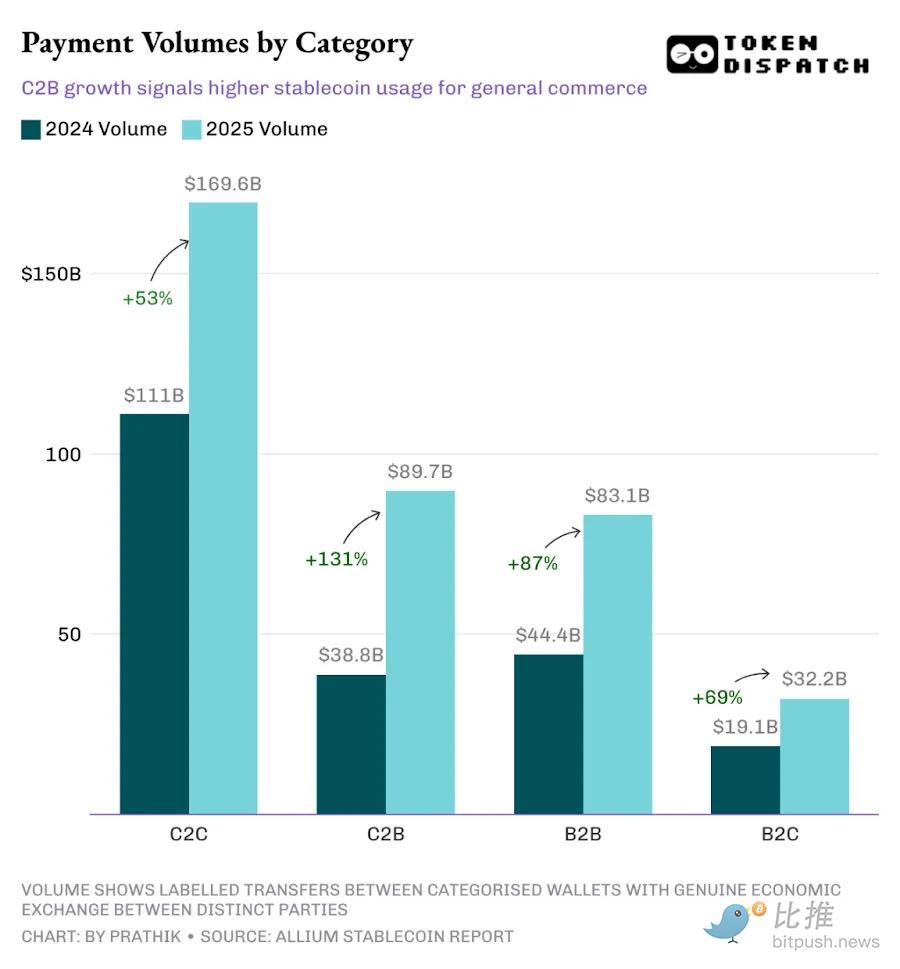
The slowdown in C2C growth further confirms the maturation of stablecoin usage, as person-to-person transfers are the simplest use case. They require no merchant integration, no invoicing tools, no APIs, and have minimal adoption barriers. This is the typical starting point for every new payment technology.

When India launched the Unified Payments Interface (UPI) a decade ago, retail users joined first, driven by cashback and other customer acquisition strategies. I remember using Google Pay (initially launched as Tez in India) to transfer money between my own accounts just because it gave me a one-dollar cashback. Only when commercial tools, reporting, and dedicated payment confirmation audio device systems (speakers) were introduced did stores and institutions join.

As infrastructure matures, commercial use cases begin to absorb market share. And this transformation seems to be happening.

The high growth in C2B indicates that more users are using stablecoins for general commerce, subscriptions, and merchant payments. Meanwhile, the growth in B2B indicates that commercial counterparts are beginning to adopt stablecoins in invoice processing, supply chain payments, and financial operations. Both growth rates (131% for C2B and 87% for B2B) exceed the overall payment growth rate of 76%, indicating that the share of commercial payment volume is expanding.

When you combine the growing C2B transaction volume with the decreasing average transaction value in C2B (from $456 to $256), it suggests a trend of people starting to use stablecoins for recurring purchases.

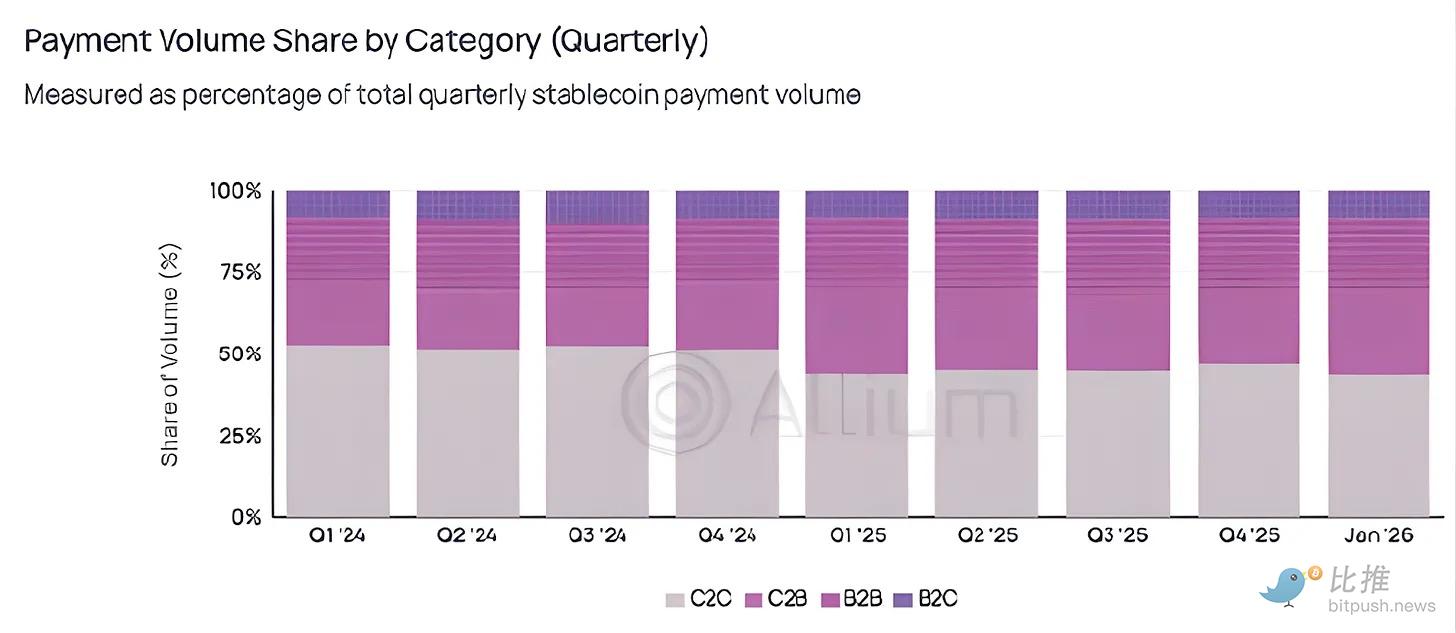
Although peer-to-peer (P2P) categories still dominate in absolute terms, they will soon cede ground. Quarterly share data makes this rotation even more undeniable.
Allium

After falling below the 50% mark in Q1 2025, C2C's share of total payment volume has never exceeded 50% again.

The world seems to be moving beyond the experimental phase of using stablecoins for low-risk, low-frequency peer-to-peer transfers, toward consistently using them for high-frequency payments.

When I first started tracking stablecoin adoption, a mainstream narrative supporting stablecoins was how they could enable cross-border remittances and potentially disrupt Western Union by allowing workers in developed economies to send money home. But the data tells a different story.

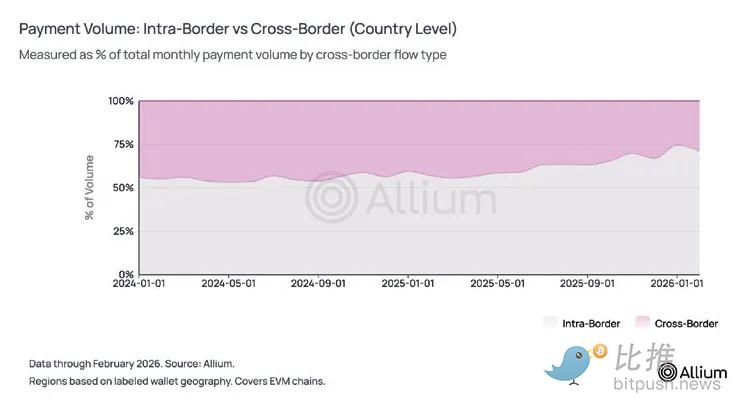
Currently, about three-quarters of stablecoin payments occur domestically. Over the past year, the share of cross-border payments at the country level has decreased from 44% to about 25-29%. At the regional level, 84% of payments remain within the same geographic region.
Allium

Based on all our previous charts, it is clear that stablecoins are not competing with SWIFT in the international settlement space. Instead, B2B metrics—including 74% domestic dominance, declining average transaction size, payroll, and growing invoice use cases—point to stablecoins competing with domestic payment rails like ACH.

For reference, ACH B2B payments grew about 10% in 2025, while stablecoin B2B payments grew 87% during the same period. I realize the absolute scales are not comparable, and we must consider the low base effect of stablecoins. However, this growth cannot be ignored.

Outlook

For a long time, I viewed cross-border remittances and peer-to-peer transfers as the main drivers of stablecoin adoption.

Imagine a son in India receiving dollars from his family in Dubai on a bank holiday without intermediaries taking 7% to 8% in fees—this narrative is indeed appealing. This story still holds today, but perhaps it is no longer the main storyline.

Interestingly, the narrative of domestic consumption scenarios has quietly and rapidly surpassed everything else. C2C's market share hasn't returned to 50% for over a year, a metric that never seemed to trend in crypto discussions. But it is this metric that marks stablecoins' transformation from a 'crypto product' to 'financial infrastructure'—enabling transactions between consumers and businesses, or between businesses themselves.

It's also worth noting that the payment transaction volume labeled by Allium is based on their analysis of wallets they can cover, identify, and tag. Although this data shows that payment transactions account for only 2% to 3% of the total adjusted stablecoin transaction volume, this should be considered a lower bound—as there are undoubtedly many wallets that Allium has not covered.

Moving forward, I will focus on two directions: whether the shares of C2B and B2B continue to rise, and whether the average transaction value can remain low in the coming quarters. If these trends persist even during a crypto market downturn, it will indicate that stablecoin payment infrastructure has truly begun to decouple from the speculative cycles of the crypto market.


Twitter:https://twitter.com/BitpushNewsCN

Bitpush TG Discussion Group:https://t.me/BitPushCommunity

Bitpush TG Subscription: https://t.me/bitpush

Original link:https://www.bitpush.news/articles/7618187

Related Questions

QWhat does the data from Allium's report indicate about the primary use case of stablecoins?

AThe data indicates that stablecoins are increasingly being used as a payment rail for general commerce and B2B payments, rather than primarily for cross-border remittances or as savings products.

QHow has the velocity of stablecoins changed over the past two years, and what does this signify?

AThe velocity of stablecoins has increased from 2.6x to over 6x in the past two years, signifying that stablecoins are maturing from a store of value asset into a more active medium of exchange or value transfer tool.

QWhich payment category has the slowest growth rate among C2C, C2B, B2B, and B2C, and what does this suggest?

AThe Consumer-to-Consumer (C2C) category has the slowest growth rate, suggesting that stablecoin usage is maturing beyond simple peer-to-peer transfers, which are the typical starting point for new payment technologies.

QWhat percentage of stablecoin payments are domestic, and how has this changed over the past year?

AApproximately 74% of stablecoin payments are domestic, and the share of cross-border payments at the country level has decreased from 44% to about 25-29% over the past year.

QWhat two trends should be monitored to determine if stablecoin payment infrastructure is decoupling from crypto market speculation cycles?

AThe two trends to monitor are whether the share of C2B and B2B payments continues to rise and whether the average transaction size remains low in the coming quarters, even during crypto market downturns.

Related Reads

KOL's Perspective: Why Is SOL Set to Rise from This Point?

**Summary: Why SOL is Positioned for Growth at This Level** The article argues that SOL is poised for an upward move from its current price point, citing several key factors. Primarily, SOL has just broken out of a 4-month consolidation phase. This breakout signals a return of risk appetite to the broader crypto market, as SOL is seen as a key indicator of overall crypto health. The token's ownership has reportedly shifted from short-term traders and tourists to long-term accumulators, leading to low volume. Any meaningful increase in trading activity could thus trigger significant upward momentum. Fundamental strengths include strong institutional adoption, integration with DeFi and RWAs (Real-World Assets), and the potential benefits from the Clarity Act. Despite its high volatility—having dropped 70% from its all-time high but still up 12x from its bear market low—SOL is highlighted as one of the few tokens from the last cycle to reach new highs. It boasts a robust ecosystem of applications, users, and protocols. Future catalysts include the expected influx of AI developers following the Miami Accelerate conference, which focused on AI on Solana. Furthermore, Solana is positioned as the premier chain for memecoin activity, a trend expected to continue and drive network usage and fees. The article concludes that recent price action reflects a healthy transfer to long-term holders, setting the stage for growth.

marsbit32m ago

KOL's Perspective: Why Is SOL Set to Rise from This Point?

marsbit32m ago

Those Pre-Bitcoin PoW Protocols Have Recently Been Reimplemented

This article details a recent surge in replicating pre-Bitcoin Proof-of-Work (PoW) protocols, specifically focusing on Hal Finney's 2004 RPOW (Reusable Proofs of Work). Within five days in May 2026, multiple independent builders in the Bitcoin/cypherpunk community launched projects inspired by this early electronic cash proposal. The initiative began with Fred Krueger's `rpow2.com`, a centralized but auditable system that replaced RPOW's original IBM 4758 hardware with Ed25519 signatures. Initially a faithful replica, it later adopted Bitcoin-like features (21M supply cap, difficulty adjustment) and a controversial 5.24% founder allocation. This sparked rapid forks, including `rpow4.com` which incorporated full Bitcoin parameters, a prediction market (`rpowmarket.com`), and a DEX (`rpow2swap.com`). Concurrently, Mike In Space created a prototype of Wei Dai's 1998 b-money proposal (`b-money.replit.app`), pushing the historical exploration even further back. The article contrasts these centralized, server-dependent experiments with Bitcoin's core innovation of decentralized, trustless consensus. It also highlights a parallel development: the `HASH` project on Ethereum, which uses smart contract hooks to enable a purely fair-launch, browser-mineable PoW token with 0% allocations to team or VCs. The collective activity is framed as a meme-driven, educational exploration of cypherpunk history rather than a serious financial movement, with all projects heavily disclaiming any investment value.

marsbit37m ago

Those Pre-Bitcoin PoW Protocols Have Recently Been Reimplemented

marsbit37m ago

South Korean Exchanges 'Battle' Regulators, Challenging the Boundaries of Enforcement and Legislation

South Korea's cryptocurrency industry is engaged in a rare, direct confrontation with regulators. The Financial Intelligence Unit (FIU), the primary anti-money laundering (AML) watchdog, has recently imposed heavy penalties on major exchanges like Upbit and Bithumb for alleged violations involving unregistered overseas VASPs and AML procedures. However, exchanges are now actively challenging these actions in court and through industry associations. In a significant shift, the Seoul Administrative Court ruled in favor of Upbit's operator, Dunamu, overturning part of an FIU-ordered business suspension. The court found the FIU's penalty criteria and justification insufficiently clear. Similarly, the court suspended the enforcement of a six-month business suspension against Bithumb pending a final ruling, citing potential irreversible harm to the exchange. Beyond legal battles, the industry is contesting proposed legislative amendments. The Digital Asset eXchange Alliance (DAXA) strongly opposes a draft rule that would mandate Suspicious Transaction Reports (STRs) for all crypto transfers over 10 million KRW (~$6,800). DAXA argues this "poison pill" clause violates legal principles and would overwhelm the STR system, increasing reports from 63,000 to an estimated 5.45 million annually for major exchanges, thereby crippling effective AML monitoring. This conflict highlights a structural tension in South Korea's crypto governance: comprehensive digital asset laws are still developing, while regulators rely heavily on AML enforcement. The industry's move from passive compliance to active legal and legislative challenges signifies a new phase, pressing for clearer rules and more proportionate enforcement. While short-term disputes may intensify, this clash could ultimately lead to a more mature and sustainable regulatory framework for South Korea's vibrant crypto market.

marsbit1h ago

South Korean Exchanges 'Battle' Regulators, Challenging the Boundaries of Enforcement and Legislation

marsbit1h ago

After 50x Storage Surge, Justin Sun Always Looks to the Next Decade

Sun Yuchen, known for his controversial stunts like a $30 million lunch with Warren Buffett (canceled due to a kidney stone) and eating a $6.2 million duct-taped banana, is often overshadowed by a significant fact: his decade-long track record of spotting major investment trends. In 2016, he famously advised young people to invest in Bitcoin, Nvidia, Tesla, and Tencent instead of buying property. A hypothetical $20,000 investment in Nvidia and Tesla from that list would now be worth over 50 million RMB. His latest major call was on November 6, 2025, predicting a "50x storage opportunity" tied to the AI boom, which materialized with Sandisk's stock surging nearly 50-fold by 2026. Looking ahead, Sun now focuses on the next frontier: Physical AI. He identifies four key areas: 1. **Embodied AI/Robotics**: He sees this reaching its "iPhone moment," with companies like UBTech and Galaxy General leading in commercialization. 2. **Drones**: Viewed as the first commercially viable form of Physical AI, revolutionizing sectors from warfare (e.g., AeroVironment's Switchblade) to logistics. 3. **Spatial Computing**: Beyond VR, it's about AI understanding physical space, a foundational technology for robotics and autonomous systems, exemplified by Apple's Vision Pro. 4. **Space Exploration**: After a 2025 suborbital flight with Blue Origin, Sun advocates for space as the ultimate frontier, discussing blockchain's potential role in space asset management and data transactions. His investment philosophy involves betting on entire, inevitable trends rather than single companies. For robotics, he sees Tesla (the body/manufacturer) and Nvidia (the brain/AI platform) as complementary plays. In defense drones, he highlights companies making tanks obsolete (AeroVironment) and those augmenting fighter jets (Kratos). For space, he participated in Blue Origin's flight and anticipates SpaceX's potential IPO to redefine the sector's valuation. Sun Yuchen's vision frames the next two decades not as a revolution in information flow (like the internet), but in the fundamental operation of the physical world through AI-powered robots, autonomous systems, and spatial intelligence, ultimately extending human and AI activity into space. While many still focus on conventional assets, he continues to look toward the next technological horizon.

marsbit2h ago

After 50x Storage Surge, Justin Sun Always Looks to the Next Decade

marsbit2h ago

Trading

Spot
Futures
活动图片





