The First Large-Scale Strike in the AI Era Comes from the Factories That Build AI

marsbitPublished on 2026-05-21Last updated on 2026-05-21

Abstract

The article describes a potential large-scale strike at Samsung Electronics, narrowly averted in May 2026 after a temporary agreement. The strike, planned by the company's union, would have been the first major labor action in the AI era targeting a core AI supply chain player. Samsung, alongside SK Hynix, produces roughly two-thirds of the world's memory chips, critical components for AI training and data centers like HBM. An 18-day strike could have disrupted global supply, affecting prices and production for tech companies and cloud providers. For South Korea, where semiconductors constitute about 35% of exports and Samsung represents a quarter of the stock market's value, such an action threatens national economic stability. The union's demands include a 7% base wage increase and, crucially, a clear, substantial profit-sharing model. They want 15% of annual operating profit as an employee bonus pool and the removal of the existing cap (about 50% of annual salary). This frustration is amplified by seeing rival SK Hynix successfully negotiate a deal granting employees 10% of operating profit as bonuses, with reports suggesting some workers could receive bonuses equivalent to hundreds of thousands of dollars. The conflict stems from deeper issues in South Korea's chaebol (conglomerate) system, where rapid national industrialization often prioritized corporate growth over labor rights. Samsung long maintained a "no union" policy until a 2020 apology from its leader. The ar...

By Sleepy

AI may redefine the future, but to this day, it cannot replace the dignity inherent in labor.

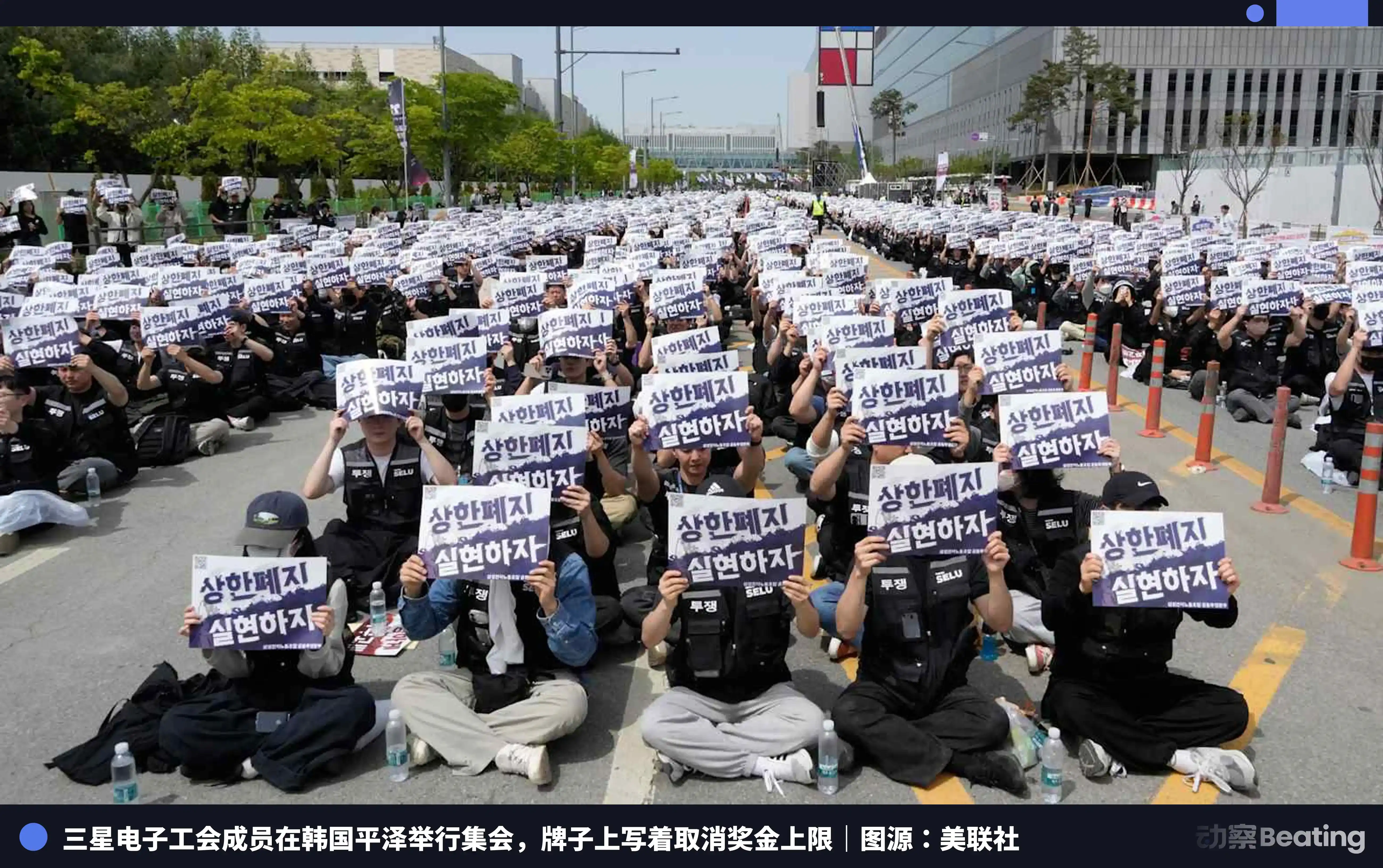
On May 20th, wage negotiations between Samsung Electronics and its union nearly broke down. The union originally planned to launch an 18-day strike starting May 21st. At the last minute, both sides reached a temporary agreement, pausing the strike for now, pending a vote by union members. However, the underlying issues have not disappeared.

Strikes are not unfamiliar to us.

Those past events were also heavy, occurring in old industrial bases, automotive supply chains, and foreign trade factories reliant on cheap manual labor. The keywords were always low wages and unpaid dues. Initially, people were taken for granted as durable consumables, settled within plans named "the greater good." Only when life became suffocatingly oppressive did people suddenly realize they hadn't devolved into iron components. So, they straightened their backs within that cold order and made a bit of human noise.

But this time is different.

This time, it's the workers of Samsung Electronics who are standing up.

They are not workers left with no retreat in the tide of globalization, but people located at the very heart of the AI supply chain, closest to the "future." Within Samsung's colossal chaebol machinery, this giant controlling the lifeline of global semiconductors is being paused by its own workers.

A Strike That Endangers Global AI

This strike is precisely choking the throat of the global AI industry chain.

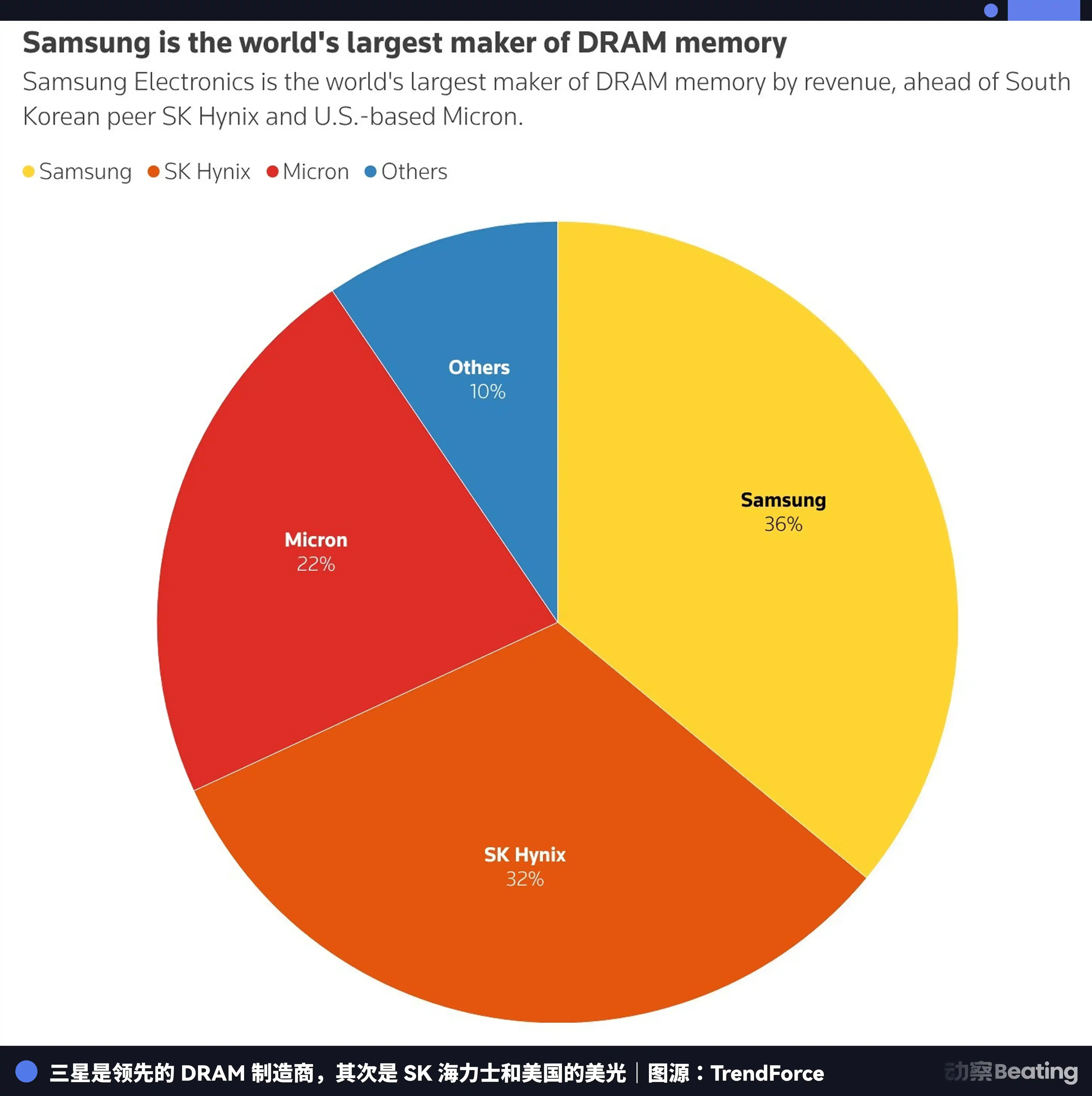
Samsung and SK Hynix together produce roughly two-thirds of the world's memory chips.

Memory chips, while always important, weren't considered a particularly glamorous business. Until AI arrived, and they suddenly became a strategic battleground. Large model training, inference, data center expansion—GPUs alone aren't enough. Data needs to be fed, stored, and retrieved at high speeds, requiring High Bandwidth Memory (HBM) and other solutions.
According to estimates by KB Securities analyst Jeff Kim, this 18-day strike could disrupt 3% to 4% of global DRAM supply and 2% to 3% of NAND supply. While not apocalyptic, it's enough to tighten nerves around price expectations, customer production schedules, cloud provider costs, and tech stocks.

The South Korean government is even more on edge. Because Samsung is no ordinary company; it's more like an embodiment of national strength.

Yonhap News reported that semiconductor exports account for about 35% of South Korea's total exports. In Q1 2026, South Korean exports hit a record high of $219.9 billion, with semiconductor exports growing 139% year-on-year to $78.5 billion.

Samsung alone accounts for about a quarter of the KOSPI market capitalization. In other words, a tremor in Samsung's production lines doesn't just shake one company's profit sheet; it shakes South Korea's exports, stock market, currency expectations, and the nation's narrative confidence.
More crucially, AI arrived too suddenly. South Korea's past tech power narrative was about phones, displays, cars, appliances, and semiconductors. Now, the global narrative is reshuffled by large models, with the spotlight on OpenAI, Google, Anthropic, China's batch of large model companies, and compute giants like Nvidia. South Korea naturally wants its own sovereign AI, and the government is promoting national AI infrastructure, with Nvidia announcing plans to deploy over 260,000 AI chips in South Korea. But South Korea knows that relying solely on models, it's hard to exert overwhelming international influence squeezed between the two superpowers, the US and China.

What it truly holds is the harder, heavier, less glamorous path: memory chips, HBM, DRAM, NAND, advanced manufacturing, and the underlying supply chain that feeds AI data centers. This is why Samsung is more important today than ever.

The further AI runs, the more the world realizes that large models aren't magic floating in the cloud. They need electricity, GPUs, and also memory. South Korea might not change the world with one model, but it can make the world's models inseparable from its chips.

The AI industry loves to talk about computing power, models, giants' games, and who disrupts whom.

The Samsung strike suddenly yanks everyone back down to earth. No matter how high the computing power, it ultimately lands on factories, shifts, bonus formulas, and labor negotiations.

The future isn't floating in the cloud. The future also needs to pay wages.

Why Are They Striking?

The union's core demands are several:

A 7% increase in base salary;

Allocating 15% of Samsung's annual operating profit to an employee bonus pool;

Abolishing the current bonus cap of about 50% of annual salary, and clarifying how bonuses are calculated, when they are paid, and whether they will be counted in the future.

Samsung disagrees. The company considers the union's demands excessive, especially if extending high bonuses to loss-making business divisions, which would break the rule of "those who make profits get more bonuses."
Reportedly, a key point of contention in the final mediation was precisely the issue of profit sharing among different divisions within the semiconductor department. The memory business is profitable, while other businesses are under pressure or even losing money. Should large bonuses also be given to employees in loss-making divisions?

In modern large corporations, ordinary employees less and less negotiate money directly with the boss. Money is tucked into things that seem objective: performance, coefficients, costs, cycles, business units, profit margins, bonus caps.

Samsung's bonuses have long been tied to a complex formula. Korean media repeatedly mention a term called EVA. The gist is that profits must first deduct taxes, investments, and various capital costs, with the remainder counting toward bonuses. The financial logic is fine, but it's hard for people to accept. Employees don't understand: Since company profits are rising, why isn't my bonus moving? Did I lose on performance, or did I lose to this formula? Does my sweat even count as contribution in the company's eyes?

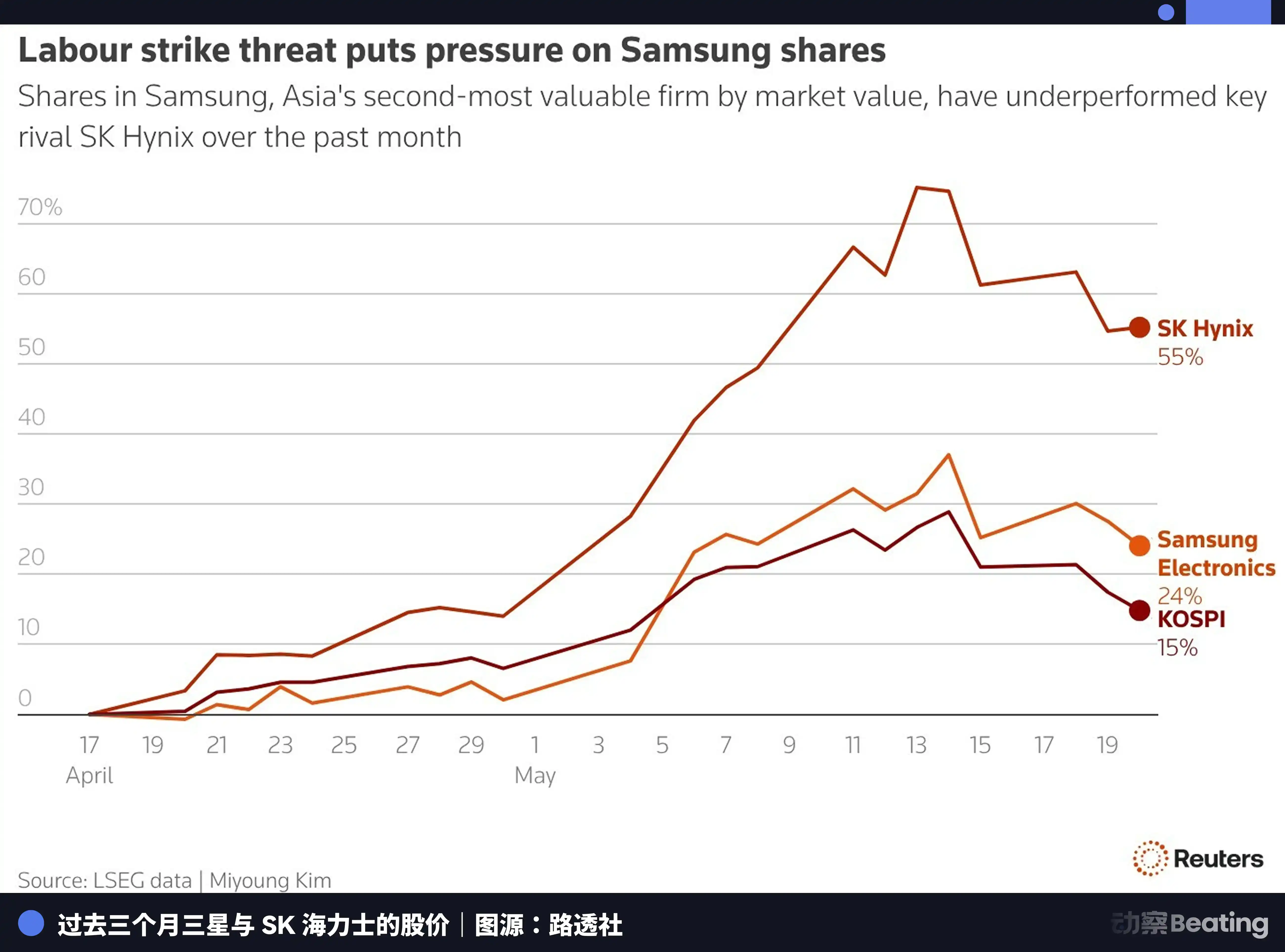
The reason Samsung employees' anger has built up to today's eruption is because they have a mirror beside them: SK Hynix.

SK Hynix secured an excellent position in the AI memory field, shining brightly in the HBM supply chain. More importantly, it knows how to convert this glory into tangible numbers on employees' paychecks.

In September 2025, SK Hynix and its union agreed on new rules: Over the next ten years, the company will allocate 10% of its annual operating profit to employees each year, and the previous bonus cap was abolished.

JoongAng Ilbo reported then that under the new agreement, employees were expected to receive about 100 million won in bonuses that year, approximately 450,000 RMB. By early 2026, Seoul Economic Daily, based on the company's 2025 performance, reported that SK Hynix's approximately 34,500 employees would receive performance bonuses averaging about 140 million won, roughly 630,000 RMB.

Even more exaggerated, Seoul Economic Daily cited an FnGuide prediction that SK Hynix's 2026 operating profit might reach 230.0885 trillion won. Ten percent of that is about 23 trillion won in bonus pool. Simply dividing by 34,549 employees gives an average of about 670 million won per person, approximately 3.04 million RMB.

The neighbor has already served the meat from the pot. At this point, when Samsung employees hear the company talk about EVA, capital costs, and departmental differences, of course they get angry.

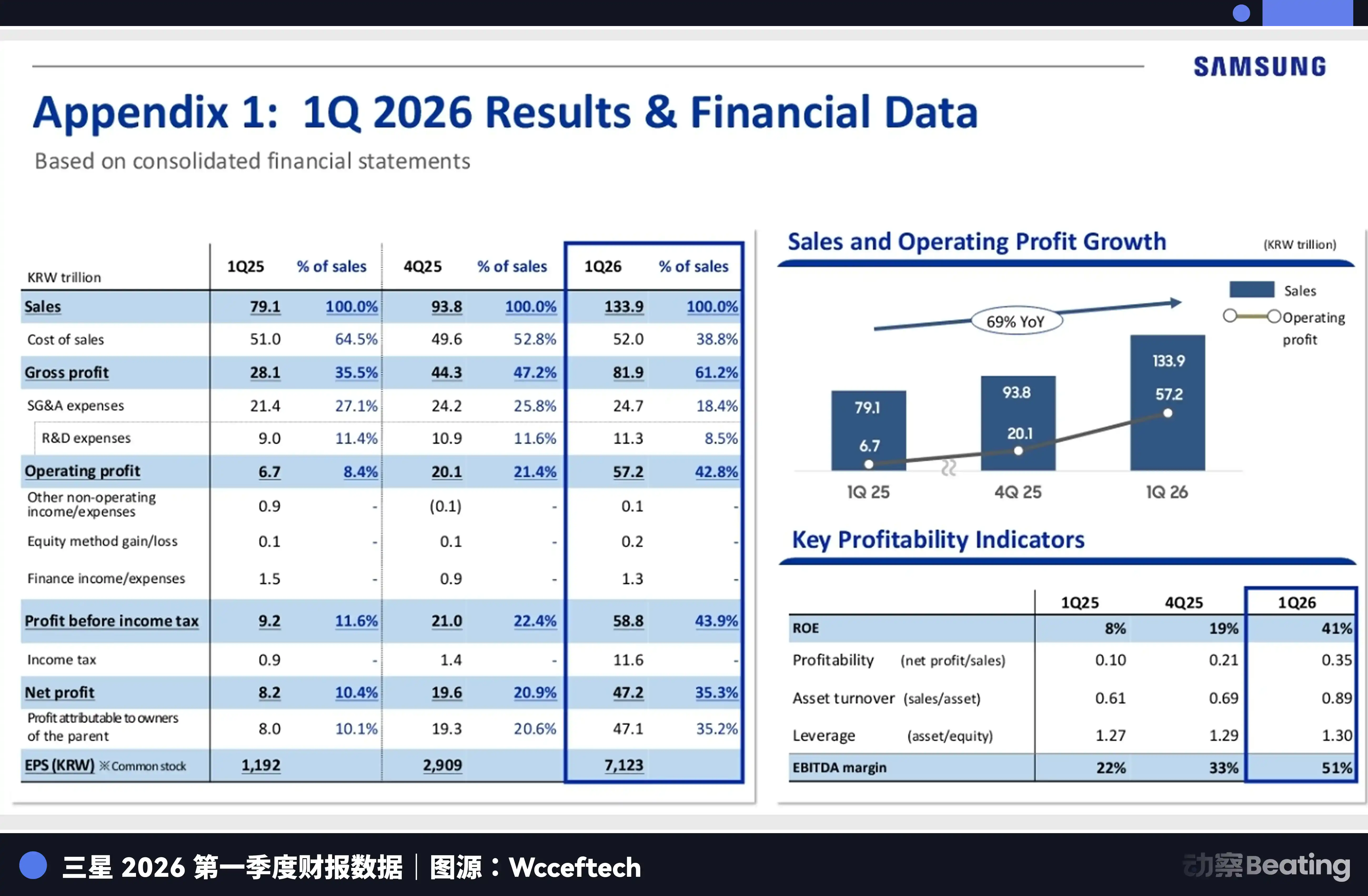
Samsung's official financial report shows that in Q1 2026, consolidated revenue reached 133.9 trillion won, a historic quarterly high; operating profit reached 57.2 trillion won. The semiconductor division's Q1 revenue was 81.7 trillion won, with an operating profit of 53.7 trillion won. The money mainly came from AI-related demand, such as high-value-added AI memory, rising industry memory prices, HBM4, and AI data center expansion.
The awkwardness lies right here.

When the company loses money, people have no leverage. The boss advises everyone to endure, saying the cycle will turn. Employees may not be convinced, but there's indeed no visible profit on the books, so they let it go. But when the company becomes prosperous again, and the fat meat is genuinely served on the table, who gets the chopsticks, who sits at the head, and who can only stand by smelling the aroma—these things can no longer be glossed over with sentiment.

The Root of the Problem

To understand why Samsung has made its employees so angry today, one cannot look only at a payslip. One must look back at the long-tightened line between Korean chaebols and workers.

South Korea's modernization process was more like a forced march led by the state. Large companies were pulled to the front, with workers following, heads down. This vehicle indeed ran fast, but the allocation of seats was never determined through discussion.

Post-war South Korea was destitute. Starting from the Park Chung-hee era, the state became the chief dispatcher of industrialization, vigorously supporting chaebols to seize orders, build factories, and catch up on technology. Samsung, Hyundai, SK—these names gradually became the face of the nation. They were preset as flag-bearers who must win, because South Korea needed this victory. For this, the state handed over resources, banks handed over loans, and society handed over endless endurance, while factories were left with iron-clad discipline.

Within this system, the role of labor was clear: Build the nation first, grow the company first, endure a little. Wages can come later, rights can come later, unions can come later, dignity can be discounted for now. The car isn't moving yet, don't ask if the seat is comfortable.

1987 was a watershed. Cracks appeared in the ironclad order. Workers emerged from factories through the cracks. Unions took root in large enterprises. Workers were no longer willing to be just a blurry background in grand narratives like the "economic miracle." They stepped forward, demanding wages, safety, and, more importantly, to be treated as living creators, not worn-out parts to be casually discarded.

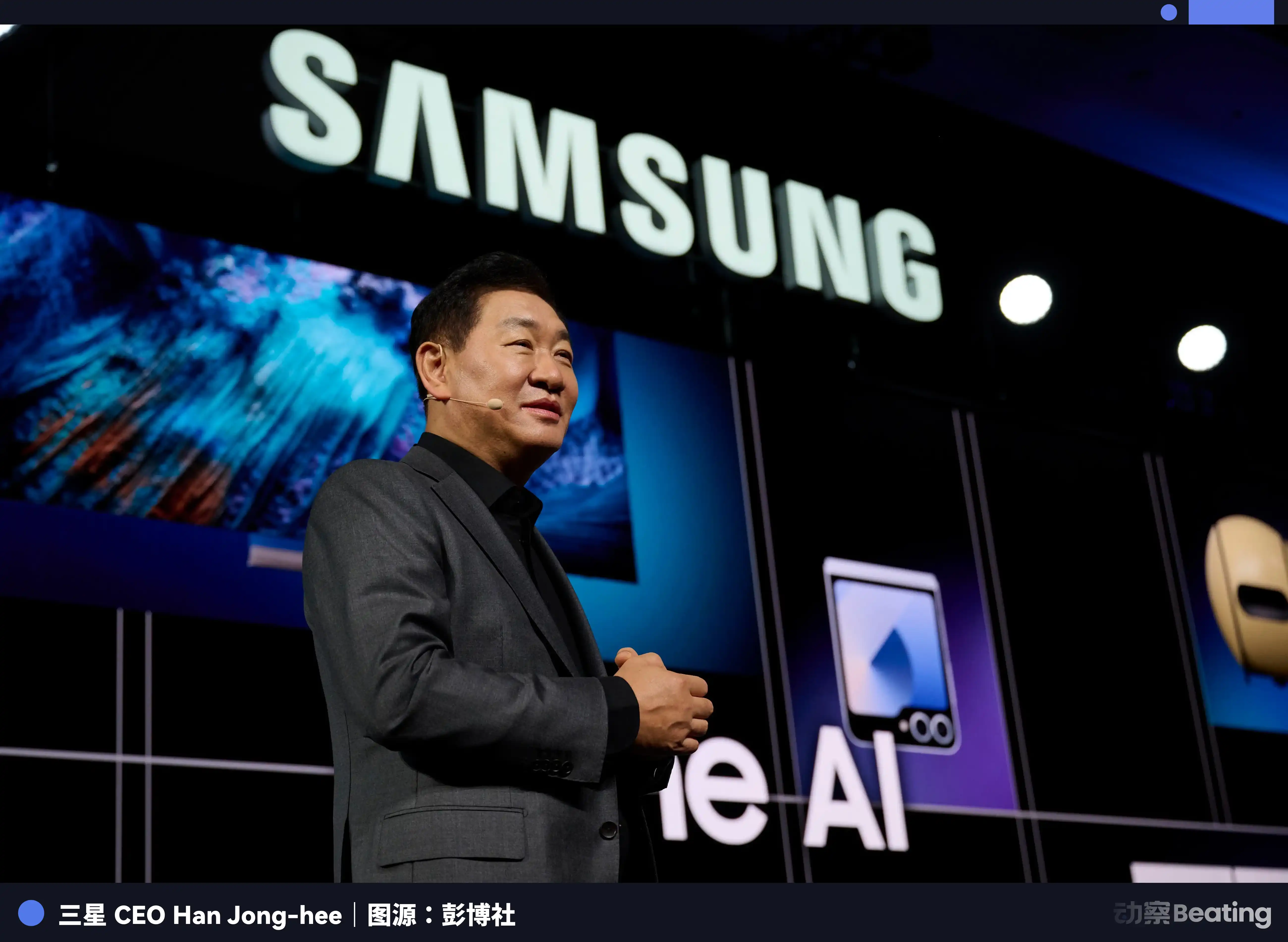
But Samsung was a long-standing exception. Samsung's "no union management" was a long-standing part of its corporate culture. In 2019, Samsung executives and employees were implicated in various ways for interfering with or obstructing legal union activities. Samsung Electronics board chairman Lee Sang-hoon went to prison for union busting. In 2020, Lee Jae-yong publicly apologized, pledging to abolish the chaebol's old ways. Only then did the iron curtain at Samsung crack open a bit.
Therefore, this strike is not abrupt. Behind it lies post-war Korean industrialization, the chaebol's old methods, the labor movement after 1987, Samsung's long-standing no-union tradition, and that belated apology in 2020.

The most hurtful part of this whole affair is not the money, but that some capitalists are only willing to "share hardship" but not "share prosperity."

When the company is in difficulty, employees are often asked to be like family. When the company makes money, employees are reminded it's a company. The first sentence speaks of emotion, the second of systems. The problem is, people have emotions not only during hardship.

Writing here, it's no longer just a Korean story.

Weathering difficulties together, reducing costs and increasing efficiency, improving quality and efficiency, embracing AI, enhancing human efficiency, optimizing costs. These are all phrases too familiar to each of us now.

This might be the most unseemly aspect of the AI era.

We thought AI would liberate people from labor. Often, the result is that people must adapt to AI to save the company money; people must learn AI to make departments more efficient; people must accept job reassignments, performance reevaluations, and salary adjustments. As for the dividends, someone always advises you to wait, don't be impatient; the company still needs to invest, needs R&D, needs to withstand cycles, needs to maintain competitiveness.

These reasons might all be true. But the problem is, if they only ever push in one direction, they become a very decent excuse. In reality, many companies often act this way too. Money is earned together, but when it comes to discussing how to divide it, you'd better not interrupt.

Samsung workers are now interrupting.

But their interruption doesn't guarantee victory. The South Korean government might use emergency mediation, courts have already restricted some actions, and Samsung has complex production and legal tools. A semiconductor factory isn't a small workshop that can be easily shut down, and a union cannot stop such a precise system without cost. The real world isn't a satisfying revenge story; labor doesn't easily achieve victory.

Snowpiercer

In Bong Joon-ho's "Snowpiercer," humanity is crammed onto a train that must not stop.

The front is order, technology, the future; the tail is crowded, silent, and preordained fate. The story's sharpest sting isn't the forced segregation of compartments, but that everyone accepts one premise: the train must not stop.

As long as the train must keep moving forward, then in which compartment you suffer, and whether you eat cockroaches, all become "necessary costs" to maintain the system's operation. For that grand momentum, specific living people always seem expendable.

Samsung's strike is similarly trapped on a train that "must not stop."

Wafers must not be damaged, production lines must not stall, AI servers must not wait, South Korea's export data absolutely must not fall, and global tech companies don't want to see memory chip prices pushed higher again. Every reason is so correct it's unarguable, and loudly proclaimed. From the standpoint of the national economy, Samsung must not stop; in the ledger of the global supply chain, Samsung must not stop; in the undecided AI race, Samsung absolutely must not stop.

The more a machine is forbidden to stop, the more the people inside are asked to endure.

Endure the production line, endure the cycle, endure performance reviews, endure company strategy, endure global competition. Enduring to the end, people find they are always making way for something bigger. Bigger like the enterprise, bigger like the industry, bigger like the future.

Ordinary lives seem small before these big words, small like a screw. But screws also have their metal fatigue.

What the Samsung union is doing this time does not negate the benefits AI brings to the world, does not deny the semiconductor industry, and certainly does not say technological progress is unimportant.

It's not the old story of the poor rebelling against the rich, nor is it a small story about high-paid employees getting more bonuses.

It actually touches on one of the most unsettling propositions of the AI era: As technology becomes more advanced, will labor become increasingly silent? As machines become more massive, is ordinary people's bargaining power destined to shrink? As growth becomes more dazzling, will the certainty of our lives become increasingly weak?

We love to talk about the future, and the word "future" is indeed useful. It's like a high-wattage spotlight, always illuminating the blueprints at launch events, the ambition in financing plans, and those fluctuating company valuations. But the future cannot only illuminate the front of the train; it must also move toward the tail, shine on the grueling night shifts, the badges on chests, the resumes in graduates' hands, shine on those who are told all day to "embrace change" but are shown the door when the good fruits are being divided.

The Samsung strike might ultimately end with compromise, arbitration, partial concessions, or a new bonus formula. Labor negotiations often go like this, starting dramatically and ending with a set of ratios, a piece of paper, and a few cautiously worded announcements. The news cycle will pass, stock prices will continue to fluctuate, AI companies will still release new models, and servers will devour more chips.

But some questions won't disappear with the negotiation table.

What most needs questioning in the AI era isn't just how strong the computing power is, how fast the models are, or how expensive the chips are. We need to ponder more: Can those who physically pull the "future" into reality finally receive a share of a certain life from that future?

This sentence may not sound grand enough, but what ordinary people want isn't grand. It's nothing more than work that has value, income with clear terms, a life with hope, and not being easily cast aside when the times take a turn.

The future must certainly move forward. But a train truly headed toward the future cannot have only its front brightly lit.


Related Questions

QWhat is the core reason behind the planned strike at Samsung Electronics, and why is it considered historically significant?

AThe core reason is the dispute over wage increases, bonus structures (specifically the demand for a share of operating profits and the removal of the bonus cap), and the perceived inequity in profit distribution, especially compared to rival SK Hynix. It's considered historically significant because it involves workers at the heart of the global AI supply chain (a high-tech, 'future-facing' industry) within Samsung, a traditional Korean chaebol with a long history of anti-union practices, signaling a shift in labor dynamics in the era of advanced technology.

QWhy is a potential strike at Samsung seen as a threat to the global AI industry?

AA strike at Samsung is a threat because Samsung and SK Hynix collectively produce about two-thirds of the world's memory chips. These chips, especially high-bandwidth memory (HBM), are critical for training and running AI models in data centers. A prolonged production halt could disrupt global supply, affecting prices, production schedules for clients (like cloud providers), and ultimately the pace of AI development and deployment worldwide.

QHow does the situation at SK Hynix serve as a catalyst for the labor unrest at Samsung?

ASK Hynix set a new benchmark by agreeing to allocate 10% of its annual operating profit to employee bonuses and removing the bonus cap. This resulted in substantially higher, widely publicized bonuses for its workers. Samsung employees, seeing their company's record profits from the AI boom but facing a complex bonus formula (EVA) and a cap, feel their compensation is unfairly lagging behind their direct competitor, fueling their demands and frustration.

QWhat historical and cultural context in South Korea contributes to the current labor tensions at Samsung?

ASouth Korea's rapid industrialization was state-led, prioritizing corporate growth (chaebols like Samsung) over workers' rights, with labor expected to sacrifice for national economic goals. While a major labor movement emerged in 1987, Samsung long maintained an explicit 'no union' policy. It was only after a 2020 apology from its leader that unions were formally accepted. The current strike is thus a clash between this legacy of top-down control and delayed worker empowerment within a critically important modern corporation.

QWhat broader, symbolic question does the article suggest the Samsung strike raises about the AI era?

AThe strike raises the question of whether technological advancement and the AI boom will lead to the silencing of labor and a erosion of workers' bargaining power and life security. It challenges the narrative that AI solely liberates humans, highlighting instead how workers might be pressured to adapt for corporate efficiency without fairly sharing in the generated prosperity. It asks if the 'future' being built will provide stable, valued lives for the very people constructing it, or if they risk being left behind.

Related Reads

Warsh's First Day in Office, Markets Deliver a 'Wake-up Call': Rate Hike Expected This Year

On his first day in office, newly inaugurated Federal Reserve Chairman Warsh received a stark market warning, with expectations now fully pricing in a 25-basis-point interest rate hike this year. The shift was triggered by hawkish remarks from Fed Governor Waller, who stated that inflation is now the key policy "driver" and that the odds of a hike or cut are evenly split. This sent short-term Treasury yields higher. Waller signaled a significant pivot in his stance, citing disappointing inflation and labor data. He suggested removing "easing bias" language from Fed statements and did not rule out future rate increases if inflation fails to recede, though he noted immediate action isn't warranted without signs of unanchored inflation expectations. Chairman Warsh faces immediate pressure at his first FOMC meeting in June. With the preferred inflation gauge at a three-year high, analysts warn that failing to hike could be interpreted as an implicit easing of policy. The geopolitical situation in the Middle East is adding to existing price pressures. The market's expectation for a hike contrasts sharply with earlier forecasts for multiple cuts. While long-term Treasury yields have been contained by lower energy prices recently, analysts note they remain under structural upward pressure. Warsh's swearing-in at the White House highlights political scrutiny over Fed independence. However, the market has made it clear that inflation is the most urgent challenge, leaving the new chairman little time to settle in.

marsbit6h ago

Warsh's First Day in Office, Markets Deliver a 'Wake-up Call': Rate Hike Expected This Year

marsbit6h ago

Has Microsoft Lost Its Way in the AI Race, and Can Copilot Bring It Back on Track?

Microsoft, once seen as an early AI frontrunner due to its investment in OpenAI, is navigating a strategic shift amid increased competition. Its initial reliance on OpenAI’s GPT models has been complicated by OpenAI’s growing ambitions as a direct competitor, rapid advancements from rivals like Claude and Gemini, and the disruptive rise of AI agents, which challenge its traditional SaaS business model. These factors contributed to stock declines and slower-than-expected adoption of its flagship Copilot products. In response, CEO Satya Nadella has taken a hands-on role in product development, signaling the urgency of change. Microsoft is pivoting from a model-centric strategy to a "model-agnostic" enterprise platform approach. It aims to become the foundational layer connecting various AI models—from OpenAI, Anthropic, or its own new "Superintelligence" team—with enterprise workflows, data, security, and cloud services. Recent organizational changes merged consumer and enterprise Copilot teams to accelerate innovation, exemplified by new products like Copilot Tasks and Copilot Cowork. However, this transformation comes at a high cost. Microsoft faces massive capital expenditures, potentially reaching ~$190 billion by 2026, to support AI infrastructure. While its platform strategy shows early signs of traction with growing Azure AI revenue, it must balance startup-like agility with the reliability expected by enterprise clients. The core challenge is no longer being the sole AI winner but defending its position as the essential enterprise software entry point amidst rapid technological commoditization and the shift towards always-on AI agents.

marsbit7h ago

Has Microsoft Lost Its Way in the AI Race, and Can Copilot Bring It Back on Track?

marsbit7h ago

Why Haven't Forex Stablecoins Taken Off?

Why FX Stablecoins Never Took Off: A Path Forward via Synthetic FX Despite the explosive growth of stablecoin-powered digital banking, which has seen ~$6B in VC investment and a 24x surge in crypto card spending in under a year, a major limitation persists: these banks are essentially dollar-only accounts. This leaves 95-99% of global accounts, which are denominated in non-USD currencies, underserved. Attempts to create native foreign currency (FX) stablecoins (like EURC) have largely failed, with total FX stablecoin TVL at ~$600M compared to $400B for USD stablecoins—a 700x gap. These FX tokens face critical challenges: fragile pegs due to low liquidity, limited exchange/FinTech acceptance, poor on/off-ramps, complex regional compliance, and a chicken-and-egg adoption problem. The article argues that the solution lies not in competing with entrenched USD stablecoin networks (USDT/USDC), but in adopting a synthetic FX model inspired by traditional finance. Specifically, it advocates for Mark-to-Market Non-Deliverable Forwards (NDFs)—cash-settled FX derivatives that allow users to maintain underlying USD stablecoin holdings while having their account balance and P&L denominated in a foreign currency. This approach offers key advantages: strong oracle-based pegs, retention of deep USD stablecoin liquidity and yield, superior on/off-ramps, scalability to any currency with a reliable feed, and capital efficiency. It mirrors how modern institutional FX markets operate. Primary use cases for on-chain NDFs include: 1. **Digital Banks/Wallets:** Enabling multi-currency accounts for international users without leaving the USD stablecoin ecosystem, boosting deposits and retention. 2. **FX Carry Trade Vaults:** Offering access to sovereign interest rate differentials (e.g., earning yield on BRL) in a more stable and scalable format than crypto-native products like Ethena. 3. **Global Enterprise Payments:** Allowing merchants to receive payments in local currency equivalents while settling in USD stablecoins, similar to services offered by Stripe for fiat. The conclusion is that synthetic FX, not native FX stablecoins, is the viable path to integrating foreign exchange into the growing stablecoin digital banking landscape, potentially unlocking the next phase of institutional DeFi and multi-trillion-dollar global adoption.

链捕手7h ago

Why Haven't Forex Stablecoins Taken Off?

链捕手7h ago

Trading

Spot
Futures

Hot Articles

What is LINON

Linde plc Tokenized Stock (Ondo): Revolutionizing Traditional Equity Access Through Blockchain Innovation The emergence of Linde plc Tokenized Stock (Ondo), represented by the ticker $LINON, signifies a monumental shift in the fusion of traditional financial structures and decentralized finance (DeFi). This innovative financial instrument showcases the tremendous potential of blockchain technology to democratize access to traditional equity markets while ensuring the security and regulatory compliance necessary for institutional-grade financial products. Through Ondo Finance's pioneering tokenization platform, $LINON provides a seamless pathway for global investors to engage with one of the world's leading industrial gas companies, Linde plc, creating a blockchain-native representation of the underlying equity. Introduction to Linde plc Tokenized Stock The landscape of financial markets is witnessing a groundbreaking transformation through the tokenization of real-world assets. Linde plc Tokenized Stock (Ondo) epitomizes this revolutionary approach by bridging the gap between conventional stock ownership and blockchain-enabled financial infrastructure. The $LINON token allows investors to gain exposure to one of the prominent industrial companies worldwide through decentralized technology. Operating within Ondo Finance's comprehensive ecosystem, $LINON symbolizes a practical application of tokenization technology that enhances accessibility, efficiency, and global connectivity in traditional financial markets. By leveraging blockchain infrastructure, this tokenized stock enables international investors to participate in U.S. equity markets, overcoming traditional barriers associated with cross-border investing. The significance of $LINON goes beyond technological innovation; it represents a fundamental shift in asset structuring, distribution, and trading in the digital age. This tokenized stock maintains all the economic benefits associated with traditional Linde plc shares while offering improved liquidity, programmable compliance features, and seamless integration with decentralized finance protocols. The development of $LINON indicates a growing acceptance of blockchain technology as a viable means for traditional finance, exemplifying how even well-established assets like Linde plc can integrate into blockchain systems. This approach preserves the core attributes that appeal to investors while introducing advanced capabilities that enhance the overall investment proposition. Project Overview and Objectives Linde plc Tokenized Stock (Ondo) encapsulates a strategic effort to democratize access to traditional equity markets through advanced blockchain technologies. The primary objective of $LINON is to provide approved global investors seamless access to the economic exposure associated with Linde plc shares, furthering an effort to create a more inclusive financial ecosystem. Beyond the digital representation of traditional assets, $LINON endeavors to eliminate barriers of geography and time zones that limit investor participation. Its design ensures that blockchain technology can elevate traditional investment vehicles without undermining the security or compliance requirements expected by investors. Key goals of the project include enhanced liquidity provision, programmable compliance mechanisms, and interoperability with other blockchain networks. Each $LINON token is fortified by actual Linde plc securities housed at U.S.-registered broker-dealers, allowing holders to reap economic advantages akin to traditional stockholders, such as dividend reinvestment. Furthermore, $LINON aims to establish new industry standards for institutional-grade tokenized securities, paving the way for traditional assets to embrace blockchain technology while remaining compliant with regulatory frameworks. By associating itself with a company as reputable as Linde plc, the project opens avenues for exploring tokenized equities catering to both conservative institutional players and daring retail investors. Project Creator and Development Team The vision for Linde plc Tokenized Stock (Ondo) comes from Nathan Allman, founder and CEO of Ondo Finance. His background in traditional finance coupled with expertise in blockchain technology positions him uniquely to navigate the complexities of asset tokenization. Allman's academic journey began at Brown University, focusing on Economics and Biology, equipping him with valuable analytical skills. His time at Goldman Sachs in the Digital Assets division strengthened his understanding of the interplay between financial institutions and emerging technologies, laying the groundwork for his later endeavors in alternative investment strategies. Under Allman's guidance, Ondo Finance has emerged as a leader in asset tokenization, launching $LINON as a flagship example of the company's larger mission towards revolutionizing traditional financial systems using blockchain technology. His commitment to leveraging blockchain for creating institutional-grade financial products has shaped the landscape of real-world asset tokenization. Investment and Funding Structure The growth of Ondo Finance, the platform powering Linde plc Tokenized Stock (Ondo), is bolstered by robust financial backing from prestigious venture capital firms and strategic investors. This strong investment foundation underpins the development of the key infrastructure essential for compliant tokenized securities like $LINON. In August 2021, Ondo Finance secured $4 million in seed funding led by a major venture capital firm, which enabled the company to commence platform development and establish the necessary regulatory processes for tokenizing real-world assets. This early investment cemented Ondo Finance's credibility within the industry. The Series A funding round followed, garnering $20 million with participation from renowned firms committed to transformative technology companies. This backing demonstrated substantial institutional confidence in Ondo Finance's vision, allowing it to hone its approach to asset tokenization through mechanisms that ensure compliance and accessibility. Noteworthy contributors, including institutional investors and experienced partners, have added significant value to Ondo Finance’s development efforts. Their involvement underscores the confidence across sectors in Ondo Finance's approach to bridging traditional finance with blockchain innovations. Technical Infrastructure and Innovation The technical architecture that underpins Linde plc Tokenized Stock (Ondo) represents a sophisticated melding of traditional finance systems and cutting-edge blockchain technology. The architecture's foundation is built on the Ethereum network, renowned for its security and programmability—both critical for intricate financial instruments. The $LINON tokenization process comprises creating a blockchain-native representation of Linde plc shares that preserves economic benefits while augmenting investor capabilities. Each token corresponds to actual shares held at U.S.-registered broker-dealers, creating a compliant custody structure that legitimizes the asset's existence and value. Automated compliance systems are integrated into the tokenization process, managing critical components such as know-your-customer (KYC) verification and anti-money laundering (AML) protocols. This incorporation of programmable compliance empowers $LINON to uphold regulatory standards essential for institutional proliferation. Cross-chain interoperability characterizes the advanced technical features of $LINON. While initially deployed on Ethereum, the framework is designed for expansion to other networks such as Solana and BNB Chain. This adaptability enhances liquidity and accessibility, allowing investors to select their preferred blockchain ecosystems. Historical Timeline and Development Crafting the history of Linde plc Tokenized Stock (Ondo) unfolds in parallel with the evolution of Ondo Finance's tokenization platform. The timeline's inception dates back to March 2021 when Nathan Allman laid the foundations for creating institutional-grade financial products on blockchain infrastructure. The initial funding round in August 2021 provided crucial resources for developing the platform and establishing partnerships necessary for effective tokenization. By January 2023, Ondo Finance launched its tokenized treasury products, establishing mechanisms that would facilitate future tokenized equities such as $LINON. A pivotal milestone arose in February 2025 when Ondo Chain—a Layer 1 blockchain designed specifically for asset tokenization—was introduced. This infrastructure enhances capabilities vital for institutional markets, demonstrating Ondo Finance's long-term commitment to tokenization. Subsequently, the launch of Ondo Global Markets in September 2025 marked the official debut of $LINON. This milestone showcased the successful transition from development to active trading, enabling investors around the world to access American financial markets seamlessly. Ongoing development plans include a targeted expansion of available tokenized assets to over 1,000 by the end of 2025, pointing to a bright future for Ondo Finance's ecosystem and its mission to broaden tokenized equity accessibility. Regulatory Compliance and Legal Framework The legal architecture governing Linde plc Tokenized Stock (Ondo) emphasizes a sophisticated approach to regulatory compliance, allowing tokenized securities to be implemented within a blockchain-based framework. The legal structure governing $LINON spans multiple jurisdictions while maintaining a robust legal footing. Compliance systems ensure that only eligible investors can access the token, enforced through automated verification that aligns with international regulations. This innovative regulatory technology promises real-time enforcement of complex requirements, considerably enhancing efficiency in operating within the regulatory landscape. The custody framework undergirding $LINON ensures that the underlying shares are securely held at U.S.-registered broker-dealers, complying with necessary regulations while delivering blockchain-driven access to investors. The token maintains its economic equivalency and security through this carefully structured custody arrangement. KYC and AML compliance systems are embedded within the smart contract architecture, ensuring integrity and adherence to regulatory practices while fostering transparency for investors. The jurisdictional restrictions mark a commitment to navigating the evolving landscape of international securities laws. Market Impact and Industry Significance The advent of Linde plc Tokenized Stock (Ondo) holds profound implications for the broader financial landscape, symbolizing a clear shift towards blockchain-enabled markets. $LINON serves as a proof-of-concept for integrating traditional companies into blockchain ecosystems, showcasing the potential benefits such as broader accessibility and improved efficiency. The market's response to $LINON indicates a growing acceptance of tokenization among institutional investors, contributing to the emergence of an expanding sector wherein traditional assets can be interconnected with blockchain innovations. The success of $LINON further solidifies market confidence, indicating an overarching shift towards recognizing asset tokenization as a transformative force in finance. Future Development and Expansion Plans The future trajectory for Linde plc Tokenized Stock (Ondo) centers around the expansion of the tokenization ecosystem and enhanced infrastructure supporting blockchain-enabled financial services. Plans for cross-chain integration usher in new opportunities for liquidity and flexibility within the investment framework, with existing capabilities poised for continuous enhancement. With the introduction of Ondo Chain, Ondo Finance aims to transition $LINON to an optimized blockchain environment specifically designed for asset tokenization. This new infrastructure heralds exciting prospects for the development of institutional-grade financial products, ensuring ongoing compatibility with contemporary investment strategies. Further integration with decentralized finance protocols signifies a commitment to empowering $LINON holders through advanced financial strategies. The anticipated expansion of available tokenized assets promises to broaden investor access, enhancing the utility and appeal of the platform. In alignment with ambitions for regulatory expansion, ongoing efforts to secure approvals for new jurisdictions will enhance investor access, further positioning $LINON at the forefront of the burgeoning tokenization market. Conclusion Linde plc Tokenized Stock (Ondo), as represented by the $LINON token, stands at the intersection of traditional finance and blockchain innovation. It embodies a transformative milestone in how financial assets are structured, distributed, and engaged within modern investment ecosystems. The technical sophistication behind $LINON, combined with its regulatory compliance framework, illustrates that asset tokenization can improve financial infrastructure rather than simply digitizing existing products. This pioneering effort not only enhances investor access to U.S. equity markets but also signifies an evolution of how traditional financial services can integrate blockchain technology. As the asset tokenization market grows exponentially, with prospects suggesting significant valuation increases, $LINON paves the way for a future where tokenized securities become standard fixtures in the financial landscape. The trajectory of $LINON will undoubtedly influence how traditional finance adapts to a transformed, blockchain-powered world.

2.8k Total ViewsPublished 2025.12.05Updated 2025.12.05

What is LINON

What is CRMON

Salesforce Tokenized Stock (Ondo): Revolutionising Traditional Equity Access Through Blockchain Innovation The emergence of Salesforce Tokenized Stock (CRMON) marks a pivotal advancement in integrating traditional financial markets with blockchain technology. This innovative approach offers investors unprecedented access to equity exposure through tokenisation. Developed by Ondo Finance, CRMON provides tokenholders with economic exposure equivalent to holding Salesforce stock (CRM) while automatically reinvesting dividends. This effectively bridges the gap between conventional equity markets and decentralised finance (DeFi). Introduction and Comprehensive Overview of Salesforce Tokenized Stock In recent years, the financial landscape has dramatically transformed due to blockchain technology, fundamentally altering how investors access and interact with traditional assets. The development of Salesforce Tokenized Stock (CRMON) is a prime example of this evolution, representing a sophisticated fusion of conventional equity markets with cutting-edge distributed ledger technology. CRMON is a tokenised version of Salesforce stock, emerging from the innovative work of Ondo Finance, a leading platform in the real-world asset tokenisation sector that positions itself as a bridge between traditional finance and decentralised systems. Designed to provide tokenholders with economic exposure that mirrors the performance of the underlying Salesforce stock, CRMON incorporates automatic dividend reinvestment mechanisms. This eliminates many traditional barriers associated with international equity investment, such as complex brokerage relationships, currency conversion challenges, and restricted trading hours. The tokenisation process reimagines stock ownership as a blockchain-native asset while maintaining its economic equivalence with the underlying security, offering enhanced portability and integration capabilities within decentralised finance ecosystems. CRMON transcends its individual utility as an investment instrument to represent a fundamental shift in how financial markets can operate in an increasingly digital world. By maintaining full backing through U.S.-registered broker-dealers and implementing robust compliance frameworks, CRMON demonstrates that tokenised securities can achieve the regulatory standards necessary for institutional adoption while delivering the technological advantages of blockchain infrastructure. Understanding Tokenized Real-World Assets and CRMON's Strategic Position Tokenised real-world assets signify one of the most significant innovations in modern finance, fundamentally reimagining how traditional securities are represented, traded, and utilised within digital ecosystems. CRMON operates as a tokenised equity instrument correlating directly with Salesforce stock while optimising accessibility and efficiency. This aligns with Ondo Finance's broader mission to democratise access to institutional-grade financial products through innovative tokenisation strategies. The tokenisation process guarantees complete economic equivalence with the underlying Salesforce equity. Each CRMON token represents a proportional claim on Salesforce stock held by qualified custodians, with dividend payments automatically reinvested to maintain continuous exposure to total return performance. This structure simplifies dividend management and ensures that tokenholders receive the full economic benefit of their equity exposure, encompassing both capital appreciation and income generation. Ondo Finance's strategy in tokenising Salesforce stock demonstrates its expertise in creating compliant, institutional-grade products that meet traditional financial markets' stringent requirements. The platform’s focus on merging regulatory compliance with blockchain benefits positions it at the forefront of decentralised finance, captivating both institutional and retail investors seeking blockchain-native solutions. The Technology and Innovation Framework Behind CRMON The technological infrastructure supporting CRMON integrates blockchain technology with traditional financial mechanisms, delivering institutional-grade security and compliance while maintaining the operational advantages of decentralised systems. Built on the Ethereum blockchain, CRMON utilises robust smart contract capabilities to ensure transparent, secure operations. The smart contract architecture incorporates layered security and compliance mechanisms, enabling automated compliance checks and real-time asset backing verification. Integration with oracle services maintains accurate pricing and dividend information, ensuring CRMON reflects the underlying Salesforce stock's accurate performance. This architecture delivers automated dividend reinvestments and other corporate actions, eliminating manual processing requirements and directly enhancing tokenholder benefits. Ondo Finance ensures CRMON's security structure includes daily third-party verification of holdings, independent collateral agents, and a multiple-layer custody system through partnerships with established financial institutions. This framework safeguards tokenholder interests against operational risks while providing robust asset backing. The user interface enhances integration capabilities, allowing seamless interaction between CRMON and various decentralised finance protocols, as well as cryptocurrency exchanges. This interoperability enables users to leverage their tokenised equity across multiple platforms, creating sophisticated investment strategies that marry traditional equity characteristics with blockchain-native innovation. Leadership and Corporate Structure of Ondo Finance The leadership team behind CRMON and Ondo Finance blends expertise from traditional finance and blockchain technology, presenting a robust combination of skills essential for successfully bridging conventional markets with decentralised finance. Nathan Allman, the founder and CEO, emerged from a distinguished financial background before establishing Ondo Finance in 2021. Allman's experience includes notable roles at major financial institutions, including significant contributions to developing cryptocurrency market services. His insights into regulatory compliance were paramount in developing products like CRMON that successfully unify traditional securities with blockchain technology. With a team of professionals boasting substantial experience in both conventional finance and blockchain sectors, Ondo Finance's leadership comprises diverse expertise that covers every aspect of tokenised asset development. Justin Schmidt serves as President and COO, contributing unique operational expertise, while Chris Tyrell brings essential compliance knowledge. Investment Landscape and Funding History The investment landscape surrounding Ondo Finance reflects significant institutional confidence in its mission to tokenise real-world assets. The company has raised substantial funds through various investment rounds, attracting leading venture capital firms and strategic investors that recognise the transformative potential of tokenised securities like CRMON. Notably, Ondo Finance completed a successful Series A funding round in 2022, led by well-known venture capital firms. This funding success validates Ondo Finance's innovative approach to creating compliant, institutional-grade tokenised products. In total, Ondo Finance has successfully secured substantial funding, raising significant capital for product development and market expansion, including a noteworthy token sale that reinforced its governance structure through the establishment of the ONDO token. The diverse composition of investors reflects broad market confidence in Ondo Finance's business model, demonstrating support from both traditional and blockchain-native organisations. Operational Mechanics and Technical Implementation The operational framework supporting CRMON exemplifies sophisticated integration of traditional financial mechanisms with blockchain technology. The technical implementation introduces multiple layers of security, compliance, and operational efficiency to meet institutional standards while enhancing accessibility. The tokenisation process begins by acquiring actual Salesforce stock through U.S.-registered broker-dealers, ensuring each CRMON token maintains direct correlation with the underlying equity performance. Smart contracts automate operational processes, including dividend reinvestment and corporate action processing, facilitating a streamlined user experience. The Minting and redemption processes allow authorised participants to manage CRMON tokens effectively. During U.S. trading hours, institutions can mint new tokens by depositing stablecoins that are used to purchase corresponding Salesforce equity. This structure maintains a tight correlation with underlying assets, enhancing liquidity and price discovery. Additionally, the infrastructure supports twenty-four-hour token transfer capabilities, providing CRMON holders with operations outside traditional market hours. This represents a significant advantage over conventional securities ownership, thus promoting integration with decentralised finance applications. Plans for cross-chain compatibility through partnerships signal further ambitions for CRMON's market reach. By expanding to other blockchain networks, Ondo Finance aims to enhance accessibility and user engagement with tokenised equity products. Timeline and Historical Development of Tokenized Equity Innovation The timeline of CRMON's development and Ondo Finance's broader tokenised capabilities demonstrates a systematic innovation process beginning with the company's founding in 2021. 2021: Ondo Finance is founded by Nathan Allman and co-founders, launching initial products focused on structured vault offerings on the Ethereum blockchain. 2022: The company completes substantial funding rounds—both equity and token sales—totaling significant capital and launching initial tokenised U.S. Treasury products. 2023-2024: Ondo Finance experiences substantial growth, establishing partnerships with major financial institutions while expanding its product offerings beyond fixed-income securities. February 2025: Ondo Global Markets is announced, marking the transition into equity tokenisation with plans for accessing over one hundred U.S. stocks and ETFs. September 2025: The official launch of Ondo Global Markets includes CRMON alongside other tokenised equity offerings, marking a significant evolution in Ondo Finance's product ecosystem. This timeline highlights the organisation's rapid growth and its capability to adapt its technological and compliance frameworks to accommodate different asset classes effectively while maintaining security and regulatory integrity. Regulatory Framework and Compliance Approach Ondo Finance's regulatory framework showcases a sophisticated compliance strategy, essential for achieving institutional adoption in the tokenised securities market. The company's strong partnerships with U.S.-registered broker-dealers promote adherence to Securities and Exchange Commission regulations and apply robust investor protections. Acquisitions, such as Oasis Pro—a registered broker-dealer—significantly enhance Ondo Finance's compliance capabilities, ensuring thorough alignment with existing regulatory structures. The company employs independent verification procedures that foster transparency, aiming for a solid performance standards reputation. Furthermore, Ondo Finance's commitment extends to international regulatory compliance, ensuring token access remains restricted to eligible investors while adhering to pertinent cross-border securities regulations. Comprehensive attention to tax implications and reporting requirements fortifies the security and compliance landscape of CRMON, ensuring that investor obligations remain manageable. Future Prospects and Market Positioning The forward-looking landscape for CRMON and Ondo Finance illustrates substantial growth opportunities driven by institutional adoption of blockchain technology and escalating demand for efficient alternatives to conventional securities ownership. Market projections indicate the tokenised asset sector could value multiple trillion dollars by 2030. With plans to scale CRMON offerings significantly and integrate it with a dedicated blockchain infrastructure—Ondo Chain—Ondo Finance aims to elevate its institutional-grade tokenised asset operations. Additionally, the development of strategic partnerships enhances distribution capabilities while establishing the company's credibility in the financial market. Furthermore, the integration of tokenised equity with decentralised finance protocols offers new potential for innovative financial products and strategies previously impossible with traditional securities. These factors underscore CRMON's positioning to effectively capture increased market share and deliver innovative solutions for international investment exposure. Conclusion Salesforce Tokenized Stock (CRMON) symbolises a transformative development within financial markets, successfully bridging traditional equity ownership with blockchain technology to create unprecedented accessibility for global investors. Through Ondo Finance's sophisticated tokenisation framework, CRMON provides complete economic exposure to Salesforce equity performance while enhancing operational advantages that exceed traditional ownership. The launch of CRMON reflects the broader evolution of financial markets towards blockchain infrastructures that maintain regulatory compliance while delivering increased efficiency. Ondo Finance's extensive approach to regulatory adherence, institutional-grade security, and technological innovation solidifies CRMON as a model for future tokenised securities, delivering access previously unattainable in conventional brokerage structures. As the tokenised asset sector continues to develop, CRMON is well-positioned to address historical inefficiencies in capital markets while providing investors with innovative solutions for accessing traditional securities. The outlook for CRMON looks exceptionally promising, supported by ambitious expansion plans, technological innovations, and strategic partnerships, thereby representing a pioneering model of modern financial infrastructure evolving through blockchain integration.

2.9k Total ViewsPublished 2025.12.05Updated 2025.12.05

What is CRMON

What is SHOPON

Shopify Tokenized Stock (Ondo): A Comprehensive Analysis of Real-World Asset Tokenization in Web3 This article delves into the Shopify Tokenized Stock (Ondo), recognised by its ticker symbol $SHOPON, exploring its implications at the intersection of traditional finance and blockchain technology. As a part of Ondo Finance's tokenized securities platform, Shopify’s tokenized stock exemplifies advancements in democratizing access to global capital markets through innovative digital assets. Introduction and Overview of Shopify Tokenized Stock (Ondo) Shopify Tokenized Stock (Ondo), or $SHOPON, portrays a pivotal innovation in the realm of tokenized securities, allowing investors to gain economic exposure akin to directly owning shares of Shopify Inc. This token, developed under the umbrella of Ondo Finance, not only provides investors with the ability to hold digital representations of the company’s stock but also integrates features such as automatic reinvestment of dividends. This advancement represents a substantial shift in the landscape of decentralized finance (DeFi), linking conventional equity markets with blockchain solutions designed to enhance accessibility, transparency, and liquidity. By eliminating geographical barriers and enabling 24/7 trading capabilities, $SHOPON is positioned as a bridge connecting traditional financial instruments and the emerging Web3 ecosystem. What is Shopify Tokenized Stock (Ondo), $SHOPON? The $SHOPON token serves as a digital manifestation of Shopify Inc.'s shares, engineered to provide a direct correlation to the underlying asset's performance. Through the utilization of blockchain technology, the token gives holders a mechanism to participate in the economic benefits associated with equity ownership, including capital appreciation and dividend distribution. The unique aspect of $SHOPON lies in its automatic dividend reinvestment mechanism, which allows returns to compound without necessitating active management by the investor. This feature inherently enhances its attractiveness as an investment vehicle, particularly for individuals seeking passive income growth alongside exposure to high-performing equities. The tokenization process is facilitated by the custody of actual Shopify shares through regulated intermediaries, ensuring that every $SHOPON token is verifiably backed by real equity. This structure empowers investors with the dual advantages of both traditional financial characteristics and the innovative benefits tied to blockchain technology. Who is the Creator of Shopify Tokenized Stock (Ondo)? The creator of Shopify Tokenized Stock (Ondo), Nathan Allman, is an experienced figure in the finance sector, formerly associated with Goldman Sachs. His rich background includes significant expertise in digital asset development, bridging the gap between traditional finance and cryptocurrencies. Allman’s educational journey, marked by studies at Brown University, provided him with a deep understanding of economics and biology, equipping him with analytical skills that inform his strategic vision. In 2021, he founded Ondo Finance, committing to developing tokenized securities that meet institutional-grade standards while leveraging blockchain's transformative capabilities. Under Allman's leadership, Ondo Finance has focused on creating compliant and innovative financial products that empower a diverse investor base. Who are the Investors of Shopify Tokenized Stock (Ondo)? The investment landscape surrounding Shopify Tokenized Stock (Ondo) is notably robust, underpinned by significant institutional support. Primarily, Pantera Capital stands out as a strategic partner through the Ondo Catalyst initiative, a $250 million commitment aimed at accelerating the development of on-chain capital markets. This partnership not only signifies institutional confidence in the potential of tokenized assets but also reinforces Ondo Finance's operational capabilities and market positioning. The funding pathways have included earlier rounds that amassed millions in seed funding and further structural investments, solidifying relationships with both venture capital firms and private investors. Moreover, the financial framework is complemented by strategic partnerships with established financial institutions and technology companies, enhancing Ondo’s infrastructure and operational expertise. How Does Shopify Tokenized Stock (Ondo), $SHOPON Work? At the core of $SHOPON's operational framework is a sophisticated system integrating traditional finance mechanisms with blockchain technology. The custody of actual Shopify shares ensures that token holders retain authentic economic exposure, safeguarding their investments in line with recognized legal structures. The smart contracts employed in managing $SHOPON handle various functions, including automatic dividend reinvestment and ownership transfer, offering instant settlement and increased liquidity, marking a significant departure from conventional trading systems plagued by multi-day settlement delays. By providing interoperability with other decentralized finance applications, $SHOPON empowers holders with potentially lucrative opportunities for advanced investment strategies, including lending and automated market making. This complex integration presents a unique value proposition, catering to both traditional and crypto-native investors. The innovative structure of $SHOPON also allows for real-time settlements and transactions documented on the blockchain, delivering unparalleled transparency and security—a major advancement over standard equity trading practices. Timeline of Shopify Tokenized Stock (Ondo) March 2021: Nathan Allman establishes Ondo Finance, initially focusing on decentralized finance yield optimization. August 2021: Completion of a $4 million seed funding round led by Pantera Capital. January 2023: Launch of initial tokenized treasury security products, laying the groundwork for future equity tokenization. July 2025: Announcement of the Ondo Catalyst initiative, a strategic investment program valued at $250 million, aimed at propelling the development of tokenization in capital markets. September 3, 2025: Launch of Ondo Global Markets featuring over 100 tokenized U.S. stocks and ETFs, including $SHOPON. Technical Implementation and Blockchain Infrastructure Shopify Tokenized Stock (Ondo) operates on a technical architectural framework that marries blockchain protocols with traditional financial custody arrangements. The ecosystem leverages Ethereum's smart contract capabilities, providing seamless transaction management while ensuring compliance with regulatory standards through established financial custodians. Central to this architecture are security measures and transparent transaction records that affirm the legitimacy of each tokenholder's economic stake. With automated features managed by intricate smart contracts, $SHOPON not only streamlines ownership transfers but also allows for the tactical reinvestment of dividends—a hallmark of modern investment strategies. Moreover, the incorporation of LayerZero technology facilitates cross-chain interoperability, making $SHOPON accessible across multiple blockchain environments while preserving its functional robustness. This forward-thinking technical design positions $SHOPON as an adaptable asset within the larger DeFi milieu. Regulatory Framework and Compliance Architecture $SHOPON's regulatory framework is built upon the meticulous navigation of existing financial regulations that govern securities. The custody arrangements for the underlying Shopify shares are managed by U.S.-regulated broker-dealers, ensuring compliance and protection for investors. By maintaining a separation between the blockchain tokenization process and traditional custody, $SHOPON adheres to legal requirements while offering innovative functionalities that challenge conventional constraints. This dual-layered compliance approach enhances investor confidence and underscores Ondo Finance's commitment to regulatory integrity. Notably, the availability of $SHOPON is tailored to international investors from regions such as Asia-Pacific, Europe, and Africa, as regulatory parameters in the U.S. and U.K. present challenges in accessing tokenized securities. Market Access and Global Distribution Strategy The distribution strategy of $SHOPON is keenly designed to optimize global access while conforming to regulatory standards. The platform aims to establish comprehensive coverage for eligible investors across multiple regions, effectively dismantling traditional barriers through the implementation of blockchain technology. Integration with various cryptocurrency wallets and exchanges also promotes user-friendliness and accessibility, establishing a streamlined experience for investors to manage their holdings. Moreover, the 24/7 trading capabilities afforded by the tokenized model allow participants to react promptly to market shifts, fundamentally transforming how global equities are accessed and traded. Technology Integration and Cross-Chain Functionality The remarkable technological underpinnings of $SHOPON propagate its multi-chain functionality, set to expand its reach beyond Ethereum to networks such as Solana and BNB Chain. Such cross-chain capabilities allow users flexibility when navigating between blockchains, concurrently leveraging distinct network attributes to optimize their trading experience. LayerZero serves as the backbone for ensuring decentralized transfers between networks while providing the requisite security and speed, quintessential for maintaining investor trust. This comprehensive interoperability illustrates $SHOPON's commitment to being a versatile, user-centric asset in the evolving investment landscape. Ecosystem Integration and DeFi Compatibility Incorporating $SHOPON into broader DeFi protocols signifies its potential beyond traditional stock ownership. Token holders can leverage their holdings for various sophisticated strategies and applications, enhancing investment returns and liquidity management. By establishing a presence in lending protocols and automated trading systems, $SHOPON effectively democratizes access to advanced financial strategies previously limited to institutional investors. Such integration contributes to a more competitive and dynamic financial landscape, where individual investors can capitalize on tools typically reserved for larger entities. Risk Management and Security Framework Security remains paramount in the operational infrastructure of $SHOPON. The tokenization framework employs multiple layers of protection—beginning with regulated custody of the underlying Shopify shares. The operational protocols establish rigorous auditing, key management, and transaction monitoring standards, thus safeguarding against potential vulnerabilities. Moreover, meticulous adherence to evolving regulatory requirements provides an extra layer of security, fortifying investor protections and institutional compliance. Market Impact and Industry Implications The introduction of Shopify Tokenized Stock (Ondo) heralds a transformative shift in how financial markets operate, emphasizing the potential of tokenized securities to reshape traditional investment paradigms. The successful integration of $SHOPON encapsulates the efficiencies inherent in blockchain technology and opens avenues for new user demographics previously barred from extensive market participation. The impact extends beyond the immediate benefits to token holders, indicating broader trends that may challenge the status quo of investment services, particularly in addressing geographic restrictions and operational costs typically associated with traditional brokerage platforms. Undeniably, $SHOPON encapsulates the potential for traditional institutions to innovate further, leveraging the increasing demand for seamless blockchain access to complement existing financial infrastructure. Future Development Roadmap and Strategic Vision As Ondo Finance looks forward, the trajectory of $SHOPON rests on ambitious goals aimed at broadening the spectrum of available tokenized assets significantly. Over the next few years, plans are in place to expand to more than 1,000 tokenized securities, further enhancing market participation and investment options for individuals worldwide. Continued integration with traditional financial actors, development of specialized institutional products, and enhancements in automated trading capabilities will ensure that $SHOPON maintains its position at the forefront of financial innovation. Regulatory collaboration will also remain a focal point, establishing a framework that not only supports the compliance requirements but also promotes a healthy environment for tokenized asset proliferation. Conclusion and Market Significance In summary, Shopify Tokenized Stock (Ondo), represented by the ticker $SHOPON, is more than merely a tokenized equity offering; it embodies the innovation possible when traditional finance collides with modern blockchain applications. With a robust technical architecture, a commitment to compliance, and a clear strategic vision, $SHOPON exemplifies the potential for tokenized assets to enhance liquidity, accessibility, and functionality in capital markets. As the global investment landscape evolves, the transformative implications of $SHOPON extend beyond individual investors to revolutionize how financial instruments are perceived, traded, and utilized within both traditional and decentralized frameworks.

2.9k Total ViewsPublished 2025.12.05Updated 2025.12.05

What is SHOPON

Discussions

Welcome to the HTX Community. Here, you can stay informed about the latest platform developments and gain access to professional market insights. Users' opinions on the price of ERA (ERA) are presented below.

活动图片