The Dollar Teeters, ECB Economist Reveals the Truth About Bitcoin as a Safe Haven

marsbitPublished on 2026-01-20Last updated on 2026-01-20

Abstract

European Central Bank Chief Economist Philip Lane warns that political pressure on the Federal Reserve could undermine the U.S. dollar's global standing by driving up U.S. term premiums and triggering a reassessment of dollar-denominated assets. This could destabilize global markets through key channels like real yields, dollar liquidity, and institutional credibility. While recent geopolitical tensions initially drove oil and inflation expectations higher, Lane highlights a deeper risk: a "governance discount" on U.S. assets that could cause term premiums to spike even without Fed rate changes. Bitcoin, highly sensitive to liquidity and discount rates, faces two potential macro scenarios: in a traditional "yield differential" paradigm, higher U.S. rates strengthen the dollar and pressure risk assets like Bitcoin; in a "credibility risk" paradigm, dollar weakness coupled with rising term premiums could position Bitcoin as a monetary escape valve. The crypto ecosystem’s reliance on dollar-backed stablecoins ties it directly to U.S. Treasury dynamics, meaning term premium shocks could affect stablecoin yields and on-chain liquidity. Key indicators to watch include term premiums, TIPS yields, inflation expectations, DXY movements, Bitcoin ETF flows, and options positioning. Lane’s warning underscores that a repricing of dollar risk could create a regime shift, with Bitcoin reacting more sharply than traditional assets.

Author: Gino Matos

Compiled by: Deep Tide TechFlow

Deep Tide Introduction: Against the backdrop of global macroeconomic volatility and escalating geopolitical tensions, Philip Lane, Chief Economist of the European Central Bank (ECB), has issued a rare warning: the "tussle" between the Federal Reserve and political forces could jeopardize the international status of the US dollar.

This article delves into how this political pressure is transmitted to global financial markets through the term premium and explains why, at this moment of a shaking credit system, Bitcoin might become the last safe haven for investors.

The author combines multi-dimensional data, including US Treasury yields, inflation expectations, and the stablecoin ecosystem, to break down the two截然不同的 (distinctly different) macro paradigms that Bitcoin may face in the future.

Full Text Below:

European Central Bank (ECB) Chief Economist Philip Lane issued a warning that most market participants initially viewed merely as European "housekeeping": while the ECB can currently maintain its easing path, the "tussle" around the Federal Reserve's mandate independence could lead to global market turbulence by pushing up US term premiums and triggering a reassessment of the dollar's role.

Lane's framing is crucial because it identifies several specific transmission channels that most significantly impact Bitcoin: real yields, dollar liquidity, and the credibility framework underpinning the current macro system.

The immediate trigger for the recent market cool-down was geopolitics. As concerns about a US strike on Iran subsided, the risk premium on crude oil weakened. At the time of writing, Brent crude fell to around $63.55, and West Texas Intermediate (WTI) fell to around $59.64, down about 4.5% from the high on January 14th.

This at least temporarily severed the chain reaction from geopolitics to inflation expectations to the bond market.

However, Lane's comments point to another risk: not a supply shock or growth data, but political pressure imposed on the Fed, which could force the market to reassess US assets based on governance factors rather than fundamentals.

The International Monetary Fund (IMF) has also emphasized in recent weeks that the Fed's independence is crucial, noting that a weakening of independence would have a "negative impact on credit ratings." This type of institutional risk often manifests in term premiums and foreign exchange risk premiums before it makes headlines.

The term premium is the component of long-term yield that compensates investors for uncertainty and duration risk, independent of expected future short-term rates.

As of mid-January, the New York Fed's ACM term premium remained around 0.70%, while the St. Louis Fed's (FRED) 10-year zero-coupon valuation was approximately 0.59%. On January 14th, the 10-year Treasury nominal yield was about 4.15%, the 10-year TIPS real yield was 1.86%, and the 5-year breakeven inflation expectation (January 15th) was 2.36%.

By recent standards, these figures are in a stable range. But Lane's core point is that this stability could quickly unravel if the market begins to price a "governance discount" into US assets. A term premium shock doesn't require the Fed to raise rates; it can occur when credibility is damaged, pulling long-end yields higher even if policy rates remain unchanged.
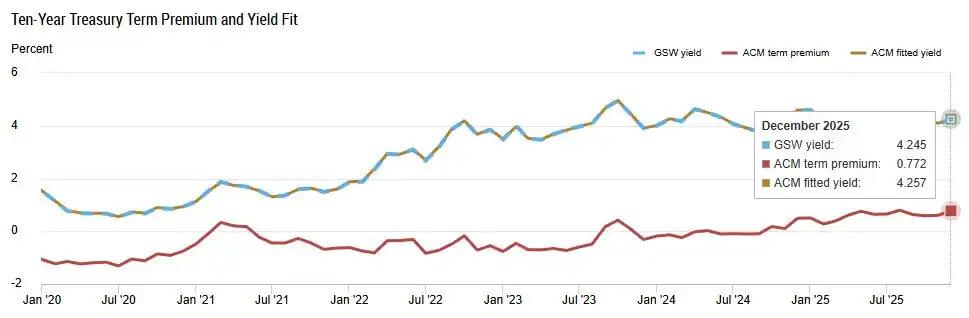
Caption: The 10-year US Treasury term premium rose to 0.772% in December 2025, its highest level since 2020, while the yield reached 4.245%.

The Term Premium Channel is the Discount Rate Channel

Bitcoin exists in the same "discount rate universe" as stocks and other duration-sensitive assets.

When the term premium rises, long-end yields climb, financial conditions tighten, and liquidity premiums compress. ECB research documents how the dollar exchange rate appreciates with Fed tightening across multiple policy dimensions, making US rates the core pricing kernel for global pricing.

Bitcoin's historical upward momentum has often come from the expansion of liquidity premiums: when real yields are low, discount rates are easy, and risk appetite is high.

A term premium shock reverses this dynamic without the Fed changing the federal funds rate. This is why Lane's argument is significant for cryptocurrencies, even though he was speaking to European policymakers at the time.

On January 16th, the US Dollar Index (DXY) was around 99.29, near the low end of its recent trading range. But the "reassessment of the dollar's role" mentioned by Lane opens up two截然不同的 (distinctly different) scenarios, not a single outcome.

In the traditional "yield differential" paradigm, higher US yields strengthen the dollar, tighten global liquidity, and pressure risk assets, including Bitcoin. Research shows that post-2020, cryptocurrency correlation with macro assets is stronger, and in some samples, it shows a negative correlation with the DXY.

But in the credibility risk paradigm, the outcome diverges: if investors demand a premium for US assets due to governance risk, the term premium could rise even as the dollar weakens or fluctuates. In this case, Bitcoin would trade more like a "release valve" or alternative monetary asset, especially if inflation expectations rise alongside credibility concerns.

Furthermore, Bitcoin is now more connected to equities, AI narratives, and Fed signals than in previous cycles.

According to Farside Investors data, Bitcoin ETFs saw net inflows again in January, totaling over $1.6 billion. Coin Metrics notes that open interest in spot options is concentrated near the $100,000 strike price expiring at the end of January.

This positioning means a macro shock could be amplified through leverage and Gamma dynamics, turning the abstract "term premium" concern mentioned into a concrete catalyst for market volatility.
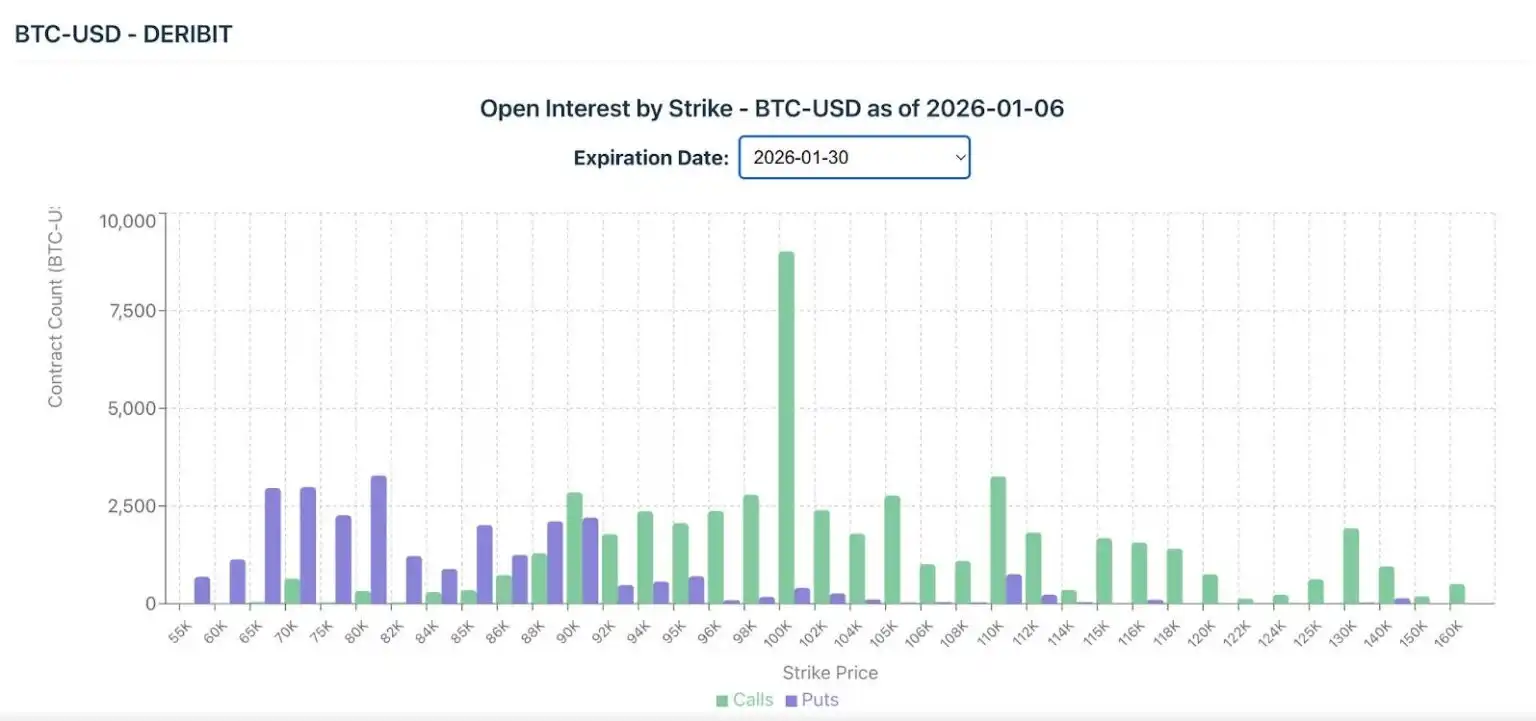
Caption: Open interest for Bitcoin options expiring January 30, 2026, shows over 9,000 call contracts concentrated at the $100,000 strike price.

Stablecoin Infrastructure Makes Dollar Risk "Crypto-Native"

A significant portion of the cryptocurrency trading layer operates on dollar-denominated stablecoins, which are backed by safe assets (typically US Treasuries).

Research from the Bank for International Settlements (BIS) links stablecoins to the pricing dynamics of safe assets. This means a term premium shock is not just some "macro vibe"; it directly permeates stablecoin yields, demand, and on-chain liquidity conditions.

When the term premium rises, the cost of holding duration increases, which could affect stablecoin reserve management and alter the liquidity available for risk trades. Bitcoin might not be a direct substitute for US Treasuries, but it exists in an ecosystem where Treasury pricing sets the benchmark for the definition of "risk-free."

Currently, the market sees about a 95% chance the Fed holds rates steady at its January meeting, with major banks pushing expected rate cuts into 2026.

This consensus reflects confidence in near-term policy continuity, thereby anchoring term premiums. But Lane's warning is forward-looking: if this confidence cracks, the term premium could jump 25 to 75 basis points within weeks, without any change in the funds rate.

A mechanical example: if the term premium rises 50 basis points and expected short-term rates hold steady, the 10-year nominal yield could drift from 4.15% towards 4.65%, with real yields repricing in sync.

For Bitcoin, this implies tighter financial conditions and brings downside risk through the same channels that squeeze high-duration stocks.

However, if triggered by a credibility shock causing dollar weakness, the risk profile becomes completely different.

If global investors begin reducing US asset holdings based on governance grounds, the dollar could weaken even as the term premium rises. In this scenario, Bitcoin's volatility would spike dramatically, and its direction would depend on whether the yield differential paradigm or the credibility risk paradigm dominates at that time.

While academia still debates Bitcoin's "inflation hedge" properties, the dominant channel in most risk regimes remains real yields and liquidity, not simply breakeven inflation expectations.

Philip Lane's argument forces us to consider both possibilities simultaneously. This is why a "dollar repricing" is not a one-way bet but a fork in the regime road.

Watchlist

The checklist for tracking this development is clear:

At the Macro Level:

  • Term Premiums
  • 10-year TIPS Real Yields
  • 5-Year Breakeven Inflation Expectations
  • US Dollar Index (DXY) Level and its Volatility

At the Crypto Level:

  • Bitcoin Spot ETF Flows
  • Options Open Interest around Key Strikes (e.g., $100,000)
  • Changes in Skew around Major Macro Events

These indicators link Lane's warning to Bitcoin's price action without speculating on the Fed's future policy decisions.

Lane's signal was initially sent to European markets, but the "pipes" he describes are the very logic that determines Bitcoin's macro environment. The oil premium has faded, but the "governance risk" he pinpointed remains.

If the market begins pricing in the Fed's political tussle, this shock will by no means be confined to the US. It will be传导 (transmitted) globally through the Dollar and the Yield Curve, and Bitcoin's reaction to such a shock is often sharper and earlier than that of most traditional assets.


Related Questions

QWhat warning did European Central Bank (ECB) chief economist Philip Lane issue regarding the US Federal Reserve?

APhilip Lane warned that the 'tussle' over the Federal Reserve's mandate independence could lead to global market turbulence by pushing up US term premiums and triggering a reassessment of the dollar's role.

QHow might a rise in term premiums affect Bitcoin according to the article?

AA rise in term premiums could tighten financial conditions, compress liquidity premiums, and create downward pressure on Bitcoin, as it exists in the same 'discount rate universe' as other duration-sensitive assets.

QWhat are the two different scenarios for Bitcoin if investors demand a premium for US assets due to governance risks?

AIn a credibility risk paradigm, Bitcoin could trade more like a 'release valve' or alternative monetary asset, especially if inflation expectations rise alongside governance concerns, potentially leading to volatility and a different risk profile compared to the yield differential paradigm.

QHow do stablecoins relate to US Treasury pricing and term premium shocks?

AStablecoins, which are largely dollar-denominated and backed by safe assets like US Treasuries, are linked to the pricing dynamics of these assets. A term premium shock could affect stablecoin yields, demand, and on-chain liquidity conditions.

QWhat key indicators should be monitored to assess the impact of Lane's warning on Bitcoin?

AKey indicators include term premiums, 10-year TIPS real yields, 5-year breakeven inflation expectations, the Dollar Index (DXY), Bitcoin spot ETF flows, options open interest around key strike prices like $100,000, and changes in skew around major macro events.

Related Reads

Must-Watch Events Next Week|CLARITY Act Could Face Senate Vote; SpaceX, Circle to Report Earnings (8.3-8.9)

**Summary: Key Events and Developments to Watch (August 3-9)** The upcoming week is marked by significant financial disclosures, key legislative deadlines, and notable product updates. **Major Financial Events:** Several companies are scheduled to release their Q2 2026 earnings. American Bitcoin (ABTC) will report on August 3, followed by SpaceX and Hut 8 Mining Corp. on August 4, and Circle on August 5. Notably, a significant portion of SpaceX shares (up to 12% of total shares) will be unlocked on August 6 following their earnings release. **Key Legislative Deadline:** The U.S. Senate faces an August 7 deadline to secure 60 votes for the CLARITY Act, a bipartisan bill aiming to establish a federal regulatory framework for cryptocurrencies. The Senate may hold a full vote on the bill during the week. **Economic Data:** The U.S. July Non-Farm Payrolls report will be released on August 7, providing crucial labor market data. **Technology & Product Updates:** * **Shutdowns:** DeFi portfolio tracker Zapper and wallet app Ctrl Wallet will cease operations on August 3. * **Upgrades:** LayerZero will deprecate its v1 relayers on August 3. XRP Ledger's new version 3.3.0, featuring five new functions, is expected next week. * **AI:** Elon Musk announced that the advanced Grok 4.6 AI model is set for release around August 7. * **Bitcoin:** The BIP-110 forced signaling for a potential Bitcoin network change is scheduled to begin around August 8. **Other Notable Events:** Chinese robotics firm Unitree Tech has set its preliminary price inquiry for its IPO for August 5. South Korean exchange Upbit will delist AQT and AERGO tokens on August 3.

marsbit1h ago

Must-Watch Events Next Week|CLARITY Act Could Face Senate Vote; SpaceX, Circle to Report Earnings (8.3-8.9)

marsbit1h ago

Stocks Are Plummeting More Sharply Than Cryptocurrencies. Where Has the Money Gone?

Stock Markets Plunge Deeper Than Cryptocurrencies: Where Did the Money Go? In late July, Seoul's Kospi index triggered circuit breakers for two consecutive days, plummeting over 40% from its June high. The collapse was led by heavyweight stocks like SK Hynix, whose record profits still disappointed investors, and devastating leveraged ETFs, with one major product losing over 83% of its value. This signaled a global, forced deleveraging targeting the most crowded trades. Interestingly, while stocks exhibited extreme volatility akin to crypto markets, Bitcoin rose nearly 15% in July after a prior steep drop. Analysis shows the money fleeing equities did not flow into Bitcoin. Instead, Bitcoin had already absorbed its sell-off in May-June, when U.S. spot Bitcoin ETFs saw historic outflows. The true safe-haven beneficiary was gold, whose price rose over 20% year-on-year, highlighting a decoupling between Bitcoin and gold as "digital gold." The sell-off was a targeted unwinding of leveraged positions in tech and semiconductors, accelerated by broker-dealer risk management and shifts in the AI narrative, including new competition from Chinese memory chipmakers. The retreat path was clear: from high-valuation tech stocks to cash and U.S. Treasuries, then to gold. For Bitcoin to attract sustained institutional inflows, conditions like eased global liquidity pressure, a "soft-landing" Fed rate cut, and U.S. regulatory clarity via legislation like the stalled CLARITY Act are needed. Currently, Bitcoin is not a safe haven but an already-cleared asset. Its low correlation with tech stocks, however, makes it a potential diversification play for institutional portfolios once the storm passes. The money isn't here yet, but the positioning is underway.

marsbit1h ago

Stocks Are Plummeting More Sharply Than Cryptocurrencies. Where Has the Money Gone?

marsbit1h ago

In Conversation with Ray Dalio: We Are Currently in an AI Bubble, with 1% of My Portfolio in Bitcoin

Ray Dalio, founder of Bridgewater Associates, warns in an interview that the current AI boom shows classic bubble characteristics, which could lead to significant economic downturns as seen in past cycles like 1929 or 2000. He explains that speculative enthusiasm, fueled by debt and overvaluation, often precedes a crash when rising rates or taxation force asset sales, causing widespread losses and recession. Dalio also outlines his "Big Cycle" theory, describing an approximate 80-year pattern where widening wealth gaps, massive government deficits, and shifting geopolitical power (like China's rise) create internal conflict and global instability. He emphasizes that we are in a late-cycle, transitional phase where traditional powers like the US and UK face decline. For personal wealth protection, Dalio advises diversification beyond cash into assets like stocks, bonds, real estate, and particularly gold, which he prefers over Bitcoin. While he holds about 1% of his portfolio in Bitcoin as a non-printable hard asset, he views gold as more secure from technological or governmental threats. Regarding AI's impact, Dalio believes it will disproportionately benefit capital owners, worsening inequality by replacing both physical and cognitive labor. He suggests that human intuition and emotional intelligence, combined with AI, will be key for future workers. On taxation, Dalio argues that wealth taxes are impractical and risk triggering asset sell-offs, reducing productive investment. He points to the UK as a cautionary example of debt, low productivity, and political strife. Geopolitically, Dalio foresees a more regionalized world, with the US showing weakness in prolonged conflicts like with Iran, akin to past imperial declines. The ideal outcome, he suggests, is coexisting powerful blocs (e.g., Americas, China-Asia Pacific) without major war.

marsbit5h ago

In Conversation with Ray Dalio: We Are Currently in an AI Bubble, with 1% of My Portfolio in Bitcoin

marsbit5h ago

Trading

Spot
活动图片




