The Dilemma Without a Moat: Why Couldn't Optimism Keep Base?

marsbitPublished on 2026-03-02Last updated on 2026-03-02

Abstract

The article "The Dilemma of No Moat: Why Couldn't Optimism Keep Base?" discusses how Optimism's strategic decision to release the OP Stack under the permissive MIT license enabled widespread adoption, making it the dominant infrastructure for Ethereum scaling. However, this move also eliminated barriers to exit, allowing major chains like Base (built by Coinbase) to use the technology without obligation. Base grew to contribute over 96% of Optimism Collective's gas fees but eventually left the Superchain ecosystem, citing technical efficiency and autonomy. The promised native interoperability feature—the core value proposition for revenue sharing—never materialized, reducing incentives for Base to remain. The departure triggered a significant drop in OP's token value, highlighting a recurring pattern in open-source projects where value accrues to entities controlling distribution (like Coinbase) rather than those building the technology. The article contrasts Optimism's approach with Arbitrum's more restrictive, contract-based model and concludes that sustainable value in L2 networks lies not in forkable technology but in structural advantages like user bases and liquidity depth.

Written by: Thejaswini M A

Compiled by: Luffy, Foresight News

Optimism's story could have had a version of great victory.

In that version, the OP Stack becomes the default infrastructure for Ethereum scaling, dozens of well-funded chains join the Superchain, revenue flows back to the Collective, interoperability features launch smoothly, and the entire ecosystem compounds, looking from afar like a new form of the internet: it belongs to no one, is governed by all, and is self-sustaining.

This version was not a fantasy. For a time, it really looked like it was about to happen. The problem is: everything Optimism did to achieve this vision also made it impossible to protect it.

The OP Stack was released under the MIT open-source license. The importance of this decision almost surpasses any other choice made by Optimism, so it's necessary to clarify its meaning: MIT is currently the most permissive general open-source license. Anyone can take the code, develop it further, modify it, commercialize it, or even do a full fork. No royalties, no revenue sharing, no obligations whatsoever—you don't even have to say thank you.

Optimism made this choice deliberately. The logic is simple: if you want to become the default framework, you must every reason not to adopt you. Reduce the onboarding cost to zero, make the protocol uncontroversial, and allow any team, company, or exchange with a development budget to launch an OP Stack chain permissionlessly, without signing any documents, with just one click.

It succeeded. By mid-2025, the OP Stack processed 69.9% of L2 transaction fees, with 34 chains live on mainnet. Coinbase, Uniswap, Kraken, Sony, and Worldcoin were all using it. When people talked about Ethereum scaling, they were usually talking about something built on Optimism's code.

Optimism won the standards war.

Then, the largest chain it helped build announced it no longer needed this relationship.

On February 18, 2026, Coinbase published a blog post with a carefully worded, affectionate title—a typical writing style for companies announcing major events without wanting to sound harsh. The Base chain would integrate its codebase, accelerate its development cycle, and reduce coordination costs. The post expressed gratitude and praised the cooperation.

Upon the news, the OP token plummeted 28% within 48 hours, with selling volume surging 157%. In just a few days, the token was down 89.8% from a year ago, standing at just $0.12 at the time of writing, compared to a high of $4.85 in March 2024. OP Labs CEO Jing Wang wrote on X: "This is a blow to short-term on-chain revenue."

To understand why, you must understand what the Superchain was truly selling.

The OP Stack is free. The license makes this permanent and irrevocable. So why would any chain be willing to share revenue with the Optimism Collective? Optimism's answer was: interoperability. Join the Superchain, and your chain isn't just a chain, but part of a unified network—liquidity and users can flow freely between all member chains, developing on one chain is equivalent to developing on all, achieving a 1+1>2 effect.

This was its value proposition: pay 2.5% of total revenue or 15% of net profit, and in return, you get something no single chain could build alone.
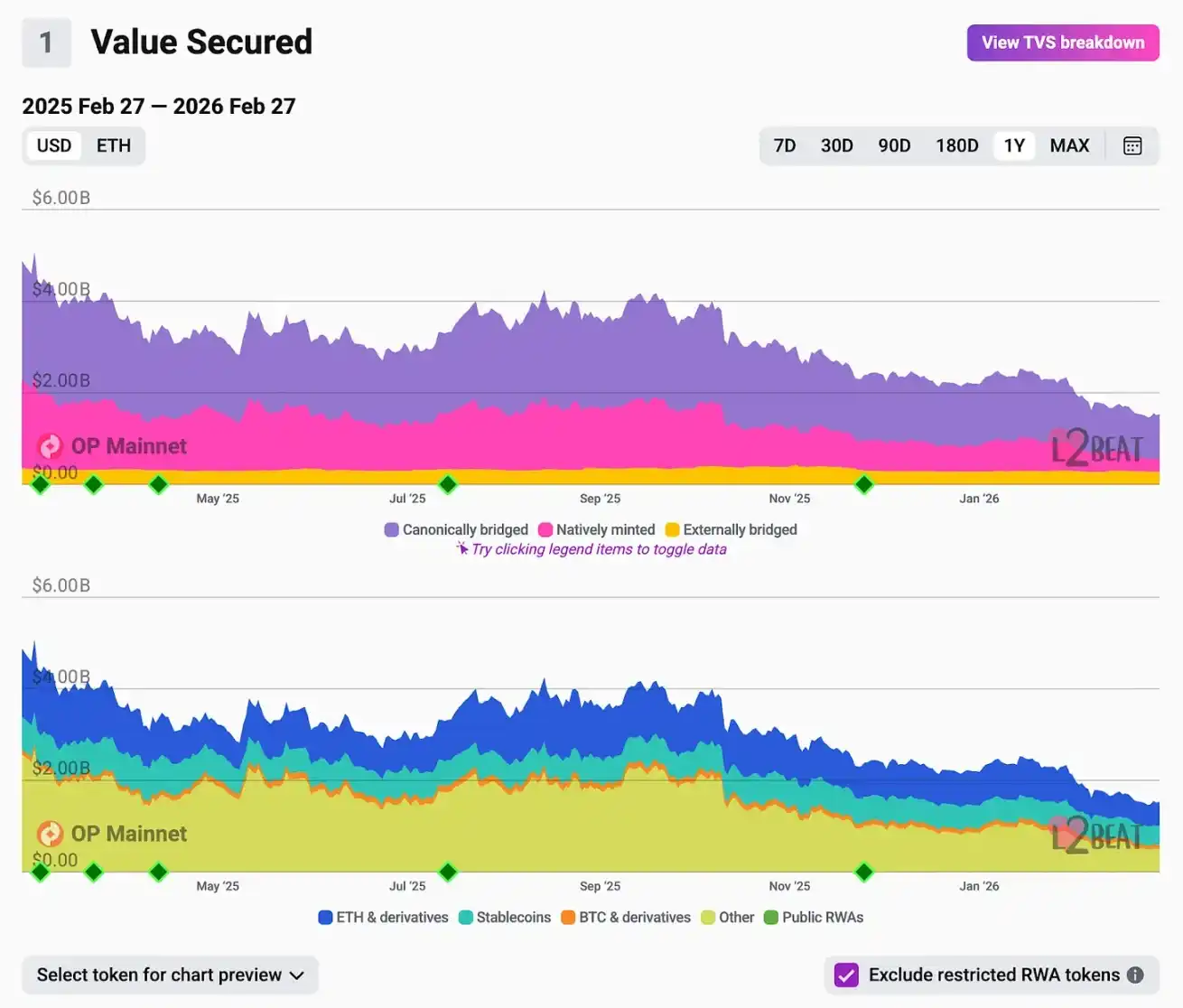
But interoperability never launched.

Optimism was originally scheduled to launch native interoperability on mainnet in early 2025, but it didn't arrive. A long-time governance delegate stated: "Despite years of technical development, unfortunately, this was not achieved."

Members were paying "taxes," but the product this money was supposed to support remained theoretical. What the Superchain actually provided was only a shared brand, shared governance costs, and a revenue obligation. The thing that was supposed to make this obligation worthwhile was always "just around the corner." Meanwhile, Base continued to grow.
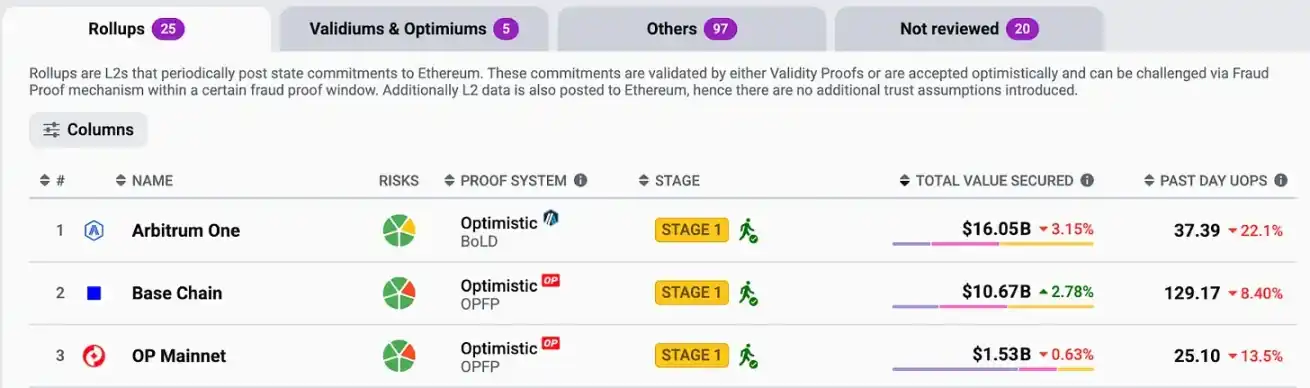
By January 2026, Base contributed 96.5% of all gas fees flowing into the Optimism Collective—almost all of it. Base's transaction volume was about 4 times that of OP Mainnet, DEX volume about 144 times, and gas fee generation 80 times. During their partnership, the Collective received a total of about 14,000 ETH in its lifetime, with Base contributing 8,387 ETH, and its monthly revenue share approached 100%.
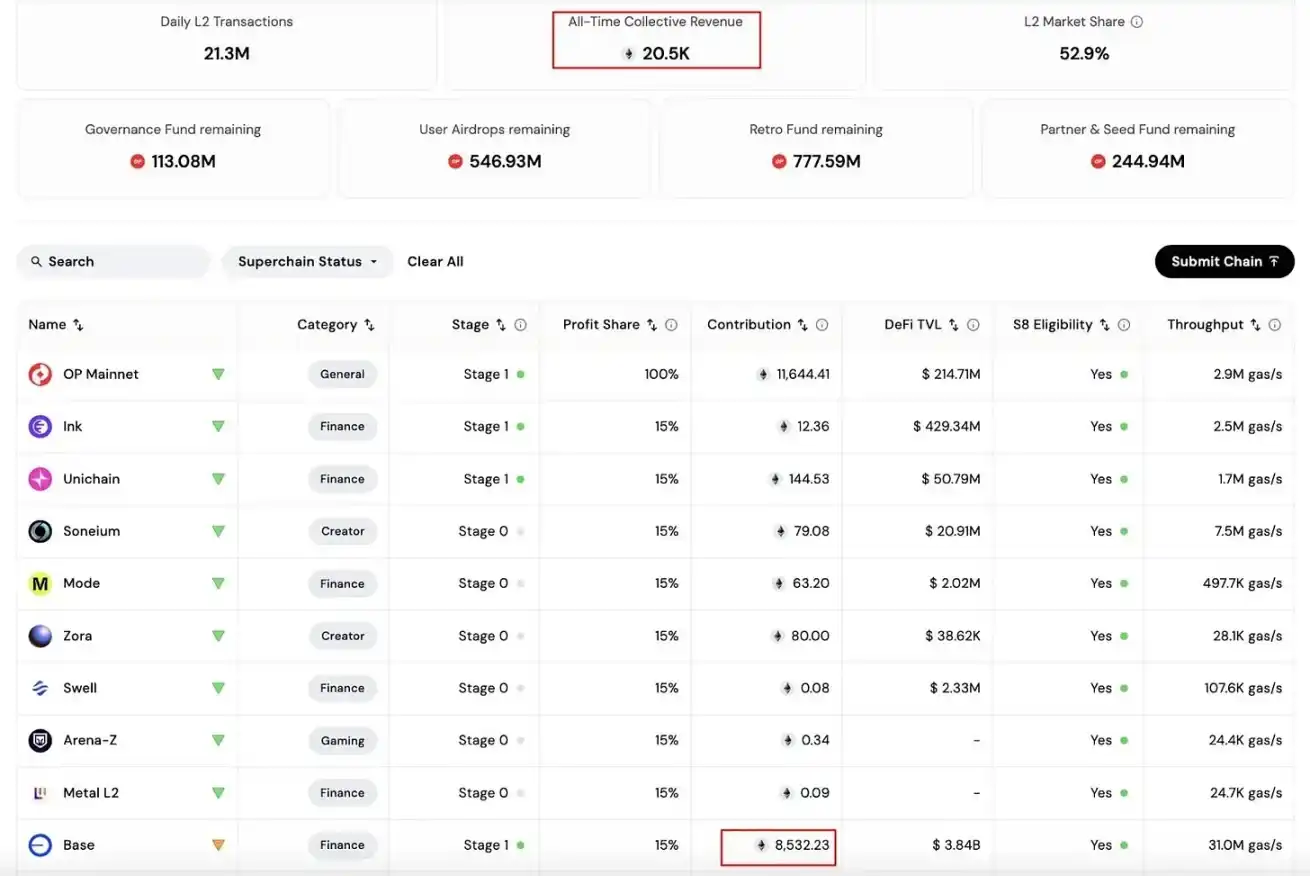
The other 33 Superchain members were on the list but economically insignificant. In the first half of 2025, the second most active member, World Chain, accounted for only 11.5% of Superchain computation, OP Mainnet itself for 11.4%, and Ink, Soneium, and Unichain together for less than 13%.

Beyond its name, the Superchain had effectively become a one-chain ecosystem. The alliance was real on paper, but economically it was entirely Base.

In any alliance, there comes a point where the strongest participant asks the obvious question: What am I actually getting out of this?

Almost every successful open-source story follows this same logic. MongoDB built a widely used database, released it open source, and then watched as AWS built a profitable托管 service on top of it without paying a dime. AWS controlled traffic distribution, MongoDB set the standard. Value flowed to the entity that controlled the users, not the one that wrote the code. MongoDB eventually changed its license, and AWS forked it into OpenSearch.

Elastic and Redis went through the same cycle. The details differ, but the structure is identical: the infrastructure maker establishes the standard, a giant with distribution adopts it, the giant harvests the value, and eventually the giant internalizes the tech stack and leaves.

Optimism is the crypto version of this story.

Arbitrum saw this logic clearly and made a different choice. Its Orbit chains, the counterpart to the Superchain, use the Business Source license, with revenue sharing based on contractual obligations, not voluntarism. When your largest partner can leave without legal consequences, the alliance's survival depends entirely on its willingness to stay. Arbitrum did not want to build an ecosystem based on that assumption.

The official reason Base gave for leaving was technical: unifying the codebase meant faster development, aiming for 6 major upgrades per year instead of 3; independent control of the security council meant no external body could delay or block network decisions; reducing dependencies meant Base could keep pace with Ethereum's own upgrades without waiting for governance processes it didn't control.

Coordinating across multiple codebases is indeed slower than controlling your own tech stack.

But there was another reason, left unstated. Morgan Stanley estimated that a Base token could bring Coinbase about $34 billion in equity value and raised its price target to $404. As long as Base was paying 15% of its net profit to the Collective of an external protocol, designing a Base token with reliable value capture mechanisms was structurally very difficult. Leaving the Superchain was a prerequisite, not a side effect. Both motives pointed in the same direction, and Base did just that.

What remains for Optimism is not nothing, but one must be honest about the change that has occurred.

OP Mainnet still holds $1.5 billion in TVL. On the same day Base announced its departure, ether.fi stated it would migrate its on-chain credit card product to OP Mainnet, bringing 70,000 active cards, 300,000 accounts, and over $160 million in TVL. A few weeks earlier, the Collective had just passed a buyback plan, using 50% of sequencer revenue for monthly OP buybacks.

The ether.fi partnership gives OP Mainnet a clearer use case in consumer payments. But ether.fi's annualized fee contribution is only about $13 million, while Base's profit in 2025 alone was $55 million. The revenue base underpinning the buyback plan no longer exists. Token unlocks for investors and contributors continue at a rate of about $32 million per month.

Pivoting to enterprise services might be the right move. OP Labs has raised over $175 million, possesses top engineering talent, and there is genuine demand from institutions for hosted OP Stack deployments—entities that want to launch a chain but don't want to build their own maintenance capabilities. Jing Wang positioned it as "the Databricks of blockchain infrastructure," a reasonable analogy. It's a services business, and it could work.

But a services business is completely different from a network generating compound protocol revenue through an alliance. The OP token's valuation was priced for the latter. The market understood this less than 12 hours after the blog post was published.

Zooming out. What happened on February 18th is essentially not just about Optimism.

For most of 2024, over 50 L2 networks competed for users and liquidity. By the end of 2025, Base, Arbitrum, and Optimism together handled nearly 90% of L2 transactions, with Base alone exceeding 60%. Small Rollups saw activity drop 61% since June. The Dencun upgrade brought a 90% fee reduction, compressing profit margins across the industry. Base was the only L2 to be profitable in 2025.

The chains that survived, and those that will define this layer in the coming years, are not necessarily the most technically proficient. They are the chains with structural reasons for user retention. Exchange-backed chains (Base, Ink, Mantle) leverage the existing user base of their parent company for built-in distribution; every Coinbase user wanting to get on-chain is just one click away from Base. DeFi-native chains like Arbitrum and Hyperliquid hold their ground based on liquidity depth that is difficult to rebuild elsewhere.

Technology can be forked. The OP Stack proved this perfectly. What cannot be forked is Coinbase's relationship with its 100 million users, or Arbitrum's tens of billions in open interest. Lasting value lies here, almost regardless of which license you choose for your codebase.

Optimism's decision to release the OP Stack under a permissive open-source license was the right choice. It led to the broadest adoption among L2 frameworks, making Optimism the infrastructure standard for an entire generation of Ethereum scaling. Without this decision, Base might have been built on other technology, or might not have appeared at all.

But the decision that made it all possible also made exit costless. When Base grew large enough, with its own users, its own token roadmap, and its own reasons for pursuing full infrastructure sovereignty, there was nothing in the license to constrain it, and the promise of interoperability wasn't enough to give it a reason to stay.

Optimism won the standards war. It's just that this standard didn't come with a mechanism to capture the value it created. A token price of $0.12 is the market's final pricing of all this value.


Related Questions

QWhat was the core reason for Base's departure from the Optimism Superchain, according to the article?

AThe core reason was that the promised native interoperability, which was the primary value proposition for paying a portion of revenue to the Collective, never materialized. This, combined with Base's massive growth and its own ambitions for a token and full technical sovereignty, meant it had little incentive to remain.

QWhat open-source license did Optimism choose for the OP Stack, and what was the strategic reasoning behind it?

AOptimism chose the MIT license, the most permissive open-source license. The strategic reasoning was to eliminate any barrier to adoption, making it the default infrastructure for Ethereum scaling by allowing anyone to use, modify, and commercialize the code without any cost or obligation.

QHow significant was Base's financial contribution to the Optimism Collective before its departure?

ABase's contribution was overwhelmingly dominant. By January 2026, it contributed 96.5% of all gas fees flowing into the Collective. It contributed 8,387 ETH out of the total ~14,000 ETH the Collective had ever received, and its monthly share was approaching 100%.

QHow did the market react to the news of Base leaving the Superchain?

AThe market reaction was severely negative. The OP token price plummeted 28% within 48 hours, with selling volume surging 157%. The token fell 89.8% from its high a year prior, dropping to $0.12 from a high of $4.85 in March 2024.

QWhat does the article identify as the true source of lasting value in the L2 landscape, which cannot be forked like code?

AThe article identifies structural user retention advantages as the true source of lasting value. This includes the relationship a chain has with its users, such as Coinbase's connection to its 110 million users, or the deep liquidity and open interest (e.g., Arbitrum's billions in open positions) that are difficult to replicate elsewhere.

Related Reads

STAR 50 Soars 10.73%, Why Did A-Shares Stage a "V-Shaped Reversal"?

After a prolonged decline, the Chinese A-share market staged a strong rally on July 21. The STAR 50 index surged 10.73%, its largest single-day gain in nearly a year, leading a broad-based "V-shaped" reversal. The Shanghai Composite Index rose 1.79%, the Shenzhen Component Index gained 4.81%, and the ChiNext Index jumped 7.05%. Total market turnover reached 2.97 trillion yuan, an increase of 256.1 billion yuan from the previous session, with over 3,100 stocks advancing. The semiconductor sector spearheaded the rebound, with related ETFs posting significant gains. Analysts attribute the surge to three converging factors. First, coordinated capital inflows from "national team" institutions, insurance funds, listed company buybacks, and fund house self-purchases have bolstered market liquidity and confidence. Second, supportive policy signals, including commitments from regulators to ensure stable market operations, provided a favorable backdrop. Third, a stabilization and recovery in overseas markets, notably South Korea, created a positive external environment. Institutions suggest the most severe panic selling phase for the tech sector has likely passed, following a significant digestion of crowded positions and leveraged funds. While short-term volatility may persist, the medium to long-term outlook remains underpinned by enduring trends like AI computing demand expansion and semiconductor localization. The market's focus now shifts to the sustainability of supportive fund flows, earnings reports, and upcoming catalysts from the global AI industry chain.

marsbit18m ago

STAR 50 Soars 10.73%, Why Did A-Shares Stage a "V-Shaped Reversal"?

marsbit18m ago

U.S. Tech Momentum Stocks Post Largest Single-Day Gain Ever, But Is the Plunge Over?

US tech momentum stocks staged a sharp rebound on Tuesday (July 21st). Morgan Stanley's TMT Momentum Factor surged over 12%, marking its largest single-day gain on record, exceeding even peaks from the 2000 dot-com bubble. Key momentum indices from Goldman Sachs also posted their strongest daily performances in years. The rally was led by semiconductors, with the Philadelphia Semiconductor Index jumping 4.6%. This rebound followed three consecutive down days and a cumulative 33% plunge in momentum stocks, one of the steepest drawdowns since the dot-com era. Analysts attribute the surge largely to a short squeeze. Heavy selling had pushed high-beta momentum stocks into deeply oversold territory, forcing many short sellers, particularly in Asia, to cover their positions, creating a self-reinforcing buying spiral. However, the rebound's internals appear weak. Trading volume was notably low, and advancing stocks still lagged decliners on the S&P 500, indicating a narrow, concentrated rally rather than broad market participation. Diverging views emerge on the outlook. BTIG warns the bounce has hit key resistance and recommends selling into strength, citing extreme volatility and historical parallels to past market tops. Conversely, Goldman Sachs and UBS believe the momentum unwind is nearing its end, suggesting it may be time to gradually add exposure, as positioning has been significantly reduced. They caution, however, that high volatility warrants a measured approach, potentially using defined-risk strategies. The upcoming earnings season, particularly reports from major tech firms like Alphabet, is seen as a critical test for the rally's sustainability. Simultaneously, bond markets flashed a warning, with yields rising partly due to spiking oil prices. Analysts note that if long-term Treasury yields break decisively higher, it could pose a significant headwind for equities, especially growth stocks.

marsbit25m ago

U.S. Tech Momentum Stocks Post Largest Single-Day Gain Ever, But Is the Plunge Over?

marsbit25m ago

U.S. Tech Momentum Stocks Record Largest Single-Day Gain Ever, but Has the Rout Ended?

U.S. tech momentum stocks staged a dramatic rebound on Tuesday, July 21st. Key momentum indices like the Morgan Stanley TMT Momentum Factor and Goldman Sachs' High Beta Momentum Long Index posted historic or near-historic single-day gains, fueled largely by semiconductor stocks. This sharp rally followed a severe three-day sell-off that saw momentum stocks plunge 33%, marking one of the steepest pullbacks since the dot-com bubble. Analysts attribute the bounce primarily to a short squeeze, as forced covering from over-leveraged traders, particularly in Asia, created a buying spiral. However, the rally's health is questioned due to weak market breadth—overall trading volume was low, and decliners outnumbered advancers in the S&P 500 despite the index's gain—suggesting a narrow, concentrated surge rather than broad recovery. Opinions on the sustainability diverge. BTIG strategists warn the rebound has hit key resistance levels, citing extreme volatility and historic stock dispersion as signs of an ongoing broader correction, and recommend selling into strength. Conversely, Goldman Sachs and UBS view the aggressive momentum unwinding as nearing its end, noting reduced positioning and a lack of new fundamental catalysts. They suggest the sell-off presents a selective opportunity to add exposure, albeit cautiously and gradually using defined-risk strategies. The immediate trajectory hinges on the ongoing earnings season, with market focus on Alphabet's capital expenditure guidance for AI investment clarity. Meanwhile, bond markets present a risk, with rising Treasury yields—potentially heading toward 5.5%—and widening credit spreads for mega-cap tech companies posing a threat to equity valuations. The combination of technical factors, earnings results, and macro conditions leaves the durability of the rebound in doubt.

链捕手27m ago

U.S. Tech Momentum Stocks Record Largest Single-Day Gain Ever, but Has the Rout Ended?

链捕手27m ago

Long-Divided Must Unite, Long-United Must Divide: When L1 Becomes Its Own Rollup, What Is Ethereum's Endgame?

"The Inevitable Cycle: When L1 Becomes Its Own Rollup – What is Ethereum's Endgame?" For years, the Ethereum community grappled with concerns that L2s were fragmenting the ecosystem and eroding L1's value. While L2s provided cheaper execution, they also splintered liquidity and the unified user experience of a single chain. This has prompted a fundamental reassessment of the relationship between L1 and L2. Ethereum's roadmap is evolving. The "Scale" initiative merges L1 and L2 expansion into a holistic framework. L1 itself is advancing with higher gas limits, statelessness, and zkEVM verification, no longer content to be just a low-throughput settlement layer. Consequently, the primary value proposition of L2s is shifting from merely providing cheap blockspace to offering L1 cannot easily provide: application-specific optimizations, privacy features, and flexible governance models. L2s are becoming a spectrum of execution environments with varying degrees of security inheritance from Ethereum. A critical challenge in this multi-chain future is interoperability. The vision is to make Ethereum "feel like one chain again." This relies on advancements in native account abstraction (like EIP-7702) and intent-based architectures (Open Intents Framework), where users declare desired outcomes, and solvers handle the complex cross-chain execution. Furthermore, shortening Ethereum's finality time from minutes to seconds is crucial, as it underpins trust between chains for bridges, stablecoins, and cross-chain applications. Perhaps the most provocative idea is that Ethereum L1 itself could become a form of "its own Rollup." As zkEVM and proof systems mature, high-performance nodes could execute transactions and generate validity proofs. Regular validators would then verify these proofs instead of re-executing all transactions. This blurs the traditional L1/L2 hierarchy, making "Rollup" more of a general execution-verification architecture. Native Rollup aims to integrate L2 validation more directly into the Ethereum protocol, allowing L2s to inherit L1's security more fully and move away from reliance on security councils. In the end, L2s are not destined to replace L1 or be made obsolete by it. The likely future is a unified system where diverse execution environments—each optimized for specific use cases like DeFi, gaming, or privacy—coexist. They will share a common foundation of security, liquidity, and verifiable state, seamlessly connected to restore a cohesive user experience. The next phase for Ethereum is not just about scaling through separation, but about intelligently reintegrating what was separated back into a coherent whole.

链捕手44m ago

Long-Divided Must Unite, Long-United Must Divide: When L1 Becomes Its Own Rollup, What Is Ethereum's Endgame?

链捕手44m ago

Trading

Spot
活动图片




