The Cost of an 11.5% Annualized Return: Will MicroStrategy's STRC Face a Moment of Reckoning?

marsbitPublished on 2026-04-23Last updated on 2026-04-23

Abstract

This article analyzes the potential risks associated with MicroStrategy's (MSTR) use of structured financial products like STRC to leverage its BTC exposure. While these tools have enabled impressive returns (e.g., 11.5% annualized) and fueled significant capital inflows ($13.5B outstanding), they also create substantial annual dividend obligations (~$400M). The author argues that this structure, while effective in a bull market, could become a liability if BTC price stagnates or declines. The core risk is a potential negative feedback loop: the growing dividend burden from continued STRC issuance may eventually outweigh the benefits of increased BTC holdings. To meet these obligations, MicroStrategy might need to use new issuance proceeds for dividends instead of buying more BTC, which could disappoint equity investors. If the market capitalization (mNAV) falls below the value of its BTC holdings, the company could be forced to sell BTC instead of issuing new shares, potentially triggering a panic. The author estimates a potential inflection point in 6 months, where annual dividend costs reach $3-4B. At that stage, CEO Michael Saylor might face a difficult choice: sell BTC to meet obligations or sacrifice the credibility of the preferred shares by halting dividends. The article concludes that this financial engineering, while powerful, could ultimately "backfire" on MicroStrategy if market conditions turn.

Editor's Note: As Michael Saylor continues to amplify his company's exposure to Bitcoin through tools like STRC, a seemingly efficient financial structure is simultaneously accumulating dividend pressure and potential risks. In the short term, it drives capital inflows and price increases; but once the market turns, this mechanism reliant on continuous financing could quickly backfire on the company itself. This article explores this structure, attempting to outline its operational boundaries and potential chain reactions under extreme scenarios.

Below is the original text:

Through STRC, Saylor has created a "Frankenstein's monster."

Victor Frankenstein created this monster out of arrogance—he was confident he could play God and challenge death. But after the monster successively destroyed his family and friends, it ultimately dragged him into ruin as well.

Through STRC, Saylor has designed an "idealized" BTC-linked instrument, allowing retail investors to capture Bitcoin's excess returns in a manner similar to a "risk-free rate." It is this financial engineering capability that enables him to claim unprecedented Sharpe ratios and an 11.5% return with just 1 basis point of volatility—but ultimately, this mechanism could also crush MSTR.

Note: The following analysis is based on one premise—BTC trades sideways or declines. If BTC can achieve the 20–25%+ compound growth rate assumed in Strategy's internal model, then many of these assumptions would no longer hold (though not all would be invalidated).

In just the past two weeks, STRC has attracted nearly $3.5 billion in inflows, with total issuance reaching $8.5 billion. Combined with other preferred instruments from Strategy, the outstanding amount is currently about $13.5 billion (excluding convertible bonds here). These financing proceeds have supported the corresponding scale of BTC purchases and were likely a major driver behind last week's price surge to $78,000; but at the same time, they also bring an annual dividend obligation of approximately $400 million.

Previously, Saylor maintained a dividend reserve of about $2.25 billion. Before the April issuance round, this reserve could cover about 25 months of dividends. But the new issuances in just the last two weeks have already compressed the coverage period to 18 months. To restore it to 25 months, he would need to raise about $500 million through ATM (at-the-market) offerings.

Currently, MSTR's mNAV has fallen back to 1.25–1.30 times the annual high range, which has also prompted the crypto community (CT) to call for large-scale BTC purchases again this week. However, the issue is that I believe about 50–70% of this week's new issuances will be used to replenish the dividend reserve, rather than directly for buying BTC.

More importantly, it is worth considering STRC's performance in "extreme scenarios." MSTR's current market cap is approximately $55–60 billion. The practical question is: How much more STRC can Saylor issue before the dividend burden puts substantial pressure on mNAV?

A simple estimation method: the annual issuance scale could be controlled at 1–2% of MSTR's average daily volume (ADV). Based on the current daily trading volume of about $2–3 billion and 252 trading days per year, this roughly corresponds to an issuance space of $5–15 billion—equivalent to 3–10 times the current annual dividend/coupon payments.

However, I tend to believe this range represents the "upper limit," not the常态 level. In fact, for shareholders holding only common stock, the structural cost of this trade is already becoming apparent: STRC's success is actually suppressing MSTR's mNAV—and in the震荡区间 since 2023, this metric was closer to 1.5 times (though one could argue the current environment is more like mid-early 2022).
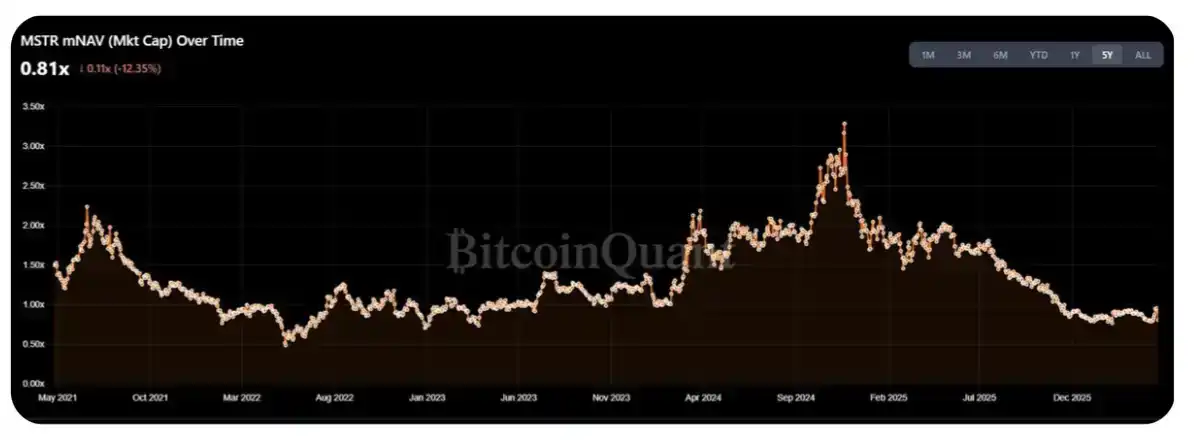
On the surface, for common stockholders, continuing to support these "yields" that do not translate into their own upside gains seems irrational—under continuous issuance, the BTC holdings per share have not substantially increased (though this is largely due to Strategy's already massive size).
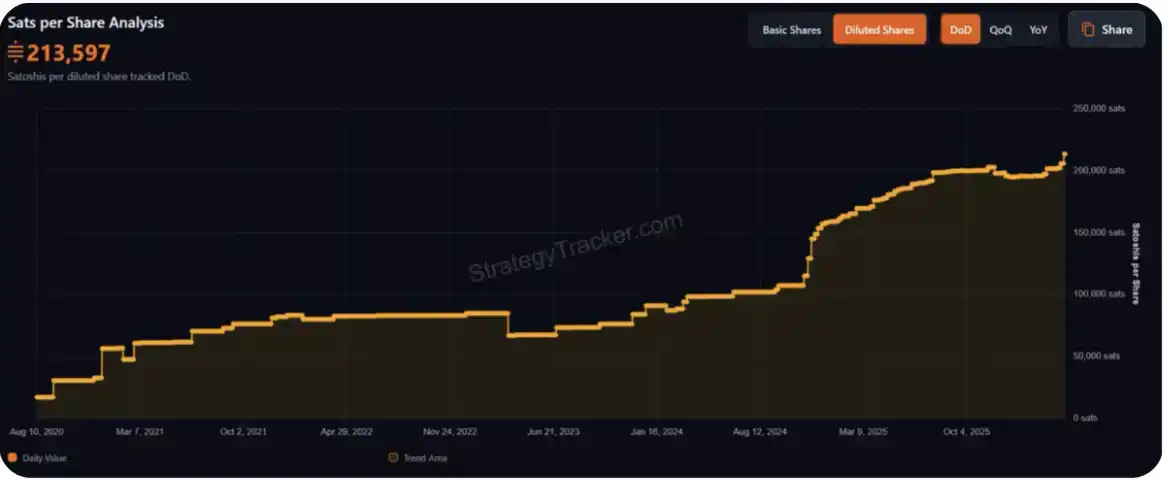
That said, DAT shareholders are a rather "special" group, and I can imagine they can withstand such pressure, at least for the next year, without necessarily adopting this view.

Additionally, the above analysis implies a key premise: MSTR can maintain an mNAV above 1 times for the foreseeable future. If it falls below 1 times, then compared to directly issuing stock, selling BTC would result in less dilution for shareholders. This would open the floodgates of supply, pushing the market into a phase of "DAT reflexivity dominating in a downturn"—a point I discussed last year (see original post).

To briefly summarize this logical chain:

STRC continues to expand;

As the scale grows, Saylor needs to pay越来越多的 dividends;

MSTR buyers gradually realize that the stock they are buying is actually financing dividends, not用于增持 BTC;

Buyers find this is not the交易结构 they initially expected and start exiting;

Once new buying dries up, mNAV falls below 1 times;

mNAV < 1 times → Saylor is forced to sell BTC instead of issuing more stock;

The market enters a panic state.

In my view, the correct way to judge STRC's maximum supply scale is to find a "tipping point": where the dividend burden from new issuances begins to exceed the marginal benefit of per-share BTC growth. A rough estimate suggests this tipping point corresponds to an annual dividend支出 of $3–4 billion, equivalent to issuing about $10–20 billion more STRC. At the current pace, it could be reached within 6 months.

Of course, Saylor still has room to maneuver. The dividend reserve does help stabilize prices and market confidence, but if the震荡 or downtrend continues, holders are essentially playing a game of "musical chairs." When the dividend reserve is down to 6 to 9 months, the rational choice might become: exiting early in the 90–95 price range, rather than bearing the downside risk of Saylor suspending dividends (another option he has).

Although STRC dividends are "cumulative," in extreme cases, I believe Saylor is more likely to choose "com sacrificing preferred stock credit" rather than being forced to大规模 sell BTC. Essentially, he faces this arithmetic problem: "If I fulfill preferred stock obligations and give up future issuance space, how much more BTC can I buy" - "the amount of BTC I have to sell to maintain preferred stock" = result

If the result is positive, choose to sell BTC; otherwise, "sacrifice" preferred stockholders

The main argument against this judgment is: once it really reaches the stage where this calculation is needed, the market has likely already turned, and MSTR's mNAV has most likely fallen below 1 times.

Thank you for reading, even if the beginning was somewhat "sensational." Also welcome any different views or criticisms. (Acknowledgments to @TraderBot888, the first person to discuss this idea with me back in the day.)


Related Questions

QWhat is the core risk that the article highlights regarding MicroStrategy's STRC (Structured Tokenized Return Certificate)?

AThe core risk is that the STRC, while providing a high annualized return of 11.5% and attracting massive capital inflows, creates a massive and growing dividend obligation for MicroStrategy. If the Bitcoin market turns bearish or remains stagnant, this reliance on continuous financing to pay these dividends could quickly deplete the company's dividend reserve, potentially forcing it to sell its Bitcoin holdings or default on its obligations, leading to a downward spiral for the company.

QAccording to the article, what is the estimated annual dividend obligation created by STRC and other preferred instruments?

AThe article states that the outstanding scale of STRC and other preferred instruments is approximately $13.5 billion, which creates an annual dividend obligation of about $400 million.

QWhat is the 'inflection point' or 'tipping point' mentioned in the analysis for the STRC structure?

AThe 'inflection point' is the point at which the dividend burden from new STRC issuances begins to exceed the marginal benefit of the increase in Bitcoin holdings per share. A rough estimate places this point at an annual dividend expenditure of $3-4 billion, which would be equivalent to issuing an additional $100-200 billion in STRC.

QWhat critical scenario would force MicroStrategy to sell its Bitcoin holdings instead of issuing more stock?

AThe critical scenario is if MicroStrategy's market capitalization falls below its metric Net Asset Value (mNAV), specifically if mNAV drops below 1x. In this case, selling Bitcoin would be less dilutive to shareholders than issuing more stock, potentially opening the floodgates to a panic-driven market.

QWhat is one potential extreme action Michael Saylor might take if the dividend burden becomes unsustainable, according to the author's analysis?

AThe author suggests that in an extreme scenario, Michael Saylor might choose to 'sacrifice the credit of the preferred shares' entirely—meaning he would likely suspend dividend payments to STRC holders—rather than be forced into a large-scale sell-off of MicroStrategy's Bitcoin treasury.

Related Reads

POLY's Appearance Hints Are Getting Denser, How Far Away Is the Polymarket Airdrop?

**POLY Debut Hints Grow More Frequent: How Far is the Polymarket Airdrop?** Recent continuous hints from Polymarket team members regarding the POLY token have sparked widespread analysis within airdrop communities about its launch timeline and potential scale. According to predict.fun data, the probability of "Polymarket launching its official token before year-end 2025" currently stands at 56%. Hints about POLY began in October 2024. CEO Shayne Coplan's social media post mentioning $POLY alongside major cryptocurrencies first fueled speculation. This was followed by Growth Lead William LeGate discussing "prospective airdrop farmers," and CMO Matthew Modabber explicitly confirming that "Polymarket will have a token, and there will be an airdrop." The momentum continued into 2025. In April, major crypto data platforms CoinGecko and CoinMarketCap created placeholder pages for POLY, further solidifying expectations. May saw discussions shift towards token utility and airdrop criteria. A team member's "Soon" reply to a question about staking POLY for fee reductions, and a leaked internal screenshot showing an "Airdrop" tab, significantly increased anticipation. LeGate also outlined potential airdrop qualifiers, mentioning badges for employees, high-volume/high-profit traders, and ecosystem builders. He suggested that linking a Polymarket account to X (Twitter), sharing trades and market insights, and actively engaging with the community might constitute part of the eligibility criteria, leading to a surge in related social media activity. Despite the growing hype, the article's author expresses a personal view that Polymarket might prioritize platform stability and infrastructure upgrades—especially with the upcoming World Cup—over an immediate token launch, opting for a post-event release. Their current strategy involves hedging positions across prediction markets, actively trading on Polymarket, and engaging on social media to potentially qualify for a future airdrop.

Odaily星球日报8m ago

POLY's Appearance Hints Are Getting Denser, How Far Away Is the Polymarket Airdrop?

Odaily星球日报8m ago

Chat with the Godfather of Crypto: $60k Bitcoin is Definitely Not the Bottom, the Real 'Capitulation Moment' is in October

**Summary: Interview with "Crypto Godfather" Michael Terpin on Bitcoin Outlook** Michael Terpin, founder of Transform Ventures and author of "Bitcoin Supercycle," discusses his market views in a podcast. He argues that Bitcoin's price around $60K is likely not the cycle bottom, with odds favoring a further decline to the $48K–$57K range, potentially bottoming in October. Key points include: * **Saylor & STRC:** He clarifies Michael Saylor's recent statement about potentially selling Bitcoin to pay dividends is driven by STRC's retail/ hybrid structure requiring an "escape valve," not a strategic shift. Saylor's large-scale OTC purchases create a floor for Bitcoin's price. * **October Bottom Thesis:** Terpin cites historical patterns (e.g., ~1-year bear markets, Coin Days Destroyed indicator, 23/35-month cycles) pointing to an October bottom. Current selling pressure is largely from leveraged retail liquidations, not whales. * **Cycle Dynamics:** He notes diminishing returns per cycle (e.g., 3000x, 100x, 30x, ~8x) and converging drawdowns. The long-term $1M Bitcoin target by 2033 remains. * **Risks & Narratives:** The real near-term "FTX moment" risk is an advanced AI model attacking a major Ethereum smart contract (e.g., Lido), not quantum computing breaking Bitcoin soon. AI tokens are expected to outperform Bitcoin in the next three years, with profits potentially flowing back into BTC. * **Market Mechanics:** He comments on reported systematic selling by firms like Jane Street and how Wall Street tactics (OTC buying, public market shorting) now influence Bitcoin. * **Supercycle & Design:** Terpin believes Satoshi intentionally aligned Bitcoin's 4-year halving cycle with US election years, influencing global liquidity cycles. He discusses Bitcoin's role in a potential new commodity supercycle driven by currency debasement.

marsbit41m ago

Chat with the Godfather of Crypto: $60k Bitcoin is Definitely Not the Bottom, the Real 'Capitulation Moment' is in October

marsbit41m ago

Trading

Spot
Futures
活动图片




