The "Bitcoin Whale" Closes Position Held for Two Months, Realizing a Profit of $11.6 Million

cryptonews.ruPublished on 2026-08-25Last updated on 2026-08-25

Abstract

Blockchain analytics platform Lookonchain identified two addresses likely belonging to the same trader, which simultaneously closed long Bitcoin positions held for nearly two months, securing a combined profit of $11.6 million. The exit coincided with Bitcoin's sharp rally above $81,000 on August 25th, a move linked by BitMEX co-founder Arthur Hayes to new U.S. Treasury bond-buying programs signaling a fresh bull market. The surge to $81,000 was fueled by $225 million in short liquidations within 10 minutes, creating a squeeze that propelled prices. While some large holders took profits after months of paper losses earlier in the year, others continued accumulating, betting on further upside. With Bitcoin having one of its strongest quarters since 2021, the market now watches whether the $80,000 level will hold as support or if profit-taking pressure will emerge. Macro voices like Hayes suggest Treasury liquidity could drive Bitcoin toward six figures, making the coming days crucial to see if such whale exits are isolated or the start of a broader trend.

Blockchain analytics platform Lookonchain identified two addresses (0x5FA and 0x237) that may belong to the same trader. Both wallets simultaneously closed long Bitcoin positions, concluding a trade this investor had held for nearly two months.

The total profit amounted to $11.6 million, although the exact entry price and position size remain unknown. The timing evidently coincided with Bitcoin's sharp price surge of $20,000 to the $81,000 mark on August 25th (a gain of over 25% during the position's holding period).

Bitcoin's breakthrough past the $80,000 level occurred on the same day that BitMEX co-founder Arthur Hayes, in a new article, stated that the expansion of the US Treasury's bond buyback program marked the beginning of a new bull market for this asset—this thesis precisely aligns with the period during which this major investor held his position.

A Rally Built on Liquidations

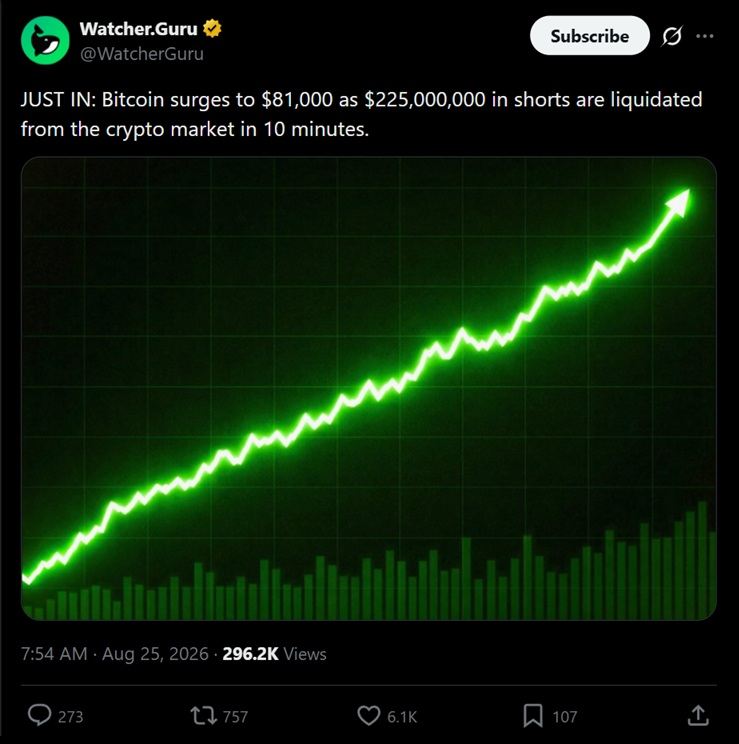
The whale's exit is just one of several events that contributed to Bitcoin's five-figure price increase. Data shows that the surge of $BTC to $81,000 occurred against a backdrop of $225 million in short position liquidations on the crypto market within 10 minutes—a chain reaction that can easily push prices upward.
Furthermore, some large holders took advantage of this rally to lock in profits after several months of paper losses for much of this year, given that Bitcoin traded significantly below $70,000 for a substantial part of this period. Others continued to accumulate positions, betting that the rally still had potential.

The third quarter has been one of Bitcoin's strongest since 2021, and the price action in the latter half of August played a significant role. Whether the wallet activity described above reflects "smart money" anticipating a local peak, or simply traders disciplinedly taking profits after a two-month hold, may become clearer in the coming weeks.

Bitcoin Price Levels Must Stabilize

The next few days will be crucial for the market, as both retail traders and institutional investors eagerly await whether the $80,000 mark will hold as a new support level, or if the aggressive short liquidations that fueled the latest rally will give way to profit-taking pressure. Furthermore, concerns about large-scale quantitative easing loom larger on the horizon, which could impact Bitcoin's price dynamics.

Finally, given the growing voices of Hayes and other macroeconomic experts arguing that Treasury liquidity dynamics could push $BTC into six figures, the coming days should show whether such whale exits are an exception or the beginning of a broader trend.

end-content
Related Questions

QWhat event did the blockchain analytics platform Lookonchain identify regarding two specific wallet addresses?

ALookonchain identified that two wallet addresses (0x5FA and 0x237), which likely belong to the same trader, simultaneously closed long Bitcoin positions they had held for nearly two months.

QAccording to the article, what was the result of the Bitcoin whale closing its position?

AThe result was a profit of $11.6 million. The closing coincided with a sharp $20,000 surge in Bitcoin's price to $81,000 on August 25th, representing a gain of over 25% during the holding period.

QHow did the article link the Bitcoin price rally to market liquidations?

AThe article stated that the spike in Bitcoin's price to $81,000 occurred alongside the liquidation of $225 million worth of short positions on the crypto market within a 10-minute window, which acted as a chain reaction pushing prices upward.

QWhat is the critical question for the market in the near term, as mentioned in the article?

AThe critical question is whether the $80,000 level will hold as a new support level or if the aggressive short liquidations that fueled the recent rally will give way to profit-taking pressure.

QWhich prominent figure's market thesis is mentioned in the article as aligning with the whale's trading period?

AThe article mentions BitMEX co-founder Arthur Hayes. His thesis, published in a new article on the same day Bitcoin broke $80,000, stated that the expansion of the US Treasury's bond buyback program marked the beginning of a new bull market for Bitcoin.

Related Reads

How Does Wall Street View Warsh's Jackson Hole Debut? Hawkish 'Correction' of July Communication; Failure to Hike in September May Further Damage Fed Credibility

Wall Street widely interpreted Fed Chair Wash's first speech at the Jackson Hole symposium as a "hawkish correction" to the Fed's July FOMC communications. Wash firmly reiterated the Fed's unwavering commitment to the 2% inflation target, indicated that overall financial conditions are not restrictive, and stated that recent positive PCE and CPI data are not enough to show meaningful improvement in underlying inflation trends. He said if confidence is lacking that inflation is falling "clearly and fast enough," the Fed "has more work to do," with Reuters calling it his closest admission yet that another rate hike may be needed. This shifted market focus to the September meeting. JPMorgan's Priya Misra called it a "hawkish speech" that cleaned up July's communication "misstep." Aberdeen's Matthew Amis warned that if the Fed doesn't hike in September, its credibility could take another hit. Barclays and Société Générale now forecast 25-basis-point hikes in September and December, with SocGen adding a March hike expectation. However, analysts noted Wash provided principles but no explicit forward guidance. The "new Fed whisperer," Nick Timiraos, observed Wash gave a more hawkish diagnosis but no clear "reaction function." The CME's FedWatch Tool showed the probability of a September hike jumped from about 35% to around 50-60% after the speech. The bond market reaction was telling: short-term yields rose more than long-term yields, indicating traders were repricing near-term rate hikes. In essence, Wash rebuilt a hawkish policy logic: if the economy remains resilient and inflation doesn't fall fast enough, more tightening is possible. The consensus is that he successfully delivered a hawkish reset. While a September hike is now a serious possibility, the final decision will hinge on incoming data, creating a credibility test for the Fed if data doesn't improve and it holds rates steady.

marsbit10m ago

How Does Wall Street View Warsh's Jackson Hole Debut? Hawkish 'Correction' of July Communication; Failure to Hike in September May Further Damage Fed Credibility

marsbit10m ago

Warsh's Latest Speech: The Era We Are In

Federal Reserve Chairman Kevin W. Warsh delivered a speech titled "In Our Time" at the Jackson Hole Economic Policy Symposium. The remarks struck a cautiously hawkish tone, with Warsh emphasizing that inflation remains significantly above the Fed's 2% target and should be the primary focus of monetary policy. He expressed that recent, better-than-expected CPI and PCE data do not yet signal a meaningful improvement in the underlying inflation trend. Warsh outlined core principles for monetary policy, including the firm commitment to the 2% inflation target, the importance of both price stability and maximum employment, and the primary role of short-term interest rates as a policy tool. He also stressed the relevance of monetary aggregates and advocated for a Fed that communicates with greater purpose and restraint. A significant portion of the speech addressed the practice of "forward guidance." Warsh argued that while essential during crises, forward guidance should be limited in normal times. He warned that excessive pre-commitment to future policy paths can constrain the Fed's flexibility and create a "hall-of-mirrors" problem, where markets rely too heavily on Fed signals rather than independently assessing economic fundamentals. On the current economy, Warsh noted impressive resilience, strong business investment (partly driven by AI infrastructure), healthy consumer spending, and a stable labor market with low unemployment. However, he observed that broad financial conditions are not particularly restrictive. Despite economic strength, inflation metrics remain elevated, with a high proportion of PCE basket components still showing price increases above 3%. Warsh concluded by stating the Fed's standard: policymakers must be confident that underlying inflation is moving clearly and sufficiently quickly toward the 2% target. Otherwise, "we have more work to do." He framed his approach as a commitment to disciplined policy-making rather than to any specific near-term decision.

marsbit1h ago

Warsh's Latest Speech: The Era We Are In

marsbit1h ago

Access to Active Sessions Instead of Databases: How the Shadow Market in Russia Has Changed

The Russian cybercriminal underground is shifting from selling massive, stolen corporate databases to trading active, short-term access to user accounts, according to a 2026 report. The value of information intercepted directly from infected devices by malware has risen nearly 13% in a year. Attackers now sell packets containing active session tokens (bypassing passwords and two-factor authentication), live email credentials, VPN and cloud storage logins, and corporate network access. A subscription for a steady stream of fresh data costs $250-$300 per month, far exceeding the value of outdated archives. While Russian regulators have successfully penalized companies for data leaks from centralized storage—with no repeat violations recorded after imposing turnover fines—this framework fails against the new threat model. Malware now steals data *after* it leaves the corporate perimeter and is on a user's personal device, a legal grey area. In 2026, 60% of studied web attacks aimed to steal keys for infiltrating corporate infrastructure. The situation mirrors global trends, akin to the Genesis Market shutdown in 2023, and highlights a structural risk: the demand for "fresh" data incentivizes botnet operators to maintain long-term control of infected devices for recurring revenue. This creates a persistent vulnerability layer between personal devices and corporate networks, currently outside the reach of existing regulatory protections.

cryptonews.ru4h ago

Access to Active Sessions Instead of Databases: How the Shadow Market in Russia Has Changed

cryptonews.ru4h ago

Trading

Spot
活动图片