Author: Nunchuk
Compiled by: AididiaoJP, Foresight News
Original title: "After You're Gone": How Should Bitcoin Be Inherited?
Self-custody is changing the way we plan for inheritance. A good Bitcoin inheritance plan must: protect your Bitcoin during your lifetime, while also ensuring that designated individuals can successfully recover these assets after you pass away.
Bitcoin grants individuals a rare ability: to hold wealth without relying on banks, brokerages, or custodial institutions. This is one of its greatest advantages.
But it is precisely this feature that makes inheritance exceptionally difficult.
For traditional assets, there is usually an intermediary institution. Banks can freeze accounts, verify documents, cooperate with courts, and transfer control. Bitcoin is completely different. The network does not recognize heirs, death certificates, probate documents, nor does it handle customer service requests. It only recognizes keys and spending conditions.
This leads to a simple but severe problem: the very characteristics that make Bitcoin difficult to steal also make it difficult to inherit.
Why Bitcoin is Different
Bitcoin inheritance is essentially a "recovery design" problem: who can access the Bitcoin, under what conditions, and through what safeguards.
The first challenge is the contradiction between security and accessibility. During your life, you need strong protection against theft, coercion, and operational errors; after you die or become incapacitated, you want trusted individuals to have a clear path to recovery. These two goals are often in conflict.
The second challenge is complexity. Many powerful Bitcoin setups (especially multisig) might be clear to the designer, but they can be completely incomprehensible to a spouse, children, trustees, or executors who don't regularly use Bitcoin. A plan that only a calm, technical person can operate is likely to fail when recovery is truly needed.
The third challenge is privacy. Inheritance planning exposes sensitive information: who owns Bitcoin, roughly how much, and who will inherit it. A poorly designed plan creates unnecessary risks for both the owner and the heirs.
The fourth challenge is time. A true inheritance plan might need to remain effective for years or even decades. This means evaluating a solution not just on whether it works today, but on whether it can outlast devices, assumptions, and even the companies involved in its setup.
This is more important than many realize. An inheritance plan that relies on a specific company existing forever might be convenient, but it is certainly not durable.
Six Questions to Ask Yourself
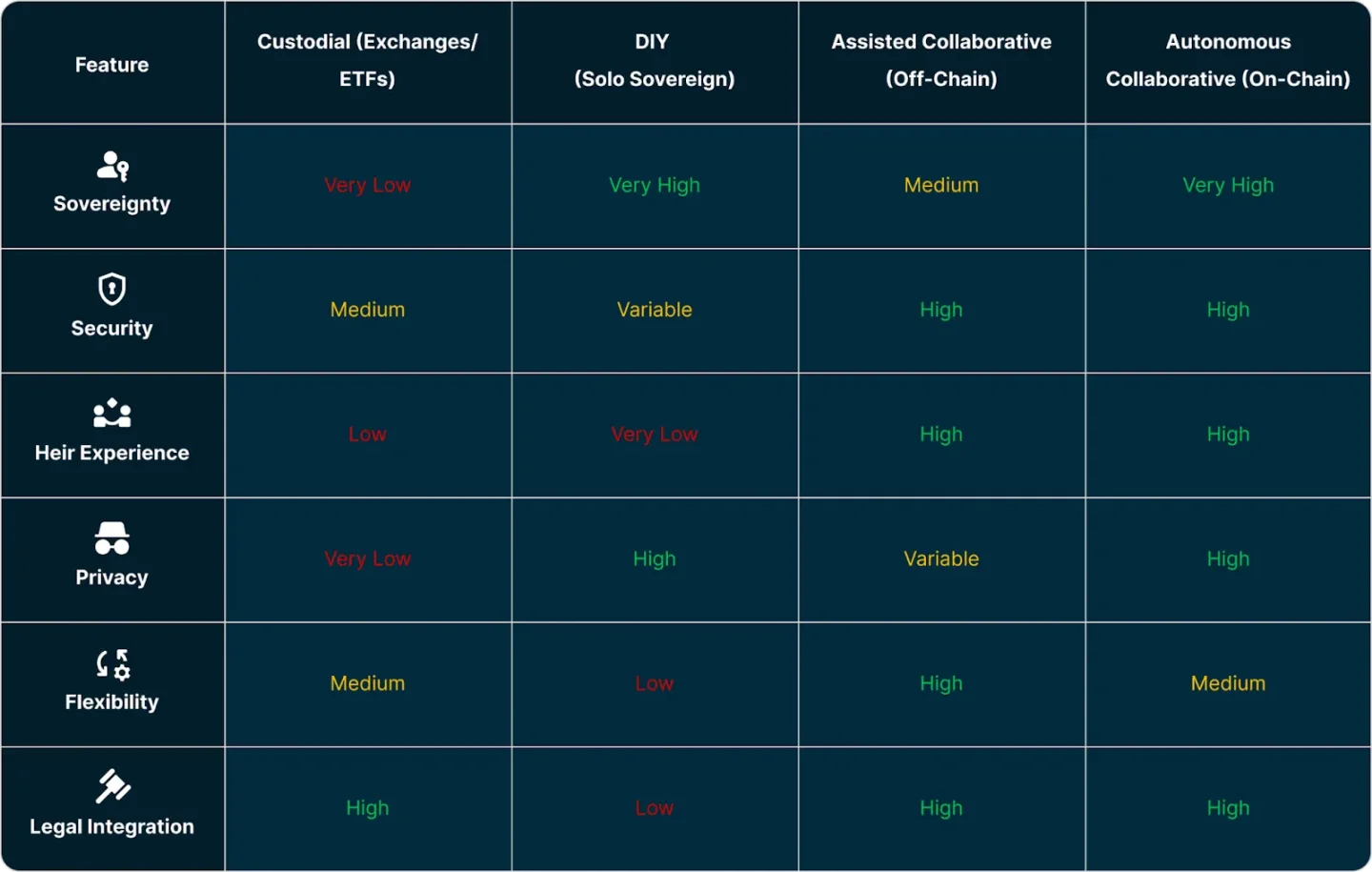
Every Bitcoin inheritance solution involves trade-offs. The simplest way to compare them is to ask six questions:
-
Autonomy: Does it preserve your full control over the assets, or does it rely on a company, custodian, trustee, or legal process to function?
-
Security: During your lifetime, does it effectively prevent Bitcoin from being stolen, coerced, or accidentally misplaced?
-
Heir Experience: Can your designated heirs actually recover the funds without confusion or making fatal mistakes?
-
Privacy: How much sensitive information about you or your family does this solution expose?
-
Flexibility: Is it easy to update the plan when beneficiaries, timelines, or family circumstances change?
-
Legal Compatibility: If needed, can it work alongside wills, trusts, or trustee systems?
No single solution excels in all dimensions, but these six questions make the trade-offs clear.
Four Common Solutions
1. Custodial Inheritance
The most traditional method is to keep Bitcoin on an exchange, in an ETF, with a brokerage, or with another custodian, and let the traditional legal system handle the transfer.
Its appeal is obvious: accounts are tied to identity, there are statements, customer support, and a relatively clear legal process for heirs.
But the cost is also clear: the institution holds the private keys. This means whether the assets can be withdrawn depends on the institution's policies, compliance processes, jurisdiction, and its ability to survive long-term. Heirs might face the dual hurdles of both the legal system and the trading platform. The concentration of vast amounts of sensitive customer data in one place also introduces privacy and security risks that don't exist with self-custody.
This approach is feasible, but its way of solving the inheritance problem essentially abandons the core value proposition of self-custodying Bitcoin.
2. DIY Inheritance
DIY inheritance covers a broad spectrum. At the simplest end is single-signature handover: directly leaving the seed phrase, hardware wallet, or a complete recovery backup to heirs. At the complex end are multisig and timelock setups built with open-source tools.
These should not be conflated.
From a security perspective, the most vulnerable is the simple single-signature handover. Each additional seed phrase backup is another target for theft, especially when a single person or location can unlock the entire wallet. Leaving complete recovery materials in a home safe, office drawer, or bank safety deposit box with no additional protection is even riskier.
Adding a BIP39 passphrase can improve this situation, but it brings new risks: there's no checksum to detect transcription errors; short passphrases can be brute-forced; long and complex passphrases might be impossible for the owner or heirs to accurately reproduce years later, locking them out of the wallet.
On the other end, well-designed DIY multisig or timelock scheme can be extremely robust. Many experienced Bitcoin users choose this path for good reason. But the cost is operational: the responsibility for setup, maintenance, and recovery falls entirely on the owner and their heirs, with often no one to ask for help if something goes wrong.
If executed properly, DIY can offer极强的 (extremely strong) autonomy and security, but it demands more from everyone involved.
3. Service-Assisted Collaborative Custody
There is a middle path: collaborative custody. In this model, the owner still uses a multisig setup, but a service provider assists with account setup, key management, recovery operations, and the inheritance process.
Compared to pure custody or pure DIY, this is a definite step forward. The owner retains more control, while heirs get assistance when needed.
Most of these services handle the inheritance logic off-chain: waiting periods, proof of life checks, beneficiary arrangements, and recovery processes are coordinated through the service provider's systems, rather than being directly encoded into the Bitcoin chain's spending conditions.
This has clear benefits. Off-chain inheritance is easier to update. If the owner wants to change beneficiaries, adjust waiting periods, or set up more complex phased distribution plans, off-chain operations are usually much more convenient than fully on-chain solutions.
The cost is the reliability of the recovery path. Whether inheritance can be realized still depends on whether the service provider exists and is willing to cooperate when the heirs make a request.
For many families, this is still a good choice, especially when guided recovery and operational flexibility are important.
4. On-Chain Collaborative Inheritance
A newer model builds on collaborative support by adding an on-chain fallback option.
The owner still gets the security of multisig and the guidance of a service provider, but the recovery path for inheritance is also written into the Bitcoin chain's spending rules. For example, using a timelock to set a deadline, after which the spending conditions automatically change, allowing heirs to recover the funds on their own even if the service provider is unavailable.
This is an important change in risk control: the recovery path is anchored in Bitcoin's rules, not just dependent on the continued cooperation of a single service provider.
This model, of course, also has costs. Because part of the plan is enforced on-chain, it is less convenient to adjust. Modifying inheritance timing or plan structure might require moving funds and paying network fees.
But for holders who want collaborative support while also having a long-term reliable backup, on-chain inheritance is a significant advancement.
Where the Real Trade-offs Lie
When comparing modern inheritance solutions, the most meaningful question isn't "which is best," but "what are you most trying to optimize for?"
Off-chain collaborative solutions often excel in flexibility: easy to update, adaptable to family changes, and simple to adjust over time.
On-chain collaborative solutions often excel in durability: the fallback path is designed to work even if the service provider fails, which is crucial for inheritance plans that need to remain effective for decades.
Many families could reasonably choose either. The key is what matters most to you.
If you view Bitcoin as generational wealth, then durability should be a core consideration.
Smooth Path + Last Line of Defense
Most Bitcoin inheritance solutions tend to lean towards two extremes.
One end sacrifices autonomy for convenience: easy to understand, but heavily reliant on institutions, identity verification, or service provider cooperation.
The other end sacrifices usability for autonomy: reduces trust in third parties, but places the complex technical burden on the heirs, and at their most vulnerable time.
The most robust方案 (solution) combines both paths.
The first is the smooth path: when the service provider is available and everything is normal, heirs recover the assets through a guided process that is smooth, low-stress, and error-resistant.
The second is the last line of defense: a recovery path enforced by the Bitcoin network, executable even if the service provider disappears.
This combination is important because it aligns with real inheritance scenarios: most people want their families to receive help, not face complex technical operations alone; simultaneously, very few are willing to entrust their legacy to a company that "must exist forever."
Estate Planning is Still Important
A common misconception is that Bitcoin inheritance must either completely脱离 (break away from) the traditional system or be fully integrated into the traditional financial system.
In reality, many families need a hybrid model.
Some holders want Bitcoin transferred directly and privately to their families. Others want trustee involvement, for example, for phased distribution, protecting minor children, or integrating with existing trusts. Some want to clarify their intentions with legal documents, while keeping the actual recovery path out of public probate records.
A good Bitcoin inheritance solution should support these different choices.
Therefore, it helps to think about two questions separately: Who should receive these assets? Who can actually recover these assets?
A will or trust can clarify intentions, define beneficiaries, and set legal obligations, but it doesn't itself solve the "how to recover" problem. Conversely, a purely technical recovery solution cannot bypass tax, reporting, and inheritance law requirements.
The most comprehensive plans consider both levels clearly.
Common Mistakes
Many inheritance plans fail for very ordinary reasons.
One mistake is assuming a spouse, child, or executor will "figure it out." Possessing a hardware wallet does not equate to understanding the recovery process.
Another mistake is concentrating too much power in a single point: one document, one device, one envelope that can completely unlock the funds. This certainly facilitates inheritance, but it also facilitates theft.
Another mistake is overestimating the security of a "passphrase" without thinking through the human factors in recovery. A passphrase can indeed enhance the security of a single-signature setup, but only if there is true operational discipline in every step of creation, storage, and communication.
Finally, many people make a plan once and never revisit it. Beneficiaries may change, devices may fail, family relationships may shift. A Bitcoin inheritance plan is not a static object, but a system that needs regular review.
A Simple Action List
Inheritance planning can start simple, as long as each step is intentional and regularly revisited.
-
Step 1: Determine who should inherit your Bitcoin, and whether these individuals have the ability to handle self-custody directly. Some can receive Bitcoin directly, others might need a trustee, phased handover, or guided assistance.
-
Step 2: Choose an appropriate security model based on the size of the assets and the situation of the heirs. The larger the amount, the more important multisig and formal inheritance design become.
-
Step 3: Store secrets and instructions separately. Private keys, hardware devices, and "instruction manuals" (explaining how to recover) are best kept separate, and preferably not given to the same person.
-
Step 4: Clarify what you value most. Some families are better suited for flexible off-chain coordination, others need an on-chain fallback that can outlive the service provider.
-
Step 5: Test the plan. Not with all assets, but enough to verify that the recovery path is actually usable. A plan never rehearsed is just a theory.
-
Step 6: Review your plan after major life events and periodically. Marriage, divorce, childbirth, death, moving, service providers changing – all can affect whether the original plan remains sound.
The Final Question: The True Test of Self-Custody
It's easy to think of inheritance as something to deal with "later." But in reality, it is the ultimate test of whether a custody solution is truly robust.
Custodial solutions offer familiarity, but at the cost of reintroducing reliance on institutions. DIY solutions can be excellent if technically sound, but demand more from both the owner and the heirs. Off-chain collaborative inheritance improves usability and flexibility. On-chain collaborative inheritance adds a robust long-term backup.
The most important recent advancement in this field is inheritance design that combines guided recovery with autonomous on-chain fallbacks.
For holders who want Bitcoin to become generational wealth, this shift in direction makes a lot of sense. The goal is no longer just "leaving instructions," but "leaving a recovery path that is secure, private, and operable in the long term."
Twitter:https://twitter.com/BitpushNewsCN
Bitpush TG Discussion Group:https://t.me/BitPushCommunity
Bitpush TG Subscription: https://t.me/bitpush