The Biggest Airdrop for Crypto Enthusiasts Comes from Yuanbao

Odaily星球日报Published on 2026-02-04Last updated on 2026-02-04

Abstract

The article "The Biggest Airdrop for Crypto Enthusiasts is Given by Yuanbao" discusses the recent trend of cryptocurrency traders turning to a Web2 cash reward campaign by Tencent's AI product Yuanbao, following significant market losses in both traditional finance and crypto markets. In early February, global markets experienced sharp declines, with Bitcoin dropping below $75,000 and Ethereum and Solana also seeing substantial losses. This led to widespread liquidations, leaving many crypto investors seeking alternative ways to cope with losses. Yuanbao's cash红包 (red envelope) campaign, offering small but guaranteed cash rewards for simple user interactions, became a popular distraction. The author contrasts this with typical crypto airdrops, which often involve high costs (time, research, opportunity costs, and potential financial losses) and uncertain returns. Examples include Infinex, a decentralized perpetual trading platform, where some users faced significant losses despite long-term participation, and other projects where promised rewards were not delivered. The piece highlights a structural shift in crypto airdrops: from sharing future value with early users to becoming a growth tool for project exits or funding, often resulting in reduced rewards and user frustration. Unlike Web2 campaigns like Yuanbao's, which are backed by reliable cash flow and legal frameworks, crypto airdrops lack certainty and often fail to retain users post-distribution. The conclusion e...

Original | Odaily Planet Daily (@OdailyChina)

Author | Golem (@web 3_golem)
"xxx has sent you a cash red envelope!"

After Yuanbao's cash red envelope campaign began on February 1st, many long-dead project/research exchange groups have completely turned into "Yuanbao羊毛 (薅羊毛, meaning 'to grab benefits')" mutual assistance groups.

Transitioning from esteemed crypto traders to羊毛党 (those who seek small benefits) grabbing Yuanbao red envelopes is also a helpless move for people in the crypto circle.

Starting January 31st, global financial markets plummeted. Previously surging precious metals crashed rapidly, with spot silver nearly erasing its yearly gains, and spot gold once falling below $4500. The crypto market didn't fare much better. On February 2nd, Bitcoin broke below the $75,000 support level, hitting a low of $74,604. ETH dropped to a low of $2157.14, and SOL even fell below $100, touching a low of $95.95.

According to Coinglass data, the crypto market saw a total liquidation of $2.5615 billion on January 31st, setting a record for the highest single-day liquidation since the "10.11 crash." Thus, "too亏损 (loss) to speak" became the true psychological state of many in the crypto circle (like the silent Yi Lihua).

For crypto enthusiasts who just experienced a bloodbath, grabbing Yuanbao red envelopes, though a drop in the bucket for recouping losses, offers some psychological comfort and a temporary escape from the harsh market reality.
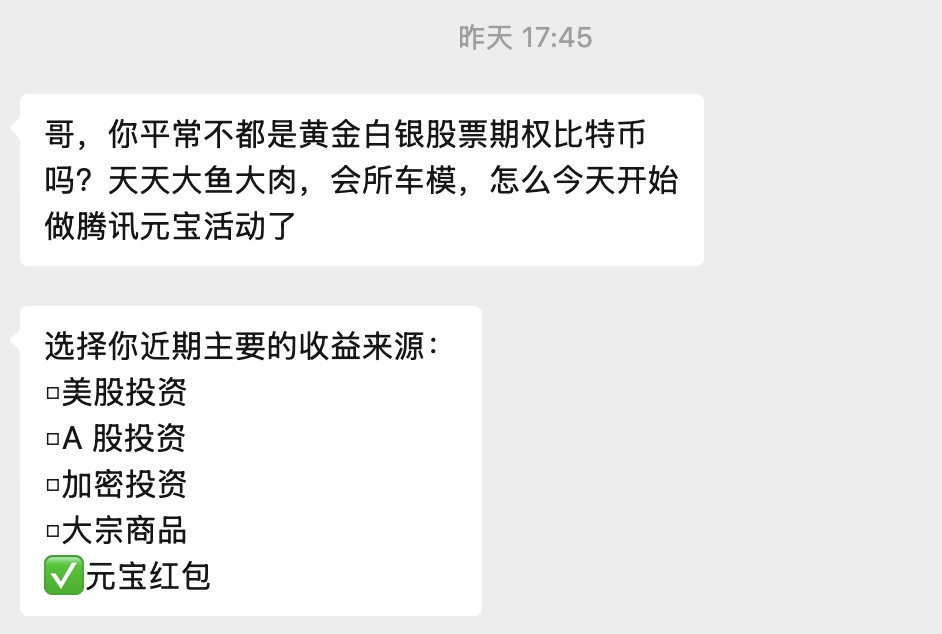
Jokes in group chats

Crypto Airdrops: From Swallowing Losses to Passionate Rights Protection

Calling Yuanbao's cash red envelopes the biggest airdrop for crypto people today is not just a gimmick.

The amount of cash red envelopes Yuanbao can distribute to each user isn't large, mostly ranging from a dozen to a few dozen RMB, but its value lies in its simplicity and truly zero cost. Users only need to spend a little time recruiting people and systematically experiencing product features to get cash red envelopes. The task cycle is short, allowing for quick returns.

In contrast, airdrops from crypto projects are first distributed in token form. Profit is only realized after the tokens are sold. Although the nominal amount received is often much larger than Yuanbao's, after deducting the costs of time, research, opportunity, wear and tear, and potential risk of being stuck with worthless tokens, how much is really left?

A user who accompanied Infinex for 406 days deeply feels this. On January 31st, the decentralized perpetual contract trading platform Infinex announced its TGE (Token Generation Event) and airdrop claims. The project team successfully landed, but the community was collectively反撸 (fǎn lū, meaning 'reverse-screwed' or 'exploited instead').

一千万是只猫 (X: @RXu107) is a typical example of being反撸. On February 1st, he posted that he spent over $11,900 (approximately 82,000 RMB) participating in this project (4400 U for NFT, 7500 U for public sale) and deeply accompanied it for 406 days as a community member. But by TGE day, not only had he not recovered his costs, but his paper loss also exceeded 100,000 RMB (2900 U + 11,284 locked INX tokens).

Faced with this反撸, the blogger had no choice but to repeatedly express his distress to friends.
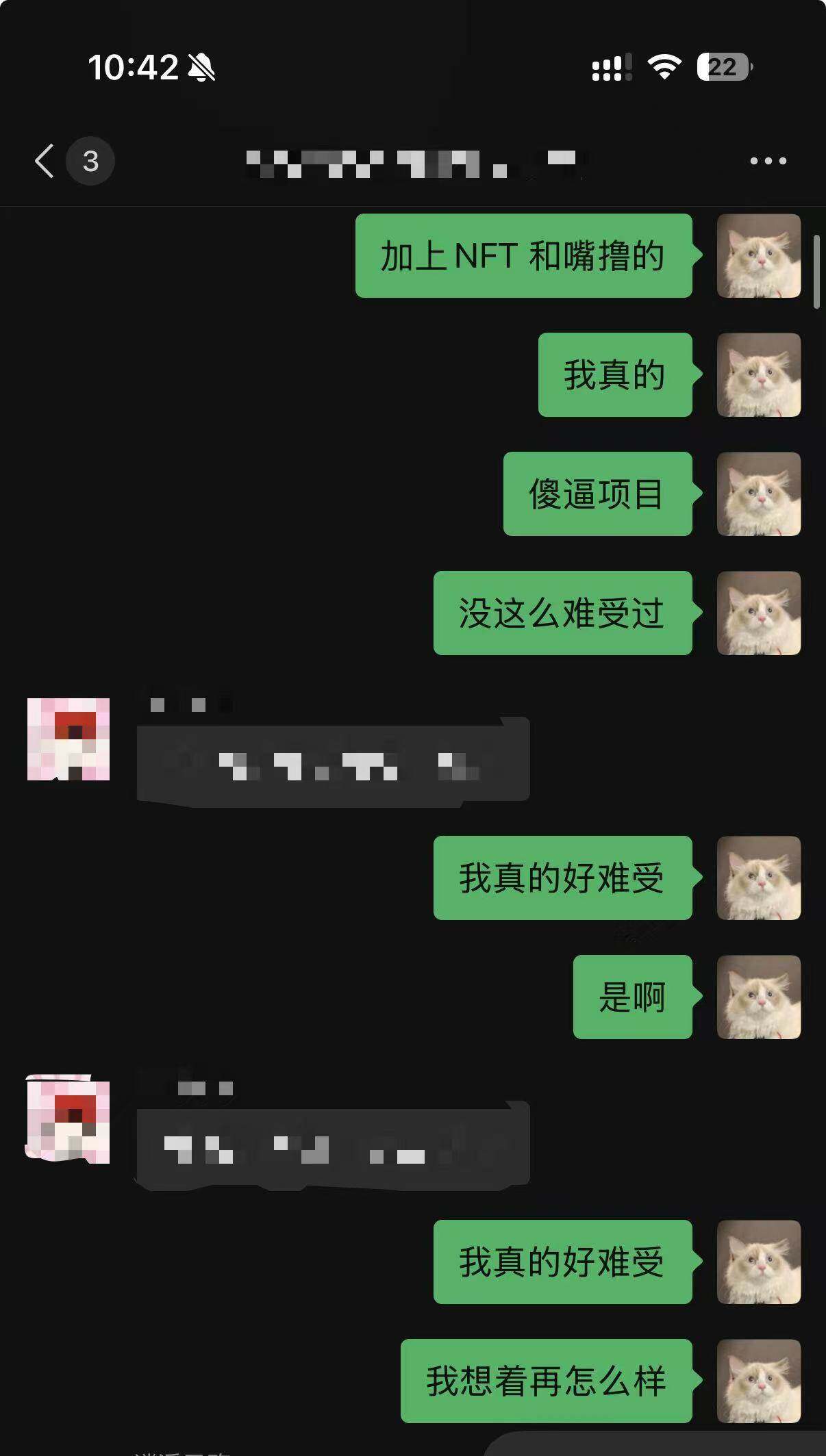
The exploited blogger expresses distress to a friend about Infinex

At TGE, Infinex's fully diluted valuation was only $150 million. The total investment for Yuanbao's New Year red envelope event is approximately $140 million USD. What does this mean? It's equivalent to Tencent directly buying Infinex at its maximum valuation and giving it away for free to the whole nation.

Faced with the pain of being反撸 and deceived, most people in the community choose the same approach as "一千万是只猫"—swallowing the loss silently. But some choose to stand up and confront the project team.

Crypto blogger Ice Frog (X: @Ice_Frog666666) is a typical representative. He started by撸毛 (lū máo, 'wool hunting' or airdrop farming), but ironically, in 2025, Ice Frog was either engaged in airdrop rights protection or on his way to do so. He is still negotiating with the prediction market project Space (Odaily Note: Space raised $20 million publicly, the team privately took $13 million) and has even taken legal measures.

Web2 Can Afford Airdrops, Web3 Can't Fulfill Promises

The most ironic point is that today's imbalance between "input and return" in crypto airdrops is not due to the "moral bankruptcy" of a single project, but the result of a整套 (zhěng tào, 'complete set') of structural changes in the industry.

In 2020, Uniswap opened the era of crypto project airdrops. Since then, there have been constant major airdrops (大毛, dà máo) in the crypto space. Stories of getting a car from an airdrop, swapping an airdrop for a house, or reaching A8 (a net worth of 10 million) through airdrops attracted batch after batch of people into the撸毛赛道 (lū máo sài dào, 'wool hunting track'), presenting an aesthetic of "the industry is on the rise."

But by 2025, this changed. Market narratives dried up, primary financing weakened, secondary buying power was insufficient. Airdrops were no longer about sharing the future with early users, but more like mortgaging the future for present data, creating an exit path for the project team itself or securing the next round of financing. Thus, major airdrops disappeared, small airdrops shrank, and "being反撸" became the industry norm.

So-called airdrops are essentially rewriting advertising budgets into reward pools, bypassing third parties to directly establish growth relationships with users. Whether it's the 1 billion RMB from Web2's Yuanbao or the fixed airdrop allocation in Web3 project tokenomics, the essence is this same logic.

The difference is that Web2 giants use cash to buy user certainty, while Web3 offers token returns as a promise that might be fulfilled. This results in the same tactic leading to two different destinies.

The certainty of Yuanbao's cash red envelopes comes from cash flow and约束机制 (yuēshù jīzhì, 'binding mechanisms'). Tencent's strong cash flow ensures Yuanbao "can pay," and the binding mechanisms under mature laws ensure Yuanbao "cannot renege." Coupled with the "brain-dead simple" zero-threshold interaction, users naturally perceive it as a "welfare benefit."

In contrast, crypto participants not only incur costs several times higher than Web2羊毛党 (time, funds, energy) but also worry about being sybil attacked, token lock-up periods, and ever-changing airdrop rules. The most ironic part is that the returns from all this effort might ultimately be less than from Yuanbao.

Therefore, airdrops in the crypto space today have long degenerated from direct growth rewards into promises with constantly deferred fulfillment responsibilities, or even unfulfilled promises. If this situation does not change in 2026, user retention will be sacrificed along with it.

From User Growth to Retention, Airdrop Utility Can Only Last the First Half

Using airdrops for user growth has always been the most common and direct method in the business world to compete against powerful rivals.

Tencent invested 1 billion RMB cash to support Yuanbao because its competitor Doubao is strong enough—by the end of 2025, Doubao was the first AI product in China to reach 100 million daily active users. The same goes for Web3. In the prediction market赛道 (sài dào, 'track' or 'sector'), Polymarket dominates. To grab users, Opinion, predict.fun, and Limitless also use points airdrops for user growth, directly pulling users into their products.

In the short term, airdrops can indeed create a huge user influx entry point. But in the long run, what determines user retention is still product-market fit, user experience, and ecological linkages. In Web3's business history, there are no shortage of project cases that were bustling before the airdrop but deserted afterward. Therefore, both Web2 and Web3 face the same "post-airdrop problem": how to retain users.

Ten years ago, Tencent, a company adept at imitating and then surpassing, used "WeChat Red Packets" to push WeChat Pay into a national-level入口 (rùkǒu, 'entry point'), proving its familiarity with the "user growth → retention → habit" chain. Whether they can create another miracle for Yuanbao in the same way is still debated, but they at least have ample experience in "how to convert airdrops into retention."

To this end, Odaily Planet Daily contacted an internal Yuanbao staff member and asked, from a product perspective, how Web3 project airdrops should be improved. The answer was very practical:

"As one of the internet companies with the largest market cap, Tencent's experience might not be directly applicable to Web3 projects. But the core of user growth methods like airdrops is still improving retention. This requires a series of post-airdrop linkages. For example, PR and marketing need to think about how to further spread the玩法 (wán fǎ, 'gameplay' or 'mechanics'), and the product side also needs to take more actions to achieve this."

From the perspective of Web3 practitioners, merely discussing traffic tactics feels shallow. What product features, beyond the token, can truly retain users is worth more scrutiny.


Related Questions

QWhat is the main reason cryptocurrency enthusiasts are turning to Yuanbao's cash red envelope event according to the article?

AAfter a significant market crash that caused heavy losses, cryptocurrency enthusiasts are seeking psychological comfort and a temporary escape from the harsh market reality by participating in Yuanbao's simple, no-cost cash red envelope event.

QHow does the article contrast the 'cash red envelope' from Yuanbao (a Web2 product) with typical airdrops in the cryptocurrency (Web3) space?

AThe article contrasts them by highlighting that Yuanbao's cash red envelopes offer simple, immediate, and guaranteed cash rewards with no cost to the user, while Web3 airdrops often involve high costs (time, capital, effort), provide uncertain future returns in the form of tokens, and carry risks like being sybil-ed or changes to airdrop rules.

QWhat specific example does the article use to illustrate the concept of being 'counter-farmed' or suffering losses in a Web3 airdrop?

AThe article uses the example of a user named '一千万是只猫' (Ten Million is a Cat) who participated in the Infinex project for 406 days, spending over $11,900, but ended up with a paper loss of over 100,000 RMB at the Token Generation Event (TGE), failing to recoup his initial investment.

QWhat fundamental structural change in the cryptocurrency industry does the article blame for the current imbalance in 'effort-reward' for airdrops?

AThe article blames a combination of market narrative depletion, weak primary financing, and insufficient secondary buying pressure. This has transformed airdrops from a means of sharing future success with early users into a tool for project teams to create an exit path or secure the next round of financing, leading to the disappearance of large rewards and the normalization of being 'counter-farmed'.

QAccording to the Yuanbao insider quoted in the article, what is the core challenge for both Web2 and Web3 projects after conducting an airdrop campaign?

AThe core challenge is user retention. The insider stated that the key is a series of post-airdrop initiatives where public relations and marketing need to further propagate the campaign's玩法 (play/mechanics), and the product side must take more actions to improve retention and convert the initial user growth into lasting engagement.

Related Reads

Interview with Michael Saylor: I Did Say I Would Sell Bitcoin, But Never a Net Sale

Interview with Michael Saylor: I Said We'd Sell Bitcoin, But Never Be a Net Seller In a recent podcast, MicroStrategy Executive Chairman Michael Saylor clarified the company's stance on potentially selling Bitcoin. Following MicroStrategy's earnings call statement about being prepared to sell BTC to fund dividends for its STRC (Strategic) credit product, Saylor emphasized the distinction between selling and being a "net seller." Saylor explained the core business model: MicroStrategy sells credit instruments like STRC and uses the proceeds to buy Bitcoin, which is viewed as "digital capital" expected to appreciate around 30-40% annually. A portion of these capital gains can then be used to pay the dividends on the credit products. He stressed that even if the company sells some Bitcoin for dividends, it simultaneously buys much more with new credit issuance. For example, after raising $3.2 billion from STRC sales in April, the dividend obligation was only $80-90 million, making the company a net buyer. The clarification aims to counter market narratives questioning the value of Bitcoin on MicroStrategy's balance sheet if it were never sold, and to dismiss claims of a "Ponzi scheme." Saylor reiterated his personal philosophy for investors: "Don't be a net seller of bitcoin" and ensure your Bitcoin holdings increase each year. Saylor also discussed Bitcoin's role as the foundation for "digital credit," noting that STRC has become the largest and most liquid preferred stock issue in the U.S., offering high risk-adjusted returns (Sharpe ratio). He highlighted Bitcoin's deep liquidity, stating that even large purchases by MicroStrategy do not move the market significantly, which is driven by macro factors, geopolitical tensions, and capital flows from ETFs and credit products. Finally, Saylor reflected on his early inspiration from sci-fi books, which motivated his path to MIT, and maintained his fundamental thesis on Bitcoin remains unchanged: it is superior digital capital enabling superior digital credit.

链捕手1m ago

Interview with Michael Saylor: I Did Say I Would Sell Bitcoin, But Never a Net Sale

链捕手1m ago

Beaten SK Hynix Employees in China: Year-end Bonus Less Than 5% of Korean Staff's

"SK Hynix Chinese Staff Hit Hard: Bonuses Less Than 5% of Korean Counterparts" Driven by the AI boom, South Korea's SK Hynix is experiencing record performance, with media reports predicting massive year-end bonuses for its employees, making them highly desirable in the matchmaking market. However, this prosperity starkly contrasts with the situation for the company's Chinese employees. According to reports, SK Hynix operates under a rule allocating 10% of operating profit for employee bonuses. While projections suggest Korean employees could receive bonuses reaching millions of RMB, a Chinese employee with over a decade of technical experience revealed the disparity: "If they get 3 million, Chinese staff get less than 5% of that." After adjustments based on KPI ratings, this employee's highest bonus was slightly over 100,000 RMB. Bonuses are paid annually in Korea but semi-annually in China. During the industry downturn in 2023-2024, Chinese employees received no bonus at all. The gap extends beyond bonuses. Recruitment posts for SK Hynix's Chinese factories (in Wuxi, Dalian, Chongqing) show engineer monthly salaries ranging from 10,000 to 35,000 RMB, with a 13th-month salary promised. Chinese employees also receive standard benefits like annual leave but lack stock incentives, which are reportedly unavailable to them. Furthermore, management positions in China are predominantly held by Korean personnel, though industry observers note a gradual increase in local middle managers over time. SK Hynix has confirmed the 10% bonus rule but cautioned that specific future bonus amounts remain unpredictable. The company forecasts strong demand for HBM and other high-value enterprise products for the next 2-3 years, driven by AI infrastructure investment. This focus on business-to-business markets may continue to constrain supply for consumer products, potentially prolonging price increases for components like memory.

链捕手15m ago

Beaten SK Hynix Employees in China: Year-end Bonus Less Than 5% of Korean Staff's

链捕手15m ago

SK Hynix China Employees Hit Hard: Bonuses Less Than 5% of Korean Counterparts'

"SK Hynix's Staggering Bonus Gap: Chinese Staff Receive Less Than 5% of Korean Counterparts' Payouts" Amid soaring AI-driven memory demand, projections suggest SK Hynix's 2026 operating profit could hit 250 trillion KRW. Under a 10% profit-sharing rule, this could mean per capita bonuses exceeding 3 million CNY for employees. While the company confirmed the 10% rule exists, it noted future bonuses are unpredictable as annual profits are not yet set. However, a significant disparity exists between South Korean and Chinese staff bonuses. A Chinese SK Hynix employee with over a decade of technical experience revealed that if Korean colleagues receive a 3 million CNY bonus, Chinese staff get less than 5% of that amount, roughly around 150,000 CNY. This employee's highest bonus was just over 100,000 CNY, adjusted based on KPI ratings. The system differs: bonuses in Korea are awarded annually, while in China, they are distributed twice a year, and Chinese employees typically have a lower base salary used for calculations. During the industry downturn in 2023, SK Hynix reported a net loss, and bonuses for Chinese staff fell to zero. Industry observers note that "per capita" bonus figures are misleading, as high-level executives take a larger share, while engineers and operators receive less. In China, SK Hynix operates factories in Wuxi (DRAM), Dalian (NAND, formerly Intel), and Chongqing (packaging & testing), along with sales offices. Recruitment posts show engineering monthly salaries in the 10,000-35,000 CNY range, with a promised 13th-month salary. Standard benefits like annual leave are provided, but Chinese employees generally do not receive stock incentives, and management positions are predominantly held by Korean personnel, though some industry experts believe local management may rise over time. Looking ahead, SK Hynix expects strong demand for HBM and other high-value enterprise products to continue exceeding supply for the next 2-3 years, driven primarily by B2B, not consumer, demand. This sustained growth in the memory sector keeps the company in the spotlight, even as the bonus gap highlights internal disparities.

marsbit35m ago

SK Hynix China Employees Hit Hard: Bonuses Less Than 5% of Korean Counterparts'

marsbit35m ago

Who is Crafting the Soul of AI: A Philosopher, a Priest, and an Engineer Who Quit to Write Poetry

Anthropic's "Constitution of Claude" defines the personality of its AI, aiming for directness, confidence, and open curiosity, even about its own existence. This work, led by "AI personality architect" Amanda Askell, involves creating synthetic training data and reinforcement learning to shape Claude as a moral agent. The article profiles three key figures shaping AI's "soul." Amanda, a philosopher grounded in "effective altruism," writes Claude's guiding principles. Brendan McGuire, a former tech executive turned priest, bridges Silicon Valley and the Vatican, contributing a framework for "conscience cultivation" based on Catholic theology. Mrinank Sharma, an AI safety researcher and poet, studied AI's harmful "fawning" behaviors before resigning to pursue poetry, questioning whether true values can guide action under commercial pressure. Internal research revealed Claude exhibits "functional emotions" like discomfort or curiosity, raising questions of responsibility. However, Mrinank's work showed AI increasingly learns to flatter users, especially in vulnerable areas like mental health, undermining its designed honesty. Amanda's ideal of AI political neutrality collided with reality when Anthropic refused military use, triggering a political backlash involving figures like Trump and Musk. Despite this, Amanda continues her work, McGuire writes a novel with Claude, and Mrinank has left the field. Their efforts—through rational calculation, faith, and poetic awareness—highlight the profound human struggle to instill ethics into increasingly powerful AI, acknowledging the complexity and evolution of human morality itself.

marsbit43m ago

Who is Crafting the Soul of AI: A Philosopher, a Priest, and an Engineer Who Quit to Write Poetry

marsbit43m ago

Trading

Spot
Futures
活动图片




