Texas grid is heating up again, this time from AI, not Bitcoin miners

cointelegraphPublished on 2025-12-11Last updated on 2025-12-11

Abstract

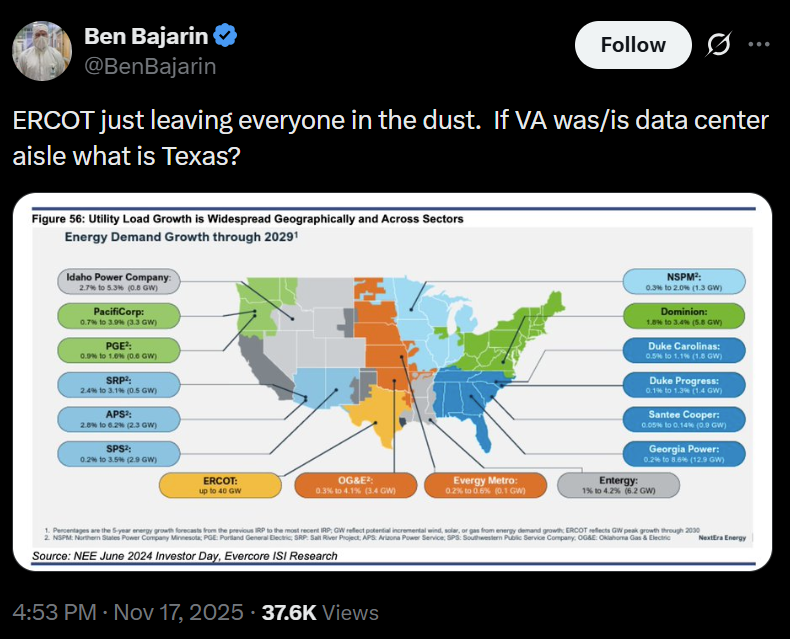
Texas is rapidly becoming a major hub for AI-driven energy demand, with a significant surge in large-load power requests—now dominated by AI data centers rather than Bitcoin miners. ERCOT, the state’s grid operator, reports a queue of 226 gigawatts of new power requests, 73% of which are linked to AI facilities. While the supply side has 1,999 generation proposals totaling 432 GW, mostly solar and battery projects, these sources can't provide the 24/7 power AI data centers need, creating potential reliability issues. Regulators are adapting with new rules for large power users and increased transmission projects. Meanwhile, Bitcoin miners, once major energy users, are shifting toward AI computing to capitalize on growing demand, as seen in projects like Galaxy’s $460 million conversion of a Texas mining site into an AI data center.

Texas is rapidly emerging as an epicenter of artificial intelligence-driven energy demand, with an unprecedented surge in large-load power requests, a wave now dominated by AI data centers rather than Bitcoin miners.

The figures, highlighted in The Miner Mag’s latest newsletter and drawn from ERCOT’s new System Planning and Weatherization Update, point to a grid facing a fundamentally different kind of growth.

ERCOT, the Electric Reliability Council of Texas, which operates the state’s independent power grid and oversees reliable electric service for about 90% of Texans, reported that its large-load interconnection queue has ballooned to 226 gigawatts of new requests, roughly 73% tied to AI facilities.

Developers have already filed 225 large-load requests this year, and on the supply side, ERCOT is reviewing 1,999 generation proposals totaling 432 GW, according to The Miner Mag.

However, the load is growing faster than the supply. While the generation queue is massive, it remains dominated by solar and battery projects, which are resources that don’t provide the around-the-clock power that AI data centers require. That mismatch is setting up future reliability and investment challenges.
Source: Ben Bajarin

State regulators are racing to adapt, The Miner Mag reported. New rules are being developed to classify any customer requesting 75 MW or more as a “special handling” case, and ERCOT has more than doubled the number of transmission projects under review.

Related: Bitcoin miners gambled on AI last year, and it paid off

What about Bitcoin miners?

The Miner Mag report drew a contrast between today’s surge in AI-driven power demand and the earlier boom from Bitcoin (BTC) miners, noting that Texas’ emerging grid crunch is now being fueled by AI, not crypto.

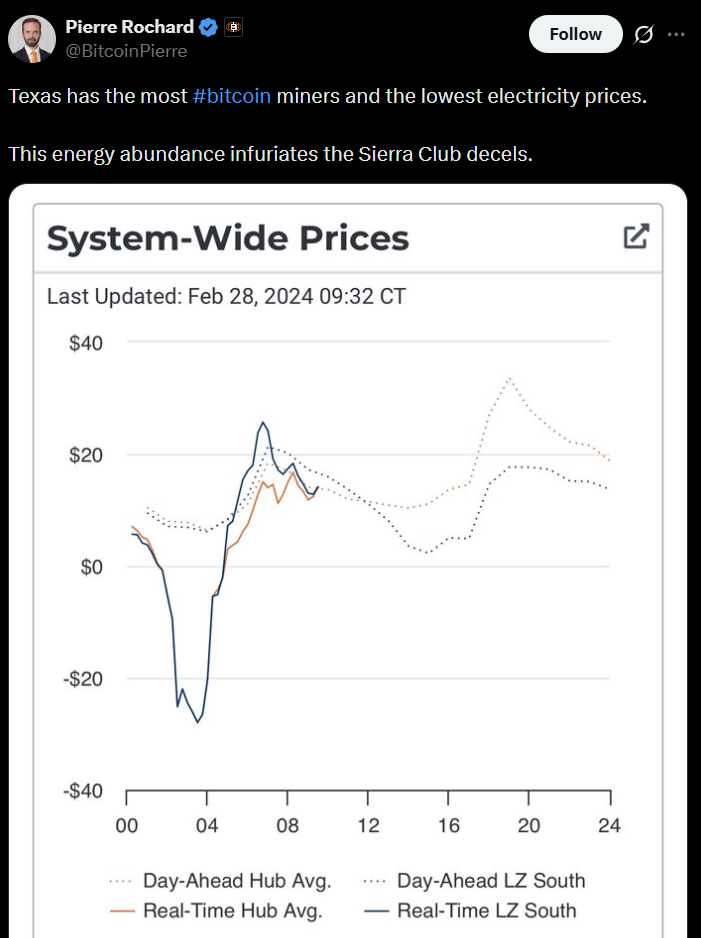
Bitcoin miners were once among the largest new power users in the state. Their impact was arguably positive: Miners frequently curtailed operations during peak demand and, according to a January study by the Digital Asset Research Institute, helped bolster grid stability and save the state an estimated $18 billion.
Source: Pierre Rochard

However, the landscape is shifting. Many miners and digital asset operators are reallocating their infrastructure toward AI computing to capitalize on the soaring demand for GPU capacity.

A recent example is Mike Novogratz’s Galaxy, which secured $460 million to convert its former Texas Bitcoin mining site into a large-scale AI data center.

Related: Bitcoin miners enter ‘harshest margin environment of all time’

Related Reads

Central Bank Responds to Call to 'Exit the Sandbox' and Allows Stablecoins

Sberbank CEO Herman Gref expressed the bank's hope for the authorization of stablecoins for domestic transactions in Russia, stating that Sber is actively discussing this possibility with the Bank of Russia. He emphasized the need to move beyond the current regulatory "sandbox" and allow basic transactional functionality with stablecoins, primarily ruble-denominated tokens for internal use. However, the Bank of Russia maintains its position that stablecoins are a form of cryptocurrency and excludes their use for domestic payments. Kirill Pronin, head of the central bank's financial market infrastructure department, argued that Russia's digital payment ecosystem is already highly developed, making such authorization unnecessary. The article notes that Russia currently operates with Digital Financial Assets (DFAs), which are tokenized versions of real assets issued on approved blockchain platforms. Some foreign digital rights, including compliant stablecoins, can be classified as DFAs. The first such recognized asset was a Kyrgyzstani ruble stablecoin, permitted only for foreign economic activity. Pronin also mentioned that the central bank is considering allowing banks and token issuers to directly issue digital assets in public blockchains, as the current method of transferring domestically issued tokens to open networks has not gained significant traction. This shift could reduce operational costs and cybersecurity risks.

RBK-crypto1m ago

Central Bank Responds to Call to 'Exit the Sandbox' and Allows Stablecoins

RBK-crypto1m ago

17 Most Anticipated Things in the Cryptocurrency Space in 2026

17 Key Crypto Developments to Watch in 2026 Stablecoin on/off ramps will mature, connecting digital dollars to local payment systems and enabling new behaviors like real-time cross-border payments and merchant adoption without bank accounts. Stablecoins will evolve into a foundational internet settlement layer. RWA tokenization will shift toward crypto-native approaches like perpetual futures for deeper liquidity. Stablecoins will see more native issuance rather than tokenization, and on-chain native debt issuance will reduce costs and improve accessibility. Banks will leverage stablecoins to innovate without overhauling legacy systems. The internet itself will become a banking layer as value moves programmatically via smart contracts and new primitives like x402. Wealth management will become personalized and automated for everyone via tokenized assets and AI-driven portfolio management. DeFi tools and tokenized private markets will expand access. AI agents will require identity verification (KYA - Know Your Agent) and new economic models to compensate content creators as agents scrape the open web. AI will also enable new research methodologies via layered, reasoning agents. Privacy will become crypto's key moat, creating strong network effects as bridging between private and public chains risks metadata leakage. Decentralized, quantum-resistant messaging will rise, emphasizing user ownership. "Secrets-as-a-service" will emerge for programmable data access control. DeFi security will evolve from "code is law" to "specification is law" with runtime enforcement of invariants. Prediction markets will expand with more contracts, AI-powered oracles, and decentralized governance. "Staked media" will rise, where commentators back arguments with verifiable, on-chain commitments. SNARKs will become efficient enough (~10,000x overhead) for verifiable cloud computing, moving beyond blockchain. Finally, crypto market structure regulation could align legal and technical frameworks, enabling networks to operate as truly open, decentralized systems.

marsbit2m ago

17 Most Anticipated Things in the Cryptocurrency Space in 2026

marsbit2m ago

Trading

Spot
Futures
活动图片