Tether-backed Northern Data sold mining firm to Tether execs: FT

cointelegraphPublished on 2025-12-22Last updated on 2025-12-22

Abstract

Northern Data, a Tether-backed data center operator, sold its Bitcoin mining business, Peak Mining, for up to $200 million to three companies run by Tether executives, including its co-founder and CEO. The sale occurred just before Rumble, a video-sharing platform in which Tether holds a major stake, agreed to acquire Northern Data. This is the second attempt to sell the mining unit to a Tether-linked entity. Northern Data is under investigation in Europe for suspected tax fraud and has a complex financial relationship with Tether, including a €610 million loan. The sale highlights Tether's expanding interests beyond stablecoins into mining, AI, and other ventures.

The Tether-backed data centre operator Northern Data reportedly sold its Bitcoin mining business, Peak Mining, to three companies run by Tether executives.

Northern Data was sold for up to $200 million to Highland Group Mining, Appalachian Energy, and an Alberta-based company, run by Giancarlo Devasini, Tether co-founder and chair, and its CEO, Paolo Ardoino, the Financial Times reported on Friday.

Filings reportedly show that Highland Group’s directors are Devasini and Ardoino, and the sole director of the Alberta company is Devasini, while it remains unclear who runs Delaware-based Appalachian Energy.

Northern Data initially announced the Peak Mining divestment in November, but did not identify the buyers, as it was not required by German regulators.

The deal also happened just before video-sharing platform Rumble, in which Tether holds nearly a 50% stake, agreed to acquire Northern Data.
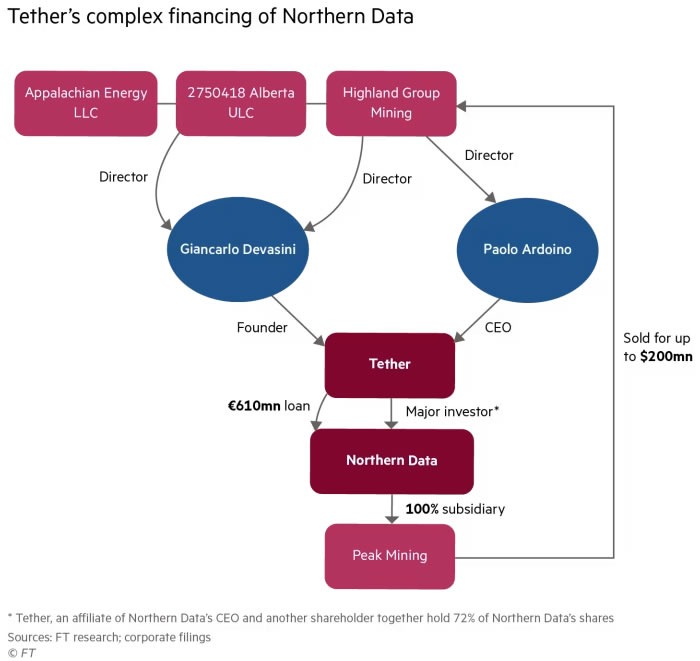
Tether’s complex web of financial ties. Source: The Financial Times

Web of complex financial ties

It is also the second attempt to sell Peak Mining to a Devasini-controlled company. The first deal announced in August was with Elektron Energy for $235 million, but it fell through amid whistleblower allegations.

Northern Data faces investigation by European prosecutors for suspected tax fraud, and its offices were raided in September.

Related: Tether deepens AI bet, backs Italian firm’s humanoid robots

Tether has also agreed on a $100 million advertising deal with Rumble and plans to buy $150 million worth of GPU services from it as it delves deeper into Bitcoin mining.

Northern Data also currently has a 610 million euro ($715 million) loan from Tether.

The stablecoin issuer will receive half of the loan balance in Rumble stock as part of the acquisition, with the rest paid in the form of a new loan from Tether to Rumble, secured against Northern Data assets, the FT reported.

Tether branching out from stablecoins

Tether remains the world’s dominant player in the stablecoin sector with a 60% market share and $187 billion in circulating supply of USDT.

In addition to Bitcoin mining, AI, and video-sharing platforms, it is also eyeing sports teams.

On December 12, Tether launched a $1.1 billion bid to acquire the Italian professional soccer club, Juventus Football Club, but it was rejected by the club’s owners.

Magazine: Big questions: Would Bitcoin survive a 10-year power outage?

Related Questions

QWhat is the name of the Bitcoin mining business sold by Northern Data, and to whom was it sold?

ANorthern Data sold its Bitcoin mining business, Peak Mining, to three companies run by Tether executives: Highland Group Mining, Appalachian Energy, and an Alberta-based company.

QWho are the key Tether executives involved in the purchase of Peak Mining, according to the Financial Times report?

AThe key Tether executives involved are Giancarlo Devasini, Tether's co-founder and chair, and its CEO, Paolo Ardoino. Devasini is a director of Highland Group and the sole director of the Alberta company.

QWhat significant event happened just before Rumble agreed to acquire Northern Data?

AJust before Rumble agreed to acquire Northern Data, the deal to sell Peak Mining to the Tether executives' companies took place.

QBesides stablecoins, what other industries is Tether investing in, as mentioned in the article?

ATether is investing in Bitcoin mining, artificial intelligence (AI), video-sharing platforms (through its stake in Rumble), and has also made a bid to acquire the Italian soccer club Juventus.

QWhat is the nature of the financial relationship between Tether and Northern Data beyond the recent sale?

ANorthern Data currently has a 610 million euro ($715 million) loan from Tether. As part of Rumble's acquisition of Northern Data, Tether will receive half of this loan balance in Rumble stock, with the rest paid as a new loan from Tether to Rumble, secured against Northern Data's assets.

Related Reads

Unitree's IPO Frenzy: The Real Mystery is How It Will Spend the 42 Billion Raised

Unitree, a Chinese robotics company, is set for a public listing after its IPO registration was approved by regulators. The company, which started with quadruped robots and has expanded into humanoids, plans to raise approximately 4.2 billion yuan through its offering. The article traces Unitree's rapid growth from its founding in 2016 to its current status. It highlights key milestones like the 2021 CCTV Spring Festival Gala performance, the 2023 launch of its affordable Go2 robot dog and the H1 humanoid robot, and a series of subsequent product launches. By 2025, the company reported revenue of 1.71 billion yuan, profitability, and sales exceeding 5,500 humanoid robots. As the first publicly-listed humanoid robot company on China's STAR Market, Unitree's main challenges are sustaining growth and deploying its newly raised capital effectively. The humanoid robot sector in China is crowded, with over 140 companies. Competitors include UBTech (focusing on industrial and consumer markets), Fourier, and international players like Tesla Optimus and 1X NEO. The article outlines three critical challenges for Unitree: establishing a strong second product line beyond its quadruped robots, maintaining its price advantage while ensuring quality, and successfully advancing its embodied AI capabilities through partnerships like the one with NVIDIA for the H2 Plus platform. Unitree's likely strategy involves a "developer tools + industry benchmarks" approach: using low-cost models like the R1 and G1 to build developer adoption and volume, leveraging high-end platforms for AI training, and securing pilot projects in sectors like logistics and manufacturing to build case studies. The company's future success hinges on converting its current momentum in shipments and pilot programs into sustainable, large-scale commercial contracts as the broader market evolves.

marsbit21m ago

Unitree's IPO Frenzy: The Real Mystery is How It Will Spend the 42 Billion Raised

marsbit21m ago

Examining the Open USD Partner Lineup: Follow Who's Joining to See Where the Money Flows

**Title: Deciphering the Open USD Partner Roster: Following the Money** The launch of Open USD is notable less for the stablecoin itself and more for its expansive list of over 140 founding partners, which reads like a "who's who" of global finance and tech. This coalition, including asset managers like BlackRock, card networks Visa and Mastercard, banks (BNY Mellon, Standard Chartered, etc.), tech giants (Google, IBM), merchants (Shopify), and crypto firms (Coinbase, Ripple, Aave, MetaMask), signals a strategic shift. The diverse membership reveals that stablecoins are increasingly viewed not as products to compete over, but as shared infrastructure too critical to be left to any single entity. Each partner category has distinct motives. Asset managers like BlackRock seek to manage the large, sticky cash reserves, a lucrative fee-generating opportunity. Merchants like Shopify aim for lower-cost settlement and potential yield on balances. Banks join defensively to retain custody and settlement roles, fearing deposit outflows to stablecoins. Tech companies bet on programmable money for future machine-to-machine commerce. Crypto firms gain mainstream legitimacy and distribution channels. Remarkably, the consortium includes direct competitors (Visa vs. Mastercard, Coinbase vs. Ripple), indicating that the fear of exclusion from this emerging financial layer outweighs competitive rivalries. However, this shared governance could also lead to slow decision-making. The roster's composition is the real message: it represents a collective bet that a widely accepted, consortium-owned stablecoin is preferable to proprietary versions or having none at all. For incumbents like Circle and Tether, this alliance poses a significant threat, as potential clients have collectively chosen to build their own alternative. The absence of major U.S. retail banks (busy with their own tokenized deposit networks) is equally telling. In essence, the partner list maps where the industry believes value and risk will flow in a tokenized dollar future, marking stablecoin's evolution from a product to a utility.

Foresight News44m ago

Examining the Open USD Partner Lineup: Follow Who's Joining to See Where the Money Flows

Foresight News44m ago

IOSG: Q-Day Countdown, Will Quantum Computing End Cryptocurrency?

IOSG: The Q-Day Countdown – Will Quantum Computing End Cryptocurrency? This analysis explores the looming threat quantum computing poses to blockchain technology. Quantum computers, leveraging Shor's algorithm, could theoretically break the elliptic curve cryptography (ECC) underpinning cryptocurrencies like Bitcoin and Ethereum. The article outlines a hypothetical "Q-Day" scenario where exposed public keys from dormant assets are compromised, leading to fund theft and a deep governance crisis. The core risk is not the complete erasure of blockchains but a systemic reset of public-key cryptography. Bitcoin faces significant challenges due to its "code-is-law" ethos and the immense social consensus required for migration. Its primary vulnerability lies in legacy UTXOs with publicly exposed keys. Ethereum's path involves a more complex, full-stack cryptographic agility upgrade across execution, consensus, and data layers. The industry has a limited "engineering comfort window" of 5-8 years to coordinate a migration to post-quantum cryptography (PQC), such as lattice-based or hash-based signatures. While the existential threat is often overstated, the real bottleneck is the immense coordination required across protocol developers, node operators, wallet providers, exchanges, and custodians. Market repricing of crypto assets may occur well before an actual Q-Day if quantum hardware roadmaps accelerate or regulatory pressure mounts. The article concludes that quantum computing is not a doomsday weapon but a severe stress test for blockchain's foundational security model and governance structures.

marsbit1h ago

IOSG: Q-Day Countdown, Will Quantum Computing End Cryptocurrency?

marsbit1h ago

Trading

Spot
活动图片