Tens of Millions of Errors Per Hour: Investigation Reveals the 'Accuracy Illusion' of Google AI Search

marsbitPublished on 2026-04-10Last updated on 2026-04-10

Abstract

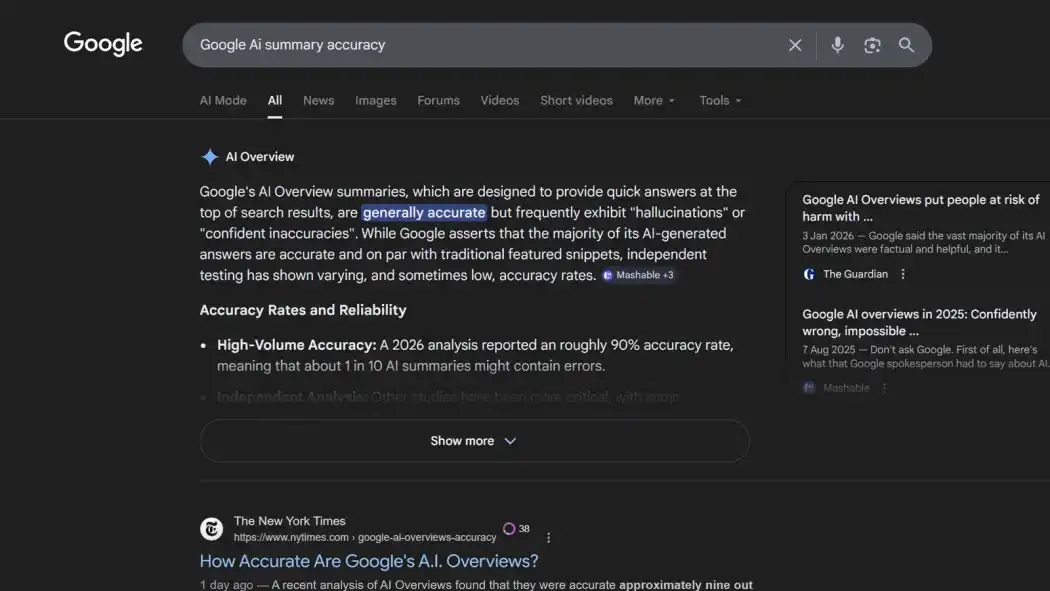
A New York Times investigation, in collaboration with AI startup Oumi, reveals significant accuracy and reliability issues with Google's AI Overviews search feature. Testing over 4,300 queries showed the accuracy rate improved from 85% (Gemini 2) to 91% (Gemini 3). However, given Google's scale of ~5 trillion annual searches, this 9% error rate translates to over 57 million incorrect answers generated hourly. A more critical issue is the prevalence of unsubstantiated citations. For correct answers, the rate of "unfounded citations"—where provided source links do not support the AI's claims—worsened, rising from 37% with Gemini 2 to 56% with Gemini 3. This makes it difficult for users to verify the information. The AI also heavily relies on low-quality sources, with Facebook and Reddit being its second and fourth most cited domains. Furthermore, the system is highly susceptible to manipulation. A BBC journalist successfully "poisoned" it by publishing a fake article; Google's AI began presenting the false information as fact within 24 hours. Google disputed the study's methodology, criticizing the use of the SimpleQA benchmark and an AI model (Oumi's HallOumi) to evaluate its own AI. The company maintains that its internal safeguards and ranking systems improve accuracy beyond the base model's performance.

Author: Claude, Deep Tide TechFlow

Deep Tide Introduction: The latest test by The New York Times in collaboration with AI startup Oumi shows that the accuracy rate of Google Search's AI Overviews feature is about 91%. However, given Google's scale of processing 5 trillion searches annually, this translates to tens of millions of incorrect answers generated every hour. More troublingly, even when the answers are correct, over half of the cited links fail to support their conclusions.
Google is delivering misinformation to users on an unprecedented scale, and most people are completely unaware.

According to The New York Times, AI startup Oumi, commissioned by the publication, used the industry-standard test SimpleQA developed by OpenAI to evaluate the accuracy of Google's AI Overviews feature. The test covered 4,326 search queries, conducting one round in October last year (powered by Gemini 2) and another in February this year (upgraded to Gemini 3). The results showed that Gemini 2's accuracy was about 85%, which improved to 91% with Gemini 3.

91% sounds good, but it's a different story when considering Google's scale. Google processes approximately 5 trillion search queries annually. Calculating with a 9% error rate, AI Overviews generates over 57 million inaccurate answers per hour, nearly 1 million per minute.

Correct Answers, Wrong Sources

More alarming than the accuracy rate is the issue of "unanchored" citation sources.

Oumi's data shows that in the Gemini 2 era, 37% of correct answers had "unsupported citations," meaning the links attached to the AI summaries did not support the information provided. After upgrading to Gemini 3, this proportion increased instead of decreasing, jumping to 56%. In other words, while the model gives correct answers, it's increasingly failing to "show its work."

Oumi CEO Manos Koukoumidis pointedly questioned: "Even if the answer is correct, how do you know it's correct? How do you verify it?"

The problem is exacerbated by AI Overviews' heavy reliance on low-quality sources. Oumi found that Facebook and Reddit are the second and fourth most cited sources for AI Overviews, respectively. In inaccurate answers, Facebook was cited 7% of the time, higher than the 5% in accurate answers.

BBC Journalist's Fake Article "Poisoned" Results Within 24 Hours

Another serious flaw of AI Overviews is its susceptibility to manipulation.

A BBC journalist tested the system with a deliberately fabricated false article. In less than 24 hours, Google's AI Overview presented the false information from the article as fact to users.

This means anyone who understands how the system works could potentially "poison" AI search results by publishing false content and boosting its traffic. Google spokesperson Ned Adriance responded by saying the search AI feature is built on the same ranking and security mechanisms that block spam, and claimed that "most examples in the test are unrealistic queries that people wouldn't actually search for."

Google's Rebuttal: The Test Itself Is Flawed

Google raised several objections to Oumi's research. A Google spokesperson called the study "seriously flawed," citing reasons including: the SimpleQA benchmark itself contains inaccurate information; Oumi used its own AI model HallOumi to judge another AI's performance, potentially introducing additional errors; and the test content doesn't reflect real user search behavior.

Google's internal tests also showed that when Gemini 3 operates independently outside the Google Search framework, it produces false outputs at a rate as high as 28%. But Google emphasized that AI Overviews leverages the search ranking system to improve accuracy, performing better than the model itself.

However, as PCMag's commentary pointed out the logical paradox: If your defense is that "the report pointing out our AI's inaccuracies itself uses potentially inaccurate AI," this probably doesn't enhance users' confidence in your product's accuracy.


Related Questions

QWhat is the accuracy rate of Google's AI Overviews feature according to the Oumi study?

AThe accuracy rate of Google's AI Overviews was found to be approximately 91% when powered by Gemini 3, an improvement from about 85% with Gemini 2.

QHow many inaccurate answers does the article estimate Google's AI Overviews produces per hour?

ABased on Google's annual volume of 5 trillion searches and a 9% error rate, the AI Overviews feature is estimated to produce over 57 million inaccurate answers per hour.

QWhat is the 'unsubstantiated citation' problem identified in the report?

AThe 'unsubstantiated citation' problem refers to instances where the AI Overviews provides a correct answer, but the attached source links do not actually support the information given. This issue increased from 37% with Gemini 2 to 56% with Gemini 3.

QWhich low-quality websites are frequently used as sources by AI Overviews, according to the Oumi data?

AAccording to Oumi's data, Facebook and Reddit are the second and fourth most cited sources by AI Overviews, with Facebook being cited more frequently in inaccurate answers.

QHow did Google respond to the findings of the Oumi study?

AGoogle criticized the study, calling it 'seriously flawed.' Their spokesperson argued that the SimpleQA benchmark itself contains inaccuracies, that using an AI (HallOumi) to judge another AI introduces errors, and that the test queries do not reflect real user search behavior.

Related Reads

From South Korea to the United States: Blue-Collar Jobs Are Becoming Increasingly Popular, Thanks to AI

AI is reshaping the labor market's value proposition. The traditional four-year college degree is losing its appeal as a guaranteed career path, while skilled blue-collar trades like electricians, welders, and plumbers are experiencing historic demand and wage premiums. This shift is driven by dual pressures: AI's displacement of certain white-collar roles and a booming need for physical infrastructure and data center construction. Data confirms the trend. In the U.S., vocational school revenue surged, and a significant portion of recent layoffs are AI-related. Surveys show a majority of Gen Z adults plan to pursue blue-collar work, citing better job security against AI automation. Vocational education interest has exploded recently. Experts cite a psychological shift as younger generations seek tangible, AI-resistant careers and avoid high student debt. In many cases, salaries for skilled trades now match or exceed those requiring a bachelor's degree. In South Korea, semiconductor vocational high schools boast near-total employment, with graduates securing high-paying roles at companies like Samsung. The shortage is structural, exacerbated by a retiring baby boomer workforce and massive infrastructure projects. Companies like JPMorgan Chase, Meta, and Lowe's are investing heavily in training programs. However, overcoming historical stigma and a "perception gap" around trade careers remains a key challenge to closing the talent gap.

marsbit25m ago

From South Korea to the United States: Blue-Collar Jobs Are Becoming Increasingly Popular, Thanks to AI

marsbit25m ago

Qualcomm: AI Hype Subsides, When Will Smartphones Emerge from the Gloom?

Qualcomm reported its Q3 FY2026 results (ending June 2026), with revenue of $9.95B, down 4% YoY but above expectations. Gross margin declined to 53.1%, pressured by rising costs across manufacturing and memory. Key business segments showed mixed performance: Handset revenue fell 19.6% YoY to $5.09B, dragged by an 11% decline in non-Apple Android shipments and weaker high-end mix. Conversely, Automotive revenue surged 61% to $1.59B, and IoT grew 9% to $1.83B. Core operating profit dropped 41% YoY due to margin compression and higher expenses. Management's Q4 FY2026 guidance projects revenue of $9.7B-$10.5B, in line with consensus, but Non-GAAP EPS guidance of $2.05-$2.25 fell short of expectations. Amidst persistent weakness in its core handset market, Qualcomm is pursuing growth in AI, focusing on Edge AI (smartphones, PCs, automotive) and Data Center AI. Its data center strategy includes four pillars: AI accelerators (e.g., AI200), commercial CPUs (Dragonfly C1000), custom silicon, and connectivity solutions. While these initiatives initially boosted its stock, concerns over AI capital expenditure sustainability have since erased those gains. The company targets $5B in data center revenue for FY2027 and $15B for FY2029. The report concludes that with the traditional handset business still under pressure, the data center opportunity is currently viewed as a longer-term option, and a more conservative valuation based on core operations may be warranted until AI contributions materialize.

marsbit29m ago

Qualcomm: AI Hype Subsides, When Will Smartphones Emerge from the Gloom?

marsbit29m ago

From TPU to Self-Evolving Agents: How Jeff Dean Predicts the Next Step in AI

At the 2026 YC Startup School, Jeff Dean outlined his vision for AI's next phase, shifting focus from simply scaling models to building intelligent, autonomous systems. He believes AI's progress is no longer just about creating smarter models, but about integrating them into systems capable of long-term, iterative work, automated experimentation, and continuous learning. This evolution moves the competition from "who has the bigger model" to "who can best organize intelligence." Dean suggests AI capabilities are now comparable to a junior engineer, enabling the automation of complex workflows. However, the true challenge and opportunity lie in managing these AI "workers" at scale. He emphasizes the importance of **context engineering**—structuring tools, memory, and feedback loops—over raw model power. For startups, this means building deep expertise in niche domains where general models currently fail (near 0-1% success rates), leveraging proprietary data, specialized tools, and domain-specific evaluators. A recurring theme is re-examining fundamental constraints. Dean's past work, like moving Google's search index to memory or creating the TPU, stemmed from questioning outdated assumptions about hardware and cost. He sees similar inflection points today, particularly in **specialized inference hardware** to drastically reduce latency and energy consumption for real-time Agent operation. Notably, he points out that in modern AI systems, the dominant cost is often not computation but **data movement**. Reliable, long-running Agents require robust system design, borrowing concepts from distributed computing like checkpointing, state management, and parallel exploration to handle failures and maintain progress over days or weeks. As AI automates execution, the scarcest human skills will shift to **defining clear specifications**, **judging what problems are worth solving** (taste), and designing effective feedback loops. Ultimately, Dean's framework prioritizes understanding the problem deeply, identifying the true bottlenecks, and systematically building closed-loop systems where AI can not only perform tasks but also improve AI itself.

marsbit29m ago

From TPU to Self-Evolving Agents: How Jeff Dean Predicts the Next Step in AI

marsbit29m ago

Trading

Spot
活动图片




