Survival Guide for Crypto KOLs

marsbitPublished on 2026-06-18Last updated on 2026-06-18

Abstract

The article titled "A Survival Guide for Crypto KOLs" discusses the recent ban on "InfoFi" or "post-to-earn" applications (e.g., Kaito, Cookie) on X (formerly Twitter), which effectively ended the era of easy monetization through engagement farming. It attributes this move to X's desire to reclaim platform control over user attention and ad inventory, noting that the incentive structure had degraded content quality and user experience. The piece outlines both the benefits—like a cleaner feed and a focus on genuine content—and the drawbacks, including immediate economic losses for creators and exposed platform risk. It then provides an updated guide for crypto content creators, emphasizing a shift from quantity to quality. Key recommendations include: 1) Doubling down on high-signal, original content (e.g., deep-dive threads, data-driven analysis). 2) Diversifying platforms (e.g., Substack, YouTube) to mitigate dependency on X. 3) Pursuing direct monetization through brand deals, newsletters, and paid communities. 4) Aligning with professional crypto marketing agencies for distribution. 5) Prioritizing reputation, offline networking, and evergreen content. The conclusion frames the ban as a painful but necessary reset for Crypto Twitter, pushing the ecosystem towards more sustainable and professional content creation models where genuine creators can thrive with less noise.

Source: @Eli5defi

Compiled and Edited by: BitpushNews

(Note: The article was compiled from January 16, 2026. Some data may have changed.)

If you woke up today and found your timeline unusually quiet (or chaotic, depending on that mysterious algorithm), it’s not your imagination.

The "InfoFi" ban is officially in effect. X (formerly Twitter) has revoked API access for the "post-to-earn" apps we all knew (and some loved to hate), including Kaito, Cookie, Wallchain, Xet, and others.

Well, "easy mode" is over. The harvest period has ended.

We need to talk about Goodhart's Law: "When a measure becomes a target, it ceases to be a good measure." We turned "replies" into a target, and in doing so, we turned the timeline into a Turing test where everyone failed.

But now what?

Why Did the Bubble Burst?

Let's be honest: the "attention economy" is suffering from hyperinflation. Apps like Kaito, Cookie, and Wallchain attempted to financialize attention.

In theory, it incentivized activity. In practice, it created a perverse incentive structure where "engagement" became decoupled from "value."

We weren't building communities; we were conducting a distributed, human-powered DDoS attack on the notification bar.

X finally realized that if they let third-party apps consume X users' dopamine, they would lose control over ad inventory and, more importantly, over genuine interaction and content on X. This is a battle for platform sovereignty.
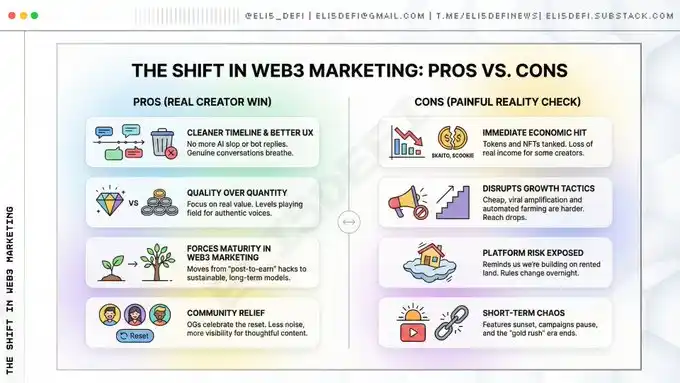
The Upside (Why This is Good for Real Creators)

  • A cleaner timeline and better UX: No more endless AI-generated junk, "gm" farms, or bot replies clogging every post's replies. Real conversations can breathe again.
  • Quality over quantity: Projects and creators who relied on paid spam now have to focus on real value. This levels the playing field for authentic voices (less noise = higher visibility for thoughtful content).
  • Forcing Web3 marketing to mature: The "post-to-earn" model was a short-term hack that made quick money but burned communities and damaged long-term trust. This pushes us towards more sustainable models.
  • Community relief: Many OGs and seasoned users are celebrating (ZachXBT called it a "fact-based decision," and even some creators see it as a reset for Crypto Twitter).

The Downside (The Painful Reality)

  • Immediate economic hit: Tokens like $KAITO, $COOKIE, and related NFTs plummeted 15-20%+ overnight. Many creators (especially in emerging markets) lost a tangible source of income as leaderboard rewards or campaigns stopped abruptly with no compensation in sight.
  • Disrupting growth strategies: Web3 projects loved using InfoFi for cheap, viral marketing. Without automated farming, promotion just got harder. Crypto topic reach might drop further.
  • Platform risk exposure: X can change the rules overnight (again). It's a reminder we're building on rented land. One policy update, and your entire strategy crumbles.
  • Short-term chaos: Projects are shutting down features, campaigns are on pause, and some creators are mourning the "gold rush" era that paid their rent for daily posting.

What We Need to Do from Now On

X's InfoFi ban has stirred the pot, but it's paving the way for a more structured, professional path for Web3 content creation. I see it as a nudge towards genuine project/agency partnerships and tight-knit creator communities.

Many creators are already pivoting in this direction, agencies are gearing up to fill the gap, building curated networks, and creator collectives are emerging as new hubs for deals and collaboration.
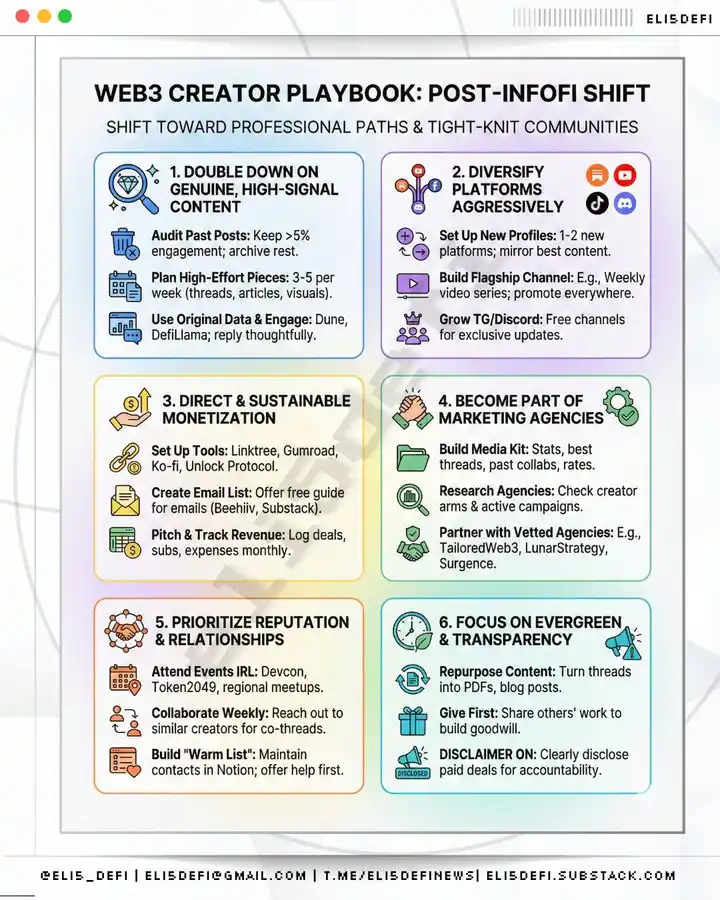
Here is the complete, updated playbook, with detailed steps for each point:

1. Double Down on High-Quality, High-Signal Content

Focus on deep analysis, threads, visual content, and genuine insights (this is what got me here in the first place). If the content is human-made and valuable, X will still reward quality interactions.

Detailed Steps:

  • Audit your last 30 days of posts: Keep only those with engagement rates >5% or meaningful replies; delete or archive the rest.
  • Plan 3-5 premium posts per week: (e.g., 10-tweet threads / long-form posts / articles with charts, simple analogies, or breakdowns).
  • Use data tools: Use @Dune, @DefiLlama, @getmoni_io, @nansen_ai, etc., for original insights, not machine-generated AI summaries.
  • Engage with replies: Thoughtfully respond to every high-quality comment within 24 hours to build genuine dialogue.
  • Subscribe to quality research: Subscribe to outlets like @fourpillarsFP, @shoalresearch, @oak_res_EN, @delphi_digital, etc. Full list here: [https://x.com/i/lists/1956904918348190144)
  • Track performance: Use X Analytics to see which format (threads vs. polls vs. video) generates the most bookmarks/shares.

2. Diversify Platforms

Detailed Steps:

  • Set up 1-2 new platforms: (e.g., Substack + YouTube); sync your best X content there.
  • Cross-post strategically: When sharing a post on X, include a link back to X.
  • Build a flagship channel: For example, start a weekly YouTube/TikTok series (like "DeFi in 5 Minutes") and promote it everywhere.
  • Grow Telegram/Discord: Create a free channel/group for exclusive updates and to connect with your audience.

3. Pivot to Direct, Sustainable Monetization

Open up DMs for genuine brand/marketing deals (this is where many projects will turn). Build your own audience flywheel: an email list, a personal site, or a paid community.

Detailed Steps:

  • Set up tools: Create a Linktree and use Beehiiv or Substack to build an email list. You can try offering a freebie (like a "DeFi Starter Guide" PDF) as an opt-in. Find what works for you.
  • Pitch yourself or offer free exposure: Reach out to projects proactively.
  • Track revenue: Use a simple spreadsheet to log deals, subscriptions, and payouts monthly.

4. Join Marketing Agencies

The ban killed permissionless reward spam, so brands/projects will rely more on trusted agencies for distribution. Top crypto/Web3 marketing agencies have already built out or expanded creator arms. Even Kaito seems to be heading down this path with Kaito Studio.

Some top agencies I've worked with (in no particular order):

@TailoredWeb3, @radarblock, @GREEND0TS, @PinkBrains_io, @apcollective, @funhouse_la, @yaptradeDAO, @JELabs2024, @growgami, @LunarStrategy, @surgence_io

Detailed Steps:

  • Build your media kit: Aggregate data (follower count, avg. engagement rate, niche focus), 3-5 best threads, past collaborations, and rates.
  • Research agencies: Visit their websites, check their creator recruitment announcements, see if they have ongoing campaigns, and pitch yourself.

5. Prioritize Reputation and Relationships

Attend in-person events, collaborate with like-minded creators, and create evergreen value that compounds (not daily spam).

Detailed Steps:

  • Attend 1-2 events per quarter: Aim for conferences like Devcon, Token2049, or regional meetups (check Eventbrite or CryptoEvents).
  • Collaborate weekly: Reach out to 3 creators of similar size for joint threads, guest spots, or shoutouts.
  • Build a "warm list": Maintain a Notion doc with 50+ contacts (creators, founders, community managers) and note how you help each other.
  • Focus on evergreen content: Repurpose top threads into Notion pages, PDFs, or permanent blog posts.
  • Be altruistic first: Offer free value (e.g., tagging helpful people, sharing their work) to build goodwill.
  • Disclosure ON: If you take a paid deal, ensure you clearly disclose it. This ensures accountability and keeps your audience fully informed.

Conclusion

The crypto space moves fast. There may be new, similar InfoFi-like models on friendlier platforms in the future. But the lesson is clear: never bet your farm on a centralized platform's incentive mechanics.

It's painful in the short term, but long term? This might be the best thing to happen to Crypto Twitter. Less noise, more signal, and the real creators will win.


Related Questions

QWhat was the main reason behind X's decision to revoke API access for 'post-to-earn' applications like Kaito and Cookie?

AX revoked API access to regain platform sovereignty. These third-party apps were consuming user attention and interaction data, which undermined X's control over its advertising inventory and the quality of genuine engagement on its platform.

QAccording to the article, what is one significant long-term benefit of the InfoFi ban for genuine content creators?

AOne significant long-term benefit is a fairer competitive environment. By eliminating automated engagement farming and low-quality spam, the ban allows for higher-quality, thoughtful content from genuine creators to gain better visibility.

QWhat immediate economic impact did the InfoFi ban have on creators and related tokens?

AThe ban caused an immediate economic shock. Tokens like $KAITO and $COOKIE, along with related NFTs, crashed by 15-20% overnight. Many creators, especially in emerging markets, lost a direct source of income from leaderboard rewards and campaigns.

QWhat are two specific strategies the article suggests for creators to diversify their presence beyond X (formerly Twitter)?

ATwo strategies are: 1) Setting up 1-2 new platforms like Substack or YouTube and syncing best content there. 2) Building a flagship channel, such as launching a weekly YouTube/TikTok series and promoting it across all platforms.

QHow does the article suggest creators should approach monetization after the ban on 'post-to-earn' models?

ACreators should shift to direct and sustainable monetization. This includes being open to direct brand/marketing deals, building their own audience flywheel (e.g., email lists, personal websites, paid communities), and clearly disclosing any paid promotions for accountability.

Related Reads

BitTorrent Launches BTTInferGrid: The Decentralized Infrastructure Layer for Scalable AI Inference

BitTorrent has launched BTTInferGrid, a decentralized GPU computing network designed to meet the surging demand for AI inference workloads. The platform aggregates global idle GPU resources into an open-access, verifiable, and pay-as-you-go infrastructure, aiming to solve the cost, scalability, and supply bottlenecks of traditional centralized cloud providers. BTTInferGrid addresses a key market shift, as industry forecasts indicate over 70% of future AI compute will be for inference—a continuous operational cost. It tackles centralization issues like inflexible resource allocation during volatile demand, prohibitive GPU pricing, and the underutilization of fragmented global compute capacity. The platform establishes a direct corridor between AI developers and idle hardware. On the supply side, it allows providers to monetize underutilized GPUs through tokenized incentives. On the demand side, it offers developers cost-efficient, on-demand inference with on-chain verification. Key differentiators include permissionless access for providers, verifiable service quality through blockchain validation, and a sustainable, demand-driven economic model. Built on BitTorrent's proven DePIN expertise from the BitTorrent File System (BTFS), BTTInferGrid follows a phased roadmap. It begins with network bootstrapping in 2026, focusing on scaling GPU nodes, and aims to evolve into a foundational Web3 AI infrastructure layer by 2028, supporting diverse model architectures and decentralized fine-tuning.

TheNewsCrypto5m ago

BitTorrent Launches BTTInferGrid: The Decentralized Infrastructure Layer for Scalable AI Inference

TheNewsCrypto5m ago

Gate Research Institute: Analysis of Chart Patterns and Breakout Trading Strategies

Gate Research Institute: Chart Pattern Analysis and Breakout Trading Strategies Chart patterns are crucial tools in technical analysis for observing market supply and demand shifts, trend continuations, and reversals. This analysis involves a comprehensive evaluation of trend, volume, support/resistance, time cycles, and breakout validity, not just rote pattern recognition. Patterns are broadly categorized into reversal patterns (e.g., Double Tops/Bottoms, Head and Shoulders) and continuation patterns (e.g., Flags, Triangles, Rectangles). An effective breakout, key for trading, requires clear support/resistance, prolonged consolidation, a prevailing trend backdrop, and volume confirmation. However, breakouts are not guaranteed, as false breakouts are common. Risk must be managed through position sizing, stop-loss orders, pullback confirmations, and profit-taking in stages. Key pattern types discussed include: * **Rectangle Patterns:** Indicate market indecision within parallel support and resistance, with breakouts projecting a move equal to the pattern's width. * **Flag & Pennant Patterns:** Short-term continuation patterns following sharp price moves ("flagpoles"). * **Triangle Patterns:** Symmetrical, Ascending (bullish bias), and Descending (bearish bias) triangles, representing consolidation before a directional move. * **Head and Shoulders Patterns:** Major reversal patterns signaling trend exhaustion. The article details breakout trading strategies, defining valid breakouts by price closing beyond a key level with increased volume and minimal immediate re-entry into the prior range. It contrasts range trading with breakout trading and outlines entry methods (immediate entry, pullback entry, scaling in), stop-loss placement (based on pattern failure), and profit-taking techniques (target-based, structure-based, trend-following). It further classifies breakout outcomes: 1. **Valid Breakouts:** Strong, sustained moves in the breakout direction. 2. **Pullback Breakouts:** Price breaks out, retests the breakout level as support/resistance, then resumes the trend—offering a lower-risk entry. 3. **False Breakouts:** Price briefly breaches a level but quickly reverses back into the prior range, a common risk managed by strict stop-losses. Key validation tools for breakouts include volume analysis, the principle of support/resistance role reversal, and momentum indicators like ATR, Moving Averages, Bollinger Bands, and RSI. In conclusion, while chart patterns and breakout analysis provide a structured framework, their effectiveness relies on multiple confirming factors—trend context, volume, and proper risk management. They should be integrated into a broader trading system rather than used as standalone signals.

marsbit35m ago

Gate Research Institute: Analysis of Chart Patterns and Breakout Trading Strategies

marsbit35m ago

Joseph Chalom: Ethereum is Becoming the "Settlement Layer of Trust" for Global Finance

In a speech titled "The Industrialization of Trust," Sharplink CEO Joseph Chalom (former BlackRock digital assets head) discussed the future transformation of global finance. Drawing from 20 years at BlackRock, where he led the launch of Bitcoin/ETH ETFs and tokenized funds, Chalom highlighted the immense hidden costs of establishing trust in traditional finance—estimated at over $9.3 trillion annually in the US alone due to fragmented systems, multi-day settlements, and countless reconciliations. He argued that Ethereum is emerging as the global financial "settlement layer for trust," with its robust, decentralized infrastructure securing over $300 billion in on-chain assets and most stablecoins and tokenized assets. The future, he stated, will be driven by three accelerating pillars: stablecoins (evolving beyond crypto gateways to become efficient cross-border payment rails), tokenized assets (enabling 24/7 trading and reshaping capital markets), and DeFi (providing automated, accessible financial services). A potential game-changer, Chalom added, is the fourth pillar: "Agentic Finance," where AI agents autonomously execute programmable financial transactions via smart contracts and stablecoins. He envisions individuals soon having AI-powered "CFOs in their pockets" to optimize idle capital and manage tokenized portfolios. This shift, facilitated by Ethereum's trustless settlement, could multiply on-chain transaction volume 1000x within a year, moving finance toward a seamless, digitized future.

marsbit35m ago

Joseph Chalom: Ethereum is Becoming the "Settlement Layer of Trust" for Global Finance

marsbit35m ago

Trading

Spot
Futures
活动图片




