SUBBD Token’s Massive Projected Impact on the Content Creation Market in 2026

bitcoinistPublished on 2026-02-10Last updated on 2026-02-10

Abstract

The SUBBD Token ($SUBBD) is projected to significantly impact the $191 billion content creation market by 2026 by addressing inefficiencies in the current creator economy. It aims to replace high-fee centralized platforms with a decentralized, AI-integrated Web3 alternative. The platform consolidates tools like AI Personal Assistants, Voice Cloning, and automated interactions into a single interface, solving tool fragmentation issues. It enables multiple monetization methods, including PPV, NFT sales, and AI-exclusive content, while allowing community-led governance through token-based voting. The presale has raised $1.47 million, with tokens priced at $0.057495. A fixed 20% APY staking reward in the first year incentivizes long-term holding and reduces sell pressure. By combining AI-driven automation with decentralized infrastructure, SUBBD Token positions itself as a comprehensive ecosystem for creators seeking sovereignty and reduced operational overhead.

Trusted Editorial content, reviewed by leading industry experts and seasoned editors. Ad Disclosure

Quick Facts:

  • ➡️ SUBBD Token targets the inefficiencies of the $191B creator economy, aiming to replace high-fee legacy platforms with a decentralized, AI-integrated alternative by 2026.
  • ➡️ The project consolidates essential tools, such as AI Personal Assistants, Voice Cloning, and automated interactions, into a single Web3 interface, solving the problem of tool fragmentation.
  • ➡️ With $1.47M raised and a current price of $0.057495, the project demonstrates significant early interest and financial backing.
  • ➡️ A fixed 20% APY staking reward for the first year creates a robust mechanism for reducing sell pressure while rewarding long-term ecosystem participants.

The digital economy is heading toward a singular, undeniable friction point: the unsustainable rent-seeking of centralized platforms.

As analysts forecast the state of the industry three years out, the consensus surrounding SUBBD Token’s massive projected impact on the content creation market in 2026 is rooted in a fundamental shift from aggregation to autonomy.

Right now, the creator economy is valued at roughly $191B, yet the infrastructure supporting it remains archaic, characterized by opaque algorithms and fee structures that strip creators of up to 70% of their earnings.

This structural inefficiency creates a vacuum for decentralized alternatives. In 2026, market intelligence suggests that Artificial Intelligence won’t merely be a tool for content generation but the primary interface for monetization and community management.

The divergence is clear. On one side, legacy platforms are increasing take rates to satisfy shareholders; on the other, Web3 protocols are using Generative AI to automate workflows and slash overhead.

This collision of AI ubiquity and decentralized finance (DeFi) sets the stage for specialized utility tokens to capture significant market share. Investors and creators aren’t looking for simple payment rails anymore; they want comprehensive ecosystems that solve the ‘fragmentation headache’ of managing subscriptions, AI tools, and payouts across disparate apps.

It’s within this high-stakes environment that SUBBD Token ($SUBBD) has emerged, positioning itself not just as a currency, but as the operational backbone for the next generation of digital interaction.

Read more about $SUBBD here.

Disrupting The $191B Economy Through AI-Driven Autonomy

The projected impact of SUBBD Token ($SUBBD) hinges on its ability to dismantle the current fee logic of the $85 billion content creation industry. Standard platforms operate as walled gardens. SUBBD flips the script, introducing a model where value accrues directly to the user through Ethereum-based EVM-compatible smart contracts.

This isn’t just about lower transaction costs; it’s about using proprietary AI to remove the administrative burden that currently stifles creator growth.

The platform’s technical architecture integrates an AI Personal Assistant and advanced Voice Cloning technology directly into the user experience. For a creator, this means the ability to deploy AI-driven influencers or automate fan interactions without relying on third-party software that demands additional subscriptions.
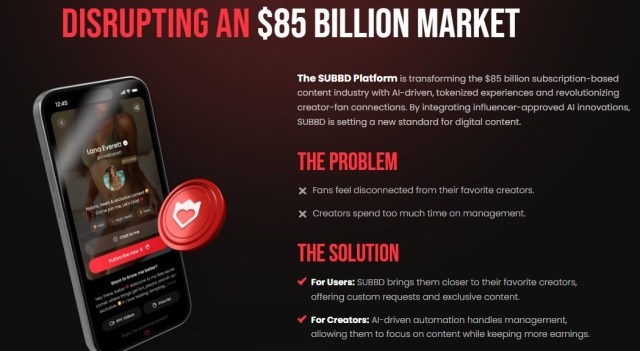
By consolidating these tools, chatbots, object recognition, and content generation, into a single Web3 environment, SUBBD addresses the fragmentation plaguing the sector.

Plus, the introduction of token-gated access fundamentally changes the relationship between creator and consumer. Instead of arbitrary bans or demonetization based on shifting corporate policies, governance is handled through token-based voting. This ensures that the community dictates feature rollouts and content themes.

The data points to a clear trend: creators are migrating toward platforms that offer sovereignty. SUBBD’s provision of multiple monetization routes, including PPV, NFT sales, and AI-exclusive content, suggests a strategic alignment with where the market is heading in 2026.

Explore the SUBBD Token presale here.

Presale Momentum And The Case For 20% APY Staking Rewards

While the technological utility provides the long-term thesis, the immediate market reaction is visible in the project’s capital accumulation.

According to official data, the SUBBD Token presale has already raised $1.47M, a figure that indicates strong early conviction from retail and sophisticated investors alike. With tokens currently priced at $0.057495, the market is pricing in the potential for this asset to bridge the gap between speculative crypto assets and tangible software-as-a-service (SaaS) utility.
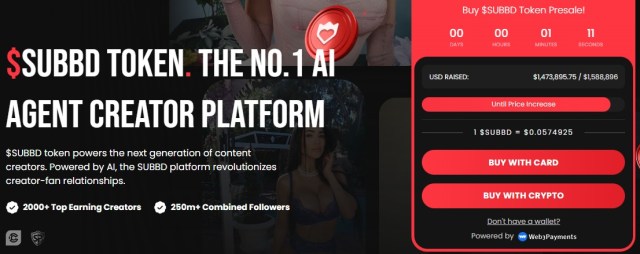
The tokenomics structure (often a weak point in new projects) looks designed to mitigate the volatility typically associated with early-stage utility tokens.

The protocol offers a fixed 20% APY for staking during the first year. This mechanism serves a dual purpose: it incentivizes long-term holding to reduce circulating supply pressure and aligns user interests with platform growth.

Beyond simple yield, staking unlocks specific platform benefits, such as XP multipliers and access to exclusive ‘HoneyHive’ content and behind-the-scenes drops.

For investors analyzing the 2026 horizon, the critical metric is user retention. The integration of financial incentives (staking) with product utility (AI tools) creates a ‘sticky’ ecosystem.

Unlike meme coins driven by ephemeral hype, SUBBD Token is leveraging its capital raise to build an infrastructure capable of handling high-throughput interactions between fans and AI-augmented creators. As the presale continues, the focus remains on how effectively this capital gets deployed to capture market share from legacy giants before the 2026 maturation point.

Buy $SUBBD here.

This article is for informational purposes only and does not constitute financial advice. Cryptocurrency investments, including presales and staking, carry inherent risks due to market volatility. Always conduct your own due diligence before participating in any token sale.

Editorial Process for bitcoinist is centered on delivering thoroughly researched, accurate, and unbiased content. We uphold strict sourcing standards, and each page undergoes diligent review by our team of top technology experts and seasoned editors. This process ensures the integrity, relevance, and value of our content for our readers.

patrubogdan

Follow

Full Profile

Related Posts

Government Shutdown Fears Trigger 2% Crypto Dip, But Bitcoin Hyper Remains Unshaken

Dogecoin Tries to Hold $0.09370 – Is 2026 the Doge Year or Will $MAXI Take Over?

US Debt Spiral Eyes $39T: Why Bitcoin Hyper ($HYPER) Is The Hedge to Watch

Crypto Exchange Backpack Targets Token Launch Soon, as BMIC Fires Up Quantum Defense

Ethereum Foundation Backs SEAL Initiative as LiquidChain L3 Protocol Gains Traction

Vitalik Buterin Outlines Ethereum’s AI Future, While SUBBD Token Targets the Creator Economy

Related Questions

QWhat is the core problem SUBBD Token aims to solve in the $191B creator economy?

ASUBDD Token aims to solve the structural inefficiencies and high fees of centralized platforms, which can strip creators of up to 70% of their earnings, by providing a decentralized, AI-integrated alternative.

QWhat key AI technologies are integrated into the SUBBD platform to help creators?

AThe platform integrates an AI Personal Assistant, advanced Voice Cloning technology, chatbots, object recognition, and content generation tools into a single Web3 interface.

QHow much capital has the SUBBD Token presale raised and what is the current token price?

AThe SUBBD Token presale has raised $1.47 million, with tokens currently priced at $0.057495.

QWhat is the purpose of the fixed 20% APY staking reward in the SUBBD ecosystem?

AThe fixed 20% APY staking reward for the first year serves a dual purpose: it incentivizes long-term holding to reduce sell pressure and aligns user interests with platform growth by rewarding ecosystem participants.

QHow does SUBBD's token-gated access change the creator-consumer relationship?

AToken-gated access shifts governance to the community through token-based voting, preventing arbitrary bans or demonetization from centralized corporate policies and allowing the community to dictate feature rollouts and content themes.

Related Reads

Agent Race Ends, Super Workbench Takes Over

The era of fragmented AI agents is ending. Over the past month, China's tech giants—Tencent, Alibaba, and ByteDance—have simultaneously shifted strategy: instead of launching new, standalone AI agents, they are consolidating their various agent projects into unified "super workbenches." Tencent integrated its QClaw teams into WorkBuddy, a strategic product hailed as a potential third flagship after QQ and WeChat. Alibaba is merging its QoderWork, Wukong, and MuleRun agents into a new "Qianwen Office" platform under DingTalk's leadership. ByteDance rebranded its TRAE SOLO coding agent to TRAE Work, signaling a broader focus on workflow collaboration. This convergence marks a pivotal industry consensus. The initial exploration phase, where companies rapidly built numerous overlapping agents for different scenarios, proved costly and inefficient. With open-source tools eroding technical barriers, competition has shifted from agent creation to resource consolidation and cost control. Historically, platform wars are won not by creating more products, but by simplifying them—as seen with browsers unifying web access and super-apps consolidating services. Now, the "super workbench" aims to become the unified AI entry point for work. This reflects a deeper market realization: the primary audience for AI is no longer just programmers (a market in the tens of millions) but all knowledge workers (a market of billions). The real opportunity lies in augmenting everyday tasks—managing emails, documents, data, and meetings—across the entire workday. The core battleground is becoming control over the primary AI entry point that employees use daily. Tencent's WorkBuddy leverages WeChat and Tencent Docs; Alibaba's Qianwen Office taps into DingTalk's organizational data; ByteDance's TRAE Work integrates with Feishu's workflows. Whoever owns this "super workbench" gains strategic control over orchestrating enterprise data and APIs. This shift is redefining enterprise software. Traditional SaaS applications, valued for their user interfaces, will recede into the background. Their core functionalities will be exposed as standardized "Skills" or APIs for the super workbench's agents to invoke. Software value will shift from selling user seats to charging based on API calls and outcomes delivered. The evolution of agents is moving through clear stages: first as novel standalone products, then as consolidated primary work entry points, and finally as pervasive, invisible capabilities embedded into the digital fabric. The recent moves by major tech firms signal the transition from the first stage into the second, accelerating toward the third. In the end, the most successful agent technology may become invisible—like electricity or the HTTP protocol—a fundamental, unnamed infrastructure powering work itself.

marsbit2m ago

Agent Race Ends, Super Workbench Takes Over

marsbit2m ago

Michael Saylor: 110 Reasons to Oppose BIP-110

Michael Saylor presents 110 arguments against Bitcoin Improvement Proposal (BIP) 110, a soft fork aimed at restricting certain non-monetary data storage uses (like inscriptions) on the Bitcoin blockchain. He acknowledges the proponents' valid concerns—such as node costs, fee pressure, and preserving Bitcoin's monetary focus—but fundamentally disagrees with the proposed solution. Saylor argues that BIP 110 represents a dangerous precedent of using consensus rules to enforce value judgments on transaction validity, moving away from Bitcoin's core principles of neutrality and permissionless innovation. His key objections are organized into eleven categories: 1) It violates neutrality and hard consensus by banning currently valid transactions. 2) It fails to meet the high burden of proof required for a consensus change, lacking concrete data on the alleged crisis. 3) Its seven bundled technical restrictions are overly broad, targeting generic script functionalities and blocking future upgrade paths. 4) It sacrifices compatibility and future optionality by closing off designed upgrade hooks. 5) Its temporary rules add significant complexity (grandfathering, expiry states) without sufficient justification. 6) The economic and security impacts, particularly on miner revenue and fee markets, are uncertain and unmodeled. 7) Superior, market-based tools (fee markets, relay/mining policies) already exist to manage blockchain load. 8) It stifles innovation by creating a chilling effect for developers. 9) Its modified activation mechanism (55% threshold, forced signaling) is aggressive and risks network splits. 10) The precedent it sets—using consensus to suppress disliked but legal uses—is more dangerous than the problem it aims to solve. 11) A better path exists: improving measurements, refining resource-based policies, and allowing market forces to work. Saylor concludes that Bitcoin's strength lies in its neutral rules, open markets, and hard consensus. Changing these foundational elements to target specific use cases is an unnecessary and risky "iatrogenic" intervention. He advocates for guarding Bitcoin's neutrality rather than acting as its redeemer.

marsbit17m ago

Michael Saylor: 110 Reasons to Oppose BIP-110

marsbit17m ago

Trading

Spot
活动图片


