Strategy CEO Lifts The Curtain On Bitcoin Talks With Largest US Banks

bitcoinistPublished on 2025-12-24Last updated on 2025-12-24

Abstract

Strategy CEO Phong Le reveals that major U.S. banks are actively engaging in Bitcoin-related discussions, driven by a need to compete with crypto-native firms like Coinbase and Fidelity. Conversations focus on foundational services such as custody and exchange, framed in traditional banking terms like "checking and savings accounts for Bitcoin." Beyond basics, banks are exploring a product roadmap including Bitcoin-backed loans, yield products, structured securities, and eventually digital money instruments offering stable high yields. Le notes that institutions like BNY Mellon, Wells Fargo, and JPMorgan are already moving toward issuing credit against Bitcoin or related derivatives, signaling a shift toward integrating Bitcoin as collateral within traditional financial systems.

Strategy CEO Phong Le has been on the road with Michael Saylor, and the message from the meetings is less about “orange-pilling” bankers than watching large institutions sprint to close a Bitcoin product gap they can no longer ignore.

In a Dec. 23 interview with CoinStories host Nathalie Brunell, Le said the conversations start with the most basic building blocks, custody and exchange because banks have already watched meaningful flows move to crypto-native and quasi-crypto incumbents.

“They’re all trying to catch up with just the base of custodying Bitcoin and providing exchange services,” Le said. “They’ve seen, for example, Coinbase or Fidelity, and what they’re doing. And they want to be able to offer their customers native services with BTC so they don’t take the money off the platform out to somewhere else.”

Large US Banks Begin Bitcoin Conversations

Le described this baseline in familiar banking language, positioning BTC as an account-type object inside existing distribution rather than an external asset clients self-custody elsewhere. “So I’ll just start that as a baseline. I call it a checking account and a savings account for Bitcoin, right?” he said. “And then on top of that, what do they want to do?”

His answer was a laddered product roadmap that increasingly resembles the capital-markets “stack” Strategy has spent the last several years industrializing: credit, yield, structured exposure, and eventually something close to money-like instruments backed by BTC collateral.

“Then they want to offer things like the coin lending, which means you get loans against Bitcoin,” Le said. “And we know a lot of folks are doing that on a one-to-one private loan basis, but they should provide it in general. Perhaps offering instruments that give you yield off of Bitcoin. That will be the next sort of step above that.”

From there, Le said, banks start converging on Strategy’s own playbook, not necessarily copying it line-by-line, but arriving at the same conclusion that Bitcoin can be used as balance-sheet collateral to manufacture investable products.

“And then a set of Bitcoin-backed products, not too much different than what we do,” he said. “An investment bank would want to be able to underwrite Bitcoin-backed securities like MSTR or like any of our preferreds. That would be the next step.”

The “underwrite” comment is the tell. This is not merely about giving wealth clients a custody button. It is about turning exposure into fundable, tradable paper that sits comfortably inside existing bank distribution: preferreds, structured notes, and credit instruments that look like what clients already buy, just with BTC as the collateral story.

Le then moved into what he called “digital credit,” explicitly tying it to preferred-style issuance and bank-native variants of the same idea.

“And then you get into offering digital credit, right? Which would be our preferreds or a bank preferred based off of Bitcoin,” he said. “And then the last thing, which is what Mike talked about at Bitcoin in the Middle East, which is digital money, right? How do you give somebody essentially access to something that looks like money backed by Bitcoin that gives them a steady yield that’s better than what they would get otherwise called eight, nine percent?”

That “digital money” framing is aligned with what Saylor has been signaling on stage: BTC as collateral that can support a broader credit superstructure. At Bitcoin MENA 2025 in Abu Dhabi, Saylor argued the shift is already underway and, in his telling, the largest names in US finance are no longer keeping their distance, as Bitcoinist reported.

“In the past six months I have noted and been approached by BNY Mellon, by Wells Fargo, by Bank of America, by Charles Schwab, by JP Morgan, by Citi,” Saylor said. “They are all starting to issue credit against either Bitcoin or against derivatives like IBIT.”

At press time, BTC traded at
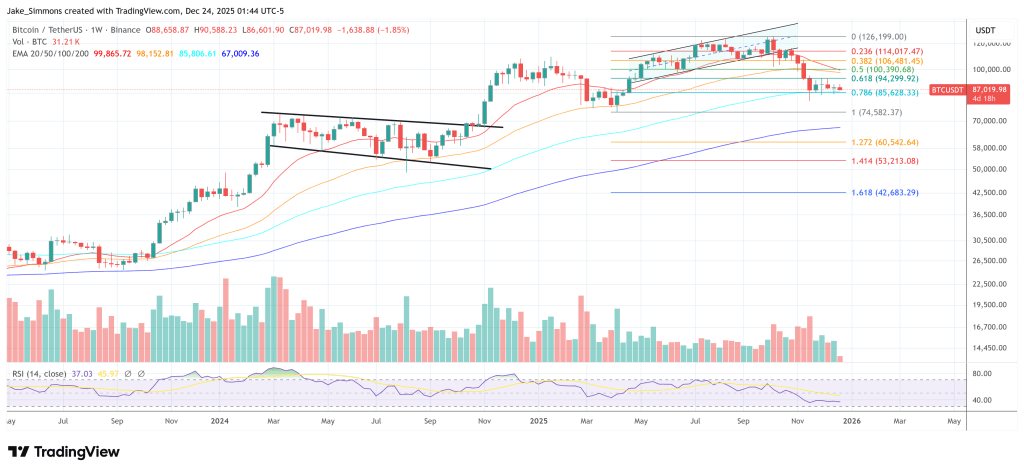
BTC remains stuck between the 0.618 and 0.786 Fib, 1-week chart | Source: BTCUSDT on TradingView.com

Related Questions

QWhat is the main message that Strategy CEO Phong Le and Michael Saylor are conveying to large US banks regarding Bitcoin?

AThe main message is less about 'orange-pilling' bankers and more about large institutions rushing to close a Bitcoin product gap they can no longer ignore, as they have seen significant capital flows move to crypto-native companies.

QAccording to Phong Le, what are the two most basic building blocks that conversations with banks start with?

AThe conversations start with the most basic building blocks: custody and exchange services for Bitcoin.

QWhat is the 'laddered product roadmap' that banks are converging on, as described by Phong Le?

AThe laddered product roadmap includes: Bitcoin custody and exchange (checking/savings accounts), lending/loans against Bitcoin, yield-generating instruments, Bitcoin-backed securities (like preferreds), and finally, digital money instruments backed by Bitcoin collateral.

QWhich specific large US financial institutions did Michael Saylor say have approached him in the past six months regarding Bitcoin?

AMichael Saylor stated he had been approached by BNY Mellon, Wells Fargo, Bank of America, Charles Schwab, JP Morgan, and Citi.

QWhat ultimate Bitcoin-based product does Phong Le refer to as 'digital money' and what is its proposed benefit?

A'Digital money' refers to instruments that look like money but are backed by Bitcoin, offering a steady yield that is better than traditional options, around eight to nine percent.

Related Reads

Trading

Spot
Futures

Hot Articles

What is $BITCOIN

DIGITAL GOLD ($BITCOIN): A Comprehensive Analysis Introduction to DIGITAL GOLD ($BITCOIN) DIGITAL GOLD ($BITCOIN) is a blockchain-based project operating on the Solana network, which aims to combine the characteristics of traditional precious metals with the innovation of decentralized technologies. While it shares a name with Bitcoin, often referred to as “digital gold” due to its perception as a store of value, DIGITAL GOLD is a separate token designed to create a unique ecosystem within the Web3 landscape. Its goal is to position itself as a viable alternative digital asset, although specifics regarding its applications and functionalities are still developing. What is DIGITAL GOLD ($BITCOIN)? DIGITAL GOLD ($BITCOIN) is a cryptocurrency token explicitly designed for use on the Solana blockchain. In contrast to Bitcoin, which provides a widely recognized value storage role, this token appears to focus on broader applications and characteristics. Notable aspects include: Blockchain Infrastructure: The token is built on the Solana blockchain, known for its capacity to handle high-speed and low-cost transactions. Supply Dynamics: DIGITAL GOLD has a maximum supply capped at 100 quadrillion tokens (100P $BITCOIN), although details regarding its circulating supply are currently undisclosed. Utility: While precise functionalities are not explicitly outlined, there are indications that the token could be utilized for various applications, potentially involving decentralized applications (dApps) or asset tokenization strategies. Who is the Creator of DIGITAL GOLD ($BITCOIN)? At present, the identity of the creators and development team behind DIGITAL GOLD ($BITCOIN) remains unknown. This situation is typical among many innovative projects within the blockchain space, particularly those aligning with decentralized finance and meme coin phenomena. While such anonymity may foster a community-driven culture, it intensifies concerns about governance and accountability. Who are the Investors of DIGITAL GOLD ($BITCOIN)? The available information indicates that DIGITAL GOLD ($BITCOIN) does not have any known institutional backers or prominent venture capital investments. The project seems to operate on a peer-to-peer model focused on community support and adoption rather than traditional funding routes. Its activity and liquidity are primarily situated on decentralized exchanges (DEXs), such as PumpSwap, rather than established centralized trading platforms, further highlighting its grassroots approach. How DIGITAL GOLD ($BITCOIN) Works The operational mechanics of DIGITAL GOLD ($BITCOIN) can be elaborated on based on its blockchain design and network attributes: Consensus Mechanism: By leveraging Solana’s unique proof-of-history (PoH) combined with a proof-of-stake (PoS) model, the project ensures efficient transaction validation contributing to the network's high performance. Tokenomics: While specific deflationary mechanisms have not been extensively detailed, the vast maximum token supply implies that it may cater to microtransactions or niche use cases that are still to be defined. Interoperability: There exists the potential for integration with Solana’s broader ecosystem, including various decentralized finance (DeFi) platforms. However, the details regarding specific integrations remain unspecified. Timeline of Key Events Here is a timeline that highlights significant milestones concerning DIGITAL GOLD ($BITCOIN): 2023: The initial deployment of the token occurs on the Solana blockchain, marked by its contract address. 2024: DIGITAL GOLD gains visibility as it becomes available for trading on decentralized exchanges like PumpSwap, allowing users to trade it against SOL. 2025: The project witnesses sporadic trading activity and potential interest in community-led engagements, although no noteworthy partnerships or technical advancements have been documented as of yet. Critical Analysis Strengths Scalability: The underlying Solana infrastructure supports high transaction volumes, which could enhance the utility of $BITCOIN in various transaction scenarios. Accessibility: The potential low trading price per token could attract retail investors, facilitating wider participation due to fractional ownership opportunities. Risks Lack of Transparency: The absence of publicly known backers, developers, or an audit process may yield skepticism regarding the project's sustainability and trustworthiness. Market Volatility: The trading activity is heavily reliant on speculative behavior, which can result in significant price volatility and uncertainty for investors. Conclusion DIGITAL GOLD ($BITCOIN) emerges as an intriguing yet ambiguous project within the rapidly evolving Solana ecosystem. While it attempts to leverage the “digital gold” narrative, its departure from Bitcoin's established role as a store of value underscores the need for a clearer differentiation of its intended utility and governance structure. Future acceptance and adoption will likely depend on addressing the current opacity and defining its operational and economic strategies more explicitly. Note: This report encompasses synthesised information available as of October 2023, and developments may have transpired beyond the research period.

363 Total ViewsPublished 2025.05.13Updated 2025.05.13

What is $BITCOIN

Discussions

Welcome to the HTX Community. Here, you can stay informed about the latest platform developments and gain access to professional market insights. Users' opinions on the price of BTC (BTC) are presented below.

活动图片















