Strategy Acquires 34,164 BTC In Largest Bitcoin Buy Since November 2024

bitcoinistPublished on 2026-04-21Last updated on 2026-04-21

Abstract

Strategy, a major Bitcoin treasury company, has acquired 34,164 BTC for $2.54 billion in its largest purchase since November 2024. This marks the company's third-largest acquisition ever, funded through sales of its stock offerings. Following this purchase, Strategy's total holdings now stand at 815,061 BTC, representing 4.07% of the circulating supply. The company's average cost per Bitcoin is $75,527, bringing its portfolio to break-even after recent market recovery. Despite a bearish trend causing other firms to pause buying, Strategy continues to be the largest corporate Bitcoin holder. In related news, Bitmine, another treasury firm, has also been actively accumulating Ethereum, now holding 4.976 million ETH. Bitcoin's price is currently around $75,000.

Bitcoin treasury company Strategy has added $2.54 billion worth of the asset to its reserves in its biggest acquisition since November 2024.

Strategy Has Just Completed A Mega Bitcoin Buy

In a new post on X, Strategy co-founder and chairman Michael Saylor has shared the details related to the company’s latest Monday Bitcoin acquisition. In total, this buy has added 34,164 BTC to the firm’s reserves, bought for a whopping $2.54 billion. Not only is the buy the largest for the year, it’s in fact the biggest purchase made by Strategy since November 2024.

According to the filing with the US Securities and Exchange Commission (SEC), the mega purchase was fueled using sales of the company’s STRC and MSTR at-the-market (ATM) stock offerings.

Overall, this acquisition is the third-largest that the company has ever made, in both BTC and USD terms. The two bigger purchases both occurred back-to-back in November 2024 and involved 51,780 and 55,500 tokens.

The latest large buy has come a week after Strategy made another billion-dollar purchase. Saylor hinted at this week’s buy being larger in his usual Sunday foreshadowing post, this time sharing the company’s Bitcoin portfolio tracker with the caption, “Think Even ₿igger.”

Strategy’s holdings have now grown to 815,061 BTC, equivalent to 4.07% of the cryptocurrency’s entire supply in circulation. The treasury company spent a total of $61.56 billion to assemble this stack, putting the average cost basis per token at $75,527. Earlier, the firm went into a state of net unrealized loss due to the bearish price action, but the latest recovery has meant that its holdings are now at about break-even.

The bearish market shift has meant that most of the treasury companies have stopped buying or started distributing. But as Strategy has continued its aggressive accumulation, it has only solidified its standing as the largest corporate holder of Bitcoin.
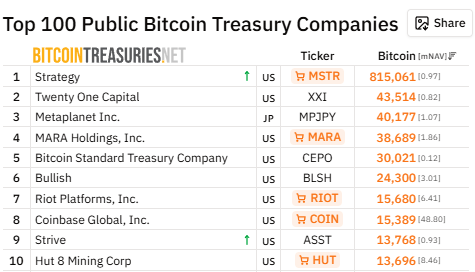
The top 10 treasury companies ranked by BTC holdings | Source: BitcoinTreasuries.net

In the wider sector, another digital asset treasury company has also maintained a regular buying schedule regardless of the recent market conditions: Bitmine. Originally a Bitcoin-mining focused firm, Bitmine is a relatively new player in the space, pivoting to an Ethereum treasury strategy just in mid-2025. Despite its age, though, the firm’s treasury has already established itself as the second-largest in the cryptocurrency sector behind Strategy.

In the past week, Bitmine has furthered its ETH accumulation, according to a Monday press release. In total, the firm added 101,627 ETH inside this window, making it the largest weekly acquisition for the company since December 2025. “Bitmine has maintained the increased pace of ETH buys in each of the past four weeks, as our base case ETH is in the final stages of the ‘mini-crypto winter,'” noted Thomas “Tom” Lee, the firm’s chairman.

After this purchase, Bitmine’s Ethereum holdings have grown to 4.976 million, equal to a supply share of 4.12%.

BTC Price

At the time of writing, Bitcoin is floating around $75,000, up more than 5% in the last seven days.

The price of the coin has retraced from last week’s high | Source: BTCUSDT on TradingView

Related Questions

QHow many BTC did Strategy acquire in its latest purchase since November 2024, and what was the total cost?

AStrategy acquired 34,164 BTC at a total cost of $2.54 billion.

QWhat is the primary source Strategy used to fund this large Bitcoin acquisition, as mentioned in the SEC filing?

AThe purchase was funded using sales of the company's STRC and MSTR at-the-market (ATM) stock offerings.

QWhat is the total amount of Bitcoin that Strategy now holds in its treasury, and what percentage of the circulating supply does this represent?

AStrategy's total holdings are now 815,061 BTC, which represents 4.07% of the entire circulating supply.

QBesides Strategy, which other digital asset treasury company is noted for maintaining a regular buying schedule, and which cryptocurrency are they accumulating?

ABitmine is the other company noted for maintaining a regular buying schedule, and they are accumulating Ethereum (ETH).

QWhat was the average cost basis per Bitcoin token for Strategy's entire treasury holdings, and what is the current state of their investment (e.g., profit, loss, break-even)?

AThe average cost basis per token is $75,527, and their holdings are now at about break-even after the recent price recovery.

Related Reads

The AI Stock Genius Who Made 60x Bets $7.7 Billion on Nvidia Topping Out

An AI-focused hedge fund named Situational Awareness LP, known for its 60x returns, has taken a significant bearish stance on semiconductor stocks in Q1 2026. Its 13F filing reveals a massive 148% quarterly increase in nominal exposure to $13.677 billion, with over 60% of the new exposure directed towards put options on major chip players. Key bearish bets include $2.04 billion in puts on the VanEck Semiconductor ETF (SMH) and $1.56 billion on NVIDIA, alongside positions against Broadcom, Oracle, AMD, and others. The fund simultaneously increased its long equity holdings in AI infrastructure and compute providers like CoreWeave and Bitcoin mining companies repurposing for compute. The core thesis behind this positioning is a shift in the primary constraint for AI expansion. The fund argues that while GPU supply was the critical bottleneck in previous years, the new limiting factors for large-scale AI cluster deployment are physical infrastructure: electrical grid access (with multi-year backlogs in the US), power availability, land, and data center construction timelines. The fund is not betting against AI's success but rather hedging against potential valuation corrections in semiconductor stocks whose prices may have run ahead, while directly investing in the downstream physical bottlenecks—power and data center capacity—it believes will capture value next. This move translates a previously theoretical narrative about infrastructure constraints into a concrete, high-conviction portfolio structure.

链捕手1h ago

The AI Stock Genius Who Made 60x Bets $7.7 Billion on Nvidia Topping Out

链捕手1h ago

Deep Dissection of the Anthropic Account Banning Storm: The Behind-the-Scenes of the Safety Religion, AI Civil War, and Claude's Dilemma Under US-China Decoupling

"Deconstructing Anthropic's Account Banning Storm: Safety Dogma, AI Civil War, and the Claude Dilemma Under US-China Decoupling" analyzes the aggressive user account suspension policies of Anthropic, particularly for its product Claude Code. The article attributes this to a multi-layered convergence of factors. The root cause is traced to founder Dario Amodei's personal "safety religion." Shaped by his father's illness and his exit from OpenAI over safety disagreements with Sam Altman, Amodei embedded this "zero-tolerance" philosophy into Anthropic's DNA. This manifests in technologies like Constitutional AI and a "preventive enforcement" approach to risk, prioritizing safety over user experience or growth. This stance defines Anthropic's position in the US "AI Civil War," pitting "safety-first" proponents like Amodei against "accelerationists" like Altman who prioritize rapid development and commercialization. Anthropic's strict model aligns with its business strategy targeting high-value, low-risk enterprise clients who pay a premium for security, unlike OpenAI's mass-market approach. Capital from Amazon and Google supports Anthropic but also creates a delicate balance, as these investors need its safety reputation without allowing overly restrictive policies to cripple its commercial viability. The conflict escalated when Anthropic refused a US Department of Defense contract requiring the removal of safety guardrails, leading to its placement on a "supply chain risk" blacklist—a key example of the public battle between the two AI factions. For Chinese users, the stringent bans are further compounded by US-China tech decoupling. Anthropic's policies act as a tool for compliance with US export controls, making Chinese users—who often circumvent regional blocks via VPNs or virtual cards—primary targets for "preventive" account terminations to avoid regulatory penalties. The article concludes that Anthropic's harsh account control measures are unlikely to loosen in the near future, being integral to its founding philosophy, business model, and geopolitical compliance needs, positioning it as a unique, security-obsessed player in the tripartite global AI competition involving US safety and acceleration factions and rising Chinese AI power.

marsbit1h ago

Deep Dissection of the Anthropic Account Banning Storm: The Behind-the-Scenes of the Safety Religion, AI Civil War, and Claude's Dilemma Under US-China Decoupling

marsbit1h ago

Trading

Spot
Futures

Hot Articles

What is $BITCOIN

DIGITAL GOLD ($BITCOIN): A Comprehensive Analysis Introduction to DIGITAL GOLD ($BITCOIN) DIGITAL GOLD ($BITCOIN) is a blockchain-based project operating on the Solana network, which aims to combine the characteristics of traditional precious metals with the innovation of decentralized technologies. While it shares a name with Bitcoin, often referred to as “digital gold” due to its perception as a store of value, DIGITAL GOLD is a separate token designed to create a unique ecosystem within the Web3 landscape. Its goal is to position itself as a viable alternative digital asset, although specifics regarding its applications and functionalities are still developing. What is DIGITAL GOLD ($BITCOIN)? DIGITAL GOLD ($BITCOIN) is a cryptocurrency token explicitly designed for use on the Solana blockchain. In contrast to Bitcoin, which provides a widely recognized value storage role, this token appears to focus on broader applications and characteristics. Notable aspects include: Blockchain Infrastructure: The token is built on the Solana blockchain, known for its capacity to handle high-speed and low-cost transactions. Supply Dynamics: DIGITAL GOLD has a maximum supply capped at 100 quadrillion tokens (100P $BITCOIN), although details regarding its circulating supply are currently undisclosed. Utility: While precise functionalities are not explicitly outlined, there are indications that the token could be utilized for various applications, potentially involving decentralized applications (dApps) or asset tokenization strategies. Who is the Creator of DIGITAL GOLD ($BITCOIN)? At present, the identity of the creators and development team behind DIGITAL GOLD ($BITCOIN) remains unknown. This situation is typical among many innovative projects within the blockchain space, particularly those aligning with decentralized finance and meme coin phenomena. While such anonymity may foster a community-driven culture, it intensifies concerns about governance and accountability. Who are the Investors of DIGITAL GOLD ($BITCOIN)? The available information indicates that DIGITAL GOLD ($BITCOIN) does not have any known institutional backers or prominent venture capital investments. The project seems to operate on a peer-to-peer model focused on community support and adoption rather than traditional funding routes. Its activity and liquidity are primarily situated on decentralized exchanges (DEXs), such as PumpSwap, rather than established centralized trading platforms, further highlighting its grassroots approach. How DIGITAL GOLD ($BITCOIN) Works The operational mechanics of DIGITAL GOLD ($BITCOIN) can be elaborated on based on its blockchain design and network attributes: Consensus Mechanism: By leveraging Solana’s unique proof-of-history (PoH) combined with a proof-of-stake (PoS) model, the project ensures efficient transaction validation contributing to the network's high performance. Tokenomics: While specific deflationary mechanisms have not been extensively detailed, the vast maximum token supply implies that it may cater to microtransactions or niche use cases that are still to be defined. Interoperability: There exists the potential for integration with Solana’s broader ecosystem, including various decentralized finance (DeFi) platforms. However, the details regarding specific integrations remain unspecified. Timeline of Key Events Here is a timeline that highlights significant milestones concerning DIGITAL GOLD ($BITCOIN): 2023: The initial deployment of the token occurs on the Solana blockchain, marked by its contract address. 2024: DIGITAL GOLD gains visibility as it becomes available for trading on decentralized exchanges like PumpSwap, allowing users to trade it against SOL. 2025: The project witnesses sporadic trading activity and potential interest in community-led engagements, although no noteworthy partnerships or technical advancements have been documented as of yet. Critical Analysis Strengths Scalability: The underlying Solana infrastructure supports high transaction volumes, which could enhance the utility of $BITCOIN in various transaction scenarios. Accessibility: The potential low trading price per token could attract retail investors, facilitating wider participation due to fractional ownership opportunities. Risks Lack of Transparency: The absence of publicly known backers, developers, or an audit process may yield skepticism regarding the project's sustainability and trustworthiness. Market Volatility: The trading activity is heavily reliant on speculative behavior, which can result in significant price volatility and uncertainty for investors. Conclusion DIGITAL GOLD ($BITCOIN) emerges as an intriguing yet ambiguous project within the rapidly evolving Solana ecosystem. While it attempts to leverage the “digital gold” narrative, its departure from Bitcoin's established role as a store of value underscores the need for a clearer differentiation of its intended utility and governance structure. Future acceptance and adoption will likely depend on addressing the current opacity and defining its operational and economic strategies more explicitly. Note: This report encompasses synthesised information available as of October 2023, and developments may have transpired beyond the research period.

363 Total ViewsPublished 2025.05.13Updated 2025.05.13

What is $BITCOIN

Discussions

Welcome to the HTX Community. Here, you can stay informed about the latest platform developments and gain access to professional market insights. Users' opinions on the price of BTC (BTC) are presented below.

活动图片















