Stock Price Surges Over 35%! Circle's Earnings Report Exceeds Expectations: USDC Circulation Soars 72%

marsbitPublished on 2026-02-26Last updated on 2026-02-26

Abstract

Circle (CRCL) reported strong Q4 and full-year 2025 financial results, with total revenue and reserve income reaching $770 million in Q4, up 77% year-over-year, exceeding expectations. This drove a 35% surge in its stock price. Key highlights include a 72% YoY increase in USDC circulation to $75.3 billion and a 247% rise in on-chain transaction volume to $11.9 trillion in Q4. Reserve income remained the core revenue driver at $733 million, while non-interest income reached $37 million. For the full year, total revenue grew 64% to $2.7 billion. Although the company reported a net loss of $70 million due to a one-time $424 million stock-based compensation expense from its IPO, adjusted EBITDA doubled to $582 million, indicating profitable core operations. Strategic developments include the stable testnet performance of its Arc blockchain, expansion of the Circle Payments Network with 55 financial institutions onboarded, and a key partnership with Polymarket to use native USDC. Regulatory progress includes conditional approval for a national trust bank. Looking ahead, Circle targets a 40% compound annual growth rate for USDC circulation. CEO Jeremy Allaire emphasized AI-driven payment demand, with 99% of agent-based payments currently using USDC. Despite challenges like declining yields and new competitors like USAT, Circle continues to execute its strategy as a growing internet financial infrastructure provider.

Author:Zhou, ChainCatcher

On February 25, stablecoin issuer Circle (NYSE code: CRCL) released its 2025 fiscal year fourth quarter and full-year financial report.

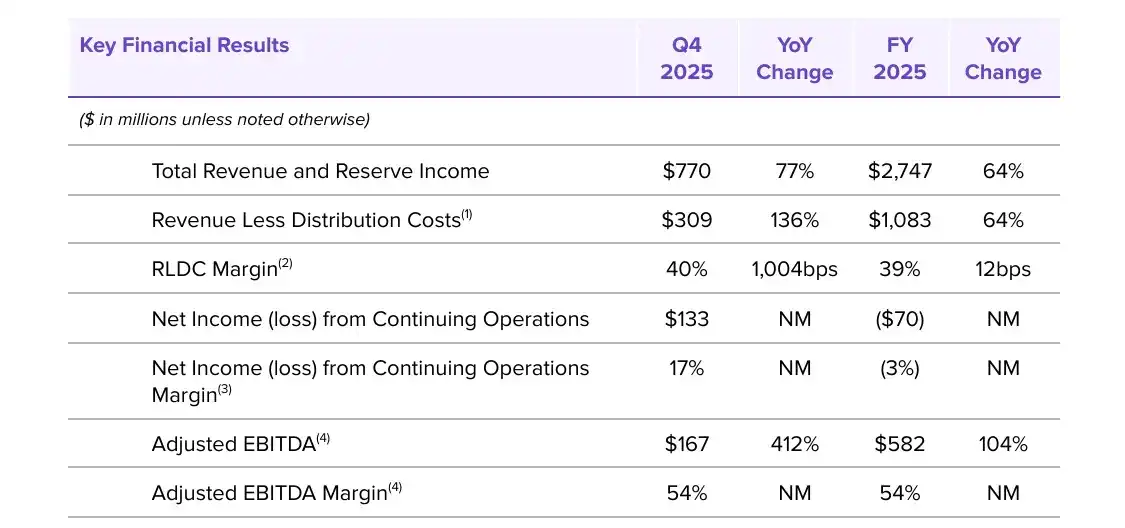
The report shows that the company's total revenue and reserve income for the fourth quarter reached $770 million, a year-on-year increase of 77%, exceeding market expectations.

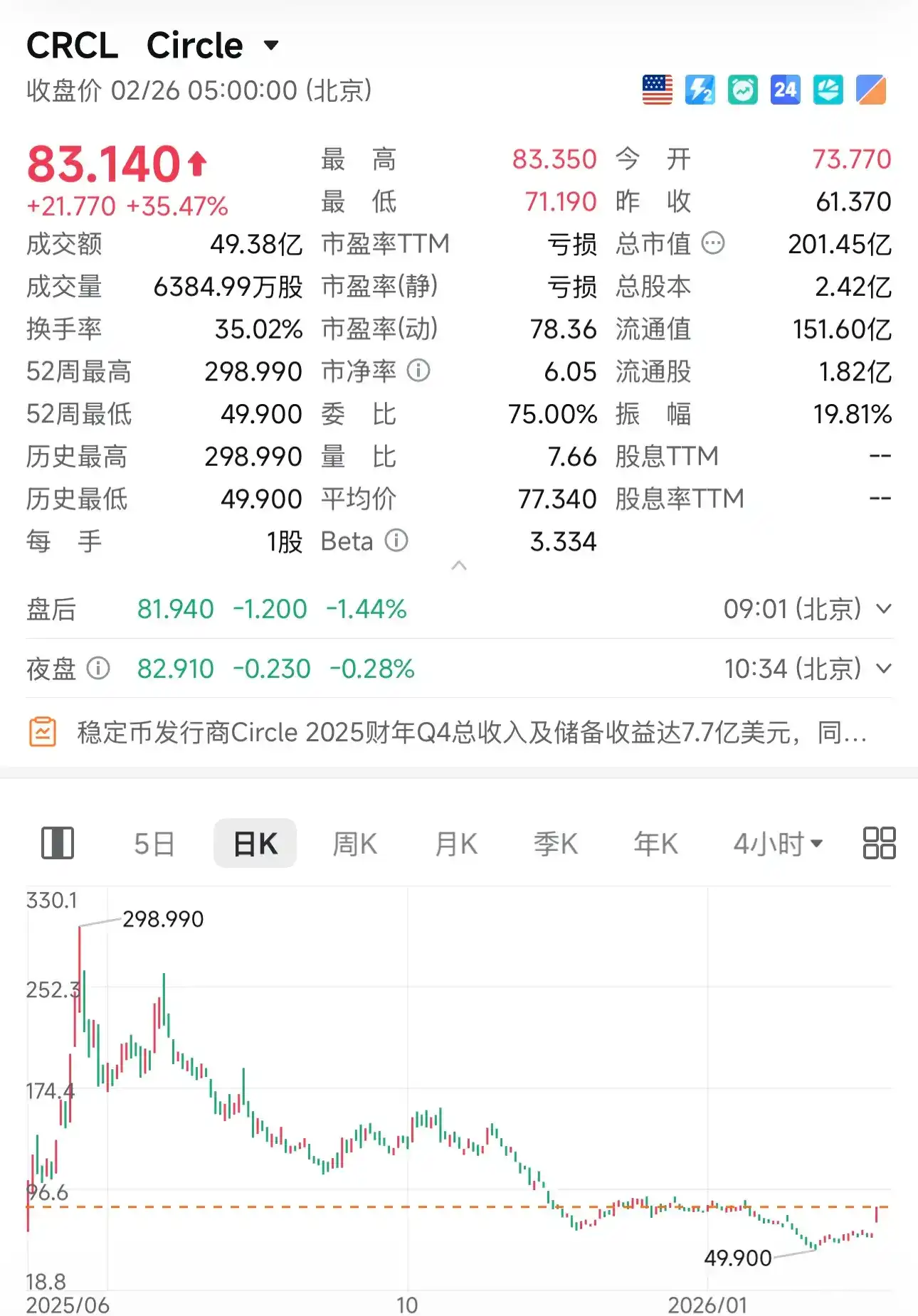
Driven by this, CRCL stock price rose over 35% at Wednesday's close.

Specifically, the growth of its stablecoin USDC was the core highlight of this earnings report. As of year-end, the circulation of USDC reached $75.3 billion, a year-on-year increase of 72%.

Meanwhile, network activity showed explosive growth, with on-chain transaction volume in the fourth quarter reaching $11.9 trillion, a year-on-year increase of 247%.


In terms of revenue composition, reserve income remains the company's main revenue pillar, contributing $733 million in Q4, a year-on-year increase of 69%.

Although market yields decreased by 68 basis points during the period, this pressure was offset by the significant expansion of USDC's average circulation scale.

At the same time, non-interest income reached $37 million, mainly due to the steady accumulation of subscription services and transaction fees.

Looking at the full-year performance, the company's total revenue and reserve income was $2.7 billion, a year-on-year increase of 64%.

Although continuing operations recorded a net loss of $70 million, this was mainly affected by the one-time inclusion of $424 million in stock-based compensation expenses during the IPO process.

As this expense is non-cash in nature, the company's core business is profitable after exclusion. Adjusted EBITDA reached $582 million, doubling year-on-year, showing that operating leverage is gradually emerging.
极

In terms of strategic layout, Circle is gradually transforming from a pure stablecoin issuer to an internet financial infrastructure provider, strengthening its underlying position in the real-time transaction field through various technological initiatives.

The report shows that the Arc public blockchain testnet is running stably, with transaction finality time shortened to about half a second, and total transactions have exceeded 166 million. The mainnet is expected to be officially launched within the year.

In terms of the payment network, the ecosystem of the Circle Payments Network continues to expand. Currently, 55 financial institutions have officially joined, with another 74 in the qualification review stage. The annualized transaction volume over the past 30 days has reached $5.7 billion.

It is worth mentioning that the strategic cooperation with Polymarket further highlights the value of USDC in emerging fields. As one of the world's largest prediction market platforms, Polymarket will gradually switch all betting and settlement to native USDC.

This cooperation not only eliminates bridging risks and improves capital efficiency but also directly converts the user growth of the prediction market into long-term increments in USDC circulation and transaction volume.

In addition, Circle is also gradually penetrating the traditional financial ecosystem. The company has not only achieved all-day settlement cooperation with Visa but also broadened application scenarios through platform integration with Intuit.

At the regulatory compliance level, the company received conditional approval from the U.S. Office of the Comptroller of the Currency to establish a national trust bank in December 2025, and further consolidated its first-mover advantage in compliance under the GENIUS Act framework.

The secondary market has given a relatively positive response. Technically, before the earnings release, the company's stock price had rebounded from its low and stabilized above the 7-day and 30-day moving averages.

On the institutional side, ARK Invest, under Cathie Wood, increased its holdings of Circle stock multiple times during market corrections. The latest holdings are about 4.14 million shares, worth approximately $261 million.

Mizuho Securities upgraded CRCL's rating from underweight to neutral at the end of January, setting a target price of $77. The institution believes that the growth of Polymarket will directly drive the expansion of USDC scale and revenue.

However, Circle still needs to deal with potential headwinds in the future.

On the one hand, the downward trend in interest rates may continue to put pressure on reserve income, which has been reflected in the decline in yield in the fourth quarter.

On the other hand, the stablecoin competitive landscape is changing. The USAT stablecoin, launched by Tether and issued by Anchorage Digital, is targeting the U.S. institutional market and is regarded as the first substantive compliant competitor for USDC domestically. This competition may lead to some diversion in the compliant institutional share.

In addition, overall cryptocurrency market volatility and macro cycles will still create uncertainty for circulation growth. According to Coinglass data, the current total stablecoin market capitalization is about $264 billion, with USDC accounting for about 28.5%. Although USDC leads the industry in growth rate, Tether still dominates.


Worthy of special attention from investors is Circle management's expectations and execution plans for the future. The company provided clear guidance for the 2026 fiscal year:

  • USDC circulation targets a compound annual growth rate of 40% over a multi-year cycle;
  • Other income (subscription, service, and transaction fees) is expected to be $150 to $170 million;
  • RLDC margin (revenue minus distribution and transaction cost margin) remains in the high range of 38% to 40%;
  • Adjusted operating expenses are expected to be $570 to $585 million.

These guidelines also reflect management's confidence in continued scale expansion, cost control, and accelerated growth in non-interest income.

Furthermore, Circle CEO Jeremy Allaire repeatedly mentioned AI agents and their payment needs during the earnings call.

He said, we are about to enter a world where there may be billions or even hundreds of billions of AI agents interacting on the internet and performing economic functions.

These AI agents need programmable digital dollars and open infrastructure to enable autonomous transactions, and Circle's products are built for this.

Specifically, Circle is heavily investing in agent-based payment infrastructure.

Currently, Circle Gateway has entered the test network phase, supporting AI agents to autonomously initiate cross-chain USDC transactions, with a single transaction cost as low as $0.00001 (extremely low fees, suitable for micro-payments and high-frequency machine-to-machine transactions).

It was also mentioned in the meeting that currently about 99% of agent-based payments use USDC, thanks to Circle's cross-chain deployment and participation in agent payment standards (such as the x402 standard, in cooperation with Google etc.).

Overall, this earnings report validates Circle's strategic execution capability in a complex regulatory environment, and the new story of AI+ payments has expanded the company's valuation imagination space. Despite facing yield fluctuations and emerging competitive challenges, Circle continues to exert efforts on the track of "financial infrastructure-ization" and "compliant expansion".


Related Questions

QWhat was the percentage increase in Circle's total revenue and reserve income in Q4 2025, and what was the exact figure?

ACircle's total revenue and reserve income increased by 77% in Q4 2025, reaching $770 million.

QBy what percentage did the circulating supply of USDC grow year-over-year, and what was its total value at the end of the period?

AThe circulating supply of USDC grew by 72% year-over-year, reaching a total value of $75.3 billion.

QWhat was the main reason for Circle's net loss from continuing operations, and what was the adjusted EBITDA figure that showed core profitability?

AThe net loss was primarily due to a one-time, non-cash stock-based compensation expense of $424 million related to its public listing. The adjusted EBITDA, which excludes this, was $582 million, showing core profitability.

QName one new significant competitor for USDC in the U.S. institutional market mentioned in the article and which company is behind it.

AA new significant competitor is the USAT stablecoin, which is issued by Anchorage Digital and backed by Tether, targeting the U.S. institutional market.

QWhat future technology trend did CEO Jeremy Allaire highlight as a major growth driver for USDC, and what specific infrastructure is Circle building for it?

ACEO Jeremy Allaire highlighted AI agents and their payment needs as a major future growth driver. Circle is building 'agentic payment infrastructure,' including the Circle Gateway currently in testnet, to support autonomous, low-cost USDC transactions for AI.

Related Reads

7 Months After the Collapse of Huiwang, Southeast Asia's Escrow Platforms Undergo a Major Reshuffle

Following the collapse of Huione Pay—dubbed the "Alipay of Southeast Asia"—seven months ago, the region's underground financial guarantee platform sector is undergoing a significant reshuffle. This power vacuum has been swiftly filled by emerging platforms such as XinBi, Tiger/Navigator, JinBei (renamed JinBo), Dali/Tiancheng, and FullyLight. These platforms, operating largely via Telegram and offering services like escrow for illicit transactions, have absorbed the vast user base and markets left behind by Huione. While positioning themselves as "trust intermediaries," their primary clientele consists of networks involved in online scams, money laundering, illegal gambling, and even human trafficking. For instance, the Tiger/Navigator platform explicitly provides "escrow" services for kidnapping-for-ransom operations ("强押车交易"). Data underscores the immense scale: Huione alone processed over $103 billion in cryptocurrency payments and facilitated over $31 billion through its escrow market before its downfall, linking it to Cambodia's notorious Prince Group. Since its collapse, competitors have seen explosive growth. For example, the XinBi platform has accumulated over $1.6 billion in total USDT revenue, while platforms like NewPay, OkPay (under Dali), and FullyLight Wallet collectively processed over $4.8 billion in USDT in a single year. This ecosystem thrives in regions like Cambodia and Myanmar, where regulatory gaps allow these platforms to act as critical financial infrastructure for sprawling cybercrime industries, from scam compounds to online casinos. The article concludes that the moniker "Southeast Asian Alipay" is a misnomer, obscuring the platforms' fundamental role in enabling serious criminal enterprises rather than representing legitimate financial innovation.

Odaily星球日报26m ago

7 Months After the Collapse of Huiwang, Southeast Asia's Escrow Platforms Undergo a Major Reshuffle

Odaily星球日报26m ago

The Changing Landscape: What Are Crypto VCs Experiencing?

Title: The Shifting Landscape of Crypto Venture Capital The era of dedicated crypto venture capital funds is undergoing a significant transformation. Once essential for navigating the sector's complexity and high risk, these specialized funds are now facing an identity crisis as the market matures. This shift mirrors historical patterns in other specialized investment classes like cleantech and SPACs, where initial information advantages dissipate as technologies become mainstream and integrated into existing industry frameworks. The article argues that crypto is reaching a critical inflection point, transitioning from a "building phase" to an "integration phase." Major players like Stripe, BlackRock, and Visa now engage with crypto not for its novel mechanics but as a foundational financial infrastructure. Their needs—regulatory compliance, banking partnerships, distribution channels—align with traditional fintech, a domain easily understood by large, generalist funds like Sequoia and Founders Fund. This evolution creates a "barbell effect" within the VC landscape. On one end are massive, diversified platforms that can incorporate crypto as one vertical among many. On the other are small, nimble funds focused on niche, experimental projects. The middle ground—medium-sized dedicated crypto funds—is being squeezed out. Their typical fund size makes it impossible to generate sufficient returns solely from early-stage crypto bets, yet they cannot compete with giants for later-stage deals. Consequently, leading crypto-native firms like Paradigm and Framework Ventures are expanding into AI, robotics, and other sectors, driven partly by LP pressure for better returns amid a broader VC DPI crisis. Others, like Dragonfly and a16z, have narrowed their crypto focus predominantly to financial infrastructure like stablecoins, reframing the sector's core narrative. For crypto entrepreneurs, this consolidation presents challenges. While generalist funds offer larger checks and broader resources, crypto projects now compete fiercely with AI for attention and capital within these firms. Furthermore, the long-term, non-commercial foundational work that built the ecosystem—funded by dedicated crypto VCs—is less likely to attract generalist capital focused on direct returns. The conclusion is that "crypto investor" as a standalone category is becoming obsolete, akin to "internet investor." Crypto is becoming a baseline infrastructure layer. The future will see a barbell structure: large-scale growth financing handled by generalist funds, while pioneering, speculative projects are funded by small, specialized vehicles. The dedicated crypto funds of the 2017-2021 boom, which incubated core infrastructure, are giving way to this new, bifurcated reality.

Foresight News44m ago

The Changing Landscape: What Are Crypto VCs Experiencing?

Foresight News44m ago

As Consensus Accelerates, What Are Young Investors Betting On?

Title: As Consensus Forms Faster, What Are Young Investors Betting On? In the rapid evolution of tech investment, a new generation of young investors is navigating a landscape where AI, robotics, commercial aerospace, and quantum computing are advancing simultaneously. Traditional investment logic based on financial models is giving way to a need for deep technical understanding and the ability to act before industry consensus forms. An analysis of trends from the "WAIC FUTURE TECH" list of young investment leaders reveals key shifts in focus. The first major trend is the movement of AI from the digital screen into the physical world. Investment is shifting from large language models and chatbots towards embodied AI, robotics, AI hardware, and edge computing. While demonstrations generate excitement, the real challenge lies in achieving scalable, reliable, and cost-effective delivery in complex real-world environments like factories and logistics. Success depends not just on algorithms but on the integration of sensors, actuators, and control systems. Second, the competitive focus for large models is moving beyond raw capability toward building an "intelligence flywheel." The goal is to create self-reinforcing systems where user interaction generates data, improving the model, which in turn enhances the user experience and attracts more engagement. Companies that successfully embed AI into workflows to create these closed-loop systems can build lasting value that isn't easily erased by the next model upgrade. Third, facing a potential bottleneck in high-quality human-generated data, investors are looking at new underlying technologies. Reinforcement learning and self-play, as demonstrated by AlphaGo Zero, offer paths for AI to generate its own experience. Scientific foundation models, which aim to build general AI capabilities for fields like life sciences and materials discovery, represent a non-consensus direction that could unlock new frontiers of knowledge and data. Finally, in deep-tech areas like quantum computing, commercial aerospace, and space-based infrastructure, patient capital is essential. These fields have long, uncertain development and validation cycles involving complex engineering, supply chains, and regulations. Investment here requires a long-term view, focusing on foundational team capabilities and the eventual emergence of market demand, even if commercial returns are distant. Collectively, these trends illustrate how young investors are adapting to a new era. They are learning to make earlier, technically-informed judgments, balance hype with real-world viability, and provide the patient capital needed to build the deep-tech foundations of the future.

marsbit1h ago

As Consensus Accelerates, What Are Young Investors Betting On?

marsbit1h ago

Trading

Spot
活动图片




