Steam, Steel, and Infinite Intelligence

marsbitPublished on 2025-12-29Last updated on 2025-12-29

Abstract

The article "Steam, Steel, and Infinite Mind" by Ivan Zhao, CEO of Notion, explores how AI is poised to become the defining technological material of our era, much like steel shaped the Gilded Age and semiconductors enabled the digital age. The author argues that while AI currently mimics past forms—like early films resembling stage plays or AI chatbots resembling search engines—it holds transformative potential. At the individual level, AI can elevate knowledge workers from "bicycles" to "cars," as seen with programmers who now use AI assistants to become dramatically more efficient. However, two key challenges remain: fragmented context across tools and the lack of verifiability in non-programming knowledge work. At the organizational level, AI acts like "steel" for companies, enabling them to scale without the inefficiencies of human communication as a bottleneck. It also parallels the steam engine, which initially replaced water wheels but later allowed entirely new factory designs. Most companies are still in the "water wheel stage," using AI within old workflows rather than reimagining operations around continuous, asynchronous intelligence. On an economic scale, AI could enable a shift from human-scale "Florence-like" organizations to AI-augmented "megacities" of knowledge work—larger, faster, and more complex, but also more powerful. The conclusion urges looking beyond the rearview mirror to imagine and build this new frontier of infinite intelligence.

Written by: Ivan Zhao, CEO of Notion

Compiled by: AididiaoJP, Foresight News

Each era is shaped by its unique technological raw materials. Steel forged the Gilded Age, and semiconductors ushered in the digital age. Today, artificial intelligence arrives in the form of infinite intelligence. History tells us: those who master the raw materials define the era.
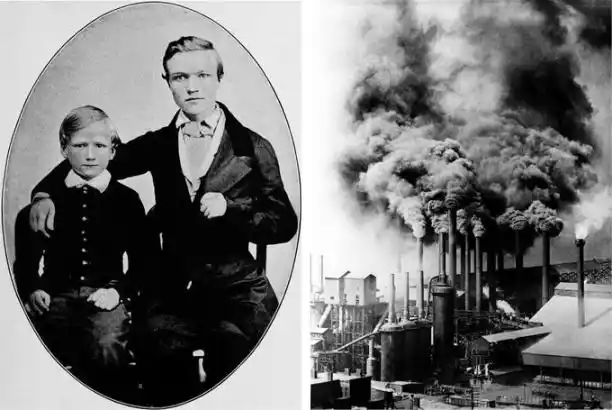
Left: Young Andrew Carnegie and his brother. Right: A steel mill in Pittsburgh during the Gilded Age.

In the 1850s, Andrew Carnegie was a telegraph messenger running through the muddy streets of Pittsburgh, a time when six out of ten Americans were farmers. Just two generations later, Carnegie and his peers forged the modern world. Horses gave way to railroads, candlelight to electric light, and iron to steel.

Since then, work has shifted from factories to offices. Today, I run a software company in San Francisco, building tools for thousands of knowledge workers. In this tech town, everyone is talking about Artificial General Intelligence (AGI), but the vast majority of the two billion office workers have yet to feel its presence. What will knowledge work look like soon? What will happen when organizations are infused with intelligence that never rests?
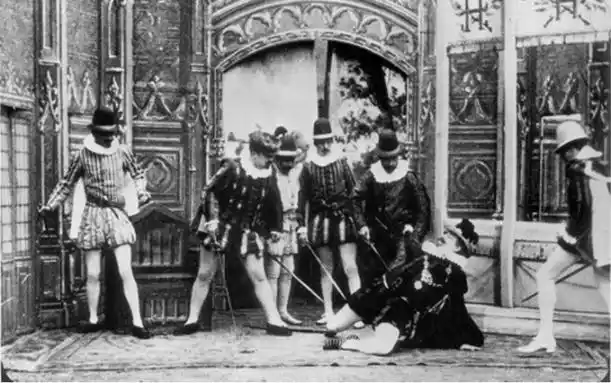
Early films often resembled stage plays, with a single camera pointed at the stage.

The future is often hard to predict because it is always disguised as the past. Early phone calls were as brief as telegrams, and early films were like recorded stage plays. As Marshall McLuhan said: "We look at the present through a rear-view mirror. We march backwards into the future."
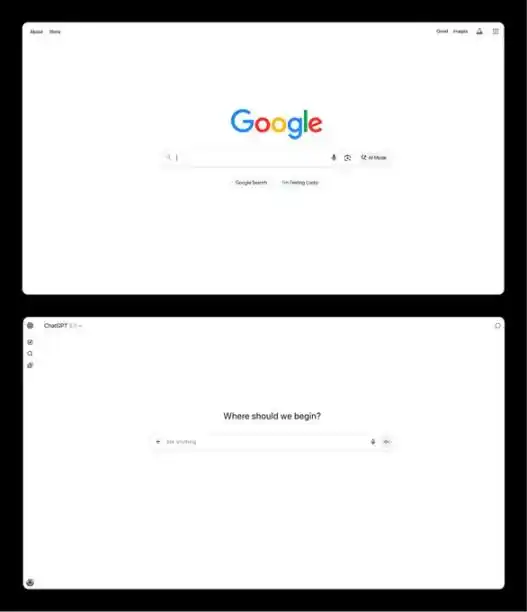
Today's most common form of AI still looks like the Google search of the past. To quote McLuhan again: "We look at the present through a rear-view mirror." Today, we see AI chatbots imitating the Google search box. We are deep in that uncomfortable transition period that occurs with every technological shift.

I don't have all the answers for what the future holds. But I like to use a few historical metaphors to think about how AI might operate at different levels: the individual, the organization, and the entire economy.

Individual: From Bicycle to Car

The first signs can be seen in the "high-level practitioners" of knowledge work: programmers.

My co-founder Simon was once a "10x programmer," but lately he rarely writes code himself. Walking past his desk, you'd see him orchestrating three or four AI programming assistants simultaneously. These assistants not only type faster but also think, making him a 30 to 40 times more efficient engineer. He often queues up tasks before lunch or bed, letting the AI work while he's away. He has become a manager of infinite intelligence.
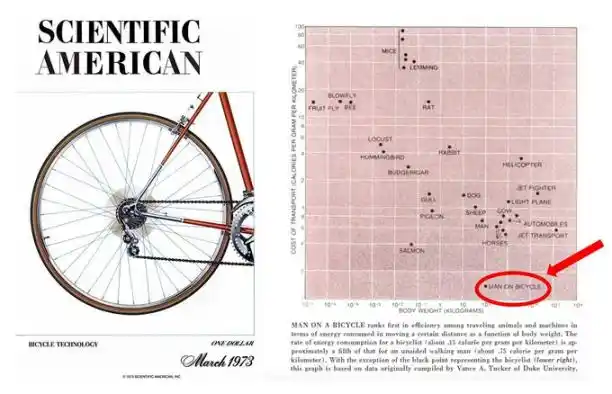
A 1970s Scientific American study on locomotion efficiency inspired Steve Jobs' famous "bicycle for the mind" metaphor. It's just that for decades since, we've been "pedaling bicycles" on the information superhighway.

In the 1980s, Steve Jobs called the personal computer a "bicycle for the mind." A decade later, we paved the "information superhighway" called the internet. But today, most knowledge work still relies on human power. It's like we've been riding bicycles on a highway.

With AI assistants, people like Simon have upgraded from riding bicycles to driving cars.

When will other types of knowledge workers get to "drive cars"? Two problems must be solved.
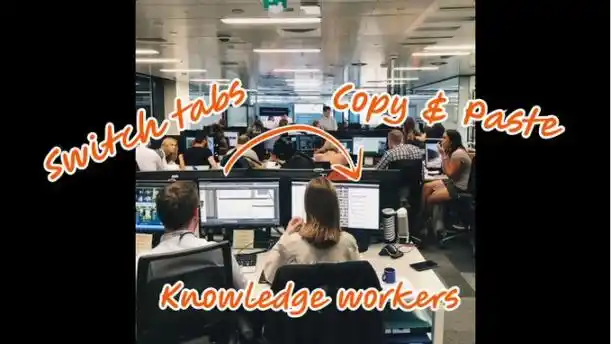
Why is AI-assisted knowledge work harder than programming assistance? Because knowledge work is more fragmented and harder to verify.

First is contextual fragmentation. In programming, tools and context are often centralized: the integrated development environment, code repositories, the terminal. But general knowledge work is scattered across dozens of tools. Imagine an AI assistant trying to draft a product brief: it would need to pull information from Slack threads, strategy documents, last quarter's data in a dashboard, and organizational memory that only exists in someone's head. For now, humans are the glue, copy-pasting and switching browser tabs to piece everything together. As long as the context isn't integrated, AI assistants will be limited to narrow uses.

The second missing element is verifiability. Code has a magical property: you can verify it through tests and errors. Model developers leverage this, using methods like reinforcement learning to train AIs to code better. But how do you verify if a project is well-managed, or if a strategic memo is excellent? We haven't yet found a way to improve models for general knowledge work. Therefore, humans still need to stay in the loop to supervise, guide, and demonstrate what is "good."
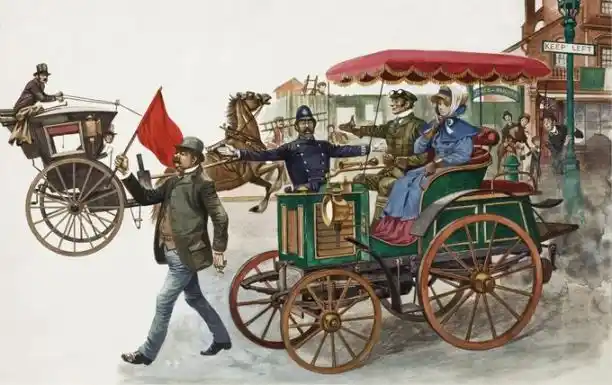
The 1865 Red Flag Act required cars on public roads to be preceded by a person on foot waving a red flag (repealed in 1896).

This year's programming assistant practice shows us that "human-in-the-loop" is not always ideal. It's like having a person check every bolt on an assembly line, or walk in front of a car to pave the way (see the 1865 Red Flag Act). We should have humans supervising the loop from a higher level, not being inside it. Once context is integrated and work becomes verifiable, billions of workers will shift from "pedaling bicycles" to "driving cars," and from "driving" to "autopilot."

Organization: Steel and Steam

Companies are a modern invention. They become less efficient as they scale, eventually hitting a limit.
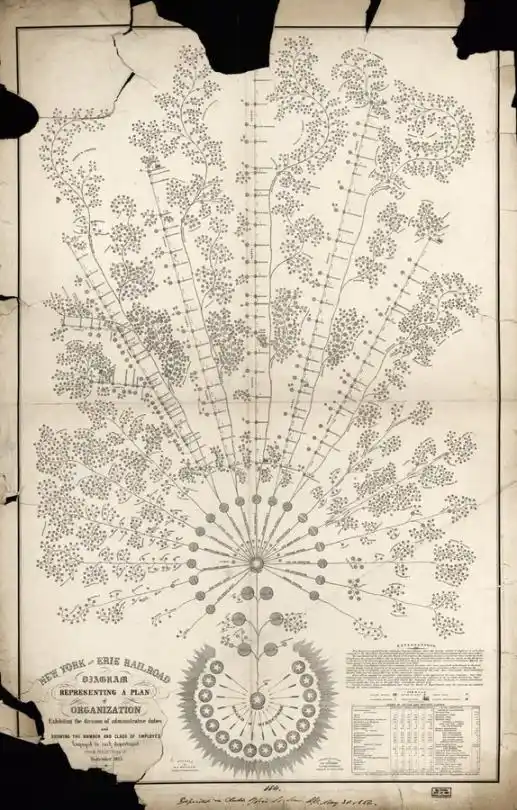
1855 organizational chart of the New York and Erie Railroad Company. The modern corporation and its organizational structure evolved with railroad companies, the first enterprises requiring coordination of thousands of people over long distances.

A few hundred years ago, most companies were workshops of a dozen people. Today we have multinational corporations with hundreds of thousands of employees. The communication infrastructure, relying on meetings and human brains connected by messages, buckles under exponentially increasing load. We try to solve this with hierarchies, processes, and documents, but this is like building skyscrapers out of wood; it's using human-scale tools to solve industrial-scale problems.

Two historical metaphors illustrate how the future might look different when organizations have new technological raw materials.

The miracle of steel: The Woolworth Building in New York, completed in 1913, was once the world's tallest building.

The first is steel. Before steel, 19th-century building heights were limited to six or seven stories. Iron was strong but brittle and heavy; add more floors, and the structure would collapse under its own weight. Steel changed everything. It was strong yet flexible. Frames could be lighter, walls thinner, and buildings soared to dozens of stories. New types of architecture became possible.

AI is the "steel" for organizations. It promises to maintain contextual coherence across workflows, presenting decisions when needed without noise. Human communication no longer has to be the load-bearing wall. Weekly two-hour alignment meetings might become five-minute asynchronous reviews; executive decisions requiring three layers of approval might be made in minutes. Companies can truly scale without the efficiency decay we've come to accept as inevitable.
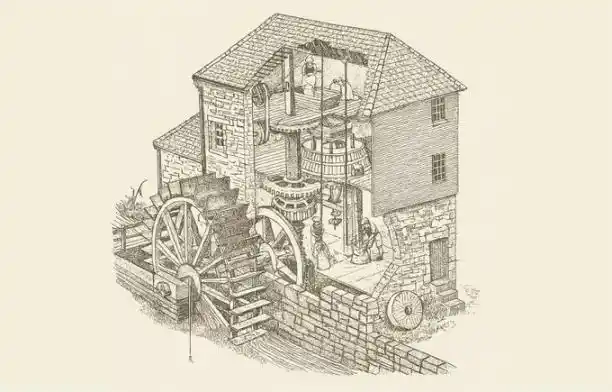
A mill powered by a waterwheel. Water power was powerful but unreliable and limited by location and season.

The second story is about the steam engine. In the early Industrial Revolution, early textile factories were built by rivers, powered by waterwheels. When the steam engine appeared, factory owners initially just replaced the waterwheel with a steam engine, leaving everything else the same. Productivity gains were limited.

The real breakthrough came when owners realized they could completely break free from the water source. They built larger factories near workers, ports, and raw materials, and redesigned the layout around the steam engine (Later, with electrification, owners further broke free from the central power shaft, distributing small motors throughout the factory to power individual machines). Productivity exploded, and the Second Industrial Revolution truly took off.
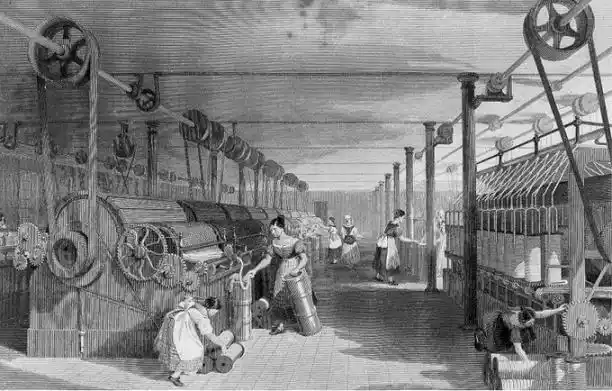
An 1835 engraving by Thomas Allom depicting a steam-powered textile mill in Lancashire, England.

We are still in the "replacing the waterwheel" stage. Stuffing AI chatbots into workflows designed for humans, we haven't yet reimagined what organizations will look like when old constraints vanish and companies can run on infinite intelligence that works while you sleep.

At my company Notion, we have been experimenting. Besides 1,000 employees, there are now over 700 AI assistants handling repetitive work: taking meeting notes, answering questions to consolidate team knowledge, handling IT requests, logging customer feedback, helping new hires learn about benefits, writing weekly status reports to avoid manual copy-pasting... This is just toddling. The true potential is limited only by our imagination and inertia.

Economy: From Florence to Megacities

Steel and steam changed not just buildings and factories, but cities.

Until a few hundred years ago, cities were on a human scale. You could walk across Florence in forty minutes. The pace of life was determined by walking distance and the range of the human voice.

Then, steel frame structures made skyscrapers possible; steam engine-powered railroads connected city centers with their hinterlands; elevators, subways, and highways followed. The scale and density of cities exploded – Tokyo, Chongqing, Dallas.

These are not just enlarged Florences; they are entirely new ways of life. Megacities are disorienting, anonymous, and hard to navigate. This "illegibility" is the price of scale. But they also offer more opportunity, more freedom, supporting more people in more diverse combinations doing more activities than was possible in a human-scale Renaissance city.

I believe the knowledge economy is about to undergo the same transformation.

Today, knowledge work accounts for nearly half of US GDP, but its operation mostly remains on a human scale: teams of dozens, workflows dependent on the rhythm of meetings and emails, organizations that struggle beyond a hundred people... We have been building "Florences" out of stone and wood.

When AI assistants are deployed at scale, we will build "Tokyos": organizations composed of thousands of AIs and humans; workflows that run continuously across time zones without waiting for someone to wake up; decisions synthesized with just the right amount of human input.

It will be a different experience: faster, with more leverage, but also more dizzying at first. The rhythms of weekly meetings, quarterly planning, and annual reviews may no longer apply; new rhythms will emerge. We will lose some legibility, but we will gain scale and speed.

Beyond the Waterwheel

Every technological material demands that people stop looking at the world through the rear-view mirror and start imagining a new world. Carnegie gazed at steel and saw city skylines; the Lancashire factory owner looked at the steam engine and saw factory floors away from the river.

We are still in the "waterwheel stage" of AI, bolting chatbots onto workflows designed for humans. We shouldn't just settle for AI as a co-pilot; we need to imagine: what will knowledge work look like when human organizations are reinforced with steel, when trivial tasks are delegated to intelligence that never rests.

Steel, steam, and infinite intelligence. The next skyline is ahead, waiting for us to build it.

Related Questions

QWhat historical metaphor does the author use to describe the transition of knowledge workers with AI assistants?

AThe author uses the metaphor of transitioning from riding a bicycle to driving a car car, and eventually to autonomous driving.

QAccording to the article, what are the two main problems that need to be solved for AI to assist general knowledge workers effectively?

AThe two main problems are contextual fragmentation the scattering of information across dozens of tools and a lack of verifiability the difficulty in measuring the quality of non-code work like project management or strategy memos.

QHow does the author compare AI to the historical material of steel in the context of organizations?

AThe author compares AI to steel, stating that just as steel allowed buildings to become stronger, more flexible, and much taller, AI will allow organizations to scale effectively by maintaining context, enabling faster decisions, and reducing communication overhead.

QWhat does the 'water wheel phase' of AI refer to in the article?

AThe 'water wheel phase' refers to the current early stage of AI adoption where AI chatbots are being awkwardly fitted into existing human-designed workflows, similar to how early factory owners just replaced water wheels with steam engines without reimagining the entire factory system.

QWhat shift in the scale of the knowledge economy does the author predict, using the analogy of cities?

AThe author predicts a shift from human-scale 'Florence'-sized organizations to AI-powered 'Tokyo'-sized organizations, which will be composed of thousands of humans and AIs, operate continuously across time zones, and offer greater scale, speed, and opportunity despite initial disorientation.

Related Reads

Wall Street's Most Famous 'Cassandra' Now Has His Sights Set on Nvidia

Michael Burry, the famed "Big Short" investor, has once again captured Wall Street's attention with a series of short positions against major tech and semiconductor stocks, most notably Nvidia. In late June and July, through his "Cassandra Unchained" newsletter, Burry disclosed short bets against Nvidia, Tesla, Applied Materials, Caterpillar, the SOXX semiconductor ETF, and later, Micron Technology. His core thesis revolves around potential distortions in the AI infrastructure boom, specifically questioning whether extended depreciation schedules (e.g., 6 years vs. a realistic 2-3 years for AI chips) by cloud giants like Microsoft and Google artificially inflate profits. He also raises concerns about possible "off-balance-sheet circular financing," where chip demand might be propped up by vendor-backed funding to clients. Nvidia's stock experienced volatility following these disclosures, briefly dipping but largely holding near Burry's reported entry points, leaving his positions roughly flat or slightly underwater as of late July. This move is part of a pattern for Burry, whose track record since his legendary 2008 bet is mixed. He has faced notable losses, such as on Tesla in 2021, while scoring on broader market turns like the 2020 pandemic crash. His methodology focuses intensely on free cash flow and scrutinizing original financial documents to spot overvaluation and structural risks, but it often struggles with timing the market. The article contrasts Burry's stance with other prominent investors. Steve Eisman, another "Big Short" figure, is not shorting Nvidia, citing strong fundamentals but expressing nervousness about sustainability. Jim Chanos agrees with the broad "accounting mismatch" concern—comparing it to the dot-com bubble—but targets financial leverage in private equity firms rather than the chip stocks themselves. While Nvidia's short interest remains relatively low at 1.3-1.4% of float, the massive stock size means absolute short losses have been significant, exceeding $5 billion earlier this year. The piece concludes that for ordinary investors, the key takeaway is not replicating specific short bets but learning from the critical frameworks these investors use: questioning rosy accounting, identifying structural vulnerabilities, and maintaining skepticism during market euphoria, even if pinpointing the exact catalyst for a downturn remains elusive.

marsbit22m ago

Wall Street's Most Famous 'Cassandra' Now Has His Sights Set on Nvidia

marsbit22m ago

Weekly Selection丨Epic Stock Market Volatility, Changxin Tech's IPO Reshapes Storage Landscape, Saylor Aims to Re-Anchor STRC Around September 8th

PANews Weekly Digest: Market Turmoil, Tech Breakthroughs, and Crypto Developments. The week saw significant volatility across global markets. South Korea's KOSPI index experienced extreme turbulence, including multiple trading halts, largely driven by sharp declines in AI hardware stocks like SK Hynix. In contrast, China's Changxin Xinqiao (CXC) achieved a landmark IPO with a market cap surpassing 4 trillion yuan, marking a major success for the domestic DRAM industry after a decade of losses. In the crypto and Web3 space, several key narratives emerged. AI is driving demand for new infrastructure, with projects like AI agent wallets and programmable payments gaining traction, attracting interest from firms like Coinbase. The Bitcoin mining sector is pivoting, with companies like MARA focusing on energy management as electricity becomes a core AI-era asset. Meanwhile, the RWA (Real World Assets) sector faces a "utilization puzzle," with hundreds of billions in on-chain assets remaining dormant. Notable market movements included a historic single-day surge of over 17% for the KOSPI index and a significant migration of $16.5 billion in staked ETH within the Lido ecosystem. Michael Saylor announced a target to re-peg the STRC stablecoin around September 8th. Other highlights include discussions on Ethereum's ambitious 2030 roadmap for scaling and privacy, analysis showing high protocol revenues not always translating to token price gains, and warnings from Citi about potential extreme commodity price shocks by late 2026.

marsbit27m ago

Weekly Selection丨Epic Stock Market Volatility, Changxin Tech's IPO Reshapes Storage Landscape, Saylor Aims to Re-Anchor STRC Around September 8th

marsbit27m ago

When the Market Begins to Question AI Capex: A Full Analysis of Q2 Earnings Reports from Five Tech Giants

In late July 2026, five major US tech giants—Alphabet, Intel, Microsoft, Meta, and Apple—released their Q2 earnings reports. While all companies exceeded revenue and profit expectations, driven by strong AI-related business growth, investor reactions diverged sharply due to concerns over escalating AI capital expenditures (capex) and their impact on free cash flow. Alphabet reported strong revenue growth and a surging cloud business, but its stock fell after announcing a doubled year-on-year capex and negative quarterly free cash flow for the first time. Intel posted its strongest revenue growth in over 15 years, but its stock experienced volatile trading after significantly raising its full-year capex guidance. Microsoft saw its stock surge after beating estimates and, crucially, lowering its capex forecast while projecting positive free cash flow. Meta faced the most severe sell-off as its profits declined despite revenue beats, with free cash flow plunging over 90% and its capex guidance raised. Apple reported record June-quarter results, but its stock plummeted after providing Q4 revenue guidance that fell short of expectations, citing supply chain constraints and forex headwinds. The overall takeaway is that the market's focus has shifted from validating AI demand to scrutinizing the timeline for returns on massive AI investments. Companies demonstrating a clearer path to managing capex and preserving free cash flow, like Microsoft, were rewarded, while those signaling continued aggressive spending faced investor skepticism.

Odaily星球日报36m ago

When the Market Begins to Question AI Capex: A Full Analysis of Q2 Earnings Reports from Five Tech Giants

Odaily星球日报36m ago

a16z: From Companies to DAOs, DUNA May Become the Next Generation Organizational Form

This article, "From Companies to DAOs: How DUNA Could Become the Next Organizational Form," traces the 500-year evolution of business collaboration. It begins with medieval structures like the *commenda* and Florentine *compagnia*, which exposed partners to personal risk. The modern corporation, exemplified by the Dutch East India Company (VOC), was a revolutionary leap, enabling large-scale, capital-intensive ventures by offering limited liability and reducing coordination costs. However, corporations introduced new challenges like principal-agent problems and bureaucratic overhead. The piece argues that software and internet-native protocols are now reducing these traditional overheads. Decentralized Autonomous Organizations (DAOs) emerged as a new model for coordination without centralized management. Yet, DAOs face a significant legal vacuum: they lack legal recognition, leaving members exposed to unlimited personal liability, and their tokens are vulnerable to being classified as securities under unclear regulations (e.g., the Howey Test). This has forced projects into suboptimal workarounds like offshore foundations. The article identifies the Decentralized Unincorporated Nonprofit Association (DUNA) as a potential solution. Recently legalized in states like Wyoming, the DUNA provides a legal wrapper for decentralized networks. It grants key protections—legal personality, limited liability, and perpetual existence—to a group without imposing a traditional hierarchical management structure. This allows token-holder communities to govern, hold assets, and contract as a single legal entity, aligning with their decentralized nature. While DUNA doesn't solve all governance challenges or magically resolve securities law questions, it represents a crucial step. It fills the legal recognition gap, offering a native legal form for internet-scale, decentralized collaboration and extending the separation of personal risk from organizational venture into a new domain.

marsbit1h ago

a16z: From Companies to DAOs, DUNA May Become the Next Generation Organizational Form

marsbit1h ago

2026 Mid-Year Report On-Chain RWA: Tokenized Stock Market Cap Doubles in a Year, But 90% of Rights Are Hollow Shells

The 2026 Mid-Year Report on On-Chain RWA highlights a significant growth in tokenized stock market capitalization, which nearly doubled from $951 million in March to $1.89 billion by July. However, the report reveals a fundamental contradiction in this "layer 2.5" ecosystem: products with the strongest legal foundation (like regulated U.S. infrastructure) lack liquidity and distribution, while freely tradable offshored wrapper products often lack substantive ownership rights. The increase is driven largely by a few products (SECZ, FGRS, STRCx) and platforms (Ondo, xStocks, Securitize collectively hold over 85% share). While distributed value across networks like Ethereum, Solana, and BNB Chain has grown, the market remains fragmented. Products referencing the same underlying asset (e.g., Apple stock) are distinct legal liabilities with different intermediaries and jurisdictional rules, offering varying degrees of legal claim. The report cautions that headline numbers are misleading, as they reflect changes in distributed token value—driven by issuance, conversions, and price movements—not pure investor inflows. True "canonical shares" with legal ownership, wide wallet distribution, institutional liquidity, and independent on-chain price discovery do not yet exist at scale. Tokenized treasuries show stronger product-market fit, and ETFs may be easier to scale than single stocks. The core takeaway is a trade-off: legal certainty versus liquidity and composability.

marsbit2h ago

2026 Mid-Year Report On-Chain RWA: Tokenized Stock Market Cap Doubles in a Year, But 90% of Rights Are Hollow Shells

marsbit2h ago

Trading

Spot
活动图片