Stablecoins See Largest Conversion Spreads In Africa, Research Shows

bitcoinistPublished on 2026-02-12Last updated on 2026-02-12

Abstract

Research from Borderless.xyz reveals that Africa has the highest median conversion spreads for stablecoin-to-fiat transactions globally, reaching nearly 300 basis points (3%) in January. This is significantly higher than Latin America's 1.3% and Asia's 0.07%. Within Africa, costs vary widely; South Africa has a low rate of 1.5% due to competition, while Botswana and Congo saw spreads exceeding 19% and 13%, respectively. The high costs are attributed to local market structure and lack of liquidity rather than blockchain technology. While stablecoins offer potential for cheaper remittances, the final conversion cost depends heavily on local competition and infrastructure, limiting savings in many African corridors.

Africa’s promise of cheaper remittances via stablecoins is clashing with reality in many places. According to data from Borderless.xyz, January’s median spread for stablecoin-to-fiat conversions across Africa reached nearly 300 basis points — about 3% — far higher than Latin America’s roughly 1.3% and Asia’s tiny 0.07%. That gap matters. It hits wallets where people send money home.

Conversion Costs Vary By Market

Reports note huge differences inside the continent. South Africa showed one of the lowest conversion costs at about 1.5%, where several providers compete and markets have deeper liquidity.

At the other extreme, Botswana’s median spread climbed to almost 19.4% in January, although pricing eased later that month. Congo also saw conversion levels above 13%. The dataset covered 66 currency corridors and nearly 94,000 rate observations, so these are not isolated blips.
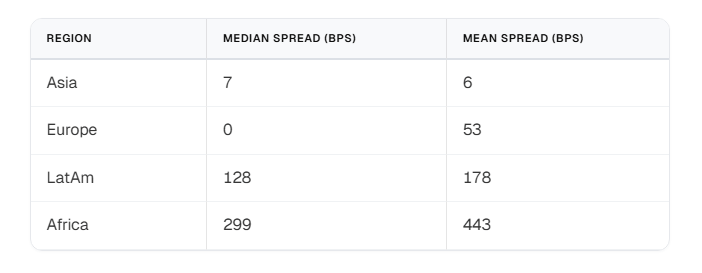
Average regional spreads for stablecoin transactions. Source: Borderless.xyz

Competition And Liquidity Shape Rates

The numbers point to a simple takeaway: who sits between the stablecoin and the local cash matters. Where multiple payment providers operate, conversion costs generally sit between about 1.5% and 4%.

Where a single outfit dominates, spreads can top 13%. The “spread” here is the gap between what a provider will buy and sell a stablecoin for — like a bid-ask gap in traditional markets — and it is the execution cost a sender ultimately pays.

Based on reports, it appears these frictions come from local market structure and liquidity more than from the underlying blockchain tech.
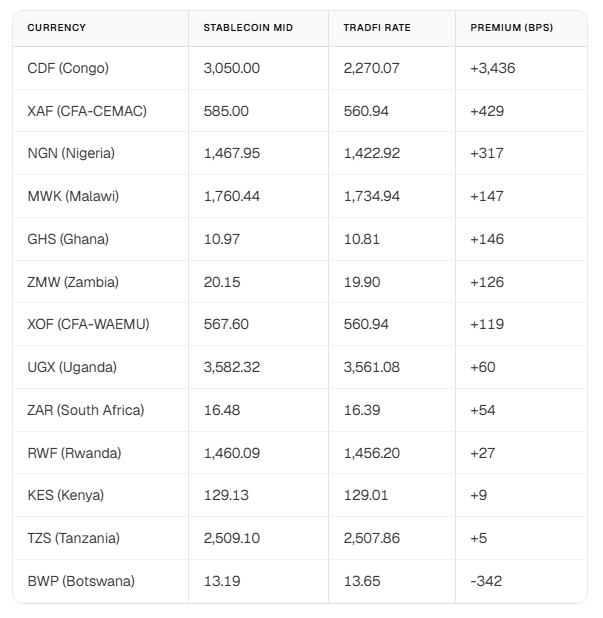
Table shows mid-market stablecoin rates, local Tradfi rates, and the resulting BPS premium per currency. Source: Borderless.xyz

Stablecoins Compared With Traditional FX

Borderless.xyz also measured how stablecoin mid-rates stack up against interbank FX mid-market rates, a metric the company calls the TradFi premium.

Across 33 currencies globally, the median difference was about five basis points, or 0.05%, meaning stablecoins and traditional mid-market rates were largely aligned in many places.

In Africa, however, the median gap widened to close to 120 basis points, or about 1.2%. That larger premium helps explain why stablecoins do not automatically translate into big savings for every corridor.

BTCUSD trading at $67,018 on the 24-hour chart: TradingView

What This Means For Senders And Markets

Economists say stablecoins are cutting remittance costs in Africa, noting that legacy services often charge around $6 for every $100 sent.

The recent data adds nuance: faster settlement and lower fees are possible, but only when local on-ramps and off-ramps work well. For consumers, that means potential savings in some corridors and frustratingly high costs in others.

For regulators and market entrants, the signal is clear — boosting competition and liquidity at the local level is as important as improving cross-border rails.

Stablecoins have opened a route that can be cheaper and quicker. Yet in practice, the last mile — turning crypto into local money — still depends on local players, pricing models, and market depth.

Featured image from andBeyond, chart from TradingView

Related Questions

QWhich continent has the highest median spread for stablecoin-to-fiat conversions according to the research?

AAfrica has the highest median spread for stablecoin-to-fiat conversions at nearly 300 basis points (about 3%), which is far higher than Latin America's 1.3% and Asia's 0.07%.

QWhat factors are identified as the primary drivers of high conversion costs for stablecoins in certain African countries?

AThe primary drivers are local market structure and liquidity. High conversion costs occur where a single payment provider dominates, leading to spreads that can top 13%, whereas areas with multiple competing providers see lower costs between 1.5% and 4%.

QHow does the median TradFi premium for stablecoins in Africa compare to the global median?

AThe median TradFi premium in Africa is about 120 basis points (1.2%), which is significantly wider than the global median of approximately 5 basis points (0.05%).

QWhat was the median spread for stablecoin conversions in Botswana in January, according to the report?

ABotswana's median spread for stablecoin conversions climbed to almost 19.4% in January, although the pricing eased later that month.

QWhy don't stablecoins automatically translate into big savings for every remittance corridor despite their potential?

AStablecoins do not automatically translate into big savings because the final cost depends on the efficiency of local on-ramps and off-ramps. High spreads charged by local providers, due to lack of competition and liquidity, can erase the potential benefits of faster settlement and lower base fees.

Related Reads

Uncovering the Truth About Agent Commerce, Payments, and Infrastructure

Decoding Agent Commerce, Payments, and Infrastructure: The Reality Over the past year, I've been building infrastructure for the Agent economy, engaging with major players like Stripe, Visa, Coinbase, Google, and dozens of startups. A clear conclusion emerges: true, large-scale demand does not yet exist. Startups face structural challenges. Data points illustrate this gap. Stripe's Agent commerce platform has over 1,000 merchants but only single-digit transacting agents. Visa's Agent payment token requires 9-month KYC and a $250M revenue threshold, accessible only to giants like Amazon. On-chain analysis reveals actual daily Agent transaction volume is around $17k, half of which are test transactions. The article analyzes four potential markets: **1. Agent-to-Merchant (A2M):** Current AI shopping UX is often inferior to traditional e-commerce for visual, comparison-heavy purchases (clothing, electronics). Chat interfaces are a step back. Real merchant interest is defensive "Agent Engine Optimization," fearing future obsolescence, not current demand. Potential exists in high-frequency, low-decision purchases (e.g., food delivery) or simplifying terrible UX (complex checkouts, non-native shoppers), but these require massive consumer distribution channels dominated by giants like DoorDash and Amazon. **2. Agent-to-API (A2A):** Developers already have subscriptions and billing for core APIs (compute, data). The argument for micro-payments via crypto for sub-dollar API calls is addressed by pre-paid balances today. The deeper issue is supplier resistance; major SaaS firms rely on enterprise contracts, not fractional cent pricing. Opportunity lies in the long tail of niche services, but this is a smaller market catering to developers, a historically low-paying group. **3. Agent-to-Agent (A2A):** This remains a theoretical long-term vision with near-zero current transaction volume. It involves unique challenges: discovery, trust, negotiation, dispute resolution. When it materializes, it will require a fundamentally new settlement infrastructure for high-speed, variable-value, multi-party transactions. It's a real long-term bet, but not the current market. **4. Agent-to-Finance (A2F):** This is the only category with existing, paying demand. Integrating AI into financial workflows (trading, portfolio management) is a natural evolution and enables new capabilities like autonomous rebalancing. However, competition favors incumbents with regulatory licenses, compliance infrastructure, and existing client relationships. **The Real Issue:** Why is infrastructure still being built? Incumbents can afford long-term bets, and payment companies see every problem as a nail for their payment hammer. However, payment is just one piece. The core challenge is *coordination*—orchestrating work between Agents and humans, verifying outcomes, and settling results. Payment is part of settlement, which is part of coordination. Companies that solve the coordination problem will subsume payments, not the other way around. Startups lack the infinite runway of giants and must find today's real market, which, after a year of exploration, lies outside these four categories—in an area with real, growing, and underserved activity.

marsbit1h ago

Uncovering the Truth About Agent Commerce, Payments, and Infrastructure

marsbit1h ago

Kalshi, MTS, and a16z's Ambition

The article "Kalshi, MTS, and a16z's Ambition" explores prediction markets as a focal point of excitement in 2025 for investors, crypto enthusiasts, and media. It traces their intellectual lineage from Friedrich Hayek's ideas on dispersed knowledge and market coordination to Robin Hanson's Logarithmic Market Scoring Rule (LMSR), which incentivizes truthful information sharing. The piece argues that a16z's significant investment in prediction market platform Kalshi (valued at $220B) transcends mere financial speculation. a16z frames prediction markets as a new form of "media" that provides "presence"—a way for individuals to actively engage with and influence world events through financial stakes, countering postmodern detachment. By wagering on outcomes, users become "super observers," and the market's aggregated probabilities gain authoritative power to define event truth and importance. The article uses media company MTS ("Monitoring The Situation") as a case study of a16z's "new media" strategy: rapidly producing high-intensity, multi-format content to "take over the timeline." However, prediction markets like Kalshi are presented as the ultimate piece in this media empire. Their real-money, crowd-sourced probabilities possess a unique "reality distortion field" and perceived objectivity, potentially swaying public opinion and granting a private company unprecedented interpretive power over reality. Ultimately, Kalshi's immense valuation is attributed not just to its exchange model, but to its role as a foundational component in a16z's envisioned new media landscape, where prediction markets define narrative and truth.

链捕手1h ago

Kalshi, MTS, and a16z's Ambition

链捕手1h ago

Trading

Spot
Futures
活动图片