Stablecoins could reach $1.5 quadrillion by 2035 – Here’s how

ambcryptoPublished on 2026-04-09Last updated on 2026-04-09

Abstract

Stablecoin usage has surged over the past decade, with significant growth accelerated by the passage of the GENIUS Act in 2025, pushing the stablecoin value to $319 billion. According to Chainalysis, adjusted volume rose 133% from 2023 to reach $28 trillion in 2025, with monthly volume hitting a record $7.2 trillion—surpassing major traditional payment channels like U.S. ACH and Visa. Transaction volume exceeded 8.1 trillion through March 2026, and active addresses grew to 51.6 million. Chainalysis projects that, if current growth continues, stablecoin volume could exceed $1.5 quadrillion by 2035, driven by generational wealth transfers ($80–100 trillion moving to crypto-friendly younger generations) and point-of-sale adoption. This would surpass the estimated $1 quadrillion in global cross-border payments. Further adoption, including real-world asset tokenization and supportive legislation like the Clarity Act, could accelerate this trajectory.

Stablecoin usage has surged over the past decade with rising adoption and mainstream acceptance. The passage of the GENIUS Act by the U.S. Congress in 2025 accelerated this growth, pushing stablecoin value to $319 billion.

This global financial shift is driving the integration of traditional and decentralized finance, with stablecoins at the center of market transformation and projected to outpace traditional finance.

Stablecoin monthly volume hits $7.2T

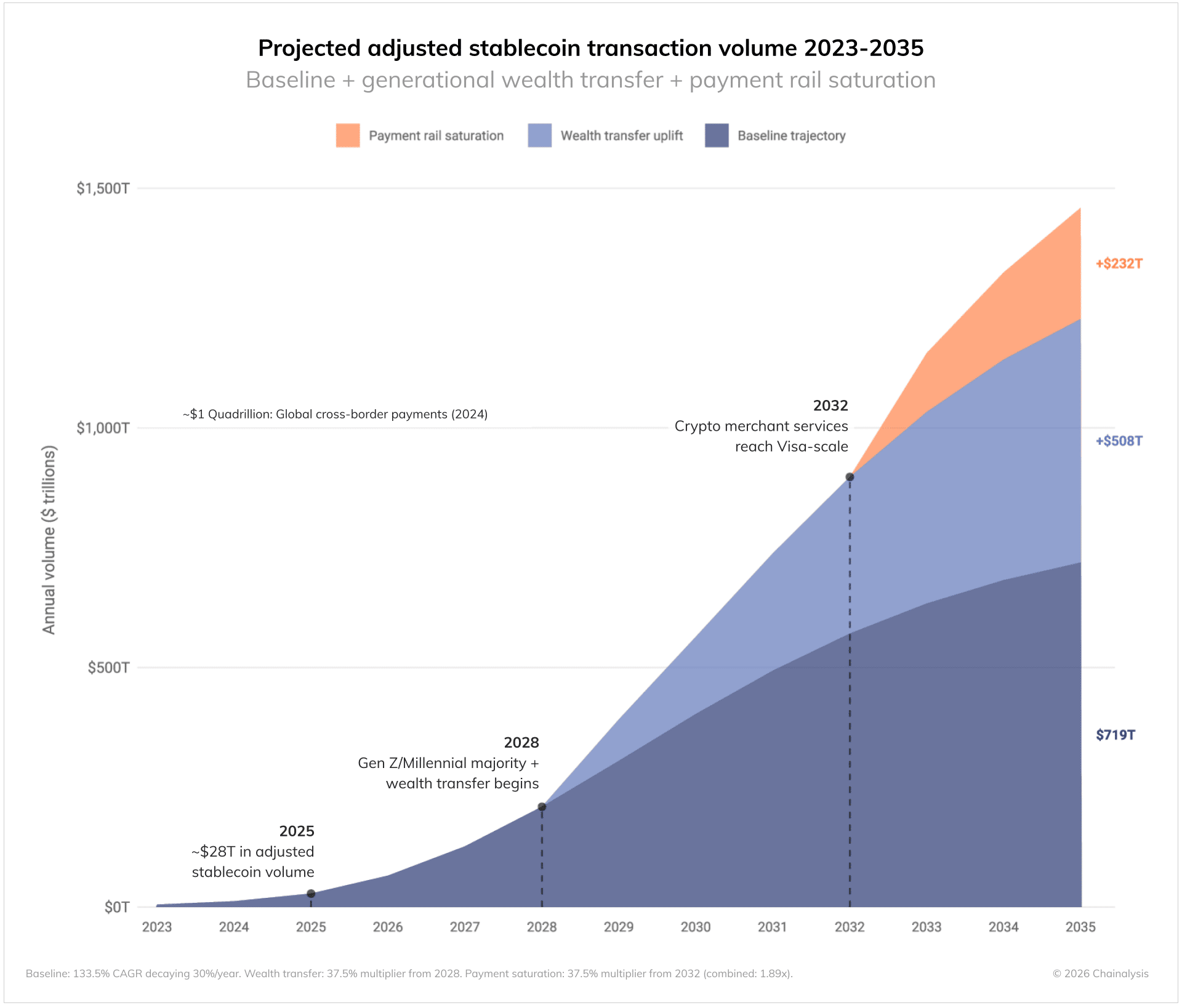
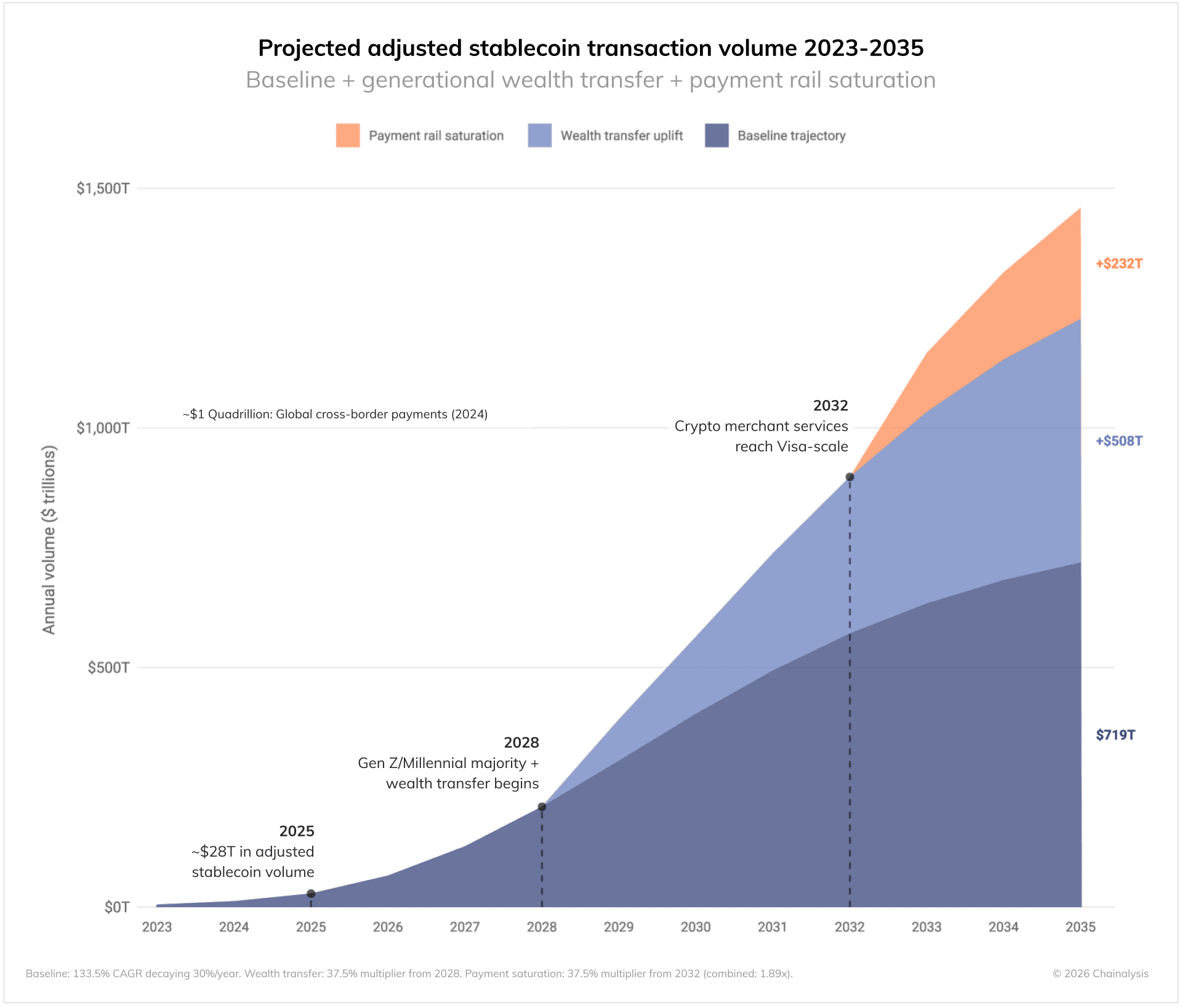
According to the Chainalysis report, Stablecoin Adjusted Volume rose 133% from 2023 to hit $28 trillion in 2025. This showed extensive growth in the economic value of stablecoins.
Source: Chainalysis

At press time, monthly volume reached a historical high of $7.2 trillion, surpassing major traditional payment channels such as U.S. ACH and Visa.

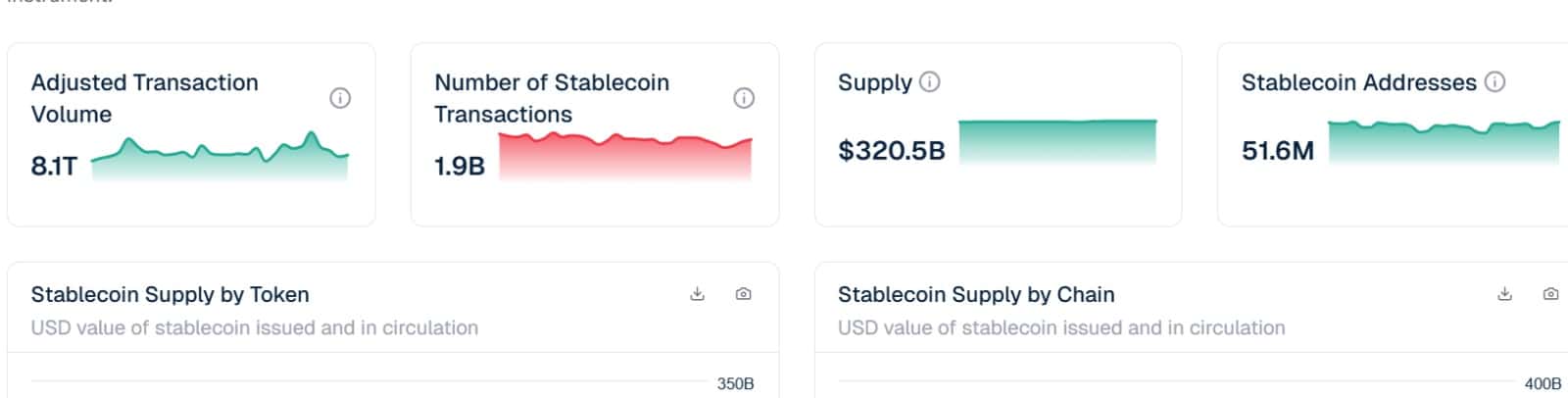
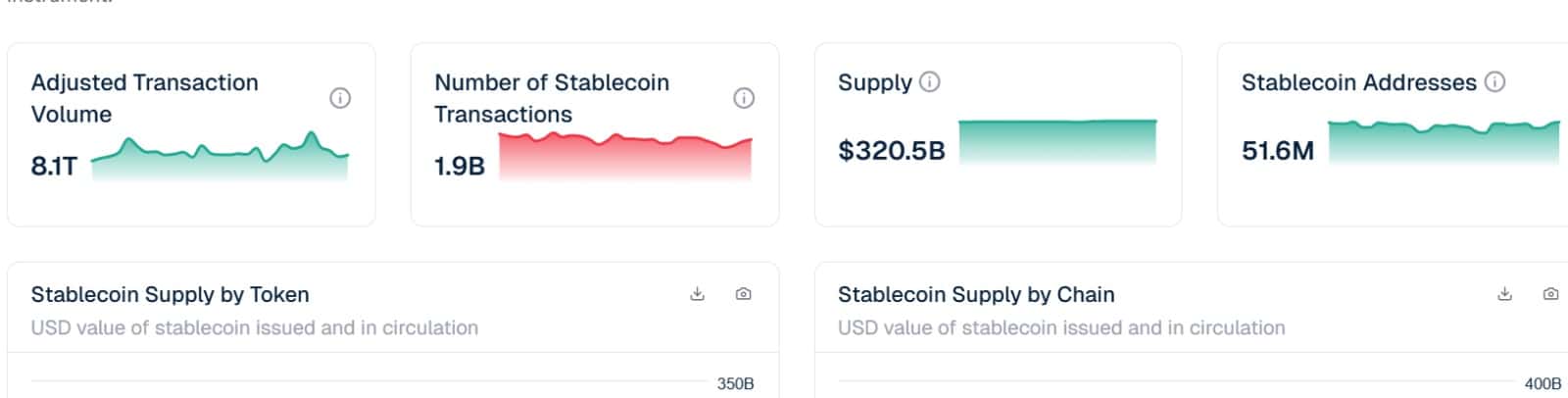
The growth has indicated the extensive usage of stablecoin in everyday life across all walks of life. In fact, Artemis data showed that both transactions and addresses have also risen significantly.
Source: Artemis

Adjusted Transaction Volume exceeded 8.1 trillion through March 2026, with the number of transactions nearing 2 trillion. At the same time, Stablecoin Addresses have surged to 51.6 million over the last 30 days, reflecting this sustained usage.

Usage to surpass $1.5 quadrillion by 2035

Chainalysis projects that if current growth continues, stablecoin volume could exceed $719 trillion by 2035. Notably, two key drivers are generational wealth transfers and point‐of‐sale adoption. Between $80 and $100 trillion in wealth is expected to move from boomers to millennials and Gen Z, nearly half of whom already hold crypto.

This transition alone could add more than $508 trillion in stablecoin transaction volume. At the same time, stablecoins may become default payment systems, further accelerating growth. Together, these forces could push stablecoin volume to $1.5 quadrillion by 2035, surpassing the estimated $1 quadrillion in global cross‐border payments.
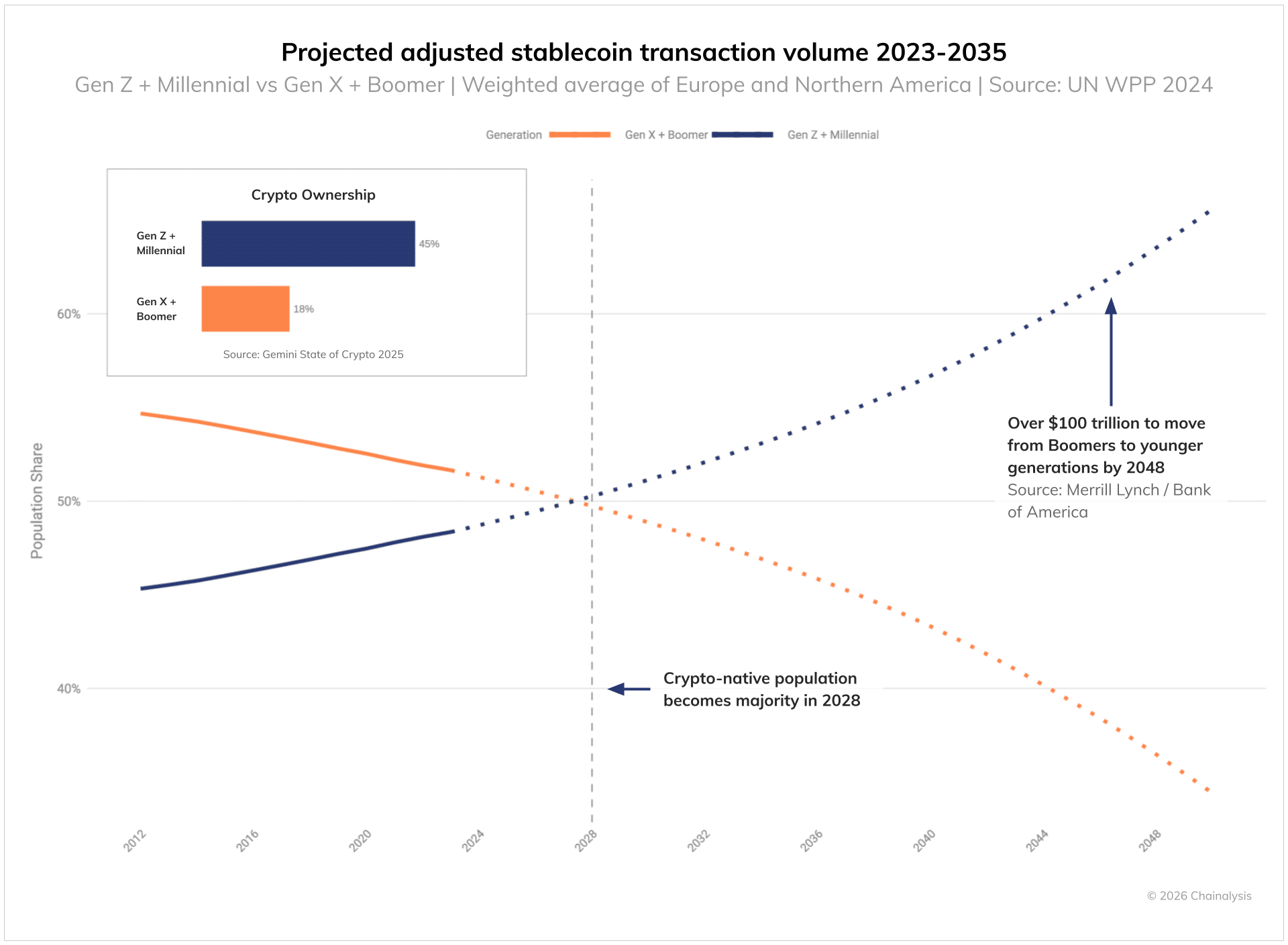
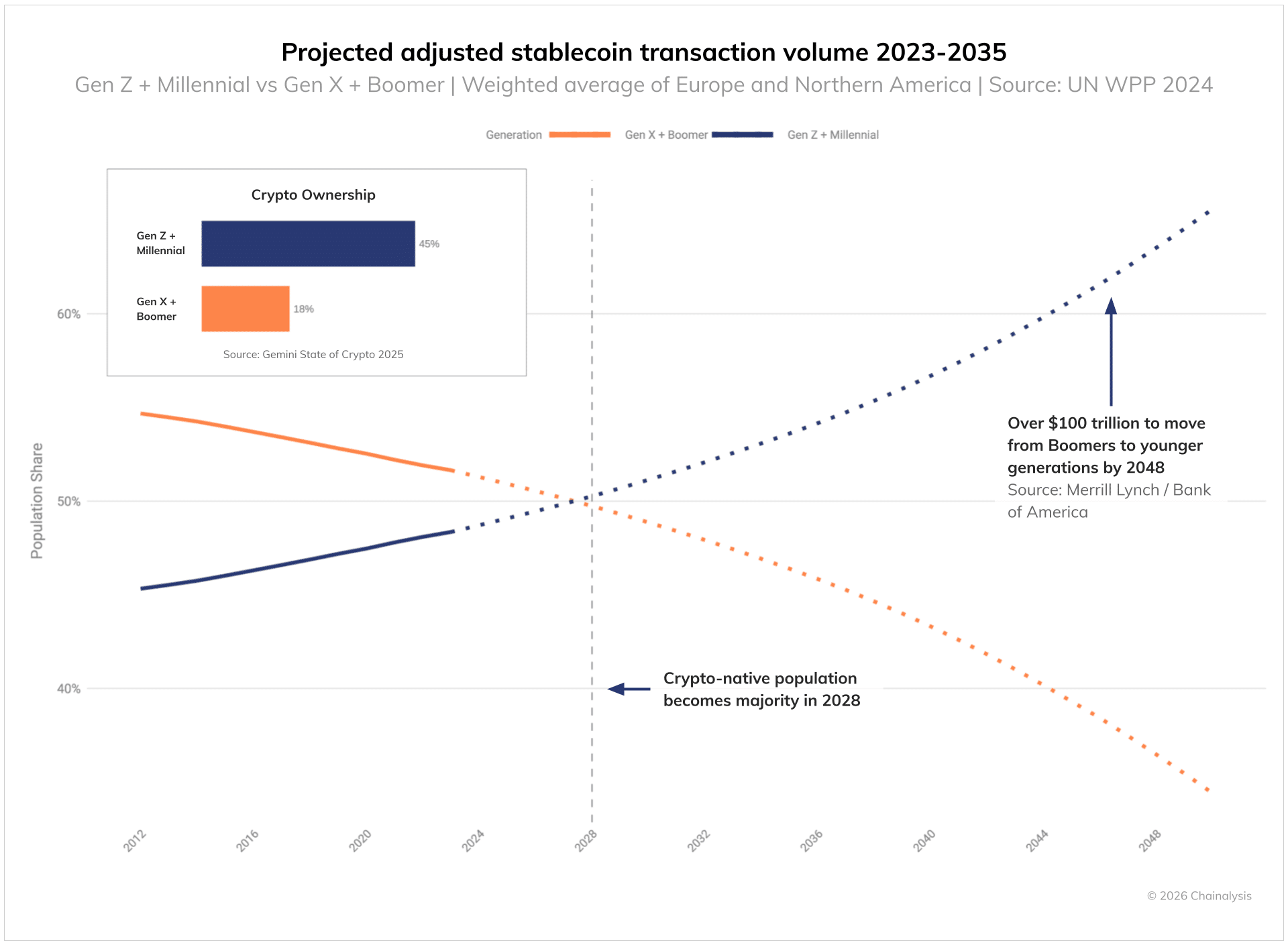
Source: Chainalysis

Even more importantly, intergenerational wealth transfers and shifts in payment infrastructure could accelerate adoption. This will see a surge in real-world asset tokenization, prediction markets, and other TradFi-to-crypto products.

Institutions and other players in TradFi will be left at a crossroads: either fully embrace crypto or see assets migrate. As many users continue to adopt stablecoin, the growth is barely starting.

Finally, if the Clarity Act, currently stalled in the U.S. Senate, is passed, stablecoins will gain a clearer growth path.


Final Summary

  • Stablecoin Adjusted Volume rose 133% from 2023 to hit $28 trillion in 2025, with a monthly volume of $7.2 trillion.
  • Stablecoin volume is projected to hit $1.5 quadrillion by 2035, surpassing the estimated $1 quadrillion in global cross-payments


Related Questions

QWhat was the percentage increase in Stablecoin Adjusted Volume from 2023 to 2025, and what was the total value reached in 2025?

AStablecoin Adjusted Volume rose 133% from 2023 to hit $28 trillion in 2025.

QWhat is the projected total stablecoin transaction volume by 2035, and how does it compare to the estimated value of global cross-border payments?

AStablecoin volume is projected to reach $1.5 quadrillion by 2035, surpassing the estimated $1 quadrillion in global cross-border payments.

QWhat are the two key drivers identified by Chainalysis that could push stablecoin volume to $1.5 quadrillion by 2035?

AThe two key drivers are generational wealth transfers (from boomers to millennials and Gen Z) and the adoption of stablecoins as a default payment system at the point-of-sale.

QWhat recent U.S. legislation is credited with accelerating the growth of stablecoins, and what is the name of the act currently stalled in the Senate that could provide further clarity?

AThe GENIUS Act, passed by the U.S. Congress in 2025, accelerated stablecoin growth. The Clarity Act is currently stalled in the U.S. Senate and could provide a clearer growth path if passed.

QWhat does the article state about the current monthly stablecoin volume compared to traditional payment channels like U.S. ACH and Visa?

AAt press time, the monthly stablecoin volume reached a historical high of $7.2 trillion, surpassing major traditional payment channels such as U.S. ACH and Visa.

Related Reads

In Jinjiang, Fujian, a Storage Super Unicorn Lies Quiet

In Fujian's Jinjiang, a city known for sportswear, lies a quiet semiconductor giant: Fujian Jinhua Integrated Circuit Co. (JHICC). Once a promising domestic DRAM manufacturer alongside Yangtze Memory and ChangXin Memory Technologies (CXMT), its journey was derailed in 2018 when the U.S. placed it on an Entity List and filed criminal charges for alleged trade secret theft. This halted production for years. A turning point came in February 2024 when a U.S. federal court found JHICC not guilty. However, it had lost crucial time. While CXMT soared to become a top-valued A-share company in 2024, JHICC, with an estimated valuation of 80 billion RMB, was just restarting. Its current output is primarily customized DDR4 chips, not the advanced DDR5/HBM demanded for AI, but it still benefits from the broader memory chip upcycle. JHICC's story is tied to Chen Zhengkun, a veteran engineer who left Micron to lead the venture. Founded in 2016 with state-backed funding, JHICC partnered with Taiwan's UMC to develop DRAM technology. Rapid progress was cut short by the U.S. actions, which Micron initiated, partly due to its heavy reliance on the Chinese market. Post-sanctions, Chen's team worked to rebuild the production line with reduced reliance on U.S. technology. According to its records, JHICC achieved small-scale production and revenue growth under immense pressure. It now focuses on the stable "niche" DRAM market (e.g., TVs, routers) with a monthly capacity of ~40,000 wafers, aiming for 60,000 by 2026. It holds over 1,000 patents but remains on the Entity List. For Jinjiang, investing in JHICC was a bold industrial leap. The local government provided unwavering financial and logistical support during the crisis, helping the company survive. JHICC has become the anchor for a growing local semiconductor cluster. Though its scale lags behind domestic peers, JHICC's persistence symbolizes a hard-won foothold in a global market long dominated by Samsung, SK Hynix, and Micron. Having missed one boom, it seeks a place in the new AI-driven memory supercycle.

marsbit7m ago

In Jinjiang, Fujian, a Storage Super Unicorn Lies Quiet

marsbit7m ago

Must-Watch Events Next Week|CLARITY Act Could Face Senate Vote; SpaceX, Circle to Report Earnings (8.3-8.9)

**Summary: Key Events and Developments to Watch (August 3-9)** The upcoming week is marked by significant financial disclosures, key legislative deadlines, and notable product updates. **Major Financial Events:** Several companies are scheduled to release their Q2 2026 earnings. American Bitcoin (ABTC) will report on August 3, followed by SpaceX and Hut 8 Mining Corp. on August 4, and Circle on August 5. Notably, a significant portion of SpaceX shares (up to 12% of total shares) will be unlocked on August 6 following their earnings release. **Key Legislative Deadline:** The U.S. Senate faces an August 7 deadline to secure 60 votes for the CLARITY Act, a bipartisan bill aiming to establish a federal regulatory framework for cryptocurrencies. The Senate may hold a full vote on the bill during the week. **Economic Data:** The U.S. July Non-Farm Payrolls report will be released on August 7, providing crucial labor market data. **Technology & Product Updates:** * **Shutdowns:** DeFi portfolio tracker Zapper and wallet app Ctrl Wallet will cease operations on August 3. * **Upgrades:** LayerZero will deprecate its v1 relayers on August 3. XRP Ledger's new version 3.3.0, featuring five new functions, is expected next week. * **AI:** Elon Musk announced that the advanced Grok 4.6 AI model is set for release around August 7. * **Bitcoin:** The BIP-110 forced signaling for a potential Bitcoin network change is scheduled to begin around August 8. **Other Notable Events:** Chinese robotics firm Unitree Tech has set its preliminary price inquiry for its IPO for August 5. South Korean exchange Upbit will delist AQT and AERGO tokens on August 3.

marsbit2h ago

Must-Watch Events Next Week|CLARITY Act Could Face Senate Vote; SpaceX, Circle to Report Earnings (8.3-8.9)

marsbit2h ago

Trading

Spot
活动图片




