Stablecoin volumes surge to $35 trillion, but real-world payments still lag at 1%?

ambcryptoPublished on 2026-01-25Last updated on 2026-01-25

Abstract

Stablecoin supply has grown 76x since 2020, surpassing $300 billion, yet real-world payments remain a small fraction of total activity. A report by Artemis and McKinsey reveals that while stablecoin volumes reached $35 trillion in 2025, only $390 billion (about 1%) was used for real-world transactions like remittances and payroll. The remaining 99% was tied to crypto trading and speculation. Key drivers of real-world stablecoin payments include B2B transactions, which grew 733% YoY to $226 billion, and card-linked spending, which surged 673%. However, these volumes are still minimal compared to the $2 quadrillion global payment market. Tether’s USDT led supply growth, increasing by $48 billion, while Circle’s USDC also saw significant expansion. The report suggests that stablecoin payments could surpass legacy systems within a decade due to their cost and speed advantages.

Since 2020, stablecoins have grown 76x and crossed $300 billion in supply. However, their volumes are still far from rivalling traditional payments.

According to a recent report by Artemis and McKinsey, on-chain dollars are “barely” scratching the surface of broader traditional payment volumes, accounting for less than 1%.

The report stated that global annual payment volumes totalled $2 quadrillion in 2025. Over the same period, stablecoin volumes hit $35 trillion, but real-world payment volumes (remittances, payroll, etc) was $390 billion or about 1% of global share.

The remaining 99% of the stablecoin volume was linked to crypto trading, speculation, internal transfers, and other activities rather than real-world transactions.

Sectors driving stablecoin growth

Even so, stablecoin payments have been growing rapidly, especially across business-to-business (B2B) and card-linked spending.

On a year-on-year (YoY) basis, B2B stablecoin payments climbed to $226 billion or a 733% growth rate. This has been the top driver for real-world stablecoin payment volumes.

Alas, this was just 0.01% compared to the global share of B2B transactions.

Peer-to-peer payments (P2P) or consumer-to-consumer transfers ranked second with $77 billion, followed closely by consumer-to-business (C2B) transactions at $76 billion.

On the contrary, business-to-consumer (B2C) activities such as payrolls, creator rewards, etc, were ranked last with a paltry $10 billion.

However, card-related spending in stablecoins exploded by 673% in 2025, making it, alongside B2B, one of two sectors seeing massive growth and likely opportunities for payment integrators.

Overall, the $390 billion figure differs from Visa’s $11 trillion figure. Finally, the report claimed that strong stablecoin payment traction could surpass legacy transfers in less than a decade due to cost and speed benefits.

Tether’s USDT leads supply growth

Meanwhile, the stablecoin supply has increased by over $100 billion over the past year, with the market size rising from $204 billion to $307 billion.

Nearly half of the new growth was driven by Tether’s USDT, which increased by $48 billion to $186 billion.

Circle’s USDC increased by $26 billion too, bringing its market supply to $76 billion. Sky Protocol’s (formerly Maker) USDS, PayPal’s PYUSD and World Liberty Financial’s USD1 made it to the top five outliers.

In particular, USDS and PYUSD offer yield and may be the growth catalyst behind their 2025 expansion. Overall, 99% of the stablecoins remain denominated in U.S dollars, reinforcing their dominance against other global currencies.


Final Thoughts

  • Real stablecoin payments hit $390 billion in 2025, representing less than 1% of global volumes of $2 quadrillion.
  • B2B and card-related stablecoin payments saw explosive triple-digit growth of 733% and 673%, respectively.

Related Questions

QWhat is the total global annual payment volume in 2025, and what percentage of this do real-world stablecoin payments represent?

AThe total global annual payment volume in 2025 was $2 quadrillion. Real-world stablecoin payments, at $390 billion, represent less than 1% of this total.

QWhich two sectors saw the most explosive growth in stablecoin payments in 2025, and what were their growth rates?

ABusiness-to-business (B2B) and card-related stablecoin payments saw the most explosive growth. B2B grew by 733% and card-related spending grew by 673%.

QWhat was the primary driver for the $100 billion increase in the stablecoin supply over the past year, and what is its current market size?

ATether's USDT was the primary driver, increasing by $48 billion. The total stablecoin market size grew from $204 billion to $307 billion.

QAccording to the report, what is the main use case for the vast majority (99%) of stablecoin volume, as opposed to real-world transactions?

AThe remaining 99% of stablecoin volume was linked to crypto trading, speculation, internal transfers, and other activities rather than real-world transactions.

QWhat potential does the report claim for stablecoin payments in comparison to legacy transfer systems, and why?

AThe report claims that strong stablecoin payment traction could surpass legacy transfers in less than a decade due to their cost and speed benefits.

Related Reads

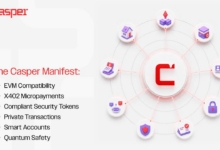
Casper Network Publishes the Casper Manifest, a Multi-Year Roadmap to Power Regulated Real-World Assets and the Machine Economy

The Casper Association has published "The Casper Manifest," a multi-year technical roadmap for Casper Network. Introduced at the Digital Finance Forum in Bermuda, the roadmap outlines nine coordinated initiatives designed to position the layer-1 blockchain as the infrastructure for regulated real-world asset (RWA) tokenization and the machine-to-machine economy. Key initiatives focus on: 1. **Developer Access:** Adding full Ethereum Virtual Machine (EVM) compatibility alongside its existing WebAssembly (Wasm) execution layer. 2. **User Experience:** Implementing gasless transactions, batch operations, and smart accounts with biometric authentication. 3. **Institutional Compliance & Privacy:** Building compliant security tokens aligned with the ERC-3643 standard and a multi-phase roadmap for confidential transactions with built-in audit tools. 4. **Machine Economy:** Implementing the X402 open payment standard to enable AI agents and machines to make autonomous, programmatic micropayments. 5. **Token Infrastructure:** Creating a Native Token Registry to give all tokens protocol-level status with fixed, predictable costs. 6. **Quantum Safety:** Developing hybrid accounts with both classical and quantum-resistant keys. The first initiative, X402 micropayments, is expected within weeks. Subsequent releases through 2026 and 2027 will include EVM compatibility, compliant security tokens, the Native Token Registry, gasless transactions, and quantum-safe features. The goal is to create a blockchain that is frictionless for users, trusted by institutions, and native for machines.

TheNewsCrypto4h ago

Casper Network Publishes the Casper Manifest, a Multi-Year Roadmap to Power Regulated Real-World Assets and the Machine Economy

TheNewsCrypto4h ago

Trading

Spot
Futures
活动图片