Stablecoin usage up 600% – Is USDC taking the lead from USDT?

ambcryptoPublished on 2026-03-23Last updated on 2026-03-23

Abstract

Stablecoin usage on the Ethereum network has grown significantly, with active addresses surging 600% from March 2025 to March 2026, indicating deeper integration beyond speculative trading into payments and cross-border transactions. A notable shift in market preference shows USD Coin (USDC) leading with a $4.5 billion supply increase, while Tether (USDT) experienced a $2 billion contraction, reflecting a move toward perceived regulatory clarity. Despite a slight decline in exchange reserves and net outflows of $485 million, the capital is being parked rather than fully exiting, reducing immediate sell pressure and supporting short-term market stability. Overall, stablecoin liquidity is consolidating rather than expanding, with total supply at $316.45 billion.

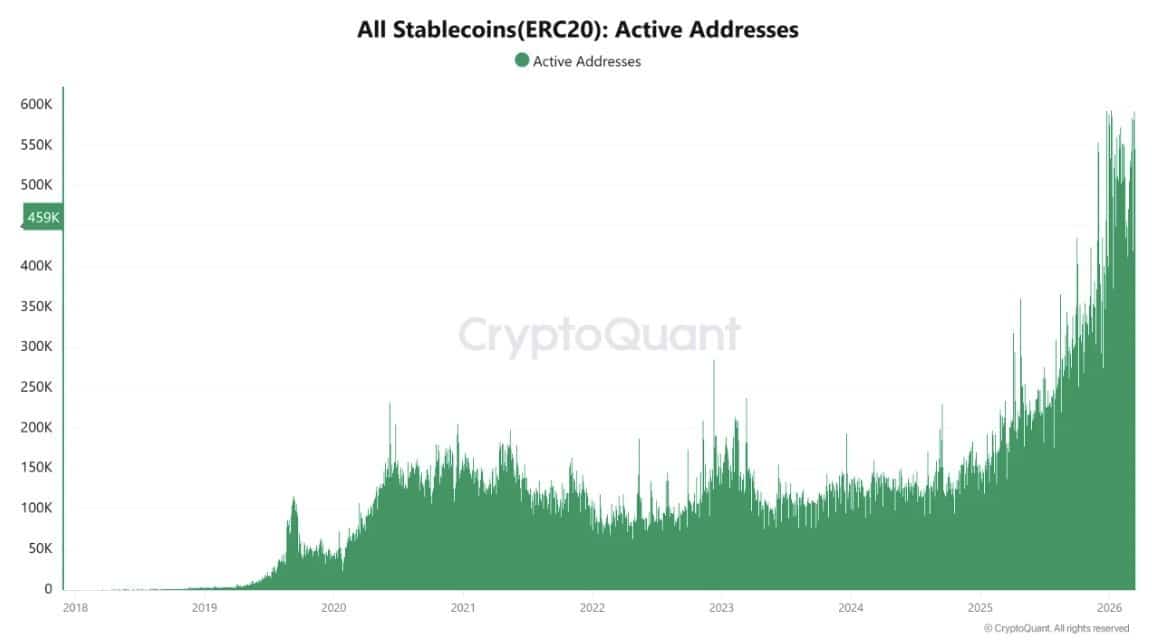
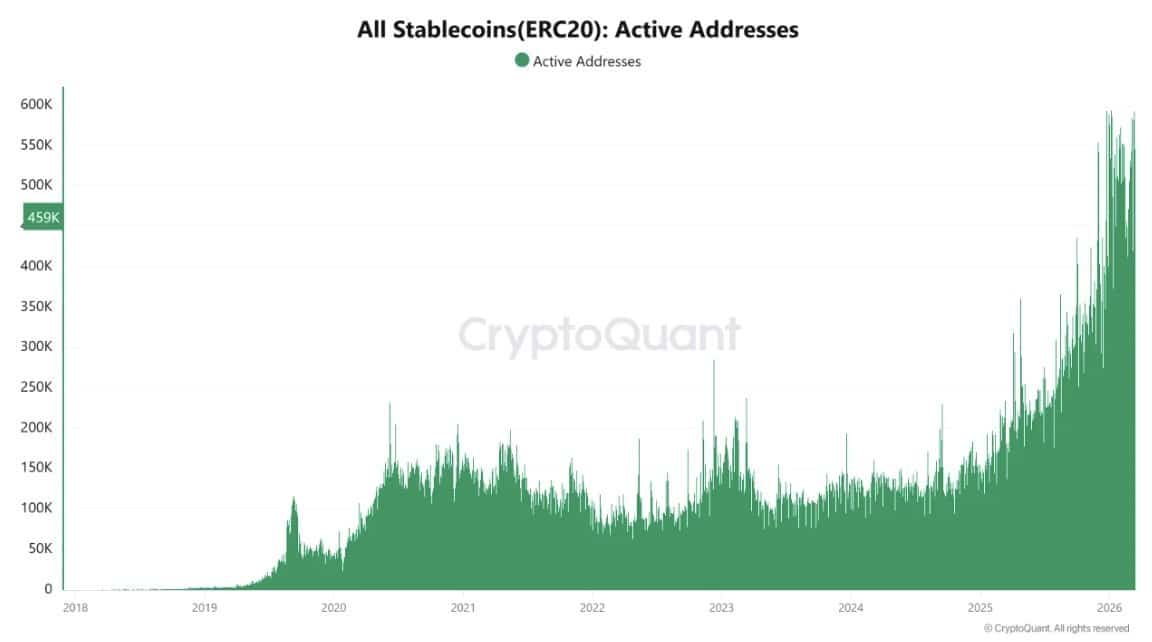
ERC20 stablecoin activity is undergoing a structural expansion, as active addresses surged from roughly 85,000 in March 2025 to nearly 600,000 in March 2026.

This 600% growth reflects more than temporary spikes, as activity has trended upward steadily since 2024. As participation broadens, the pattern shifts from isolated bursts to sustained usage, which suggests deeper integration across the network.
Source: CryptoQuant

At the same time, this rise signals a change in function.

Stablecoins are moving beyond DeFi trading pairs toward transactional infrastructure. As a result, flows increasingly reflect payments, settlements, and cross-border transfers rather than speculative positioning.

However, rising activity also implies higher dependency on stablecoin liquidity.

As usage concentrates around these assets, they become central to capital movement across markets. This dynamic suggests crypto liquidity is becoming more efficient, while also more sensitive to stablecoin-driven demand cycles.

Stablecoin flows shift as USDC gains dominance over USDT

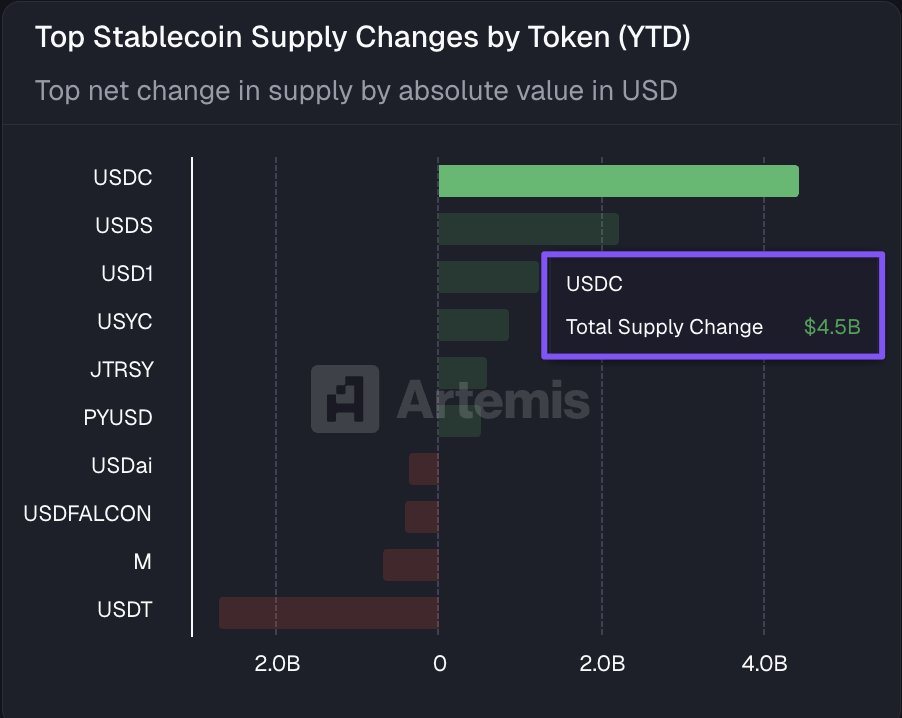
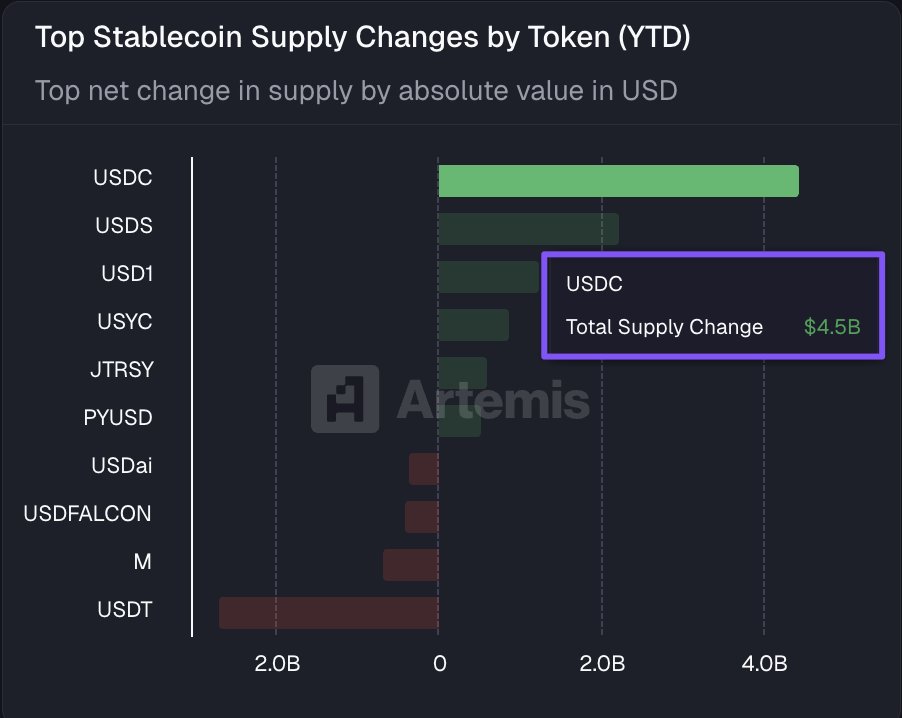
Stablecoin flows show a clear rotation in market preference, as USD Coin [USDC] leads supply expansion year-to-date.

USDC added $4.5 billion, marking the largest increase across all tracked assets. This rise reflects strong inflows during a volatile period.

Tether [USDT] moved in the opposite direction, with its supply contracting by roughly $2 billion, signaling capital outflows. As this divergence forms, it highlights a shift toward perceived stability and regulatory clarity.
Source: Artemis

This gap suggests growing usage beyond simple liquidity storage. As volumes expand, USDC strengthens its role in DeFi and payments infrastructure.

However, this concentration also implies that liquidity is becoming more centralized. As capital rotates, market dependence on fewer stablecoins increases, shaping how liquidity flows across the broader ecosystem.

Stablecoin flows show consolidation, not capitulation

Stablecoin flows reflect a cautious but balanced shift, as liquidity moves away from exchanges without fully exiting the market. Exchange Reserves stand at $65.37 billion, down 0.72% in 24 hours.

Net Outflows reached over $485 million, signaling movement toward self-custody. This suggests capital is being parked rather than actively deployed. However, this shift also reduces immediate sell pressure on exchanges, which can support price stability.

Total stablecoin supply sits at $316.45 billion, rising just 0.17% weekly. USDT grew 0.08% to $184.1 billion, while USDC fell 0.22% to $79.1 billion, showing mixed demand.

This balance implies liquidity is rotating rather than expanding, keeping markets stable in the short term while leaving momentum dependent on renewed capital deployment.



Final Summary

Related Questions

QWhat was the percentage growth in active addresses for ERC20 stablecoins from March 2025 to March 2026?

A600%

QWhich stablecoin led the supply expansion year-to-date and by how much?

AUSD Coin (USDC) led the supply expansion, adding $4.5 billion.

QWhat was the change in Tether's (USDT) supply during the same timeframe?

ATether's (USDT) supply contracted by roughly $2 billion.

QWhat is the new primary function that stablecoins are moving towards, according to the article?

AStablecoins are moving beyond DeFi trading pairs toward transactional infrastructure, such as payments, settlements, and cross-border transfers.

QWhat was the total stablecoin supply and the 24-hour change in Exchange Reserves mentioned in the article?

AThe total stablecoin supply was $316.45 billion, and Exchange Reserves were $65.37 billion, down 0.72% in 24 hours.

Related Reads

Bitcoin Withdrawals Continue: 8 Years of Storage in a Coldcard Cold Wallet Ended in Zero

Coldcard Hardware Wallet Hacked: Losses Mount Due to Vulnerable Seed Generation A critical vulnerability in Coldcard hardware wallets has led to a continued wave of fund thefts. According to Galaxy Research, the total stolen has reached 1,367.05 BTC (approx. $88.6 million) from 4,585 addresses, a significant increase from the initial 594.5 BTC reported on July 30, 2026. Most of the stolen funds remain on the attackers' addresses. The issue is not with the current firmware, which Coinkite has updated, but with seed phrases generated on vulnerable devices between March 2021 and the release of fixed firmware versions. Due to a programmer error, devices switched from using a hardware random number generator to the software-based Yasmarang generator, which was initialized with publicly accessible data like the chip's serial number. This made the seed phrases predictable through offline brute-force attacks, meaning wallets remain at risk until funds are moved to a new wallet generated with the patched firmware. Affected devices include Mk2/Mk3 with firmware 4.0.1–4.1.9 (and up to 5.0.3), Mk4/Mk5 up to version 5.6.0, and Q models up to 1.5.0Q. The only exceptions are seeds created with a high-entropy method like at least 50 independent dice rolls or a strong unique BIP-39 passphrase. All other owners must generate a new seed on the fixed firmware and transfer their assets. A case highlighting the human impact involves a 39-year-old long-term investor who lost 2 BTC (approx. $130,000) in minutes. He had accumulated the Bitcoin over eight years through physical labor, viewing it as a financial lifeline and a retirement plan in a country suffering from hyperinflation. His story underscores that even conservative "buy and hold in cold storage" strategies can be compromised by such underlying technical flaws. From a technical perspective, this incident echoes historical failures where weak random number generators undermined cryptographic security, challenging the assumption that offline storage is automatically foolproof.

cryptonews.ru1h ago

Bitcoin Withdrawals Continue: 8 Years of Storage in a Coldcard Cold Wallet Ended in Zero

cryptonews.ru1h ago

Trading

Spot
活动图片



